
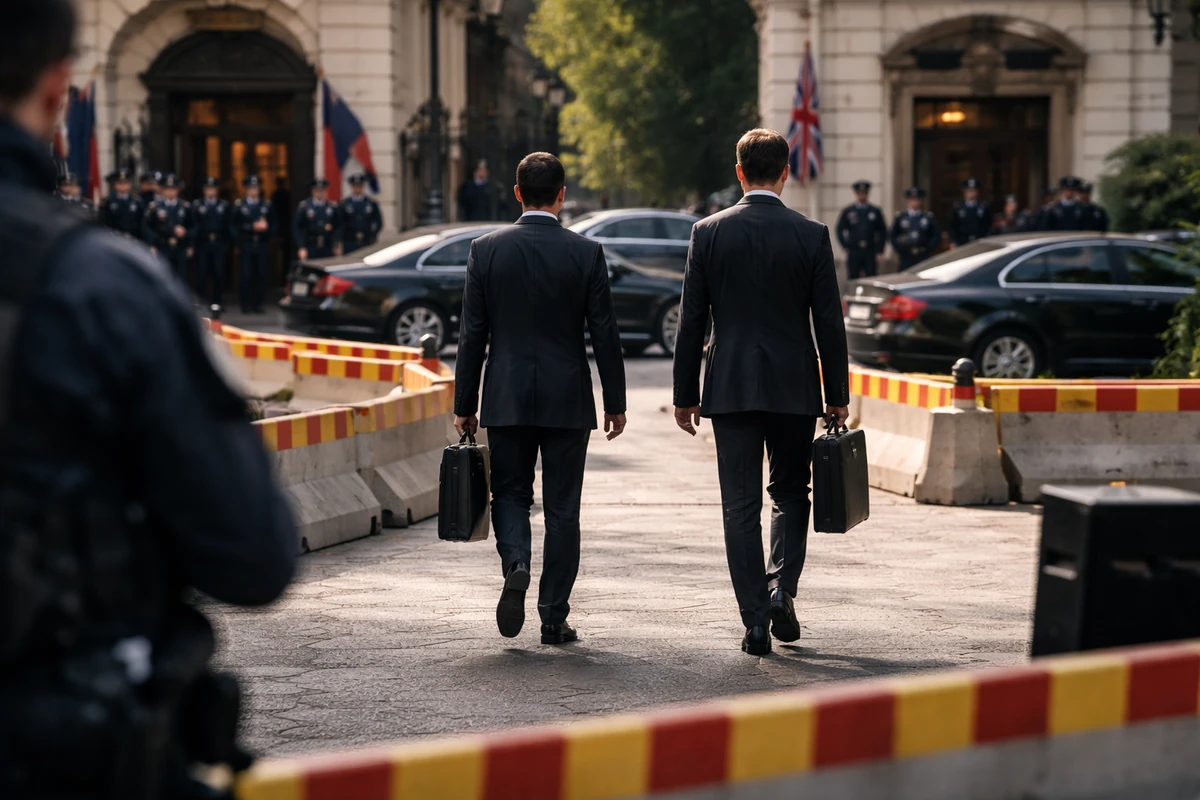
A diplomatic expulsion with a larger message
Russia’s decision to expel a British diplomat, announced March 30, is the kind of move that can sound routine in the world of statecraft. Countries regularly declare foreign diplomats persona non grata, the formal term for ordering them out, as a way to protest policy disputes, retaliate for sanctions or signal displeasure without crossing into open military confrontation. But Moscow’s stated reason in this case — what it described as security-threatening intelligence activity — suggests this is not simply another episode of diplomatic theater.
In the language of international politics, the accusation matters as much as the expulsion itself. Russia is not merely saying it dislikes Britain’s policies. It is framing the dispute as part of a broader struggle over espionage, counterintelligence and national security. That shifts the meaning of the incident. Instead of a narrow bilateral spat, it begins to look like another front in the intensifying contest between Russia and the Western security system that has hardened since the full-scale invasion of Ukraine.
For American readers, one useful comparison is the long history of U.S.-Russia diplomatic expulsions during moments of high tension. Those actions were rarely just about individual diplomats. They were signals: warnings about unacceptable behavior, displays of state resolve and efforts to limit the other side’s reach. Russia’s move against Britain fits that pattern. It is a message aimed not only at London but at the wider network of Western governments that have backed Ukraine, shared intelligence and tightened sanctions on Moscow.
Britain occupies an outsized role in that network. Even after leaving the European Union, it remains one of Europe’s most active military and intelligence powers and one of Kyiv’s strongest supporters. From Moscow’s perspective, Britain is not just another European country. It is a key node in the Western alliance system — a government with deep intelligence ties to the United States, a permanent seat on the U.N. Security Council and an unusually assertive posture toward Russia. Expelling a British diplomat under the banner of security threats therefore carries symbolism well beyond the number of people involved.
That is why this episode deserves attention. The practical impact of one expulsion may be limited in the short term. The strategic meaning may be much larger. At a time when Europe is already dealing with war on its eastern flank, energy insecurity, cyberthreats and a hardening East-West divide, the narrowing of diplomatic space matters. Quiet channels between adversaries are often least visible when they are most necessary.
Why Britain and Russia were already on a collision course
The distrust between Britain and Russia did not begin with the war in Ukraine. It has been building for years, rooted in a long history of espionage accusations, sanctions fights, political asylum disputes, asset freezes and mutual suspicion about military deployments. In British public memory, some of the sharpest turning points came from cases involving poisonings and alleged covert operations on British soil, events that deepened the perception in London that Russia was willing to project power in ways that blurred the lines between intelligence work, intimidation and outright criminality.
Since Russia’s 2022 invasion of Ukraine, that distrust has become more explicit and more institutionalized. Britain has been among the most forward-leaning European supporters of Ukraine, providing military aid, training, political backing and strong advocacy for continued Western pressure on Moscow. For the Kremlin, that posture has reinforced the view that Britain is not just a critic but an active participant in a wider campaign to weaken Russia strategically.
That matters because diplomatic expulsions tend to come after a relationship has already lost much of its cushion. In healthier bilateral ties, governments can absorb friction through meetings, private messages and back-channel negotiations. When trust is badly eroded, the same disagreements more easily spill into symbolic punishment and reciprocal retaliation. That is where Britain and Russia appear to be operating now.
Under international diplomatic norms, expelling a diplomat is one of the clearest ways a state can say it no longer accepts the legitimacy of that person’s presence or role. It is a formal expression of mistrust. And because diplomacy runs heavily on reciprocity, these actions often invite mirror-image responses. Britain may decide to answer in kind, either publicly and immediately or after internal review. Even if London avoids a dramatic retaliation, the relationship is likely to tighten further, with each side viewing the other’s embassy staff and official contacts through a more security-focused lens.
That creates a vicious cycle. As embassies shrink and official communication becomes more constrained, there are fewer opportunities to clarify misunderstandings or de-escalate moments of tension. When formal diplomatic channels narrow, intelligence services and informal contacts often become relatively more important, not less. In that sense, an expulsion justified as a response to intelligence activity can paradoxically push the relationship deeper into the world of secrecy and suspicion.
The rise of intelligence conflict as the new language of diplomacy
One of the most significant aspects of Russia’s announcement is the way it highlights intelligence activity rather than focusing only on sanctions, military aid or hostile rhetoric. That reflects a broader reality of modern geopolitical competition. Rivalry between states today is no longer confined to tanks, missiles and trade restrictions. It also unfolds through cyberoperations, surveillance, influence campaigns, disinformation, infrastructure probing and efforts to shape public narratives at home and abroad.
For many Americans, the term “spy war” may call to mind Cold War imagery — trench-coated agents, dead drops and defections in divided cities. The modern version is less cinematic and more diffuse. It includes digital intrusions, online manipulation, pressure on diaspora communities, scrutiny of academic and technological exchanges and intense monitoring of diplomatic personnel. Embassies remain centers of official state communication, but they have also long been understood as places where information is gathered, assessed and relayed.
That does not make every diplomat a spy, nor does it mean every intelligence accusation is neutral or factual. Governments frequently use national security language both to describe genuine concerns and to justify politically motivated moves. But once officials begin openly tying diplomatic personnel to security threats, the atmosphere changes. Activities that might once have been tolerated as part of the rough-and-tumble reality of statecraft become harder to separate from alleged hostile operations.
This trend has consequences far beyond Russia and Britain. If more countries start treating diplomacy itself primarily through a counterintelligence framework, routine contact becomes more politicized. Visa approvals, cultural exchange programs, university partnerships, business delegations and even journalist access can all become subject to heightened suspicion. The line between ordinary international engagement and unacceptable influence activity becomes increasingly contested.
That matters because diplomacy works best when governments preserve at least some protected space for dialogue, even amid hostility. Once the language of espionage dominates the language of negotiation, that space begins to contract. States may still keep embassies open and exchange official statements, but the practical relationship starts to resemble a cold freeze rather than active diplomacy. Europe, already burdened by war and fragmentation, can ill afford more erosion in its channels of communication.
Why this matters for Europe’s security architecture
On paper, the expulsion concerns two countries. In practice, it touches the broader balance of security in Europe. Britain may no longer be part of the European Union, but it remains central to NATO, deeply embedded in Western intelligence cooperation and influential in setting the tone of Europe’s response to Russia. Moscow knows that. A warning directed at Britain is therefore also a warning aimed at the Western alliance ecosystem around it.
That wider context is what gives the incident strategic weight. Russia appears to be signaling that confrontation with the West is not limited to battlefields, sanctions regimes or public diplomacy. It also extends into the management of diplomatic presence and the policing of intelligence boundaries. For Western governments, the likely interpretation will be that Moscow is further reducing already limited diplomatic room for maneuver and emphasizing a more confrontational style of statecraft.
The result could be a sharper political chill across Europe, even if no immediate military shift follows. Diplomatic expulsions do not command the same attention as missile strikes or troop movements, but they can be early indicators of worsening conditions for crisis management. When governments become less able or less willing to talk candidly through official channels, the risk of miscalculation rises. Small incidents become harder to contain. Signals are more easily misread. Positions harden faster.
This is especially significant during a protracted war. In long conflicts, the most serious dangers are not always the most visible. Sometimes the greater threat lies in the gradual loss of mechanisms that prevent escalation. A robust diplomatic network can help manage accidental encounters, clarify intentions, address consular emergencies and create off-ramps when tensions spike. A weakened one leaves more room for rumors, assumptions and domestic political pressure to drive decision-making.
There is also a symbolic dimension. Europe’s post-Cold War order was built, however imperfectly, on the idea that confrontation would be balanced by institutional dialogue, economic interdependence and diplomatic engagement. Much of that framework has been badly damaged since the invasion of Ukraine. Another public escalation over alleged intelligence activity underscores how far the region has moved from uneasy coexistence toward entrenched rivalry.
South Korea’s stake in a conflict that seems far away
For readers in the United States and elsewhere, the Korea angle may not be immediately obvious. But this is the kind of European security story that can ripple into Asia, including South Korea’s diplomacy and business environment. Seoul has expanded cooperation with Britain in security, defense industry ties and broader political coordination with democratic partners. At the same time, South Korea has had to preserve at least a minimal working relationship with Russia, despite sanctions tensions and sharp differences over the war in Ukraine.
That balancing act is becoming harder. The more relations between Russia and Western-aligned countries are framed through the language of security and intelligence confrontation, the narrower the room for middle powers like South Korea to manage competing priorities. Seoul often describes its foreign policy in terms that combine values and national interest — support for the rules-based order on one hand, pragmatic management of difficult relationships on the other. When diplomacy hardens into bloc politics, that balance becomes more delicate.
There are concrete business implications as well. Even if a Russia-Britain diplomatic clash does not directly target Korean firms, it can aggravate the climate in which those firms operate. Companies involved in shipping, energy, insurance, finance, legal compliance and logistics are especially sensitive to shifts in sanctions enforcement and political risk. If tensions spill into broader visa restrictions, tighter financial controls or additional security measures, the cost of doing business can rise quickly.
South Korean companies have learned in recent years that geopolitical risk is no longer a distant, abstract category handled only by diplomats. It can shape supply chains, access to payment systems, insurance rates and local legal exposure. For export-driven economies, a worsening security climate in Europe is not just Europe’s problem. It can become a real operational constraint.
There is also a messaging challenge for Seoul. South Korea must navigate ties with Britain, signal solidarity with Western partners on major security principles and yet avoid closing every line of communication with Moscow. In such an environment, wording matters. A statement intended as reassurance to one partner can be interpreted as pressure by another. That is true for many middle powers today, but South Korea faces it with particular intensity because of its own security dependence on alliances and its economic exposure to global shocks.
What comes next: retaliation, escalation or managed hostility
The most immediate question is whether Britain will retaliate. In diplomatic practice, reciprocal expulsions are common because they preserve the principle that one side will not absorb a penalty without response. London could choose a like-for-like expulsion, issue a forceful protest or combine public criticism with private efforts to prevent the situation from spiraling. The tone of any British statement will be closely watched. A restrained expression of regret would signal one path; an accusation that Russia fabricated the claim or a warning of further consequences would signal another.
A second question is whether this remains an isolated case or becomes part of a wider sequence. If Russia follows with additional restrictions affecting embassy operations, visas or travel, the dispute would move beyond a single diplomatic incident and toward a more systematic squeeze. Britain and its allies could answer not only through diplomatic channels but also through sanctions or expanded counterintelligence coordination. At that point, what began as an expulsion could evolve into another layer of Europe’s broader security standoff.
A third possibility is what might be called managed hostility. Even adversaries have incentives to avoid complete rupture. They still need channels for consular services, protection of citizens, crisis communication and the handling of humanitarian matters. During some of the most dangerous periods of the Cold War, Washington and Moscow preserved narrow forms of contact because the alternative was considered too risky. Britain and Russia may similarly decide that however deep the mistrust, some minimum level of diplomatic functionality must remain.
Still, managed hostility is not the same as stability. It can preserve a floor while the ceiling keeps dropping. Each new accusation, expulsion or security measure reduces confidence further and normalizes confrontation as the default setting. Over time, that can make restoration of even limited trust much harder.
For observers trying to gauge where this is headed, three signals matter most. First is Britain’s official wording: whether it treats the matter as a bilateral annoyance or as part of a more serious pattern of Russian conduct. Second is Russia’s next move: whether it leaves the matter at one expulsion or broadens the confrontation. Third is the reaction from NATO and key European governments. If allies rally publicly around Britain, Moscow is likely to read the incident not as a narrow dispute but as another test of Western cohesion.
More than a one-day diplomatic story
It is tempting to view the expulsion of a diplomat as the sort of foreign news item that flashes across headlines and quickly disappears. But that would miss the larger significance. This episode is a window into how international conflict is evolving. The war in Ukraine has already transformed Europe’s military and political landscape. Now it is also reshaping the practice of diplomacy itself, pushing embassies, intelligence concerns and counterintelligence rhetoric closer to the center of geopolitical competition.
That shift matters because diplomacy is not only about ceremony and protocol. It is one of the few tools states have for managing conflict short of force. When diplomatic space shrinks, the world does not become simpler or safer. It becomes harder to interpret, harder to stabilize and easier to inflame. The expulsion announced by Russia may involve a single diplomat, but it points to a much larger erosion: the weakening of the mechanisms that allow rivals to communicate in dangerous times.
For Europe, that means another sign that the region is settling into a prolonged era of strategic mistrust. For Britain and Russia, it means one more layer of retaliation in a relationship already defined by accumulated grievance. For South Korea and other countries outside the immediate dispute, it is a reminder that geopolitical fractures in one region can complicate diplomacy and commerce in another.
And for American audiences, the lesson is familiar. History shows that diplomatic expulsions are rarely just administrative acts. They are political messages delivered through personnel decisions. When those messages are framed around alleged intelligence threats, they reveal a world in which governments increasingly see each other not merely as competitors but as active security risks. That is a much colder and more fragile international environment — and one that demands close attention.



0 Comments