
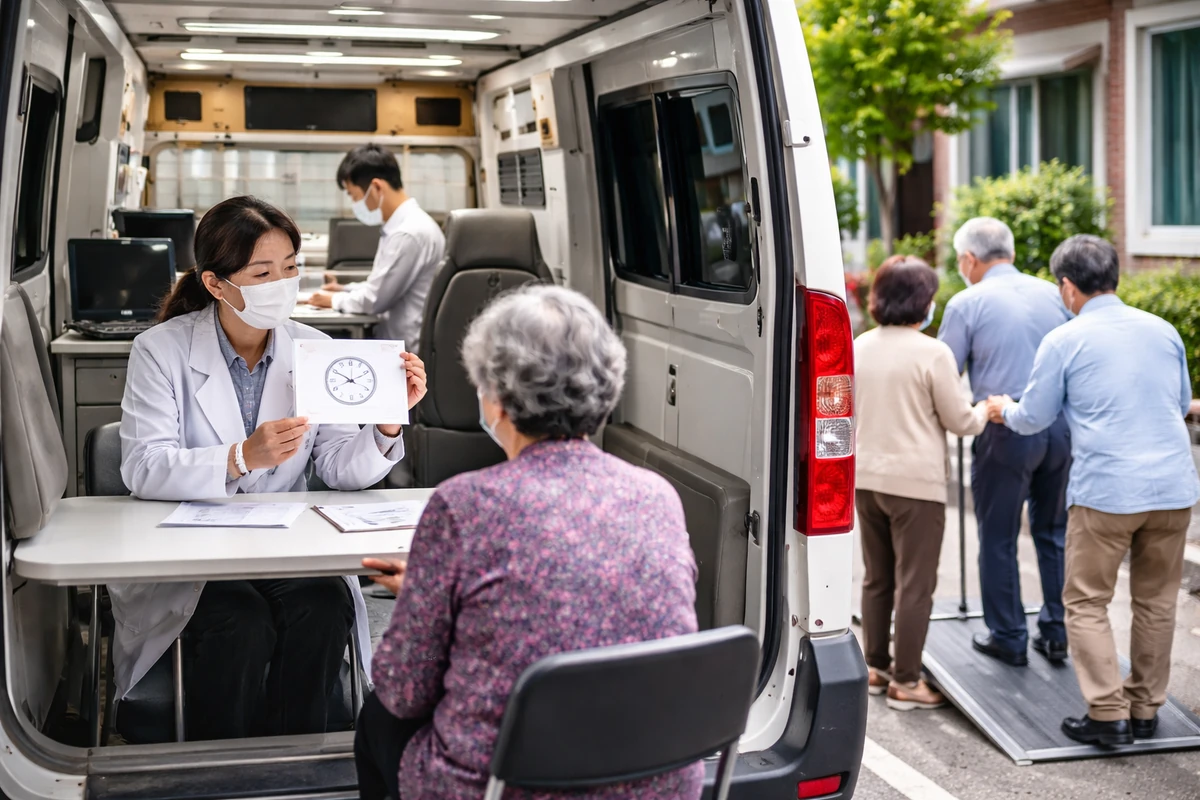
Seoul moves dementia screening out of the clinic and into the community
Seoul, one of the world’s most densely populated megacities, is preparing to try something that many public health officials in aging societies have long argued is necessary: stop waiting for older adults with memory problems to come to the health system, and start bringing the health system to them.
Beginning in April and running through March 31, 2026, the Seoul city government says it will launch a “visiting early screening” initiative for dementia, according to South Korean media reports. The idea is straightforward but potentially significant. Instead of relying mostly on older residents and their families to recognize warning signs, schedule appointments, arrange transportation and navigate a medical bureaucracy, city-backed screening teams would go into neighborhoods and reach people who are most likely to fall through the cracks.
That may sound like an administrative tweak. It is more than that. In practical terms, it reflects a major policy shift in South Korea’s approach to dementia: from a system that often discovers the disease late, after symptoms have become impossible to ignore, toward one that treats early detection as a core public responsibility.
For American readers, the comparison might be less like adding another health fair and more like a city deciding that waiting for people to show up at the emergency room is too late — and instead investing in neighborhood-based outreach, the way some U.S. communities have expanded mobile mammograms, blood pressure vans or home visits for seniors. The condition is different, but the public health logic is similar: when the patients most in need are the least likely to walk through the door, the door has to move closer to them.
Dementia is not simply about forgetfulness. It is a broad term for a decline in memory, thinking and daily functioning severe enough to interfere with ordinary life. Alzheimer’s disease is the best-known cause, but vascular dementia and other neurological conditions can produce similar symptoms. And in societies that are rapidly aging, dementia becomes not just a medical issue but also an economic, social and emotional one, reshaping family life, labor patterns and public spending.
That is especially true in South Korea, where low birth rates, long life expectancy and fast-paced social change are colliding. Seoul’s new initiative suggests the city sees dementia not as a problem to be managed only after diagnosis, but as one requiring earlier, broader and more aggressive intervention.
Why early detection matters in dementia — even when there is no simple cure
One of the most persistent misunderstandings about dementia, in the United States as well as in South Korea, is that there is little point in finding it early because there is no definitive cure for most forms of it. Public health experts have pushed back on that idea for years. While early detection does not stop the disease altogether, it can dramatically change how patients and families prepare, seek treatment and preserve quality of life.
In the early stages, subtle cognitive decline can be hard to distinguish from ordinary aging. A missed appointment, a repeated story, a misplaced wallet or trouble managing finances can all be shrugged off as “just getting older.” Depression, poor sleep, medication side effects, malnutrition and loneliness can also mimic or worsen cognitive problems. That makes screening important not only for identifying possible dementia, but also for sorting out what else might be going on.
Once symptoms become more severe, the challenges multiply. Patients may no longer fully grasp that anything is wrong. Family members may recognize a problem only after a crisis: a wandering episode, a dangerous fall, a car accident, unpaid bills, medication mistakes or a sudden hospital visit. By then, the window for making calmer, more deliberate decisions may already be narrowing.
Early detection creates room for planning. Doctors can conduct more precise evaluations to determine whether Alzheimer’s disease, vascular cognitive impairment or another neurological issue may be involved. Families can discuss medication, cognitive therapy, home safety, legal arrangements and future care while the patient is still better able to participate in those decisions. That participation matters. It can affect everything from whether someone keeps driving to who manages bank accounts to what kind of long-term care feels acceptable.
In the U.S., that conversation often centers on advance directives, powers of attorney and caregiving plans. In South Korea, the details of the system are different, but the stakes are just as high. A late diagnosis can mean families are forced into emergency decisions with little time, little information and enormous stress. An earlier diagnosis can mean the difference between phased support and full-blown crisis management.
That is one reason public officials increasingly describe dementia as a condition with a “golden time” for intervention — a period when identifying cognitive decline sooner can slow deterioration, connect patients to support and reduce chaos later. Seoul’s screening push is built around that premise.
The people most likely to miss screening are often the ones who need it most
The city’s use of a “visiting” model is not accidental. It targets a central weakness in dementia care: access. Even in a city with major hospitals, subway lines and advanced digital infrastructure, there are many older adults for whom the path to care is anything but simple.
Some are physically frail and have trouble traveling. Some live alone, a growing reality in South Korea as family structures change and more older adults age outside multigenerational households. Some have adult children who work long hours and cannot easily accompany them to appointments. Others resist screening because memory loss is stigmatized, or because they genuinely believe their symptoms are a normal part of old age.
That last point is especially important. In many families, in South Korea and elsewhere, dementia symptoms are not immediately framed as a medical issue. They may be interpreted as personality change, stress, stubbornness or the natural price of aging. That delay can keep people out of the system until the disease is already more advanced.
American readers may recognize a version of the same problem. In many U.S. households, an aging parent can quietly decline for months or years before anyone uses the word dementia. Children may live in different states. A doctor’s visit may require time off work, insurance coordination and transportation. The result is often the same: people receive help late, after avoidable harm has already occurred.
Seoul’s screening plan appears aimed at the population that traditional clinic-centered care misses first: homebound seniors, socially isolated elders, people in vulnerable neighborhoods and families reluctant or unable to initiate testing on their own. If implemented well, a visiting system can do more than administer a brief cognitive check. It can explain what screening is, lower the intimidation factor, spot environmental risks and connect residents to a broader support network.
That “last mile” challenge is one of the hardest problems in public health. A service can exist on paper and still fail in practice if the people who need it most never reach it. The importance of the Seoul initiative lies partly in the city’s acknowledgment that access is not simply about whether a hospital exists. It is about whether real people — especially older ones with physical, social or emotional barriers — can actually use it.
Aging in South Korea is reshaping family life and the politics of care
To understand why this policy matters, it helps to understand the speed of demographic change in South Korea. The country is aging rapidly, with one of the world’s lowest birth rates and a fast-growing elderly population. That means fewer working-age adults are available to support a growing number of older relatives, even as social expectations around caregiving remain deeply shaped by family responsibility.
In Korean culture, as in many Asian societies, family care for elderly parents has long carried moral weight. Adult children are often expected to help care for aging mothers and fathers, especially when illness strikes. But that expectation has been under pressure for years. Households are smaller. Women, who have historically borne much of the caregiving burden, are more active in the workforce. Urban life is expensive and time-consuming. More seniors live alone. And long-term care needs can stretch for years.
Dementia exposes every fault line in that system. It does not just affect memory; it affects supervision, safety, daily routines, emotional stability and decision-making. Families often become the de facto care managers, juggling appointments, prescriptions, meal preparation, finances and crisis response while trying to hold on to their own jobs and health.
That burden can be brutal. In both South Korea and the United States, caregivers for people with dementia frequently report exhaustion, anxiety, depression and financial strain. What differs is the structure around them. South Korea has built public institutions in recent years to address dementia more systematically, including dementia relief centers, or public community-based centers designed to provide screening, counseling and links to services. Seoul’s new plan appears to build on that broader infrastructure.
Still, the city’s announcement also highlights a hard truth: formal support systems remain uneven, and much of the real burden still lands on families. Early screening can help spread that burden out over time. A family that learns sooner about possible cognitive decline can begin to plan for long-term care insurance eligibility, medication management, community programs, fall prevention and legal protections before everything becomes urgent.
There is also a subtler benefit: reducing stigma. Dementia remains a diagnosis many families would rather avoid discussing. Shame, denial and fear can delay action. When local government proactively offers screening as a routine health service rather than a last-resort intervention, it can help normalize the idea that memory assessment is part of aging care, not a disgrace. That cultural shift may prove just as important as the screening numbers themselves.
Screening alone will not be enough if patients and families hit a wall afterward
As promising as the initiative sounds, public health experts have long warned that screening programs often succeed or fail not at the point of detection but at the point of follow-up. In other words, identifying risk is only the beginning.
If a screening suggests cognitive decline, what happens next? How quickly can a patient get a more detailed evaluation? Who explains the results in plain language? Where does a family go for treatment, counseling, case management or home support? How long are the waiting times? What does it cost? Who helps an older adult living alone stay engaged in care after the initial visit?
Those questions are not bureaucratic details. They determine whether early detection actually improves lives or simply produces anxiety without support. A family told that a parent may have dementia can be left overwhelmed if the next steps are scattered across multiple offices, medical providers and welfare institutions.
That challenge is familiar in the U.S., where even families with insurance often describe the dementia care system as fragmented and bewildering. One doctor handles diagnosis, another oversees chronic disease, another manages mental health, and a completely separate set of agencies deals with home aides, meals, transportation and long-term care. South Korea has different institutions, but fragmentation can create similar frustration.
For Seoul’s initiative to work, the screening process will need to feed into a coordinated chain of services: more precise diagnosis, medical consultation, counseling, case management and sustained follow-up for high-risk seniors, particularly those who live alone. If the city merely expands the number of screenings without strengthening those links, it risks creating a larger group of newly identified residents whose families still do not know where to turn.
Quality control is another issue. Mobile or community-based screening improves access, but it can also introduce inconsistencies if staff training, testing environments and referral standards vary. Underestimating cognitive decline can delay care. Overestimating it can trigger unnecessary panic, stigma and extra medical visits. For that reason, trust in the process matters almost as much as convenience.
Experts also increasingly argue that dementia screening should not be siloed from other senior health concerns. Cognitive decline often overlaps with depression, poor nutrition, chronic illness, medication problems and fall risk. A senior who struggles with memory may also be skipping meals, taking prescriptions incorrectly or dealing with untreated loneliness. A more integrated approach — one that sees dementia as part of a broader web of aging-related vulnerability — is likely to be far more effective than a one-off test.
What Seoul’s plan says about the future of public health in a super-aged society
At its core, Seoul’s program is about more than dementia. It reflects a broader recalibration in how governments think about aging. The traditional model of care is reactive: patients feel symptoms, families notice decline, the medical system steps in after the fact. But that model becomes increasingly costly and unstable as a society ages, especially when conditions like dementia create years of complex needs rather than one-time treatment episodes.
By shifting toward earlier, neighborhood-level detection, Seoul is effectively saying that local government should not merely subsidize treatment after decline becomes obvious. It should actively look for warning signs before the social and financial damage deepens. That is a major philosophical change.
There are echoes here of debates happening in the United States, Japan and parts of Europe, where policymakers are wrestling with how to support growing elderly populations without overwhelming hospitals, nursing homes and family caregivers. The policy tools vary, but the core question is shared: how do you build a care system that catches vulnerability earlier, outside institutional walls?
In Seoul, the answer appears to involve using the city’s local health and welfare network more aggressively. That means connecting neighborhood offices, public health centers, dementia support centers, welfare agencies and visiting health workers in a way that makes the city itself function as a detection and response system. In dense urban settings, that can be a powerful advantage. A metropolis can use proximity, data and established service infrastructure to find residents who might otherwise remain invisible.
But Seoul also has advantages not every region in South Korea shares. Rural or less-resourced areas may face steeper shortages of staff, transportation and specialized providers. That means Seoul’s model may be influential nationwide without being easily copied as-is. Other municipalities may need smaller, more flexible versions tailored to local conditions.
How success is measured will matter. If officials focus only on the number of people screened, the program could look effective on paper while missing its deeper purpose. More revealing indicators would include how many previously overlooked high-risk seniors were newly identified, how many screened residents completed confirmatory evaluation, how many families received counseling, and how many patients remained connected to care over time. Those are the numbers that show whether a screening program is changing outcomes rather than generating headlines.
In that sense, Seoul’s announcement poses a challenge not just for South Korea but for other aging societies. Are governments willing to meet elderly residents where they are — literally and institutionally — or will they continue to rely on systems designed for healthier, more mobile, more connected populations? Dementia makes that question urgent because delay is so costly, and because the burden of delay rarely falls on the patient alone.
The real test will be whether the city reaches the invisible and supports them after diagnosis
The promise of Seoul’s initiative lies in its recognition that the biggest problem in dementia care is often not medical knowledge but practical reach. The people most at risk of late diagnosis are frequently the same people least able to navigate a conventional health system: the isolated widow in a walk-up apartment, the older man whose children live far away, the couple quietly covering for each other’s confusion, the family dismissing symptoms as “just old age.”
Going out into the community to find those residents is a meaningful step. It lowers the threshold for care and reframes dementia as something public systems should help detect early, not simply something families must manage after the crisis arrives. That is a smart and potentially humane shift.
But early screening, by itself, is not a victory. The real measure of the program will be whether it can convert first contact into sustained support. Can the city move quickly from suspicion to diagnosis, from diagnosis to treatment, from treatment to counseling and daily care planning? Can it ensure that living alone does not mean being lost to follow-up? Can it treat the family caregiver not as an afterthought but as an essential part of the care equation?
Those are difficult tasks in any country. Yet they are becoming unavoidable in societies where aging is accelerating and family caregiving alone can no longer absorb the pressure. Seoul’s new dementia outreach program may not solve that challenge. But it does mark a notable acknowledgment from one of Asia’s most important cities: in an older society, waiting for vulnerable people to come to the system is no longer enough.
For Americans watching from afar, that message should sound familiar. The details of health care financing, social services and family life differ across countries. The demographic pressures do not. Whether in Seoul, San Francisco or suburban Ohio, dementia is testing the same basic question: how early, how locally and how compassionately a society is willing to respond before memory loss becomes a family emergency.
If Seoul succeeds, its model could become an important example of what modern dementia policy looks like — not only more screening, but smarter outreach, less stigma and a stronger bridge between diagnosis and care. If it falls short, the reasons will likely be just as instructive. Either way, the city’s move makes one thing clear: dementia policy is no longer only about what happens in a neurologist’s office. It is about what happens in neighborhoods, homes and the fragile spaces where aging, health and family responsibility meet.



0 Comments