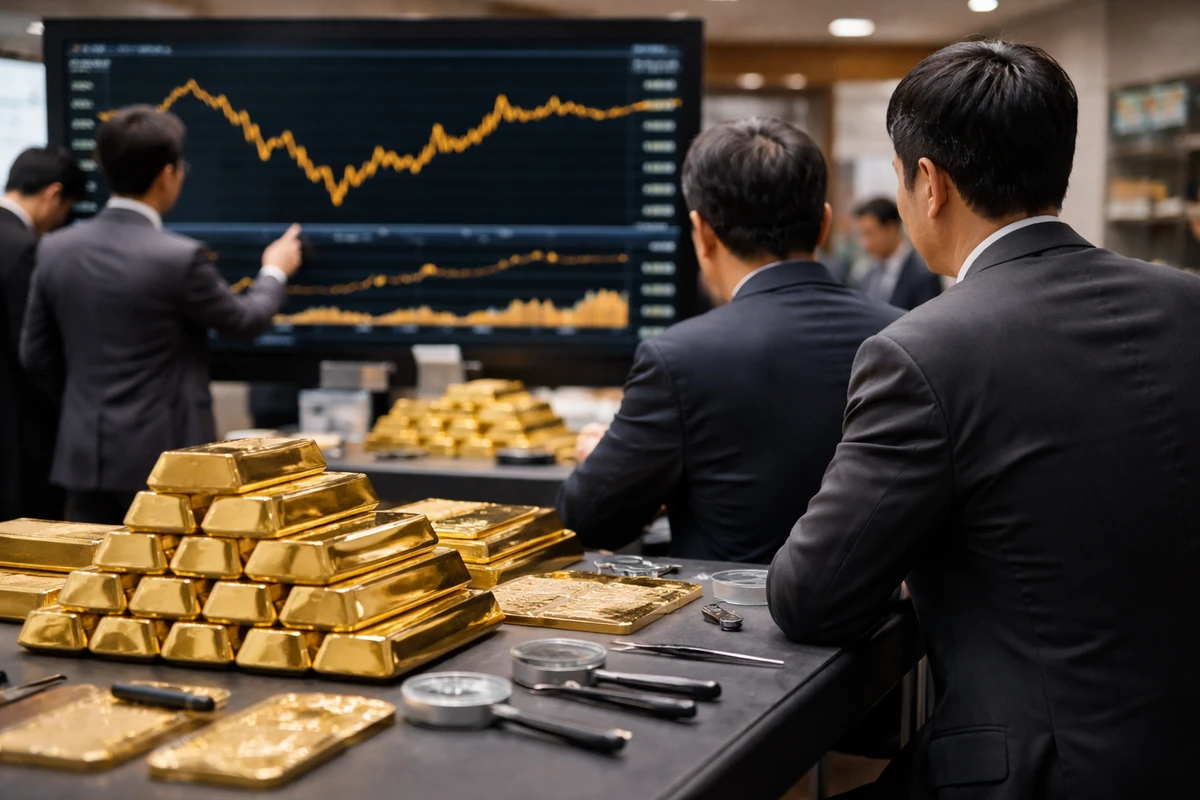
A fight over gold, and over what kind of market South Korea wants to build
South Korea is confronting a question that will sound familiar to anyone who has watched debates in the United States over financial deregulation, commodity trading and consumer protection: When demand for a popular asset jumps, should regulators make it easier for more suppliers to enter the market, or should they slow down and make sure the rules are airtight first?
That is the core issue now facing the Korea Exchange, the operator of the country’s main bourse, as it weighs whether to allow overseas suppliers to participate more directly in South Korea’s spot gold market. On the surface, the dispute may look technical, the kind of policy argument usually confined to traders, refiners and regulators. But the stakes are broader than that. The outcome could shape how gold is priced in South Korea, how much ordinary investors pay to buy and sell it, and how the country balances openness to global markets with the desire to protect domestic industry and maintain confidence in a tightly regulated financial system.
In recent years, gold has regained its appeal worldwide as a classic safe-haven asset, the financial equivalent of canned food and batteries before a storm. When stock markets wobble, currencies swing or geopolitical tensions rise, investors often pile into gold because it is seen as a store of value that can hold up when paper assets look fragile. South Korea has not been immune to those pressures. With economic uncertainty lingering, exchange-rate volatility drawing attention and risk appetite shifting, policymakers and market participants are asking whether the country’s existing gold market structure can handle sudden bursts of demand smoothly.
The Korea Exchange gold market occupies a notable place in that discussion. For many South Koreans, it has become a mainstream, regulated path to investing in physical gold, not unlike how some Americans turn to exchange-traded funds, bullion dealers or futures markets depending on their tolerance for complexity and risk. But unlike purely financial products, gold trading rests on something more tangible: the metal must meet strict standards for purity, storage, settlement and, in some cases, physical delivery. That means any move to broaden participation is not just about inviting more competition. It is also about whether the plumbing of the market can still be trusted when more players are involved.
The debate unfolding in Seoul is therefore about more than bullion. It is about liquidity versus control, efficiency versus safeguards, and whether South Korea wants its gold market to behave more like a globally integrated commodity platform or a carefully managed domestic institution.
Why this issue matters now
Timing is a big part of the story. Gold tends to attract attention when investors grow uneasy about the broader economy, and there are plenty of reasons for unease. Inflation concerns have not fully disappeared. Global central banks remain a major focus for markets. The U.S. dollar, Treasury yields and expectations around interest-rate policy continue to ripple across Asia. Add in geopolitical instability and persistent worries about growth, and gold begins to look attractive again to households and professional investors alike.
In South Korea, where retail investors are highly engaged and quick to respond to market trends, surges in interest can put unusual pressure on the domestic supply chain. If enough people rush into the market at once, a system that relies mainly on domestic suppliers can become strained. When that happens, the problem is not simply that gold becomes harder to get. Prices in the domestic market can begin to diverge from international benchmarks, and the gap between what buyers are willing to pay and what sellers are willing to accept can widen. In plain English, investors may end up paying more than they should for access to the same global commodity.
That concern is especially important in a country like South Korea, where policymakers are often sensitive to fairness in retail investing. American readers might think of the way U.S. regulators scrutinize stock market spreads, payment-for-order-flow practices or hidden fees in retirement products. In the Korean case, the concern is similar in spirit: If a market is intended to serve the public, then investors should not be penalized by avoidable structural bottlenecks.
There is also a change in the character of gold demand itself. Gold is no longer seen only as a long-term store of wealth or a purchase for jewelers and industrial users. It is increasingly used as a tactical investment, a diversification tool in portfolios and, for some, a short-term trade tied to swings in global risk sentiment. That shift matters because a more fast-moving investor base places greater demands on liquidity. Markets that may have functioned adequately in a slower, buy-and-hold environment can look rigid when money starts moving in and out more quickly.
Supporters of reform say this is exactly why the Korea Exchange is studying whether the current model still fits the modern market. Critics counter that speed and volume are not the only goals worth pursuing. Gold markets depend on trust, and trust can be easier to lose than to rebuild.
The case for opening the door to foreign suppliers
Those who support allowing overseas suppliers into the exchange’s gold market argue first and foremost that South Korea needs a deeper pool of supply. If the market is too dependent on a limited number of domestic participants, they say, it can become vulnerable to shortages in moments of intense buying. More suppliers, especially ones plugged into international bullion networks, could help smooth out those imbalances and reduce the risk of local price distortions.
For ordinary investors, the practical appeal is straightforward. Better supply conditions could mean tighter spreads, more consistent pricing and lower trading costs. Anyone who has tried to buy a thinly traded asset in the United States, whether a small-cap stock, a collectible or even physical precious metals during a period of panic buying, understands the problem. The headline price might look reasonable, but the actual cost of getting in or out can be much higher once markups, spreads and fees are taken into account. A broader supplier base could make South Korea’s gold market behave more efficiently.
There is also the argument for competition. More suppliers generally mean more pressure on market participants to improve service, sharpen pricing and reduce frictional costs. In gold markets, those costs can include more than just brokerage commissions. They may also involve storage charges, physical withdrawal fees and the premium investors pay above the international price of gold. If foreign suppliers force the market to become more competitive, proponents say, investors stand to benefit.
A third argument is that gold is, by nature, a global commodity. Its value is not set in isolation within one national market. Prices are heavily influenced by international benchmarks, currency moves and global demand conditions. That raises a natural question: If South Korea is trading an international commodity, why should its supplier structure remain overly insulated from the international market?
Reform advocates say a more open framework would make domestic prices track global prices more closely and improve the credibility of the Korean market over time. In that sense, they see the proposal not as a radical break but as an overdue modernization. To them, restricting supply too tightly risks turning the market inward and undermining the very price-discovery function an exchange is supposed to provide.
There is also a broader strategic consideration. South Korea is one of Asia’s most globally connected economies, deeply integrated into trade, manufacturing and capital flows. Supporters of opening the gold market say it would be inconsistent for a country so internationally linked in most sectors to maintain an unusually closed structure in a market built around a universally traded asset. If Seoul wants its financial markets to remain sophisticated and globally credible, they argue, it cannot ignore international norms forever.
The pushback: Quality control, trust and protection for domestic players
Opponents of opening the market are not necessarily arguing for permanent protectionism. Their concern is more specific and, in some ways, more difficult to dismiss: Gold is not a purely digital asset that can be moved around with a keystroke. It is a physical commodity whose credibility depends on exacting standards. Questions of purity, certification, chain of custody, storage and settlement are central to whether the market functions properly.
That is where skepticism toward foreign participation becomes strongest. If overseas suppliers are allowed in, what standards will they be required to meet? Will South Korea rely on domestic certification, international accreditation or some combination of both? If a dispute arises over quality or delivery, which institution bears responsibility? And if there is a mismatch between Korean regulatory expectations and international market practice, who absorbs the fallout?
These concerns may sound narrow, but they go to the heart of investor confidence. In financial markets, trust often rests on invisible infrastructure. Americans learned this in painful ways during the 2008 financial crisis, when instruments that seemed safe turned out to depend on assumptions many people did not understand. Gold is different, but the principle is similar: If the system behind the trade is murky, investors eventually pay the price.
There is also a domestic industry angle. South Korea has its own refining, distribution and precious-metals businesses, and those companies could be squeezed if the exchange suddenly gives foreign suppliers easier access to the market. Critics worry that large overseas firms, with scale and global networks on their side, could outcompete local businesses before regulators have a chance to assess the long-term effects. In their view, the exchange is not just another private marketplace. Because it helps set standards within the regulated financial system, any change to supplier rules carries broader industrial consequences.
Another fear is that more foreign participation could bring not only more liquidity, but also more volatility. This may sound counterintuitive. In theory, deeper markets should be more stable. But critics note that if foreign suppliers are tied more closely to short-term capital flows, they could also amplify rapid changes in market sentiment. Gold prices are already sensitive to psychology, inflation expectations, geopolitical shocks and currency swings. A more active supply channel might improve access without necessarily making the market feel calmer to everyday investors.
That is why many skeptics are framing the issue not as whether foreign suppliers should ever be allowed, but how fast and under what conditions. Their position amounts to a demand for guardrails first, expansion second. In a market with heavy retail participation, they argue, it is better to prevent problems than to clean them up after confidence has been damaged.
What the debate means for individual investors
If foreign suppliers are eventually allowed greater access, the most immediate change retail investors may notice is improved price access. During periods of strong demand, premiums in the domestic market could ease if supply becomes more abundant and more responsive. Bid-ask spreads could narrow, making it cheaper to enter and exit positions. For investors using gold as a hedge rather than a speculation, that matters. The purpose of owning a defensive asset is partly defeated if high transaction costs eat into the protection it is supposed to provide.
Still, lower headline trading costs would not automatically solve every issue. Investors interested in taking physical delivery, not just holding a position through the exchange, would still need to navigate fees, product specifications, pickup or storage arrangements and tax treatment. In other words, a more open supplier structure might improve what happens on the screen without fully fixing what happens after someone clicks “buy.”
That distinction is important because gold occupies a hybrid role. It is both a financial asset and a real-world object. In American terms, it sits somewhere between a stock and a commodity bought from a dealer. That dual identity is why market design matters so much. A smooth trading interface alone is not enough. Settlement, withdrawal and custody must work coherently as part of the same system.
There is also a behavioral dimension. South Korean retail investors, much like their U.S. counterparts, can be highly responsive to momentum and headlines. If easier supply makes the market feel more accessible, participation could increase further. That may be a good thing if it improves market depth and broadens investor choice. But it could also expose less experienced investors to an asset they regard as simple or inherently safe, when in reality gold can be volatile in the short run and highly sensitive to global macroeconomic conditions.
That is why investor protection remains a central part of this debate. Policymakers are not just deciding whether more metal should be available. They are deciding what kind of rules should govern a market that many households may enter precisely because they believe it offers shelter from uncertainty.
A broader test of South Korea’s regulatory instincts
At a deeper level, the gold market dispute reflects a recurring tension in South Korean economic policy. The country has spent decades building globally competitive industries, from semiconductors to shipbuilding to entertainment, while also relying on strong state oversight and tightly managed institutions. That combination has often served it well. But it can create friction when markets evolve faster than regulatory frameworks.
The gold debate captures that friction in miniature. One side is essentially arguing that South Korea should trust competition and global integration to improve efficiency. The other is saying that market openness, without careful sequencing, can undermine the very trust that makes regulated markets valuable in the first place. Both arguments carry weight, especially in a country where public expectations around oversight remain high.
For Americans, there is an understandable analogy in the long-running U.S. debate over whether regulation helps or hinders markets. Wall Street has often argued that deeper, freer markets serve investors best. Consumer advocates and some policymakers have countered that markets only work well when rules are strong, transparent and enforceable. South Korea’s gold market is smaller and more specialized, but the philosophical split is recognizable.
The challenge for the Korea Exchange, then, is not simply to pick a side. It is to design a system that captures the benefits of broader supply without sacrificing confidence in purity standards, settlement integrity and investor protections. That likely means the real policy question is not a yes-or-no choice on foreign access, but a detailed question of architecture: Which suppliers qualify, how they are vetted, how deliveries are certified, how disputes are handled and what protections are in place for retail participants.
That kind of gradual, rule-heavy approach may frustrate those hoping for a quick boost to liquidity. But it would be consistent with how South Korea often approaches market reform: cautiously, iteratively and with an eye toward avoiding abrupt dislocations.
What comes next
No matter where the policy lands, the discussion itself signals that South Korea’s gold market is entering a new phase. The country is no longer treating gold simply as a niche product for jewelers or conservative savers. It is increasingly confronting gold as a mainstream financial instrument whose market structure has to keep pace with changing investor behavior and global price dynamics.
If regulators move toward allowing foreign suppliers, they will almost certainly face pressure to build a dense framework around certification, custody, settlement and disclosure. That would be the price of convincing the public that a more open market is not a looser market. If they decide to move slowly or keep the current structure largely intact, they may be forced to explain how they plan to address the very real concerns over supply bottlenecks, price inefficiency and investor costs.
Either way, the underlying issue is unlikely to disappear. As long as gold remains a favored refuge in uncertain times, and as long as South Korean investors remain active participants in financial markets, pressure will continue to build for a system that offers both access and credibility. That is a difficult balance in any country. In South Korea, where confidence in institutions and sensitivity to market fairness can be especially pronounced, it may be even harder.
For now, the debate over foreign suppliers is best understood not as a narrow industry fight, but as a referendum on what South Korea wants from one of its most symbolically important markets. Does it prioritize speed, competition and tighter alignment with global pricing? Or does it place greater weight on control, domestic capacity and pre-emptive safeguards? The answer will determine more than who gets to sell gold on the exchange. It will help define how South Korea manages the uneasy trade-off between openness and trust in an era when investors are searching, once again, for somewhere safe to hide.
Comments
Post a Comment