Why a New Criminal Organization Allegation Is Raising the Stakes in South Korea’s Latest Political Investigation
A legal shift that changes the story
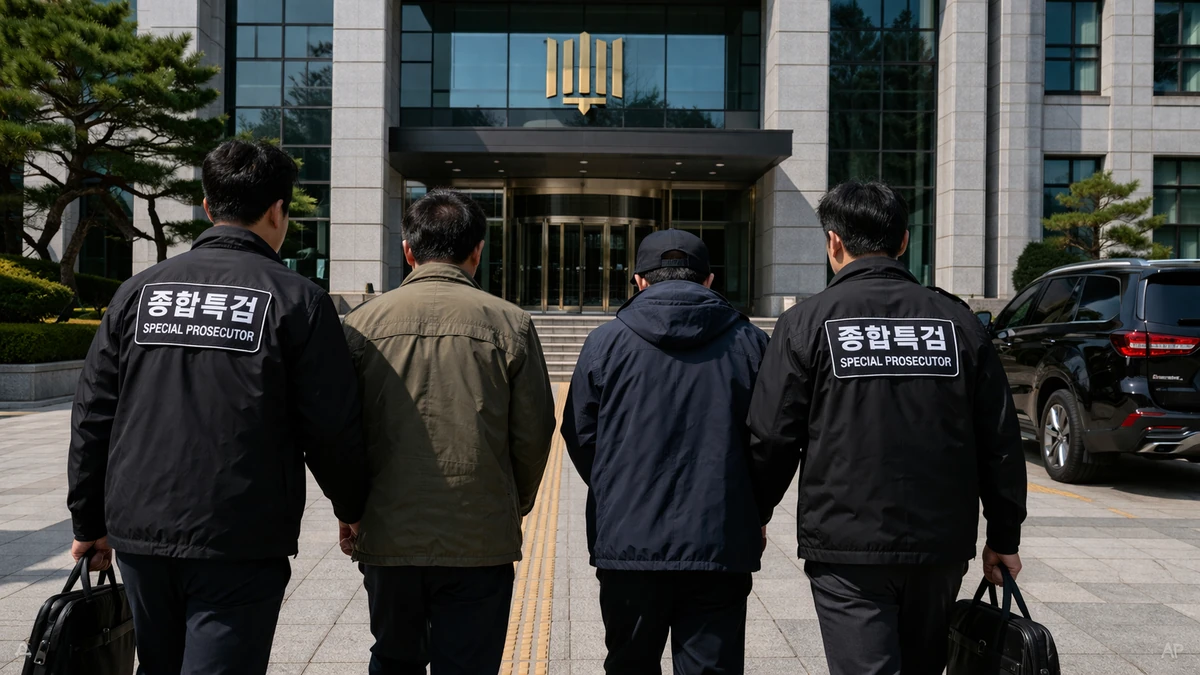
A major special counsel investigation in South Korea took a consequential turn this week when investigators said they had booked four people, including Noh Sang-won, on suspicion of organizing a criminal group. In the United States, that kind of development would be roughly comparable to a case moving beyond allegations that a few individuals may have coordinated wrongdoing and into something closer to a racketeering-style theory: prosecutors signaling that they are examining whether an organized structure existed, with roles, leadership, continuity and a shared objective.
That does not mean anyone has been convicted, or even that charges will ultimately hold up in court. In South Korea, as in the U.S., being booked or formally registered as a suspect is a procedural step in an investigation, not a finding of guilt. But the legal framing matters. It tells the public, political insiders and potential witnesses that investigators may no longer be viewing the matter as a collection of isolated acts. Instead, they appear to be asking a broader and more politically explosive question: Was there a durable chain of command and an organized system behind the alleged misconduct?
That distinction is why the reaction in Seoul has been immediate and intense. South Korean politics is already highly polarized, and special counsel investigations carry unusual public and symbolic weight. When investigators invoke a theory associated with structure, hierarchy and long-term coordination, the political implications spread quickly beyond the people named in documents. Attention turns to who designed the system, who approved actions, who carried them out and whether official institutions were bypassed along the way.
For American readers, the significance is less about the technical wording of one Korean criminal statute and more about what that wording suggests. If prosecutors are genuinely pursuing an organized-group theory, then the case is no longer just about whether a handful of people crossed legal lines. It becomes a test of whether informal power networks, hidden command channels or parallel decision-making structures may have operated alongside, or in place of, normal democratic oversight.
That is the point at which a legal investigation becomes something larger: a referendum on political trust, government transparency and the integrity of the state itself.
What South Korea’s special counsel system means
To understand why this matters so much in South Korea, it helps to understand the institution leading the inquiry. A “special counsel,” often called a special prosecutor in English-language coverage, is an investigator appointed to handle especially sensitive cases, often those involving political power, corruption or public institutions. Americans may think of a hybrid between an independent prosecutor and a high-profile congressional-era corruption inquiry, though the Korean system has its own rules and traditions.
In South Korea, special counsel probes often emerge when ordinary prosecutorial channels are seen as politically constrained, too conflicted or insufficiently trusted by the public. Their creation usually reflects a political judgment as much as a legal one: that the matter is serious enough, and public skepticism deep enough, to require a more visibly independent investigation. That also means every move by a special counsel is scrutinized not only for legal merit but for what it says about the direction of national politics.
That scrutiny is amplified in a country where politics can move at breakneck speed and where legal investigations have repeatedly shaped presidential fortunes, party alignments and public opinion. South Korea’s modern political history includes presidents impeached, imprisoned or engulfed in corruption scandals, and voters are deeply familiar with the idea that courtroom developments can reshape the national agenda. So when a special counsel escalates from examining individual misconduct to exploring whether an organized criminal structure existed, lawmakers in both major camps understand the danger instantly.
The political sensitivity is heightened by another feature of Korean public life that may be less familiar to overseas readers: the persistent concern over informal influence. In major scandals over the past decade, public outrage has often centered not only on whether laws were broken, but on whether key decisions were made through private networks, personal loyalties or shadow channels rather than transparent state procedures. In that sense, the latest development touches a longstanding nerve in Korean democracy.
If the public comes to believe that important acts were coordinated through unofficial relationships rather than lawful institutions, the fallout goes beyond criminal liability. It revives a broader anxiety that public authority in South Korea can sometimes be bent by behind-the-scenes actors who operate outside normal accountability.
Why this allegation hits harder than ordinary conspiracy claims
The phrase at the center of this latest development can sound abstract, even technical. But in practical terms, the allegation is significant because it suggests a much higher level of organization than ordinary conspiracy or joint participation. In many legal systems, several people can be accused of working together in a crime without prosecutors having to show a structured, ongoing organization. A criminal-group allegation generally goes further. It implies that investigators believe there may have been a durable arrangement with internal roles, decision-making pathways and enough continuity to function as more than an ad hoc partnership.
That is why politicians are reacting so sharply. Once investigators begin looking for hierarchy and system, the circle of relevant people can widen. The inquiry is no longer confined to what a few visible figures did on one date or in one meeting. It expands outward to include communications, internal reporting lines, who relayed instructions, who controlled information, whether tasks were divided and whether the same structure operated repeatedly over time.
In American terms, it is the difference between investigating whether a handful of operatives coordinated a single improper act and asking whether there was an organized apparatus behind it. That second question is inherently more dangerous to political institutions because it invites inquiry into command responsibility. It asks not merely who acted, but who gave direction, who knew, who benefited and whether safeguards inside government failed.
In South Korea’s current climate, that kind of inquiry is especially destabilizing. The ruling camp and the opposition both face risk. If the investigation uncovers evidence of systematic wrongdoing tied to political power, it could trigger a legitimacy crisis for whichever side is implicated. But if the case is seen as overreaching, politically theatrical or thinly supported by evidence, then the special counsel itself could become the target, accused of weaponizing law for partisan effect.
That tension is familiar in many democracies, including the U.S. Americans have seen how politically sensitive investigations can become proxy wars over the justice system itself. South Korea is no different in that respect. The legal standards may differ, but the underlying democratic pressure is the same: Can investigators pursue politically connected suspects without appearing partisan, and can politicians respond without undermining confidence in the rule of law?
That is why the allegation matters before any verdict has been reached. It changes the frame. It tells the public that investigators may be trying to map a structure, not just prove an incident.
What investigators now have to prove
The legal and evidentiary burden in a case like this is substantial. Investigators cannot simply point to multiple people being involved and call it an organized criminal group. They would generally need to show that the group had a common purpose, a meaningful degree of continuity, a division of labor and some kind of command or reporting structure. The more serious and politically consequential the allegation, the more carefully courts are likely to examine whether those elements are actually supported by the record.
That makes the next phase of the investigation crucial. Special counsel investigators will likely focus on the architecture of the alleged conduct: call logs, messaging records, schedules, meeting notes, digital files, financial trails and witness statements that either line up or conflict. They will be looking for evidence not just that people were in contact, but that contact reflected a system. Did one person assign tasks? Did others understand themselves to be operating under instructions? Was there a repeated process rather than a one-off improvisation?
Continuity is another major issue. One of the strongest defenses in a case like this is to argue that whatever happened was episodic, reactive or loosely connected, not organized in the durable sense required by law. Defense lawyers may contend that individuals acted independently, that there was no stable hierarchy, or that prosecutors are retrofitting a dramatic narrative onto facts that are messy and fragmented. That is a familiar courtroom fight in many countries: whether apparent coordination amounts to a true structure.
Investigators also have to separate individual responsibility. Even if prosecutors persuade a court that some form of organized entity existed, that does not mean every person linked to it bears the same legal blame. One person may have conceived a plan, another may have relayed instructions, another may have played only a limited operational role and another may not have understood the full nature of what was happening. Criminal law generally turns on individual knowledge and conduct, not guilt by association alone.
That distinction matters politically as well as legally. Broad allegations may dominate headlines, but cases often hinge on very specific questions: Who knew what, when? Who authorized what? Who concealed evidence, if anyone did? Who had the power to stop events but did not? The special counsel’s success will likely depend less on rhetorical force than on whether it can connect concrete evidence into a coherent, persuasive narrative that survives judicial scrutiny.
For now, the public knows only that the investigation has escalated. The key test ahead is whether investigators can explain, with precision and documentation, what exactly made this an organized structure rather than a loose cluster of actors.
Why the political fallout could spread well beyond the suspects
In South Korea, legal cases involving political power rarely stay confined to the courthouse. They quickly spill into the National Assembly, cable news, party strategy sessions and, increasingly, social media ecosystems where supporters of both camps frame every procedural step as evidence either of justice or persecution. This case appears likely to follow that pattern.
The governing side is likely to stress due process and caution against jumping to conclusions before courts have weighed the evidence. That is the safer institutional argument, particularly when the allegation is serious and the facts remain contested. The opposition, meanwhile, is likely to emphasize the gravity of the organized-group theory itself, arguing that the very existence of such suspicion shows how deeply the problem may run. Neither response is surprising. Each side is trying to shape the meaning of the investigation before the legal process fully unfolds.
There is also a strategic dimension. If the investigation broadens to include more witnesses, searches, electronic records or additional suspects, it could alter the political calendar. South Korean parties are highly sensitive to timing, especially when local elections, candidate selection or legislative battles are on the horizon. A major legal development at the wrong moment can scramble messaging, weaken leadership and drain political capital.
Congressional maneuvering is also likely. In South Korea, lawmakers can demand briefings, call for emergency committee sessions and turn investigative developments into parliamentary confrontation. That means the legal and political tracks can begin feeding each other. One new witness statement can trigger a legislative uproar; one parliamentary accusation can, in turn, deepen public expectations for further investigative action.
At the same time, both parties have reason to be careful. Korean politics has seen enough high-profile investigations to know that early narratives can collapse. Cases that appear devastating at the start can narrow or weaken under courtroom scrutiny. Others that initially seem technical can become politically catastrophic as more evidence emerges. Politicians who overstate their case too early risk backlash later.
That is one reason this moment is so volatile. Everyone understands the stakes, but no one yet knows whether the evidence will ultimately support the broadest interpretation of what investigators now appear to be examining. In the meantime, the mere possibility of an organized structure is enough to unsettle the political class.
What ordinary citizens should watch, beyond the names and factions
Big political investigations often get reduced to personalities. Which official is in danger? Which party benefits? Whose career survives? Those questions are inevitable, but they are not the most important ones. For the public, the deeper issue is not only who may have been involved, but how such conduct could have been possible in the first place.
This is where the case touches a larger and recurring theme in South Korean democracy: the tension between formal institutions and informal networks. Koreans frequently debate whether major decisions are made through official lines of authority or through private channels of influence that may include trusted aides, unofficial advisers, former officials or loyalists with access but limited accountability. That concern has appeared in scandal after scandal because it goes to the core of how democratic systems earn legitimacy.
If investigators can show that public authority was intertwined with private coordination, the consequences could reach far beyond criminal penalties. It would raise questions about recordkeeping, oversight, internal audits, appointment systems and the transparency of decision-making at the top of government. In other words, the issue would not simply be whether several people broke rules. It would be whether the rules and guardrails themselves were strong enough to prevent power from flowing through opaque channels.
That is why citizens would do well to focus less on factional score-settling and more on institutional facts. Was there a clear chain of command? Were official procedures bypassed? Did safeguards fail to detect irregular activity? Were there mechanisms for accountability that existed on paper but not in practice? Those are the kinds of questions that determine whether a scandal remains a criminal case or becomes a diagnosis of systemic weakness.
For American readers, there is a familiar lesson here. In the U.S., some of the most consequential political scandals have mattered not just because of what one person did, but because they exposed vulnerabilities in the system: weak oversight, blurred boundaries between public office and private interest, or a culture that normalized informal workarounds. South Korea’s current case may end up presenting a similar test.
The public’s long-term judgment is likely to turn on whether this process produces more than blame. It will depend on whether institutions can identify what failed and propose reforms that make similar conduct harder in the future.
What comes next in the investigation and in court
Being booked as a suspect is a beginning, not an end. The next steps are likely to include summonses for questioning, comparison of witness accounts, forensic analysis of phones and computers, efforts to trace contacts and money flows, and potentially broader search-and-seizure activity if investigators believe relevant evidence sits with additional individuals or offices. Each of those moves could produce new headlines, but their real importance will lie in whether they add up to a legally coherent picture.
If the special counsel decides to press forward aggressively with the criminal-group theory, it will need to present evidence that works together rather than in isolation. A suspicious call record, by itself, may prove little. A document, by itself, may be ambiguous. A witness, by himself or herself, may be vulnerable to impeachment. But if multiple pieces point to the same structure, same purpose and same chain of command, the case becomes more compelling.
Once the matter reaches the courts, the standard will become more exacting still. Judges are likely to examine not only whether alleged acts occurred, but whether the legal elements of an organized criminal entity are actually met. Defense teams will almost certainly challenge the prosecution’s theory on several fronts: that there was no stable organization, that individuals lacked a common criminal purpose, that roles were not clearly defined, or that the prosecution is overstating ordinary political or personal contact as evidence of hierarchy.
That contest is likely to be painstaking, document-heavy and slower than the news cycle. It may also produce a mismatch between public emotion and legal outcome. South Koreans, like Americans, are accustomed to high-profile investigations generating strong expectations. But courts decide cases based on admissible evidence and precise legal standards, not on the general sense that a situation looks troubling.
The political calendar will continue to matter. If the investigation overlaps with local elections, party nominations or major legislative fights, each new development may be interpreted through a strategic lens. Yet the ultimate durability of the case will depend on something more basic: whether prosecutors can prove structure, continuity and responsibility with enough clarity to persuade a court.
That is the central point to keep in view. The dramatic part of the story is the legal escalation. The decisive part will be the evidence.
A broader test of democratic trust
However this case ends, it is already forcing South Korea to confront a familiar but unresolved question: How does a democracy restore trust when suspicions arise that power may have been exercised through hidden, organized channels rather than accountable public institutions?
If the special counsel ultimately proves that a criminally organized structure existed, the implications will extend far beyond the fate of the four individuals now under suspicion. It would suggest that reform must reach into the mechanics of governance itself: how authority is delegated, how orders are documented, how watchdog systems operate, how public officials are monitored and how transparency is enforced when political stakes are high.
But even if the courts eventually reject the most severe legal theory, the controversy will still leave a residue. A failed prosecution does not automatically erase the civic damage caused by the appearance of opaque power. If the allegations were plausible enough to command national attention, then many voters will still ask what weaknesses in the system allowed such suspicions to flourish in the first place.
That is why process matters almost as much as outcome. In a politically charged case, legitimacy depends not only on whether the final ruling is guilty or not guilty. It also depends on whether the investigation is seen as careful, transparent and grounded in evidence rather than political theater. A fair process can strengthen democratic confidence even when it produces an inconclusive or unpopular result. A flawed process can deepen cynicism even if it secures convictions.
For South Korea, a country with a vibrant democracy, powerful civic engagement and a long memory of political scandal, that distinction is crucial. Public trust has repeatedly been shaken not only by corruption itself, but by the sense that power can operate in spaces citizens cannot fully see. The latest legal development has struck a nerve because it revives exactly that fear.
The weeks ahead will bring more tactical arguments from parties, more legal debate from experts and likely more dramatic headlines. But for the public, in South Korea and abroad, the essential question is simpler. Can the country show that when suspicions of organized abuse of power arise, its institutions are strong enough to investigate thoroughly, judge fairly and reform intelligently?
That, more than any single indictment or courtroom moment, will determine what this case ultimately means.
Comments
Post a Comment