South Korea Moves to Honor an Officer Who Resisted a Coup, Reopening Questions About Democracy, Memory and the Military
A delayed honor for a forgotten defender
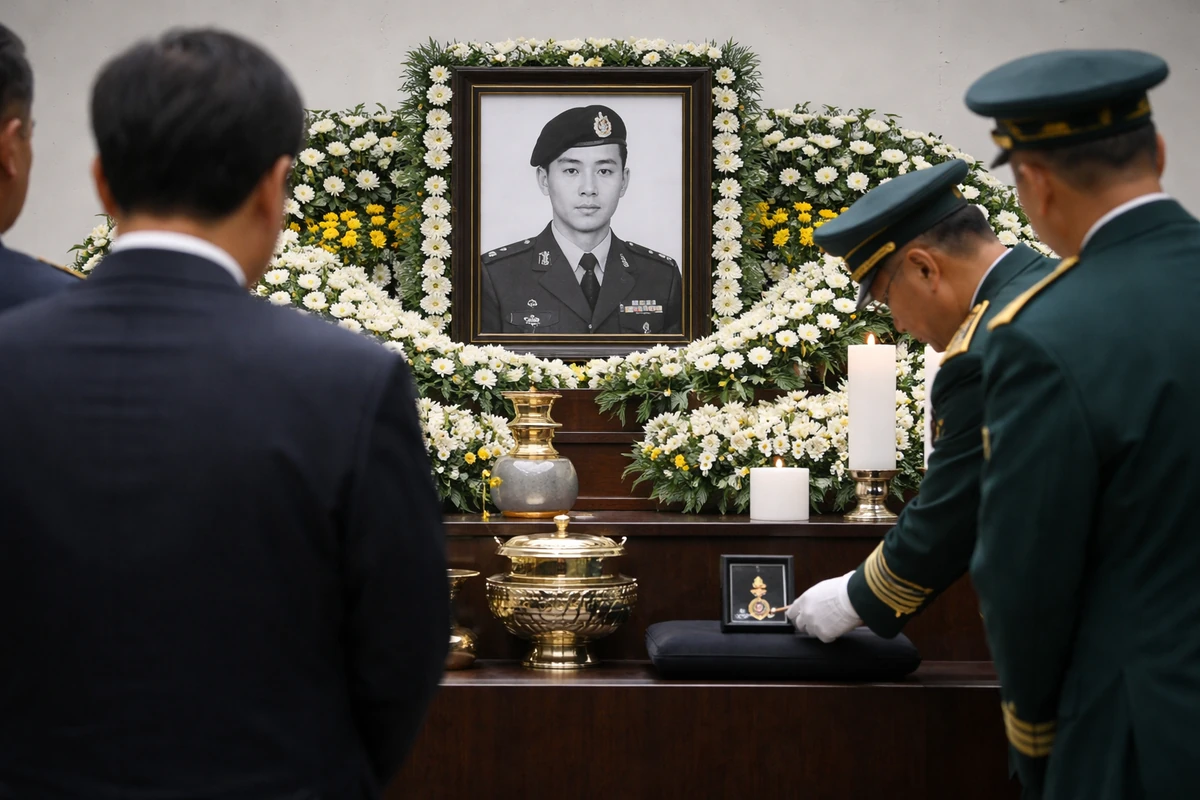
South Korea’s government says it will pursue a posthumous military decoration for Lt. Col. Kim O-rang, an army officer killed while resisting the Dec. 12, 1979, military coup that reshaped the country’s modern political history. On its face, the move might look like a long-overdue commendation for one fallen soldier. In reality, it is much bigger than that. It is a state-backed statement about who defended South Korea’s constitutional order, who tried to destroy it, and why the distinction still matters nearly half a century later.
For many Americans, the easiest point of reference may be this: imagine a democratic government formally recognizing, decades after the fact, an officer who died trying to stop an illegal seizure of power by armed insiders. The medal would not simply be about personal valor. It would amount to an official answer to a civic question: When democracy was under direct threat, who stood on the side of lawful government?
That is the weight attached to Kim’s case in South Korea today. According to the government’s announcement, officials are moving to confer a military merit decoration on Kim, who was serving under Gen. Jeong Seung-hwa, then the army chief of staff, when a faction of officers led by Chun Doo-hwan launched what South Koreans refer to simply as “12.12,” shorthand for the events of Dec. 12. That coup set in motion a chain of events that would bring Chun to power and deepen an authoritarian turn that eventually helped spark the democracy movement of the 1980s.
Kim has long been remembered in South Korea as one of the officers who resisted the coup forces in the moment, rather than accommodating them. Yet despite the country’s democratic transition, later court rulings and broad historical consensus that the seizure of power was illegal, official recognition for those who opposed it has often lagged behind the moral clarity of the history books. That gap is part of what makes the government’s new move so politically significant.
In South Korea, the way the state honors the dead is never just ceremonial. It is deeply tied to questions of legitimacy, democratic values and national identity. A medal can function as a kind of public verdict. In Kim’s case, the message is not only that he died in service. It is that he died on the right side of South Korea’s constitutional history.
Why Dec. 12 still matters in South Korea
To understand why this announcement has stirred such interest, it helps to understand what Dec. 12 means in South Korean public life. The event is not just a military episode; it is one of the defining turning points in the nation’s struggle between authoritarian rule and democratic government.
In late 1979, South Korea was already in upheaval after the assassination of President Park Chung-hee, the strongman leader who had ruled for 18 years. The country was facing political uncertainty, public unrest and a power vacuum inside the state. That was the backdrop when Chun and allied officers moved against the existing chain of command, detaining Army Chief of Staff Jeong and using military force to seize control.
For Americans, the most important way to think about 12.12 is not as an obscure internal military dispute but as an illegal power grab. South Korean courts later established that the actions amounted to rebellion and unlawful seizure of authority. Historians treat it as a foundational act in the rise of a new military regime. And for many South Koreans, it remains a cautionary tale about what can happen when weak civilian institutions and ambitious military actors collide.
The coup also cannot be separated from what came next. Chun’s consolidation of power led into one of the darkest and most important chapters in modern Korean history, including the 1980 Gwangju uprising, when citizens rose up against martial law and were met with brutal military force. In today’s South Korea, both 12.12 and Gwangju occupy a place in public memory similar to other national traumas that become democratic reference points: moments citizens revisit when asking what kind of country they are and what lines should never be crossed again.
That is why honoring someone like Kim now is not merely retrospective. It revisits the origin story of a dictatorship and, in doing so, reinforces the democratic lessons South Korea says it wants to pass on. If the first phase of reckoning was naming the coup leaders’ crimes, this new phase is about naming the people who tried to stop them.
Why Kim O-rang, and why now?
The timing matters. South Korea in 2026 is not confronting tanks in the streets or overt military intervention in politics. It is, however, engaged in a broader debate over the resilience of democratic institutions, the proper limits of presidential power, reform of state agencies and the meaning of political neutrality in the armed forces. Against that backdrop, a decision to honor a man who resisted an unlawful military takeover reads less like archival housekeeping and more like a present-day declaration of principle.
There is a symbolic logic to it. Governments often use commemorations not only to settle old accounts but to clarify current values. In this case, the value being elevated is straightforward: loyalty to the nation does not mean loyalty to whichever faction can command force. In a constitutional democracy, it means loyalty to lawful authority, legal command structures and the constitutional order itself.
That idea may sound obvious in American civic language, but it carries special weight in South Korea because the country’s postwar history includes repeated periods of military intervention in politics. Modern South Korea is one of Asia’s most robust democracies, but it arrived there through protest, repression, reform and repeated battles over state power. Its democracy was not handed down cleanly; it was fought for and, in moments, defended from within the state by people who refused to go along.
Kim’s story fits into that framework. He was not a dissident in the usual sense, not a student activist, labor organizer or opposition politician. He was a military officer operating inside the very institution used to carry out the coup. That makes his recognition especially potent. It suggests that democratic resistance in South Korea did not come only from the streets. It also came from individuals inside state structures who chose legality over factional power.
There is also a practical reason the case resonates now: South Korea’s politics of historical memory have evolved. For decades, state honors have more comfortably celebrated anti-colonial independence fighters or battlefield heroes from the Korean War. Those narratives fit familiar patriotic molds. By contrast, people who defended constitutional order against domestic usurpation have occupied a less settled place in the country’s formal honors system. Kim’s case begins to fill that gap.
More than a medal: a fight over national memory
In South Korea, the term often used in this arena is “state merit” or “patriotic and veterans affairs,” a broad category that includes pensions, recognition, memorial projects and symbolic honors. But the current discussion goes beyond administrative benefits. It goes to a basic question every democracy eventually faces: Whom does the nation choose to remember, and by what standards?
That question may sound philosophical, but it has real institutional consequences. Military decorations are not handed out in a vacuum. They require legal interpretations, documentary standards and judgments about what counts as service to the nation. Traditionally, South Korean military honors have emphasized battlefield valor or wartime contribution. Kim’s case invites a broader interpretation: Can resisting an internal coup, and defending lawful command against armed rebels, be treated as an act of national defense?
Many South Koreans would answer yes without hesitation. After all, a state can be threatened from within as surely as from outside. A tank crossing a border is one kind of danger; a coup against constitutional government is another. Yet translating that moral clarity into administrative policy is not automatic. Once the state recognizes one officer for defending constitutional order against illegal force, it begins establishing a precedent for how future cases might be handled.
That is one reason the move has drawn attention well beyond Kim’s family or veterans circles. It could help redefine the moral center of South Korea’s honors system. Instead of focusing only on protection against external enemies, the system could place greater emphasis on protecting constitutional democracy itself. In a country whose democratic identity was forged in part through resistance to authoritarianism, that would be a meaningful shift.
The symbolism also matters for surviving relatives and for civil society groups that have spent years pushing for fuller recognition of those marginalized in official memory. In many societies that reckon with traumatic pasts, governments separate apology, compensation and rehabilitation into different bureaucratic lanes. But for families, the most important question is often simpler and more human: Did the state finally say, clearly and publicly, that our loved one was right? A formal decoration does that in a way few other measures can.
That is why this moment is about more than the emotional satisfaction of overdue respect. It is about the state placing its seal on an interpretation of history. South Korea is saying that when an illegal seizure of power unfolded, resistance to it was honorable service to the republic.
The politics are easy in principle, harder in practice
On the surface, this looks like the kind of issue South Korea’s political parties should be able to agree on. The illegality of the 12.12 coup is no longer seriously in doubt in mainstream discourse. The broad democratic consensus against military rule is also firmly established. Few elected officials would want to be seen publicly opposing recognition for someone tied to the defense of constitutional order.
But broad agreement on principle does not guarantee easy follow-through. The difficult part begins the moment the government tries to move from one symbolic case to a systematic reappraisal of the past.
One possible path is narrow and manageable: honor Kim as an exceptional case, emphasize the singular facts surrounding his death, and leave the rest of the institutional landscape largely untouched. That approach would deliver a powerful symbol without opening too many bureaucratic battles. The other path is much more ambitious: use Kim’s case as the starting point for a wider review of military officers and public officials who resisted the 12.12 coup, the events surrounding the 1980 martial law crackdown, or other assaults on constitutional government.
The second option would be far more consequential, and far more politically sensitive. It could force the government to revisit personnel records, decoration standards, military academy curricula, textbook narratives, museum exhibits and commemoration budgets. It could also prompt renewed scrutiny of individuals and networks long embedded in the state’s official historical storytelling. In short, what begins as one medal could become a larger rewriting of who the state presents as defenders of the nation.
That is where political friction may emerge. Progressive politicians are likely to frame Kim’s recognition as part of a broader democratic reckoning with authoritarian rule. Conservatives, while also generally supportive of constitutional order, may prefer a more limited interpretation that avoids a sweeping relitigation of every unresolved memory battle from the military era. The core value may be shared, but the scope of its application is not necessarily.
For that reason, process will matter almost as much as outcome. If the government wants this decision to endure as a credible act of democratic restoration rather than a passing exercise in symbolism, it will need rigorous documentation, transparent standards and a clear explanation of why Kim’s actions qualify under military honors rules. The more morally charged the gesture, the greater the need for administrative precision.
A message to today’s military: loyalty belongs to the Constitution
Perhaps the most significant long-term effect of the decision may be on the culture of the military itself. South Korea’s armed forces today operate under a firmly democratic system, and the norm of political neutrality is central to that identity. But norms do not sustain themselves automatically. They are taught, reinforced and embodied through stories institutions choose to elevate.
That is where Kim’s case could have lasting power. In officer training, service academies and leadership education, historical examples often matter more than abstract rules. It is one thing to tell cadets that unlawful orders must not be obeyed. It is another to show them a real officer who stood by legal command authority during a coup and is now being honored for it by the state.
In the American context, civil-military relations are often framed around the principle of civilian control of the military and the duty of officers to the Constitution rather than to a party or individual leader. South Korea’s democratic development has produced a related lesson, shaped by its own history: the military’s legitimacy depends not merely on discipline, but on discipline bounded by law. Obedience is not the highest virtue if the command itself is unlawful.
That message carries importance beyond the military. It also speaks to prosecutors, police, civil servants and other public officials. Democratic breakdown is rarely the work of one charismatic strongman alone. It typically requires compliance, opportunism or silence from people inside institutions. By honoring those who resisted, the state highlights a different ethic of public service: duty to legal order, even under pressure.
In that sense, Kim’s story may resonate with a wider civic audience than the specifics of his rank or assignment might suggest. He becomes a case study in how democracies survive moments of internal strain: because individuals inside institutions decide that law matters more than faction, and the republic matters more than career advantage.
What American readers should understand about South Korea’s democratic memory
For U.S. audiences, it can be tempting to see South Korea primarily through a handful of familiar lenses: its high-tech economy, the North Korean threat, K-pop, Oscar-winning cinema and its strategic alliance with Washington. All of those are important, but they can obscure a central fact about the country: modern South Korea is also one of the world’s most striking stories of democratic transformation.
Within living memory, it moved from military-backed authoritarianism to a competitive constitutional democracy with a vibrant press, energetic civil society and a public deeply invested in the meaning of democratic legitimacy. That evolution helps explain why questions of historical memory carry such force in Korean politics. These are not dusty arguments for specialists. They are fights over the moral foundations of the present.
Public remembrance in South Korea often functions in a way Americans might recognize from debates over monuments, school curricula, national holidays and official apologies. Whose names are taught? Whose actions are honored? Which episodes are framed as tragic mistakes, and which as crimes? These are arguments about identity as much as history.
The difference is that South Korea’s modern democracy emerged after direct confrontations with military rule, not in the far distant past but in the late 20th century. That means the people involved are closer, the records more immediate and the political inheritances more visible. When the government acts now to honor someone like Kim, it is intervening in a still-living memory landscape.
There is also an emotional dimension Americans should not miss. In Korean public life, formal state recognition carries heavy social meaning. It is tied not just to policy but to dignity, family honor and the moral standing of the dead. A belated medal is therefore more than a line in the official gazette. It can represent an overdue correction in the nation’s moral ledger.
The larger test ahead
The decision to pursue a decoration for Kim O-rang is likely to be welcomed across much of South Korean society as an overdue act of justice. But the harder question is what comes next. Will this remain an isolated gesture, powerful but contained? Or will it become the opening move in a broader effort to align the country’s honors system, education system and official memory with the democratic values it now claims as foundational?
That distinction matters because democratic reckoning is not complete when a state condemns those who seized power unlawfully. It is more complete when the state also identifies and elevates those who defended lawful order, especially when they did so at personal risk and without the assurance that history would reward them.
In that sense, South Korea may be entering what could be called the second half of historical accountability. The first stage was legal and declarative: establishing that the coup leaders acted illegally and that military rule cannot be legitimized by later success. The second stage is commemorative and institutional: deciding who deserves the nation’s gratitude, how public honors reflect constitutional values, and what lessons future generations are expected to carry forward.
If the government handles Kim’s case carefully, transparently and consistently, the medal could do more than recognize a fallen officer. It could help refine South Korea’s democratic self-understanding. It could reinforce a principle every democracy depends on but must keep teaching anew: the state is not defined by whoever seizes power, but by the legal order that makes power legitimate in the first place.
That is why this story matters beyond South Korea, and beyond one officer’s posthumous recognition. Democracies do not preserve themselves only through elections and constitutions. They also preserve themselves through memory — through the stories they choose to honor, the lines they choose to draw, and the people they decide, even belatedly, stood on the right side of history.
Comments
Post a Comment