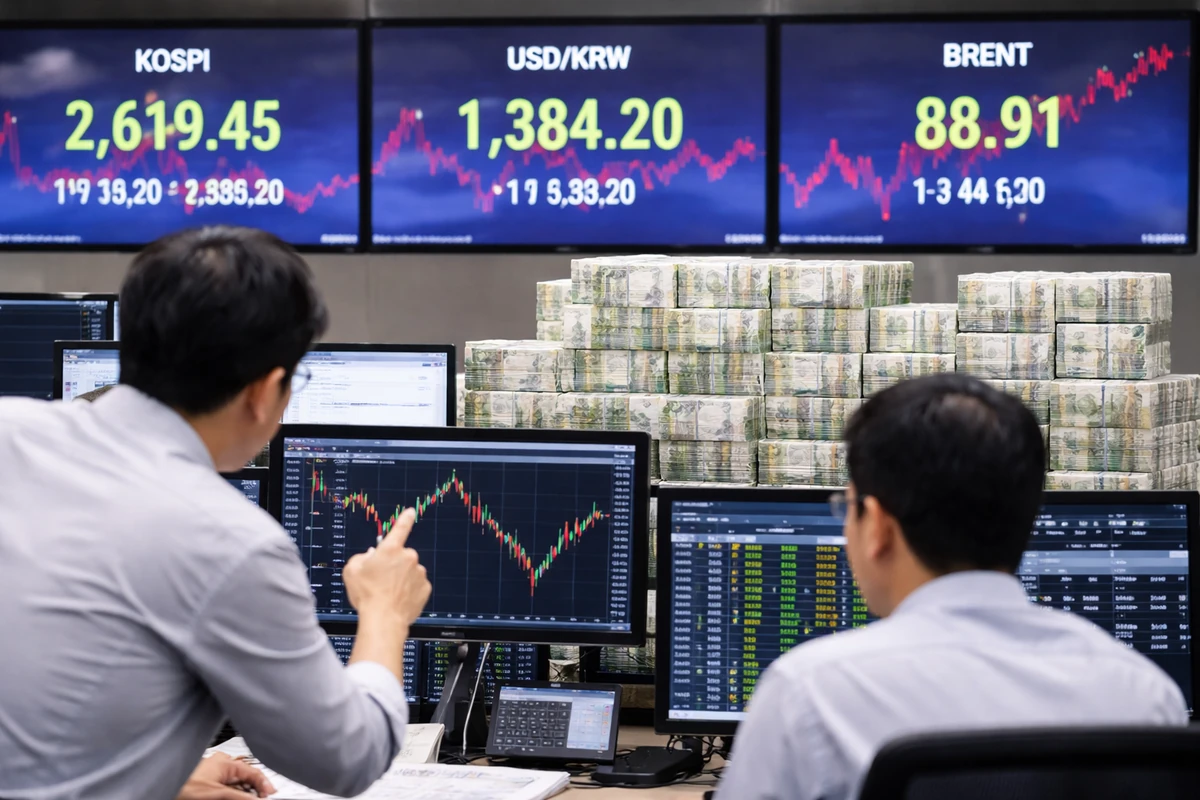
Why South Korea’s financial industry is moving now
South Korea’s biggest financial holding companies say they are prepared to supply about 53 trillion won — roughly $39 billion at recent exchange rates — to help stabilize markets and support consumers if rising tensions in the Middle East spill more forcefully into Asia’s fourth-largest economy. The announcement, reported by Yonhap News Agency, is about more than a large number. In financial markets, signals matter almost as much as the money itself, and the message from Seoul is clear: If global anxiety turns into a credit squeeze, major lenders want investors, companies and households to believe cash will still keep moving through the system.
For American readers, the easiest comparison may be the way U.S. officials and large banks talk during moments of stress about keeping credit markets functioning. South Korea is not facing a banking collapse, and this is not a replay of the 2008 financial crisis. But officials and bank executives appear to be trying to get ahead of a familiar danger: a geopolitical shock that first hits currencies and stock prices, then slowly works its way into business investment, hiring, consumer confidence and household spending.
That dynamic matters especially in South Korea because the country is unusually exposed to external shocks. It imports nearly all of its energy, depends heavily on trade, and is deeply integrated into global supply chains. When oil prices jump, shipping costs rise or the U.S. dollar strengthens as investors flee to perceived safe-haven assets, South Korea often feels the effects quickly. A weaker Korean won can raise import prices, make life more expensive for households and push up financing costs for businesses already dealing with elevated interest rates.
In that environment, the 53 trillion won plan is best understood not as a one-time rescue package but as a defensive line — a kind of market breakwater built before the largest waves arrive. The financial groups are also pairing that liquidity pledge with consumer-relief measures such as auto insurance premium support and discounts on fuel-linked credit cards, an acknowledgment that global crises do not remain trapped in trading screens for long. They show up in gasoline bills, shipping invoices and grocery budgets.
The core question now is whether this announcement becomes a credible stabilizer or remains mostly a symbolic gesture. That depends less on the headline amount than on how quickly and precisely the money is deployed, which borrowers can actually access it, and whether the broader Korean government and central bank backstop those efforts if conditions worsen.
How a faraway conflict reaches Korean households and companies
To many Americans, a Middle East crisis may first register through higher gas prices at the pump. In South Korea, the transmission channels are broader and often faster. The country’s economy is highly sensitive to imported energy prices, exchange-rate swings and shifts in global capital flows. When tensions rise in the Middle East, crude prices can climb, insurance and shipping costs can increase, and investors can pile into dollars and U.S. Treasurys. That combination can pressure the won and make imports more expensive almost immediately.
That matters because South Korea’s economy runs on trade and manufacturing in ways that may be more familiar to readers thinking about Germany, Japan or export-heavy parts of the American Midwest than about a consumer-led economy. Korean companies ranging from petrochemicals to airlines to industrial manufacturers can be hit by higher input costs. Import-dependent businesses face more expensive raw materials. Logistics companies and delivery-based small businesses see fuel costs rise. Consumers, meanwhile, feel the squeeze through transportation costs and broader inflation pressure.
There is also a financial-market layer that often moves before ordinary people notice changes in the real economy. Markets tend to price in fear early. Stocks wobble, currencies weaken, bond spreads widen and refinancing becomes more expensive. In practical terms, that means a mid-sized Korean manufacturer or supplier may suddenly find that raising money is harder or more expensive even before sales weaken. This is why Korean financial groups appear to be emphasizing liquidity rather than simply waiting to see whether the shock deepens. In stressed markets, the fear is often not just high borrowing costs but that credit becomes scarce altogether.
American readers may think of it as the difference between paying more on a loan and not being able to get one at all. The latter is what policymakers dread because it can turn a temporary geopolitical shock into a broader economic slowdown. Even healthy firms can run into trouble if short-term operating cash dries up. That is why the Korean financial sector’s move is being read not merely as a social responsibility exercise, but as a preemptive answer to a much more basic question: If stress rises, will money still circulate normally?
That question has particular urgency in a country where many households and smaller businesses are already sensitive to rates and debt burdens. South Korea has spent years managing high household debt and uneven domestic demand. So while a global shock may originate abroad, it can land on top of local vulnerabilities that are already in place.
What 53 trillion won can and cannot do
The sheer size of the announced support sounds impressive, and in dollar terms it is. But financial packages are rarely judged by their headline totals alone. Their real effect depends on transmission: who gets help, through which channels, under what conditions and how fast. In South Korea, large conglomerates generally have more financing options. They may issue bonds, borrow from banks, tap overseas funding or use internal cash reserves. Smaller firms, subcontractors and self-employed business owners have fewer choices and are more vulnerable when markets become nervous.
That means the effectiveness of the 53 trillion won plan will hinge on whether it reaches the parts of the economy most likely to lose access to funding first. If most of the money is directed toward broad banking facilities that mainly benefit stronger borrowers, the psychological effect on markets may still be positive, but the direct economic relief could be limited. If, on the other hand, the package includes short-term operating loans, trade finance, guarantees, maturity extensions and targeted support for suppliers and small businesses, it could do far more to prevent a shock from spreading.
This is where the architecture of the response matters. Short-term liquidity is essential because companies can fail from timing problems even when their businesses are fundamentally sound. But short-term fixes alone can simply postpone stress if firms need longer-run credit support to bridge a prolonged period of volatility. Korean financial groups will need to balance immediate cash-flow assistance with longer-lasting support structures. That could include refinancing options, support tied to export activity, or programs that help smaller vendors linked to major corporate supply chains.
Speed is another critical factor. Markets often react more to implementation than to announcements. A bank can say funds are available, but if credit officers continue to apply very conservative screening standards or the approval process is slow, businesses and households may feel little difference. The credibility of this plan depends on whether borrowers can access money when they need it, not weeks later after conditions have already deteriorated.
There is also the question of coordination across the sprawling financial groups themselves. In South Korea, “financial holding companies” are not just banks in the narrow American sense. Many of them control banking, credit card, insurance, securities and consumer-finance subsidiaries under one corporate umbrella. That gives them more levers than a stand-alone bank. They can combine lending support with payment discounts, insurance relief and market-making activity in securities businesses. If those units act in concert, the response can be broader and more visible to the public. If they do not, the package could feel fragmented and less effective than the number suggests.
Why consumer perks matter in a market-stability plan
At first glance, measures like discounts on gas-related cards and support for auto insurance premiums can sound like small retail promotions attached to a much larger financial story. But in the Korean context, they serve a strategic purpose. They are meant to soften the way an external shock reaches household budgets and the country’s vast self-employed sector, which plays an outsized role in the domestic economy.
South Korea has a large population of small business owners, including restaurant operators, shopkeepers, delivery-related workers and service providers whose finances are tightly linked to transportation and everyday operating costs. For someone using a car for work or commuting long distances, fuel discounts are not trivial. They can help cushion repeated increases in gasoline prices, even if they do not fully offset them. Likewise, an insurance premium cut may not transform a family budget, but it can signal that relief efforts are reaching daily life rather than remaining confined to trading desks and corporate boardrooms.
There is an American analogy here too. Think of the way policymakers in the United States often try to pair system-level financial interventions with measures voters can actually feel — tax rebates, utility assistance or gas-tax debates — because public confidence depends not only on what happens in markets but on whether households sense any relief. South Korea’s card and insurance measures appear designed to serve that same function. They are pocketbook-oriented responses attached to a broader financial-stability message.
Still, there are limits. Card discounts lose impact quickly if oil prices jump sharply. Insurance support can feel narrow if only a small segment of customers qualifies or if the savings are modest. These kinds of measures work best when the rules are clear, the duration is meaningful and consumers can easily understand how to use them. Otherwise they risk looking like branding exercises rather than economic relief.
Even so, it would be a mistake to dismiss them entirely. One of the strengths of Korea’s financial groups is that they can respond across multiple parts of household finance at once. A bank might help with lending, a card unit might trim transaction costs and an insurance arm might reduce another recurring expense. In a period when energy prices can undermine consumer sentiment, even partial offsets can slow the pace at which households pull back spending.
The sectors most likely to feel the strain first
If Middle East tensions persist or worsen, not every part of the Korean economy will be affected the same way. Industries with heavy exposure to imported fuel, shipping costs or dollar-denominated inputs are likely to feel pressure early. Airlines, refiners, petrochemical companies and transportation firms are obvious candidates. Manufacturers that rely on imported raw materials could face a double burden if both the won weakens and commodity prices climb. Retailers and logistics-heavy businesses may struggle with higher delivery costs.
Small and medium-size enterprises are particularly important here. South Korea’s economy is often associated abroad with giant names like Samsung, Hyundai and LG, but much of the employment and supply-chain activity sits beneath those headline companies. Mid-sized suppliers and smaller subcontractors can be hit hard when financing tightens, especially if they lack direct access to capital markets. A well-designed liquidity program could buy them time to absorb temporary cost spikes rather than cutting payroll, delaying investment or shutting down operations.
Self-employed workers may be even more exposed. South Korea has long had a high proportion of self-employment compared with many advanced economies, and these business owners are already navigating soft consumer demand, repayment pressure and thin margins. Higher fuel and logistics costs can eat into earnings quickly. If card-sales-based lending or policy-linked financing remains accessible, these businesses may be able to bridge short-term stress. If not, the shock could show up in closures, missed loan payments and weaker neighborhood-level economic activity.
Some exporters, to be sure, can benefit from a weaker won because their products become cheaper abroad in local-currency terms. But that advantage is not universal. Exporters that import expensive components or energy may see the gain diluted or erased. Domestic service businesses, meanwhile, get little help from currency depreciation and may simply face higher costs. This uneven impact is one reason a blanket funding pledge is only the beginning. The quality of the response will depend on whether support is calibrated by sector and business type rather than applied as a one-size-fits-all measure.
For investors, the practical test will be whether these sectors can continue refinancing normally and whether defaults or distress signals remain contained. For ordinary Koreans, the test is more concrete: whether bills rise faster than wages and whether small businesses can keep operating without resorting to emergency borrowing at punishing rates.
The role of the government, regulators and the Bank of Korea
No matter how large the private-sector commitment sounds, South Korea’s financial groups cannot carry the stabilization burden alone if market stress becomes prolonged. Their ability to support borrowers depends on their own balance-sheet health, asset quality and confidence in the broader policy environment. If delinquency concerns rise too sharply or bank funding conditions worsen, lenders may become more cautious precisely when the economy needs them to be more flexible.
That is why coordination with the government, financial regulators and the Bank of Korea is likely to be crucial. Private financial groups can move faster at first. They can roll out targeted support, reassure clients and show the market that the system is not frozen. But if the shock deepens, public tools may need to follow. Those tools can include bond-market stabilization measures, foreign-currency liquidity management, expanded policy financing and sector-specific support for vulnerable industries.
American readers can think of this as a layered response: private finance forms the first line of defense, while public institutions stand behind it to prevent a confidence problem from becoming a systemic one. South Korea has used versions of this approach before during periods of market turbulence, and the country’s policymakers are generally quick to emphasize coordination when volatility rises.
Credibility, however, depends on consistency. If financial groups announce support today but tighten lending standards tomorrow, markets will notice immediately. Trust in financial stabilization plans does not come only from headline figures. It comes from transparent rules, predictable execution and clear communication about who qualifies, under what terms and how quickly funds can be disbursed. In that sense, the next stage matters as much as the initial announcement. Investors and businesses will want details.
That includes clarity on how much of the 53 trillion won is genuinely new support, how much is contingent, and how much is simply a formalization of lending capacity that already existed. Such distinctions may sound technical, but they shape whether markets see the program as a meaningful cushion or as a public-relations exercise dressed in large numbers.
What to watch in the weeks ahead
For readers trying to gauge whether this Korean financial-industry pledge is working, three indicators stand out. The first is the exchange rate. If the won continues to weaken sharply against the dollar, that would suggest external pressure is still intensifying and that import-cost concerns may grow. A steadier currency would not solve everything, but it would indicate that markets are not spiraling.
The second is oil. Because South Korea is so dependent on imported energy, sustained increases in crude prices can spread quickly through transportation, manufacturing and consumer costs. Temporary spikes are manageable; a durable climb is more dangerous. For American audiences, this is the metric most intuitively familiar, but in South Korea its economic footprint can be even wider.
The third is funding conditions inside Korea itself, especially for corporate borrowing and loans to smaller firms. If bond spreads widen, refinancing becomes more difficult or complaints mount that promised support is not reaching the real economy, confidence in the package could fade. By contrast, if companies continue to roll over debt and smaller borrowers report access to credit without major delays, that would suggest the plan is doing what it was intended to do: not eliminate uncertainty, but stop uncertainty from hardening into paralysis.
There is a broader lesson here as well. South Korea’s response illustrates how globally connected economies now manage geopolitical risk. Military tensions in one region can quickly become a banking, currency and consumer-cost issue somewhere else. In a country as trade-dependent as South Korea, policymakers and lenders often cannot wait until the effects are visible in unemployment or bankruptcies. By then, the damage is harder and costlier to contain.
For now, the 53 trillion won pledge is best seen as an early warning response — a promise that if fear outruns fundamentals, South Korea’s major financial groups intend to keep credit flowing. Whether that promise proves sturdy will depend on execution, policy coordination and the path of events far beyond Korea’s borders. But in the logic of modern financial markets, the move makes sense: stability is easier to preserve than to rebuild after confidence has already broken.
Comments
Post a Comment