
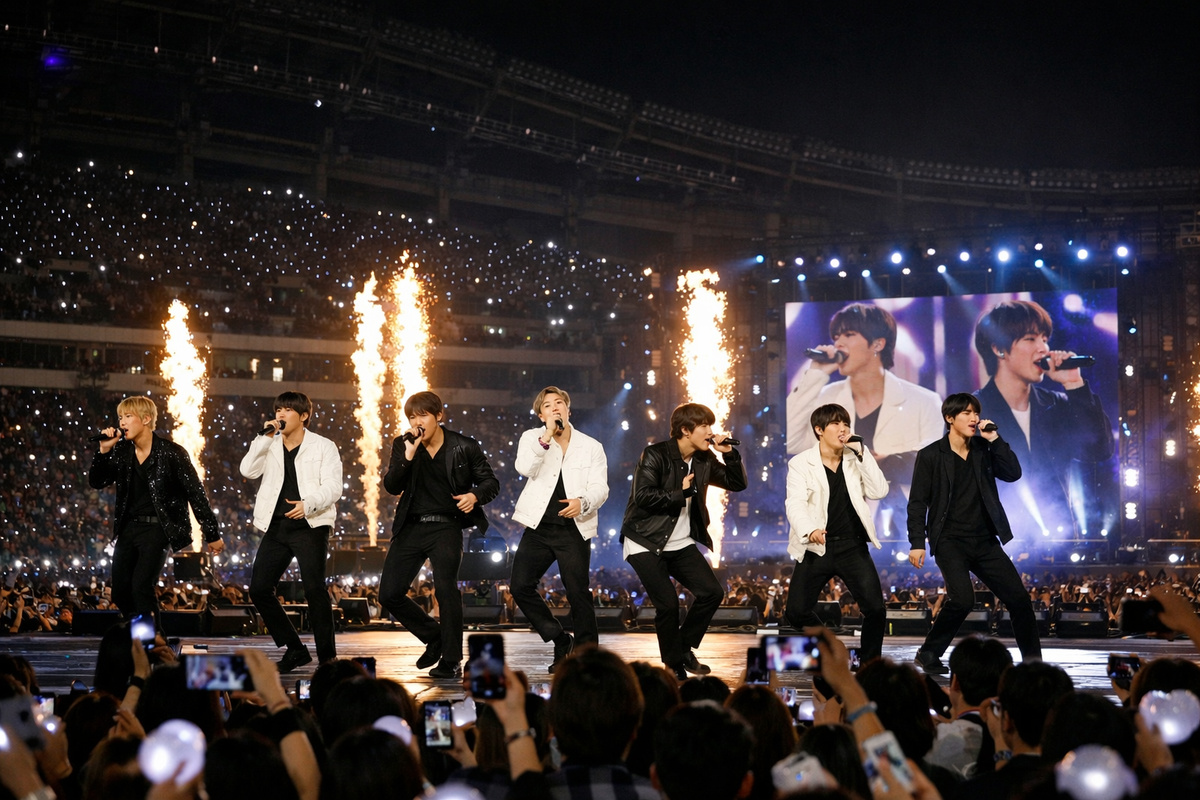
A report, not a confirmation, has already set off a wave of speculation
A single phrase in a Korean entertainment headline is doing a lot of work right now.
On March 29, South Korea’s Yonhap News Agency reported that BTS is likely to hold a concert in Busan in June at Busan Asiad Main Stadium, a major sports venue in the country’s second-largest city. But the key wording in the report was not that the concert is happening. It was that the show is expected, or appears likely, to happen. In Korean entertainment coverage, that distinction matters. A likely venue is not the same thing as an official venue. A reported month is not the same thing as a confirmed date. And until there is a formal announcement from the group’s agency, details that fans care most about, including ticketing rules, seating configuration, age restrictions, transportation plans and crowd control, remain subject to change.
That may sound like a technicality, but anyone who has followed large pop events in the United States knows how much those details matter. A stadium show is not just a concert; it is a logistical operation that affects travel, hotels, policing, transit and local business. It is the difference between casually noting that an artist may be coming to town and immediately deciding whether to book a flight and spend a weekend there.
Even so, the report itself is newsworthy because it reflects something larger than rumor. BTS has moved back to the center of South Korea’s entertainment conversation in a visible, measurable way. On the same day that Korean media circulated the Busan concert report, other BTS-related items were drawing attention as well, including fan-focused live events and newly released content. That matters because blockbuster concerts do not emerge in isolation. They are often part of a broader cycle of renewed public attention, fan activity and industry momentum.
For American readers, the easiest comparison may be the way major touring speculation builds around artists like Taylor Swift or Beyonce before formal tour legs are announced. Fans watch clues, local governments prepare behind the scenes and news outlets report what appears likely before promoters lock every detail into place. That is the stage South Korea appears to be in now with BTS and Busan: high confidence, intense anticipation, but not yet a final public playbook.
And in the BTS universe, that in-between stage can still move markets.
Why Busan matters, and why this city carries unusual symbolism for BTS
Busan is not just another stop on the map. It is South Korea’s largest port city, a sprawling coastal metropolis known for beaches, seafood markets, shipping, film festivals and a civic identity that is proudly distinct from Seoul. If Seoul is often treated as the country’s political, corporate and entertainment center, Busan is usually framed as its big, independent southern counterpart, more relaxed in style but still nationally important.
For BTS, Busan also carries symbolic weight. The city has long been associated with the group in the public imagination, in part because of members’ personal ties and in part because BTS has already been linked to major events there. That does not automatically guarantee a concert, of course, but it helps explain why the idea of a Busan performance resonates so quickly. In South Korea, where the entertainment industry remains heavily concentrated in and around Seoul, a major K-pop event outside the capital region often means more than simple geographic variety. It can feel like a national event rather than a local one.
That point may be less obvious to American audiences, who are used to blockbuster tours routing through multiple large metro areas across a big country. South Korea is much smaller geographically, and yet the concentration of media events, fan signings, launches and large-scale concerts in the Seoul metropolitan area remains striking. When a giant act performs elsewhere, fans do not simply read it as a normal alternate stop. They read it as a signal: this event is big enough to move people.
That is especially true for BTS, whose fan base, known as ARMY, operates as more than a conventional audience. It functions as a sophisticated travel network, online organizing force and consumer community. A concert in Busan would not just draw local fans from southeastern Korea. It would likely pull in people from Seoul, the surrounding suburbs and potentially overseas, creating exactly the kind of destination-event economy U.S. cities try to capture when they host the Super Bowl, the NCAA Final Four or a major Eras-style stadium weekend.
So while the headline centers on a possible June show, the deeper story is about scale. If BTS returns to Busan as a full group performance, the city would not merely be hosting a concert. It would be hosting one of the most powerful demand engines in global pop.
Why Busan Asiad Main Stadium is the leading candidate
There is also a practical reason the venue in the report makes sense.
Busan Asiad Main Stadium is one of the few places in the city that plausibly checks the boxes required for a concert of this magnitude. For top-tier K-pop acts, venue choice is about much more than capacity. A stadium show has to accommodate tens of thousands of people while also supporting complex rigging, giant LED screens, broadcast infrastructure, multiple backstage zones, emergency response access, traffic separation and crowd flow. It must also be able to handle trucks, stage construction and security perimeters on a scale far beyond what many indoor arenas can manage.
That will sound familiar to anyone who has watched American stadium touring evolve over the last decade. The venue is part of the performance. It must be large enough not only to hold the crowd but to make the production work. That matters even more for BTS, a group whose biggest live shows are known for synchronized choreography, layered storytelling, large visual set pieces and highly structured fan participation. The experience depends on sightlines, camera coordination and the ability to scale emotion across a massive space.
Busan, despite being a major city, does not offer the same breadth of large concert infrastructure as Seoul. That is one reason the reported venue stands out. In a city with more limited options for mega-pop staging, the fact that one stadium is emerging as the likely site effectively functions as an early test of feasibility. If planners are pointing to Asiad, it is because the venue appears capable of meeting the real-world requirements: transportation links, internal circulation, safety planning and the physical footprint needed for a stadium-level K-pop production.
Still, likely is not the same as locked. Korean entertainment reporting often moves ahead of formal agency announcements, and those final decisions can hinge on issues invisible to fans. Grass protection for the field, existing venue bookings, neighborhood complaints, police coordination, fire safety plans and expected ticket demand can all alter timing or configuration. In other words, even when a venue seems obvious, the last mile of approval can be complicated.
That is why the current moment is best understood as a strong indicator, not a done deal. For fans, the sensible move is patience. For the industry, however, the fact that this particular stadium is under discussion already says a great deal about the size of what may be coming.
What a Busan BTS concert could mean for South Korea’s regional economy
If the show goes forward, the economic effects are unlikely to stop at ticket sales.
This is where the story becomes legible even to readers who do not follow K-pop closely. Major live events generate a local spillover effect. Hotels fill. Restaurants extend hours. Taxis and ride-hailing services get busier. Convenience stores, coffee shops and nearby retail see traffic spikes. Travelers turn a one-night event into a two- or three-day stay. That is true in the United States, and it is true in South Korea, perhaps even more so when a city outside the capital hosts an event with national and international pull.
Busan is especially well positioned for that kind of impact because it is already both a tourism city and a transit hub. It has high-speed rail connections to Seoul through the KTX system, major domestic and international air links, a subway network and a hospitality base accustomed to handling large visitor flows. In practical terms, that means a concert could become a mini tourism package, whether officially organized or not. Fans may come for the show and stay for beach districts, food markets, harbor views and other attractions the city already promotes.
There is a phrase often used in discussions of K-pop’s business footprint: fans do not just buy music, they buy experience. In a case like this, that experience extends well beyond the stadium gates. It includes the train ticket, the hotel room, the cafe meet-up, the unofficial merchandise exchange, the themed photo spots and the city itinerary built around one performance. For regional governments, that is the dream scenario. A concert becomes an anchor event that activates an entire local service economy.
American readers may think of the way a city’s downtown hotels and bars respond when a major college football rivalry, WrestleMania or a marquee Taylor Swift weekend comes to town. The difference in South Korea is that the concentration of blockbuster entertainment in Seoul makes a city like Busan stand out more sharply when it wins one of these events. The symbolic value and the economic value reinforce each other.
There are, of course, downsides. Large-event economics often bring hotel price surges, transportation congestion and attempts by scalpers to exploit demand. Those patterns are not unique to South Korea, and they are likely to become part of the conversation if the concert is formally announced. The quality of the event experience may end up depending as much on operations as on performance: transparent ticketing, anti-resale enforcement, clear transit guidance and visible crowd management. When the artist is this big, operational credibility becomes part of the product.
How BTS fans reshape demand, from ticket strategy to hotel bookings
The most important force in this story may not be the stadium itself. It may be the behavior of the fan base.
BTS fans are often described in terms of loyalty or enthusiasm, but that can undersell what is really happening. ARMY is a large, organized and highly networked community capable of transforming media attention into immediate economic action. Once a potential concert enters public discussion, fans begin planning in layers. They do not just think about whether to go. They think about where they would stay, how they would travel, whether they can coordinate with friends, what merchandise may be available and how to manage the possibility that demand will far exceed supply.
A Busan concert would alter those calculations in meaningful ways. Fans in Seoul and its surrounding metro area, where a large share of the country’s population lives, would need to account for transportation and lodging in addition to ticket cost. That raises the real entry price of attendance. It also heightens the emotional divide between those who secure tickets and those who do not. In a fandom as large as BTS’s, scarcity does not simply produce disappointment. It restructures behavior across an entire consumer ecosystem.
This matters because concert attendance today is not just about a seat in the building. It is about participation in a temporary event culture. Fans gather before and after the show, trade unofficial freebies, visit city landmarks associated with the artist, post travel diaries and turn attendance into a social memory. That culture has become particularly visible in K-pop, where fandom rituals are often more coordinated and community-driven than what many American audiences may be used to seeing around mainstream pop concerts.
The result is what could be called a mobility economy: a market shaped by people moving because of an artist. A possible BTS performance in Busan draws attention not only because the group is famous, but because the fandom’s movement can be measured in transportation demand, hotel occupancy and neighborhood spending. In other words, the consumer unit is no longer just an album buyer or a streamer. It is a traveler.
That shift helps explain why even an unconfirmed concert report can matter to investors, venue operators, tourism officials and rival entertainment companies. The fan response begins before the official on-sale date. In some cases, it begins before the official announcement.
Why June matters in the broader K-pop calendar
The reported timing is also significant.
June is not just another month. In South Korea, as in much of the global live entertainment industry, late spring and early summer are prime windows for outdoor performances, festivals and brand-linked cultural events. Good weather, school calendars and travel behavior all make this a high-value period for live consumption. If a BTS stadium concert lands in June, it would arrive at a moment when audiences are already primed to spend on experiences.
That timing could have ripple effects across the domestic concert market. One blockbuster event can rearrange consumer attention and spending priorities, particularly in a country where K-pop fandom overlap is common. Fans who support multiple artists may suddenly need to choose among concerts, merchandise drops and travel plans. Promoters and agencies may reconsider their own scheduling to avoid going head-to-head with the largest act in the market.
This part of the story may be familiar to Americans who follow movie release calendars or sports broadcasting windows. When a giant player enters the field, everyone else reacts. In live music, timing is strategy. An event of this size can compress demand around itself, pulling media coverage, sponsorship attention and discretionary spending into its orbit.
The current flow of BTS-related content in Korean media adds another layer. Reports about new music-related material and fan-centered live events suggest that public interest is already being fed from multiple directions. That is important because concerts are strongest when they sit at the intersection of nostalgia, current visibility and fresh engagement. A possible June performance would not emerge from silence. It would arrive during an active stretch of BTS visibility, which is exactly the kind of environment that intensifies demand.
For the K-pop industry, that makes the Busan report more than a local entertainment item. It becomes an early test of how quickly a major act can reactivate the market and how much of that activation can be pushed beyond Seoul.
The bigger question is not whether one concert happens, but what it signals
At one level, this is a straightforward story about a likely stadium concert in a major South Korean city. At another level, it is a case study in how pop culture, urban branding and fan mobility now work together.
If BTS does perform in Busan this June, the event will almost certainly be judged on the usual terms: ticket demand, production quality, crowd management and whether the performance marks a significant full-group moment for fans. But it will also be judged more quietly by another set of observers, including local officials, venue operators, tourism businesses and entertainment executives asking what the event proves about South Korea’s non-Seoul concert economy.
Can a regional city outside the capital absorb and benefit from a megastar event at this scale? Can agencies treat stadium concerts outside Seoul as more than one-off symbolic gestures? Can local infrastructure, from transit to lodging, handle the surge without turning the fan experience into a cautionary tale? Those are business questions, but they are also cultural ones. They speak to whether K-pop’s biggest acts can help decentralize opportunity in an industry that still tilts heavily toward Seoul.
There is one important caveat. BTS may be uniquely positioned to make such a model work. A regional stadium strategy that succeeds for the world’s most recognizable K-pop group does not necessarily translate to every artist, even other successful ones. BTS operates at a level of scale that can justify unusual venue choices and still generate massive turnout. Industry executives know that. So do fans.
That is why this report has drawn such close attention. It offers a glimpse of what may be ahead, but it also highlights the power of anticipation itself. Before a date is confirmed, before tickets go on sale and before a stage is built, a possible BTS concert in Busan is already telling us something about the current state of Korean pop culture: demand is back, the group remains a market-moving force and one city may soon find itself at the center of one of 2026’s biggest live entertainment stories.
For now, caution remains the smartest posture. Fans should wait for an official announcement before locking in travel or lodging. But from a journalistic standpoint, the significance of the report is real even in its provisional state. In modern K-pop, possibility alone can move a city. And when the name attached to that possibility is BTS, the rest of the market pays attention.


0 Comments