A weekend that turned Tokyo into a K-pop capital
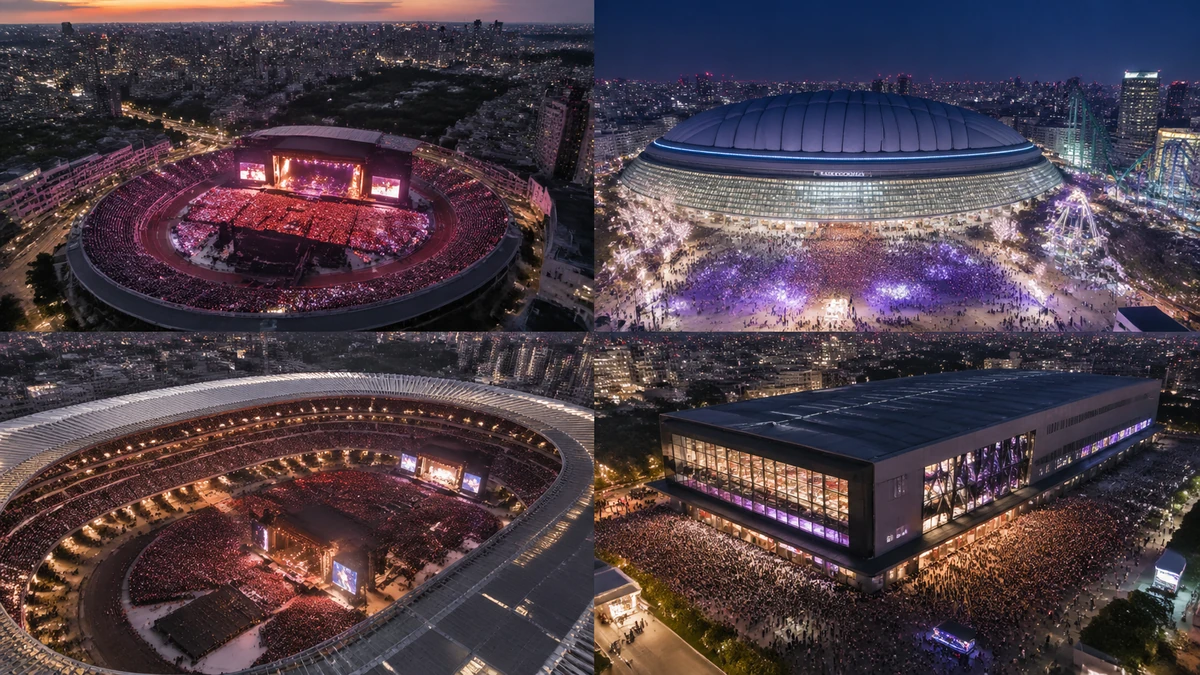
For one weekend, some of Tokyo’s biggest stages looked less like a local concert calendar and more like a live map of the Korean Wave’s staying power. TVXQ filled Nissan Stadium. Aespa packed Tokyo Dome. TWICE drew crowds at Japan’s National Stadium. DAY6 brought fans into Keio Arena. Taken together, the concerts drew more than 400,000 people, according to South Korean media reports — a number large enough to signal something bigger than a strong run of ticket sales.
What mattered was not only the crowd count, but the concentration. In one of the world’s largest cities, across a single weekend, multiple South Korean acts occupied the most symbolic tiers of the live entertainment business at once: stadiums, domes and arenas. In American terms, it would be as if a single foreign pop industry managed to dominate the same weekend in New York or Los Angeles, filling venues comparable in cultural weight to MetLife Stadium, Madison Square Garden and SoFi Stadium, all while drawing fans across generations and styles.
That scale is what makes the moment significant. K-pop has long since moved beyond novelty in Japan, but the Tokyo weekend offered an unusually visible snapshot of its current muscle. This was not one breakout star cashing in on a hot streak. It was several acts, from different eras and with different audiences, proving that demand is broad enough and stable enough to sustain multiple large-scale shows at the same time.
For Americans who mostly encounter K-pop through Billboard charts, Coachella clips or viral social media moments, the image of Seoul-made pop taking over Tokyo can seem like just another sign of global fandom. But in East Asia, and especially in Japan, these concerts carry a deeper meaning. They reflect not only cultural popularity, but a quarter-century of careful industry building, fan cultivation and cross-border entertainment ties that have outlasted trends, political tension and repeated predictions that the Korean Wave had peaked.
If anything, this weekend in Tokyo suggested the opposite. K-pop in Japan is no longer best understood as a boom. It looks more like an institution.
Why Japan matters so much
Japan is not just another stop on the global touring circuit. It is widely regarded as the world’s second-largest music market after the United States, and success there has long been one of the clearest tests of whether a pop act can translate buzz into durable business. In practical terms, Japan offers something every entertainment company wants: a large consumer base, a mature concert culture, strong physical and digital music sales, and fans willing to spend on repeat live experiences.
That is why the Tokyo weekend stood out. Filling one major venue in Japan is a career milestone. Filling several of them at once, across multiple acts from the same country, suggests a market deep enough to support K-pop not as a niche import but as part of the mainstream entertainment landscape. The important question is no longer whether one Korean act can make it big in Japan. It is whether an entire ecosystem can keep generating demand across different groups, generations and formats. The answer, at least last weekend, looked like yes.
The venues themselves tell part of the story. Stadiums represent the broadest kind of mass appeal — the kind associated with top-tier superstars who can attract casual listeners as well as devoted fans. Domes often signal intense fan concentration and reliable ticket power. Arenas can showcase acts that may not have the largest footprint but still command a dedicated, high-value audience. Seeing K-pop active across all three tiers at once showed a genre functioning not as a one-size-fits-all product, but as a layered entertainment market with room for different levels of fame, different sound palettes and different fan habits.
That diversity matters for longevity. A market built around one sensation can collapse when the public moves on. A market built around many artists with distinct identities is harder to shake. In Tokyo, TVXQ represented the long arc of fandom accumulation; Aespa brought the kind of performance-heavy spectacle that defines today’s K-pop; TWICE showed broad mainstream friendliness; and DAY6 highlighted that the Korean Wave is not limited to idol dance acts but includes bands with strong live appeal. Together, they made a stronger argument than any one concert could have on its own.
From BoA to today: 25 years of the Korean Wave in Japan
To understand why this matters, it helps to go back to the early 2000s. In South Korean media, the current moment is often framed as part of “25 years of Hallyu,” the Korean Wave — a term used to describe the international spread of Korean popular culture, from music and television dramas to film, fashion and beauty. One key early turning point in Japan came with BoA, the South Korean singer who entered the Japanese market in 2001 and reached the top of the Oricon charts in 2002. At the time, that success was treated as a breakthrough. Looking back, it also looks like the beginning of a durable pipeline.
For American readers, BoA’s role may be easiest to understand as part pioneer, part proof of concept. She showed that Korean artists could do more than make a brief splash abroad. They could localize, promote, compete and build a real fan base in a sophisticated neighboring market. Since then, wave after wave of performers — from first- and second-generation idols to today’s global chart contenders — have expanded what Korean pop can mean in Japan.
That history matters because the weekend in Tokyo was not built overnight. It rests on years of fan education, media exposure, language learning, touring routines and emotional investment passed across age groups. In some cases, parents who first encountered Korean entertainment in the early 2000s are now attending concerts with their children. That kind of intergenerational handoff is one of the clearest signs that a trend has matured into culture.
Longevity also changes the nature of success. Early on, the key question was whether Korean pop could break into Japan. Now the more important question is how it keeps renewing itself without losing the fans who helped build it. That requires more than a hit single. It requires trust, consistency and a sense that fandom is rewarded over time.
That is one reason fan testimony quoted in Korean coverage resonates. One concertgoer who attended TVXQ’s stadium show with her daughter said the artists seem to treat fans with sincerity on a regular basis, not only when they are promoting something. That may sound simple, but it points to a core engine of K-pop’s international durability: the idea that being a fan is not a passive act of consumption, but an ongoing relationship.
Different generations, same heat
One of the most revealing parts of the Tokyo weekend was the coexistence of different eras of K-pop on equal footing. TVXQ, whose Japanese career stretches back more than two decades, represented the depth of accumulated loyalty. Aespa, by contrast, embodied the high-impact, visually sophisticated present tense of K-pop performance culture. Both generated major excitement in the same city on the same weekend.
That overlap matters because it challenges a common assumption about pop music: that it is relentlessly youth-driven and therefore quick to discard its past. K-pop certainly depends on freshness, but in Tokyo it also demonstrated archival strength. TVXQ’s draw cannot be explained away as nostalgia alone. Reports from related coverage said the group brought in about 130,000 fans over two days at Nissan Stadium, around the time of its 21st Japanese debut anniversary. That kind of turnout suggests not just reverence for a legacy act, but present-day relevance — the ability to turn years of memories into current demand.
Aespa’s show at Tokyo Dome illustrated a different kind of power. Coverage described nearly 47,000 fans singing along to Korean lyrics as the group ran through songs including “Supernova,” “Next Level,” “Whiplash” and “Drama,” backed by live band elements and elaborate lighting. For anyone still tempted to reduce K-pop to carefully managed digital content, scenes like that are a reminder that the genre’s strength is increasingly live and physical. The choreography, visuals and fan participation are not side products. They are central to the experience.
Put those two acts side by side and a broader pattern emerges. K-pop’s generational shift is not happening through abrupt replacement. It is happening through accumulation. Older acts remain powerful while newer ones expand the genre’s reach and vocabulary. In business terms, that is healthier than a winner-take-all model. In cultural terms, it suggests the Korean Wave has grown layers rather than shedding them.
Americans have seen versions of this dynamic in other genres. Country music can support legacy stadium acts and rising crossover stars at the same time. Latin music now spans regional Mexican, reggaeton, pop and legacy performers across different age bands. K-pop in Japan appears to be reaching a similar level of internal diversification, where one label no longer describes one sound or one fan type.
How Gen Z helps turn concerts into a mass market
Another key detail in the Korean coverage involved younger listeners: about 39% of Japan’s Gen Z listens to K-pop, according to the reporting cited in the source material. Even without a fuller methodology, the figure points to something crucial. The energy inside the arena is linked to listening habits outside it. K-pop is not surviving only through formal fan clubs or hard-core collectors. It is embedded in everyday music consumption among younger audiences.
That matters because a healthy concert economy depends on familiarity before devotion. Casual listening creates a pool of potential ticket buyers. It allows fans to move from one group to another, or from streaming a hit to deciding a live show is worth the cost. It also means multiple acts can benefit from a general openness to K-pop, rather than each having to build awareness from scratch.
In the United States, the modern concert business has become increasingly dependent on blockbuster events, premium pricing and social media visibility. Japan’s K-pop market is showing another model: one where repeated exposure through daily listening supports a wider field of artists, who in turn sustain a thick live ecosystem. If young listeners are already comfortable hearing Korean lyrics in their playlists, then attending a concert by a Korean act becomes less of a cultural leap and more of an entertainment choice.
The image of Japanese fans singing along in Korean is also significant. K-pop has not erased the language barrier so much as transformed it into part of the fan experience. Learning key lyrics, chants and phrases becomes a form of participation. That phenomenon may feel familiar to American fans who sing along phonetically to songs in Spanish, Korean or Japanese, especially in an era when streaming and subtitled content have made language boundaries more porous. But K-pop has been especially effective at turning that participation into community.
This is one reason the genre has proved more resilient than skeptics expected. It is not only selling songs. It is selling belonging — a feeling of being part of a transnational audience with its own rituals, inside jokes, aesthetic codes and emotional vocabulary. That kind of attachment helps explain how more than 400,000 people can be spread across multiple K-pop concerts in one city over one weekend without the phenomenon feeling overstretched.
The business of care: why fandom management matters
None of this happens through music alone. K-pop’s long-term success in overseas markets has depended heavily on what industry insiders might call fandom management and what fans often experience as attentiveness. Frequent communication, polished events, exclusive content, fan meetings, language adaptation, carefully structured tours and an emphasis on reciprocity all help turn a listener into a loyal supporter.
That approach can sometimes sound clinical when described from the outside, but its effects are deeply emotional. The Korean coverage surrounding Tokyo emphasized the way artists are seen as responding sincerely to fans and, in some cases, treating them like an essential part of the group’s identity. In K-pop culture, fans are often framed not merely as customers but as participants — people whose chants, loyalty and visibility help complete the performance. If that sounds intense, it is. But it is also one of the reasons the system works.
TVXQ’s comments in related coverage underscored that mutuality. Max Changmin said it felt meaningful to share a special time with fans at a venue as large as Nissan Stadium. U-Know Yunho recalled seeing fans laugh and cry and feeling moved himself. Such remarks are common in pop, of course, but in K-pop they form part of a sustained narrative of closeness that stretches across albums, livestreams, variety appearances and tours.
For American readers, the best analogy might be the way certain legacy rock acts, country stars or boy bands maintain multidecade loyalty not simply through hits, but through the sense that fans have grown up with them. K-pop has industrialized that relationship-building to an unusual degree. The result is a fan base that is more likely to travel, buy repeat tickets, introduce the music to family members and stay engaged between major release cycles.
That emotional infrastructure may be less flashy than a viral dance challenge, but it is probably more important. A single hit can create awareness. A stable fandom creates a market.
What Tokyo says about K-pop’s next phase
The larger lesson from Tokyo is that K-pop’s global story is entering a more mature chapter. For years, headlines in the United States have often focused on firsts: the first Korean act to top a chart, sell out a venue, win a major award or break into a mainstream awards show. Those milestones were real and important. But they do not fully capture what sustainable cultural influence looks like.
Sustainable influence looks more like what happened in Tokyo: multiple acts, multiple audience segments, multiple venue sizes, all functioning at once inside a major foreign market. It looks like old and new groups coexisting. It looks like fans who do not see K-pop as an imported curiosity but as a normal part of their entertainment lives. It looks like a weekend where Korean pop does not just visit a city — it effectively occupies it.
There is also a regional dimension that should not be overlooked. Japan and South Korea have a complicated political and historical relationship, and cultural exchange between the two has sometimes been subject to shifts in public mood and diplomatic friction. The durability of K-pop in Japan, then, is not trivial. It suggests that popular culture can build its own channels of connection even when official relations are uneven.
That does not mean culture erases politics, or that entertainment should be romanticized as a cure-all. But it does show that audiences can form habits and attachments that outlast diplomatic cycles. In that sense, the Korean Wave’s endurance in Japan says something not only about music, but about how culture travels, adapts and embeds itself over time.
For now, the most striking image remains the simplest one: Tokyo, over one weekend, crowded with fans heading to different venues to see different Korean acts, each carrying a different piece of the same broader story. Twenty-five years after early pioneers helped open Japan’s doors to Korean pop, the genre is no longer asking whether it belongs there. The crowds have already answered.
Comments
Post a Comment