
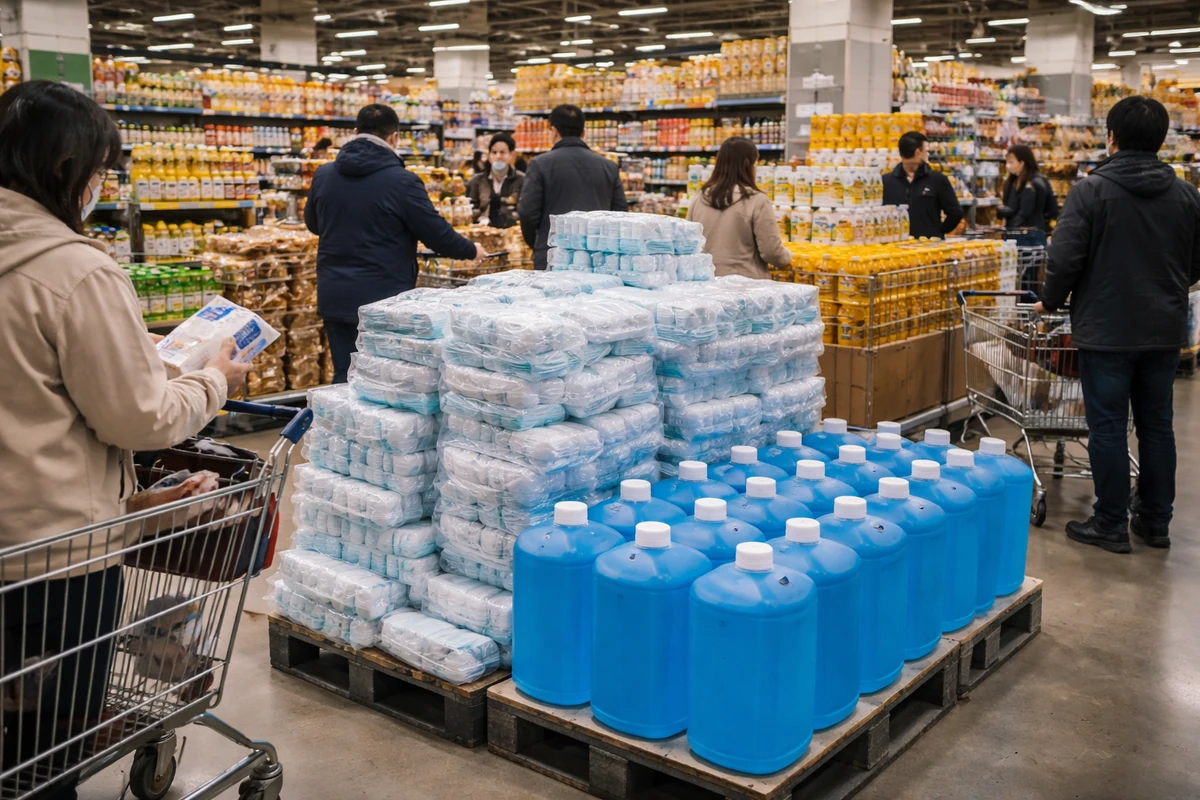
A familiar warning from Seoul carries broader economic weight
South Korea’s prime minister this week delivered what sounded, at first glance, like a brief and practical instruction to the bureaucracy: move early to prevent disruptions in the supply of everyday necessities. But in a country that still vividly remembers the scramble for face masks at the start of the COVID-19 pandemic and the 2021 shortage of diesel exhaust fluid that rattled the nation’s trucking system, the message landed as something much larger than a routine government reminder.
For American readers, it may help to think of this not simply as a warning about higher grocery bills or a temporary shortage of household products. It is closer to a government saying that the next economic shock may not begin on Wall Street, in interest rate policy or in a headline-grabbing bank failure. It may start in the shopping basket, the warehouse, the truck route or the online notice that says an item is suddenly out of stock.
According to South Korean officials cited in local reporting, the prime minister explicitly invoked the memories of the mask shortage and the urea solution crisis — two episodes that exposed how quickly modern supply chains can buckle when fear, dependence on overseas inputs and logistical bottlenecks collide. The government’s point was not only that prices matter. It was that supply itself has become a policy risk.
That distinction matters. Inflation is one thing; physical availability is another. Economists often debate the direction of interest rates, exchange rates and stock markets as macroeconomic indicators. But for ordinary households, confidence in the economy is formed less by Treasury yields than by what they see at the pharmacy, supermarket and delivery app. If consumers begin to suspect that essentials may become scarce, they do not wait for official data. They change behavior immediately — buying early, buying extra and spreading anxiety through social media and word of mouth.
That is the backdrop to Seoul’s renewed emphasis on “supply stability,” a phrase that in Korean policy language can sound technocratic but in practice refers to the government’s effort to keep daily life and industrial logistics running smoothly. In 2026, with South Korea facing a strong dollar, volatile commodity markets, possible shipping disruptions and weak consumer sentiment, officials appear increasingly concerned that even small supply tremors could produce outsized public anxiety.
Why the timing matters in late March
The timing of the warning is not accidental. Late March is a meaningful point in South Korea’s economic calendar. It is a transition period when seasonal demand begins to shift, companies manage end-of-quarter inventories and importers and retailers reassess purchasing plans for the next stretch of the year. In stable times, these are routine decisions. In uncertain times, they can amplify stress across the market.
South Korea is especially exposed to shifts in global trade because it is deeply integrated into international manufacturing and shipping networks. It imports a wide range of raw materials, energy and intermediary goods, then processes, assembles or distributes them through dense industrial and consumer channels. That means a jump in import costs, a delay at a port or a disruption in one seemingly obscure industrial input can ripple quickly into consumer prices and business expenses.
Americans got a version of this lesson during the pandemic, when shortages and shipping delays affected everything from baby formula to used cars to home improvement supplies. But South Korea’s economy, with its greater dependence on trade and its compressed urban logistics system, can sometimes feel those shocks faster and more visibly. When a disruption hits, it is not unusual for it to show up quickly in both industrial operations and daily household purchases.
That is one reason the government’s message deserves attention beyond the specific goods it may be monitoring. Officials are not just trying to prevent a shortage of one item. They are signaling that they are looking again at supply chains as a single, connected system — one that includes consumer staples, trucking inputs, warehouse capacity, import channels and public communication.
In practical terms, that means Seoul is likely less interested in old-fashioned price controls than in upstream risk management: identifying vulnerable import dependencies, watching inventories, monitoring wholesale-retail price gaps and intervening before public expectations spiral. In economic policy, that kind of expectation management has become increasingly important. A shortage does not have to be fully real to become economically damaging. The belief that one may be coming is often enough.
The mask crisis and the urea solution panic still shape policy
To understand why officials keep mentioning face masks and urea solution in the same breath, it helps to unpack what those crises represented.
The face mask shortage in the early months of COVID-19 was, in many ways, South Korea’s version of the toilet paper panic in the United States — but with much higher stakes. Masks in South Korea were not just a household precaution or political flashpoint. They became a public health necessity in one of the world’s most densely populated and highly urbanized countries. As demand exploded, distribution channels became chaotic. Consumers lined up, purchase limits were imposed and the government stepped in to direct public supply and manage sales channels.
The policy lesson was blunt: production capacity alone does not guarantee stability. A country can have factories capable of increasing output, but if distribution is confused, information is inconsistent and consumers feel they must race one another to secure supplies, the shortage becomes socially real even before output catches up.
The 2021 urea solution shortage taught a different but equally important lesson. Urea solution, known in South Korea as “urea water,” is not a household staple in the way rice, soap or diapers are. Many consumers had barely thought about it until it became scarce. But it is essential for many diesel vehicles equipped with emissions-control systems, including freight trucks. When supplies tightened, the problem was no longer confined to one industrial product. It threatened trucking, deliveries, logistics and ultimately the distribution of food and manufactured goods nationwide.
For readers in the United States, the closest analogy might be a sudden shortage of diesel exhaust fluid, semiconductors or another unglamorous input that most consumers never notice until shelves start emptying or shipping costs climb. These are the hidden components of modern economies: not flashy, not consumer-facing, but absolutely central to keeping goods in motion.
What made the urea crisis particularly alarming was South Korea’s dependence on imports tied to a narrow set of foreign suppliers. When overseas conditions changed, the domestic impact arrived faster than many had expected. It showed how a highly advanced economy can still be vulnerable to a choke point in one obscure commodity. That is the kind of vulnerability governments often miss until it becomes a national story.
Taken together, the two episodes explain why current officials are talking less about isolated price spikes and more about system resilience. The mask shortage symbolized breakdown at the consumer end of the chain. The urea shortage symbolized breakdown in the industrial and transport backbone. If both can happen, then “everyday necessities” can no longer be defined narrowly as only the items a household buys directly. The category now includes goods that keep the household economy functioning indirectly.
Why shortages hit consumers harder than the inflation statistics do
One of the clearest themes in South Korea’s renewed focus is that supply disruptions can affect public sentiment more intensely than headline inflation data. Anyone who has shopped regularly knows why. Consumers feel price changes most sharply in items they buy often: groceries, toiletries, cleaning products, diapers, over-the-counter medicine and basic prepared foods. A 5% increase in a refrigerator or washing machine may be economically significant, but many households will not feel it immediately because they do not make that purchase every week. A 5% increase in eggs, cooking oil or tissue paper feels personal almost at once.
That is why economists and policymakers pay close attention to what is sometimes called “perceived inflation” — the inflation people believe they are living through, regardless of what aggregate statistics say. In South Korea, as in the United States, that perception can drive consumer behavior. If families conclude that their shopping basket is becoming less reliable or more expensive, they tend to pull back elsewhere. Restaurant visits are delayed. discretionary purchases shrink. Sentiment sours.
And if the issue is not just higher prices but intermittent scarcity, the psychological effect can be even stronger. A household may tolerate gradual price increases more easily than uncertainty about availability. If consumers hear that a staple could soon become difficult to find, they often accelerate purchases, buy in larger quantities and store extra goods at home. That behavior, rational at the individual level, can make the broader market less stable.
This is one reason governments worry so much about hoarding and panic buying. The fear of shortage can create the shortage. In economic terms, expectations can become self-fulfilling. In political terms, shortages undermine trust. Citizens may forgive high prices if they believe the government is confronting a global problem honestly. They are less forgiving when it appears that officials failed to prepare for a foreseeable disruption in everyday life.
That dynamic is especially sensitive in South Korea, where public expectations for state competence are high and where digital communication spreads consumer anxiety rapidly. A rumor about an item running low can travel through messaging apps, online communities and e-commerce platforms within hours. Search spikes, sold-out notices and user posts can create a feedback loop. Even when total national inventories are not yet critically low, regional shortages or uneven information can create the lived experience of scarcity.
In that sense, the government’s warning is not just about goods. It is about confidence. Officials are trying to prevent a situation in which market instability migrates from supply data into public psychology.
Businesses are hearing a message about preparation, not panic
South Korean businesses, especially retailers, manufacturers and logistics operators, are likely reading the prime minister’s remarks as a call for peacetime preparedness. Supply chain crises are notoriously difficult to solve once they are visible to the public. By that point, inventories may already be tight, substitutes may be limited and consumer behavior may be distorting demand.
For large companies, the response may involve diversifying suppliers, increasing safety stock on vulnerable items, reviewing shipping routes and developing contingency plans for sudden import delays. In some cases, it could mean paying more upfront for flexibility later — a trade-off many global firms have reconsidered since the pandemic shattered the old assumption that lean, just-in-time supply chains were always the most efficient approach.
Retailers face a particularly complicated challenge. They do not just manage physical inventory; they manage consumer perception. In an era when many purchases begin online, a shortage can be amplified by the way stock information is presented. A “limited quantity” message, a sudden delivery delay or a string of out-of-stock notices can spread concern far beyond the actual size of the supply problem. Retailers may therefore need to think not only about replenishment but about how they communicate availability, whether they impose purchase limits and how they direct customers toward substitutes.
Small and midsize businesses are often more exposed than major conglomerates. Large firms typically have stronger procurement networks, larger inventories and more bargaining power with suppliers. Smaller distributors, neighborhood stores and independent manufacturers may have less room to absorb cost increases or wait out a disruption. If their input prices rise sharply, they often face a painful choice: raise prices and risk losing customers, or hold prices and see already thin margins disappear.
That is part of why supply stability has become a political issue, not merely a business issue. If policymakers focus only on big-box retail channels or large industrial importers, they may miss the points where pain is felt most acutely — local markets, regional logistics hubs and smaller firms that lack cushion. In any country, those are often the businesses that shape everyday consumer experience.
Increasingly, the best early warning system is data. Policymakers and firms alike want to know which inventories are shrinking, how long customs clearances are taking, whether wholesale and retail prices are diverging unusually and whether certain regions are seeing shortages before others. In the opening stages of a supply shock, official monthly statistics may arrive too late. Signals from freight movement, online searches, wholesale markets and distributor reports can matter more.
That is likely the direction South Korea is moving toward: a more data-driven form of monitoring that treats supply chains less as static infrastructure and more as a live system requiring constant surveillance.
What this says about the Korean economy in 2026
The government’s concern also reflects the broader economic moment South Korea is navigating. The country is contending with several pressures at once: exchange-rate strain, global raw-material volatility, lingering shipping uncertainty and soft consumer confidence. None of those problems is unique to Korea. But together they create a climate in which a disruption in basic goods can have an outsized effect.
A weaker local currency, for example, can raise the cost of imported commodities and intermediary goods. If those higher costs flow into packaging, transport or food processing, households may notice the effects quickly even without a dramatic spike in official inflation. If global shipping becomes less predictable, businesses may hold more inventory as a precaution, which raises costs further. And if consumers are already uneasy about the economy, they are more likely to respond strongly to even limited signs of scarcity.
This is one area where supply-side management can matter more politically than central bank policy. Interest rate decisions affect the economy broadly and over time. But supply disruptions in everyday goods hit fast and visibly. They shape how people talk about the economy at dinner tables, in office break rooms and on social media. If governments want to preserve credibility during periods of weak growth, keeping routine goods available can be as important as any macroeconomic speech.
There is also a strategic dimension. South Korea has spent years confronting questions about economic resilience, from semiconductor dependencies to energy imports to industrial materials sourced from a small number of countries. The new emphasis on everyday necessities suggests that officials are broadening that resilience conversation beyond headline industries. Economic security is no longer just about chips, batteries and defense-related technologies. It is also about detergent, processed food inputs, truck additives and basic household supplies.
That is a notable shift, and one that American policymakers may recognize. In the United States, supply chain debates that once centered on national security or big-ticket manufacturing have increasingly expanded to include pharmaceuticals, medical gear, infant formula and other everyday products. South Korea appears to be making a similar move: treating the mundane as strategic.
The deeper lesson: supply chains are now part of everyday politics
The prime minister’s warning ultimately reflects a broader truth about post-pandemic economics: supply chains are no longer an invisible back-office topic. They have moved into the center of public life and political accountability.
That shift carries implications well beyond South Korea. In advanced economies, consumers had grown used to assuming that basic goods would almost always be available. The pandemic, and the disruptions that followed, weakened that assumption. Governments learned that once public confidence in everyday availability is shaken, restoring it is costly and politically fraught. It requires not only finding supply, but also correcting misinformation, calming market behavior and proving that institutions are in control.
South Korea’s latest message suggests officials want to avoid learning that lesson again the hard way. By invoking masks and urea solution together, they are effectively saying that modern shortages come in different forms: some are obvious and consumer-facing, while others are hidden inside industrial systems until they suddenly affect everyone. Both must be managed early.
For American readers, the warning from Seoul should sound familiar. Whether the item is toilet paper, baby formula, eggs, diesel exhaust fluid or medicine, the principle is the same. A modern economy can look robust in aggregate and still be unexpectedly fragile in the details that structure daily life. And when those details break down, the consequences are not just economic. They are social and political as well.
That is why a short comment about everyday necessities in South Korea deserves more than a passing glance. It is a reminder that in 2026, one of the most consequential economic battlegrounds may not be an abstract chart or a central bank meeting. It may be the ordinary supply chain — the one that connects ports to trucks, warehouses to stores and government credibility to the simple expectation that what people need will still be there when they go to buy it.



0 Comments