A 7.7 Earthquake Off Japan’s Northeast Coast Revives Old Fears and Tests a Disaster System Built for the Next Shock
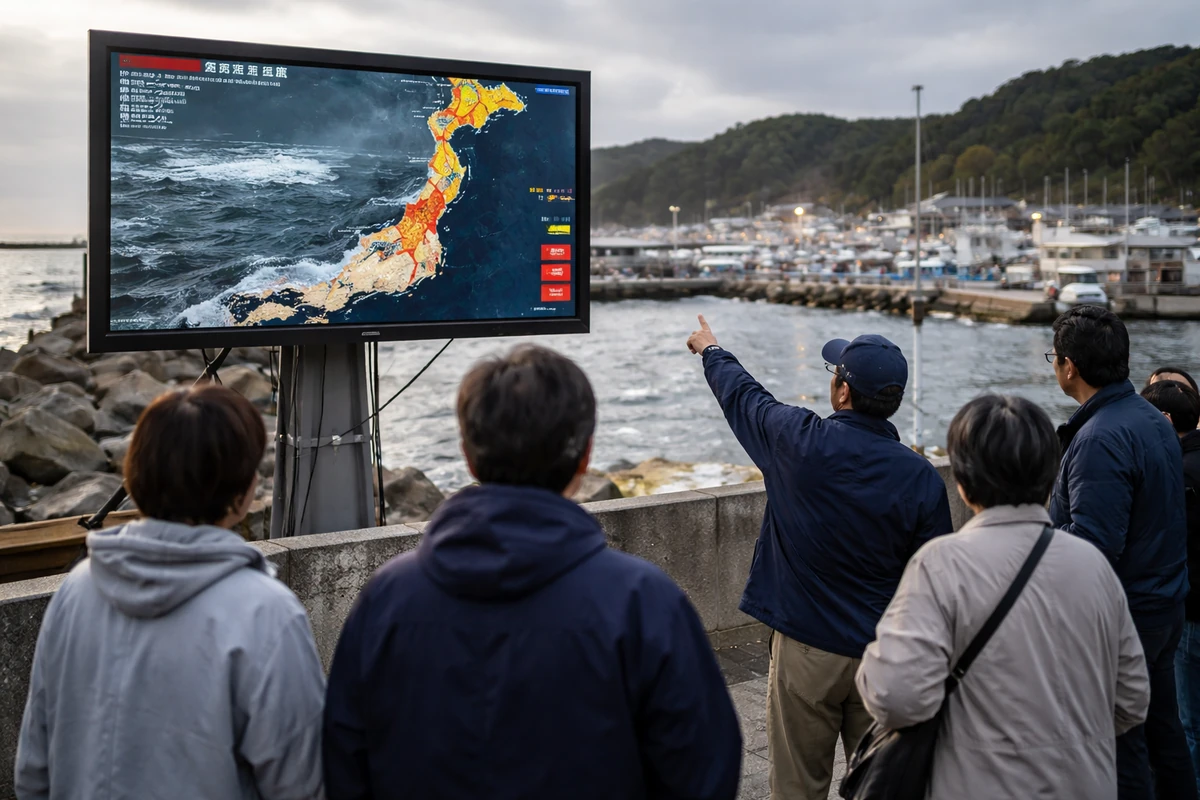
A powerful offshore quake shakes a region that knows the stakes
A powerful earthquake off the east coast of Japan’s main island on April 20 has once again pushed the country’s disaster readiness into the spotlight, rattling residents far beyond the immediate impact zone and reviving a familiar fear in the nation’s northeast: that one major quake may not be the end of the story.
The earthquake struck at 4:52 p.m. local time in waters east of Honshu, according to Japanese authorities. The Japan Meteorological Agency initially reported the quake at magnitude 7.4 before revising it upward to 7.7, with a depth of about 20 kilometers, or roughly 12 miles. The epicenter was located about 134 kilometers, or 83 miles, southeast of Hachinohe in Aomori prefecture.
In the United States, a quake of that size would immediately command wall-to-wall coverage, and for good reason. A magnitude 7.7 event is large enough to raise fears not only of structural damage but also of dangerous sea surges, transportation disruptions and prolonged aftershock activity. In Japan, however, the public conversation tends to move even faster into a second phase: What comes next?
That question matters especially in northeastern Japan, where memories of past disaster are never far from the surface. The region includes parts of the Sanriku coast, an area deeply associated with tsunami risk and with the traumatic legacy of the 2011 earthquake and tsunami that devastated communities, crippled infrastructure and triggered the Fukushima nuclear disaster. Even when the latest quake does not immediately produce catastrophic damage on that scale, it is understood through that history.
That is why this earthquake is being treated not simply as a one-time jolt, but as a warning sign in a country where seismic danger often arrives in clusters. Japanese officials moved quickly to frame the threat in those terms, stressing not only the current event but the possibility of another major earthquake in the days ahead. For a nation that has spent decades refining one of the world’s most sophisticated disaster response systems, the challenge is no longer just surviving the first shock. It is maintaining public trust, speed and discipline when the possibility of a second one hangs over daily life.
Tsunami warnings underscored how quickly normal life can freeze
Shortly after the quake, authorities issued tsunami warnings for the Pacific coast of Hokkaido and parts of Aomori and Iwate prefectures. Initial forecasts warned that tsunami waves could reach as high as 3 meters, or nearly 10 feet, before that estimate was later lowered to 1 meter, about 3 feet.
To many American readers, a reduction from 3 meters to 1 meter might sound like a sign that the danger had mostly passed. But that is not how tsunami response works, and it is not how Japanese officials or coastal residents experience those moments. The most important period is often the stretch between the first alert and the later adjustment, when governments, rail operators, schools, hospitals, fishing ports and ordinary households must act quickly based on incomplete information.
Emergency officials generally err on the side of caution in the immediate aftermath of a large offshore quake. That means initial warnings are often designed to prompt immediate evacuation and operational shutdowns before the full picture is clear. In practical terms, that can mean trains halted or delayed, roads congested, harbors shut down, businesses closed and residents moved away from low-lying areas with little time to spare.
Japan’s warning system is widely regarded as one of the most advanced in the world, but sophisticated forecasting does not make the social burden disappear. In some ways, it makes visible just how much coordination is required. A tsunami warning is not merely a technical bulletin about wave height. It is a stress test of how rapidly local governments can relay information, how seriously the public takes the order and how much economic disruption communities can absorb while waiting for the all-clear.
That is particularly true in Hokkaido, Aomori and Iwate, where coastal economies are tied closely to fishing, shipping and local commerce near the water. Even relatively modest tsunami conditions can threaten ports, disrupt supply chains and force precautionary evacuations. In rural and aging communities, where a large share of residents may be older adults, the logistics of evacuation can be especially complicated.
The lowered tsunami estimate did reduce some immediate alarm. But in Japan, that kind of revision does not erase the tension that comes with the first warning. It simply marks a transition from acute fear to uneasy watchfulness, with residents and officials still asking whether the latest reading is final and whether another offshore rupture could reset the entire calculation.
The most important warning may be about the next earthquake, not the last one
The central story in Japan’s response has not only been the quake itself but the official warning that another large earthquake could follow. The government reissued special caution information connected to the waters off Hokkaido and the Sanriku coast, reflecting concern that the region may face what Japanese authorities describe as a risk of a subsequent major earthquake.
The Japan Meteorological Agency warned that an earthquake of similar strength could occur within about a week, and called for heightened preparedness across 182 municipalities in seven prefectures in northeastern Japan, including Hokkaido, Iwate and Aomori. That is a sweeping geographic and administrative footprint, and it signals that authorities are thinking beyond the epicenter. The concern is not just one harbor or one city block. It is a broad living region that may need to operate under sustained alert.
This is an important distinction for audiences outside Japan. In the U.S., people are familiar with aftershocks after a major quake, especially in states such as California or Alaska. But Japan’s language around a “subsequent” or “follow-on” large earthquake carries an especially heavy social meaning. It implies that the country is not just tracking routine aftershocks. It is preparing for the possibility that another major event could strike while the first one’s consequences are still unfolding.
That framing changes everything. Schools may review dismissal and shelter procedures. Rail lines may operate more cautiously. Municipal officials may recheck evacuation routes and emergency stockpiles. Ports and coastal facilities may maintain restrictions longer than they otherwise would. Medical systems may move staff and supplies into standby mode. Families may sleep more lightly, keep emergency bags close by and hesitate to travel.
The psychological burden of this kind of warning is significant. Residents are asked to take the threat seriously, but they are also asked to carry on with work, school and caregiving responsibilities. That is a difficult balance in any society. In Japan, where disaster drills and public compliance are generally strong, the challenge often lies not in getting people to understand the warning, but in sustaining alertness without tipping into exhaustion or resignation.
Officials know that a public can become both highly vigilant and emotionally worn down at the same time. If people hear repeated alerts, they may react quickly one day and more slowly the next. That tension between preparedness and fatigue is one of the hidden vulnerabilities in modern disaster management, and it is one reason this earthquake has become more than a geologic event. It is now a test of endurance for the systems and habits built to confront repeat danger.
Shaking in Tokyo showed how a distant quake becomes a national event
Even though the earthquake occurred off northeastern Honshu, tremors were felt in Tokyo, a reminder that large quakes in Japan rarely remain local in their emotional impact. Reports described visible fear among train passengers as the shaking spread to the capital region, an image that resonates in a country where daily life depends heavily on dense, precisely timed public transit networks.
For American readers, one useful comparison may be the way a major storm can affect places far from landfall. A hurricane that strikes the Gulf Coast can trigger fuel concerns in the Southeast, flight disruptions nationwide and a broader sense of anxiety along the Eastern Seaboard. In Japan, a major earthquake can function similarly, except with far less warning and with a more immediate physical jolt. When office towers sway, trains slow or stop, and phone alerts begin sounding across multiple regions, the event becomes national almost instantly.
The train scenes matter because Japanese railways are often seen as symbols of order, punctuality and reliability. In ordinary times, they represent one of the clearest examples of the country’s precision and discipline. During an earthquake, however, that same enclosed and tightly organized system can become a space of vulnerability. Passengers may not know whether the train will stop, how long service will be delayed or what conditions exist outside the station network. The fear is not abstract. It is immediate, physical and shared in close quarters.
Japan has invested heavily in earthquake-resistant infrastructure, early warning systems and public education. Those investments save lives. But they do not eliminate the emotional shock of feeling the ground move beneath a city of millions. Tokyo residents understand, perhaps better than anyone, that being far from an epicenter does not guarantee calm. It means only that the consequences may take a different form: transport paralysis, communication overload, shortages, cascading disruptions and the revived memory of earlier disasters.
That psychological component is a critical part of the story. Large earthquakes in Japan are not judged solely by collapsed buildings or casualty counts in the first hours. They are also measured by how long uncertainty lingers and how deeply the event penetrates daily routines. A tremor felt in Tokyo can alter the mood of the country, especially when paired with official warnings that another major quake may follow soon.
In that sense, the April 20 earthquake did something more than shake buildings. It touched a national nerve. It reminded residents of a basic reality of life on the Japanese archipelago: that stability can feel absolute until, in a matter of seconds, it does not.
Japan’s disaster response system is built around speed, but speed brings its own strain
If there is one word that defines Japan’s initial response to a major earthquake, it is speed. Within a short span of time, authorities identified the offshore location, revised the magnitude upward, issued tsunami warnings, adjusted those warnings as more data came in and reactivated broader caution information about the risk of another large earthquake in the region.
That pace is not accidental. It reflects years of institutional learning in a country where delays can cost lives. In the early stages of any disaster, officials often do not have perfect information. What they do have is a narrow window in which to encourage evacuation, halt vulnerable systems and put emergency services on notice. Japanese authorities generally choose fast warnings over complete certainty, a strategy that can look abrupt but is rooted in hard-earned experience.
Still, rapid alerts create their own problems. Every warning sets off a chain reaction. Local governments must decide how aggressively to push evacuation orders, how to manage public facilities, how to coordinate with hospitals and schools, and how to communicate with residents who may be elderly, isolated or difficult to reach. Transportation agencies must weigh safety against the enormous pressure to keep people moving. Businesses must decide whether to close, for how long and under what threshold of risk.
The timing of this earthquake — late afternoon, as many people were nearing the end of the workday — likely added to the complexity. In any major metropolitan area, that is a sensitive hour. Commuter traffic is rising. Schools are in transition. Offices are still occupied. In Japan, where many commuters rely on trains, a disruption at that time can ripple quickly through urban and suburban life. Crowded stations, delayed departures and uncertain routing can magnify stress even in areas that avoid serious physical damage.
This is where disaster response becomes not only an infrastructure issue but an administrative one. A seawall, an early warning app or a quake-resistant building is only part of the equation. The rest depends on governance: who makes decisions, how fast they are transmitted, whether the public understands them and whether institutions from city halls to hospitals can adapt in real time.
Japan’s system is often admired abroad because it combines advanced technology with ingrained public habits, including regular drills and a broad social understanding that evacuation orders should be taken seriously. But no system, however polished, is free from trade-offs. Every rapid alert can bring false reassurance later if the impact turns out milder than feared. Every prolonged caution period risks public fatigue. Every service shutdown imposes real financial costs. The strength of the system lies not in eliminating those dilemmas but in managing them better than most countries can.
For northeastern Japan, resilience is not a slogan. It is a way of living with repeated risk
The deeper significance of this earthquake lies in what it reveals about life in a society where disaster is not viewed as a rare interruption but as a recurring condition. Northeastern Japan has spent years rebuilding, adapting and remembering. Communities there know that resilience is not just about reconstruction after a headline-grabbing catastrophe. It is also about absorbing repeated shocks that may be smaller, less globally visible and yet still deeply destabilizing.
That reality can be difficult for outside audiences to grasp. In the United States, national attention often peaks around a disaster and fades as soon as immediate rescue gives way to cleanup. In Japan, particularly in regions marked by earthquake and tsunami history, the cycle is more continuous. Recovery and vigilance are often happening at the same time. A town can be open for business, sending children to school and moving freight through its port while still carrying evacuation maps, trauma memories and household emergency kits as part of daily life.
This latest earthquake fits squarely into that pattern. The most striking issue is not necessarily whether this single event becomes a historic disaster by itself. It is whether the systems, habits and nerves of the region can withstand another period of layered uncertainty: shaking, warnings, revisions, transport disruptions, official caution notices and the possibility of another major tremor before the week is out.
There is also a broader lesson here for other countries facing climate-related and geologic threats. Preparedness is often discussed in abstract political language, but on the ground it means something more mundane and more demanding: getting people to move quickly, trust institutions, tolerate inconvenience and stay alert longer than they want to. Japan’s experience shows both the value and the limits of that model. It demonstrates what a highly prepared society can do, but it also shows that no amount of planning fully removes fear, fatigue or uncertainty.
For now, the earthquake off northeastern Honshu stands as a reminder that Japan’s greatest disaster challenge is not simply the power of the earth beneath it. It is the need to remain ready for the next strike before the current one has fully faded. The revised 7.7 magnitude, the tsunami warnings, the tremors felt in Tokyo and the reissued caution about a possible follow-up quake all point in the same direction: this was not just a test of structures and sensors. It was a test of collective stamina.
And in Japan, especially in the northeast, that may be the hardest test of all.
Comments
Post a Comment