
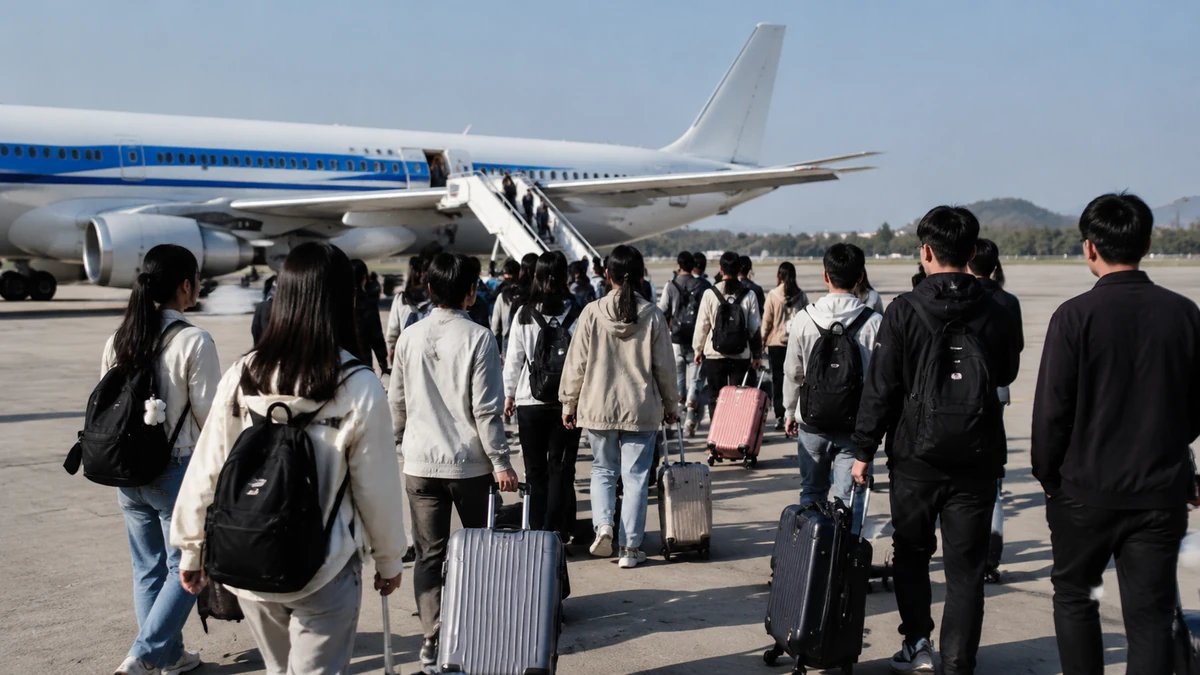
A small airport arrival with outsized meaning
In most countries, a group of international students arriving at an airport would barely register as news. In North Korea, it is different. A report that Chinese government scholarship students landed in Pyongyang on May 9 to begin their studies is being read by regional observers as something much larger than a routine education update. It is a rare public sign that one of the world’s most closed states is continuing a tightly controlled reopening to the outside world — and that China remains at the center of that process.
According to information publicized by the Chinese Embassy in North Korea through its WeChat account, the students were welcomed on arrival not only by embassy education officials but also by representatives from North Korea’s Education Ministry and from two major institutions: Kim Il Sung University and Kim Hyong Jik University of Education. That level of official reception matters. It suggests this was not a private academic trip or an informal exchange, but a state-managed, institutionally coordinated program operating through approved diplomatic and educational channels.
For American readers, it may help to think of this less as a campus international office greeting exchange students and more as a delegation arrival with political meaning. In North Korea, movement across the border is closely monitored, and foreign access is especially sensitive. When students enter the country under a formal scholarship arrangement and are publicly welcomed by multiple state-linked bodies, the event becomes a clue about how the government is calibrating openness, trust and control.
The development also says something important about the kind of contact Pyongyang is willing to permit. North Korea has not thrown open its doors after years of near-total pandemic isolation. Instead, it appears to be reopening in narrow, carefully selected ways: through trusted partners, formal institutions and programs the state can supervise closely. Chinese scholarship students fit that model almost perfectly.
That is why this story, while modest on its face, is drawing attention far beyond education circles. It offers a concrete scene — identifiable students, a specific arrival date and named universities — that helps analysts see how North Korea’s external engagement is functioning in practice rather than in theory.
Why student movement matters in a country as closed as North Korea
North Korea is often covered in the United States through the lens of missiles, nuclear negotiations and sanctions. Those subjects remain central, and for good reason. But they are not the only way to understand the country. In a place where so little is visible, even seemingly ordinary forms of exchange can reveal how the state works and what it prioritizes.
That is especially true when it comes to people crossing the border. In most of the world, student mobility is a marker of globalization, opportunity and soft power. In North Korea, it is also a barometer of state confidence and administrative control. Who is allowed in, under what terms and through which institutions can tell us a great deal about the regime’s view of risk.
The fact that these students were reportedly Chinese government scholarship recipients is key. This was not backpack tourism, independent study abroad or a private university partnership of the sort Americans might associate with semester exchange programs. It was a government-backed arrangement involving a country that remains North Korea’s most important diplomatic and economic partner. That makes the movement more predictable, more manageable and, from Pyongyang’s perspective, more politically safe.
There is also symbolic value here. Education exchanges do not generate the same headlines as summits or military tests, but they can be more durable. Students spend months or years in institutions. They build networks. They absorb messages. Governments understand this. During the Cold War, the United States and the Soviet Union both invested heavily in educational and cultural exchange because it created influence that lasted longer than a single speech or meeting. China’s scholarship system, in a different context, can serve a similar function.
For North Korea, allowing such students in does not necessarily signal liberalization in any broad sense. It does, however, suggest that the country wants some channels of external contact to function again. And it is choosing those channels with extreme care.
A measured reopening after years of pandemic isolation
The timing of this development matters almost as much as the arrival itself. North Korea imposed some of the harshest border restrictions in the world during the COVID-19 pandemic, effectively sealing itself off for years. Even after other countries resumed travel, trade and education exchanges, Pyongyang moved far more slowly. That made the border not just a public health issue, but a test of the regime’s willingness to reengage internationally.
By 2024, North Korea had reportedly resumed receiving foreign students, including a group of 41 Chinese state-sponsored students. The new arrivals in Pyongyang appear to extend that trend rather than mark a one-time exception. In other words, this is not simply an isolated airport scene. It is evidence of a reopening pattern that began earlier and is continuing under controlled conditions.
That distinction is important. A single event can be dismissed as symbolic. A repeated process is harder to ignore. If students are arriving in consecutive cycles through the Chinese government scholarship framework, then North Korea is not just experimenting with openness; it is maintaining a structured channel for it.
Still, it would be a mistake to overread the move. Reopening, in the North Korean context, does not mean normalizing. The country is not suddenly becoming accessible to broad swaths of foreign visitors, researchers or journalists. It is not inviting the kind of international academic environment familiar at American universities, where students from dozens of countries mix freely and campus life is relatively autonomous. The North Korean model is likely the opposite: limited, supervised and integrated into state priorities.
That controlled approach fits a broader pattern in North Korean governance. The regime has often shown that it is willing to allow contact with the outside world when it can define the terms. Trade, diplomacy, labor and education all tend to follow that logic. The door may open, but only partway, and only for approved guests coming through approved institutions.
For outside governments and analysts, these steps can offer a more realistic sense of North Korea’s posture than rhetoric alone. Grand statements from Pyongyang are often designed for political effect. The arrival of students, by contrast, shows logistics, coordination and actual implementation. It is a quieter but in some ways more reliable indicator of what the government is prepared to allow.
China’s role goes beyond diplomacy
The story also underscores a reality that often gets flattened in U.S. coverage: China’s relationship with North Korea is not only about security and sanctions. It is also about infrastructure, institutions and long-term influence. Education exchanges are part of that ecosystem.
China is North Korea’s principal trading partner and its most consequential political patron, even when relations are uneven. Beijing does not always get what it wants from Pyongyang, and the two governments do not agree on every issue. But when North Korea needs a stable external partner, China is usually first in line. That is true in commerce, border management, humanitarian logistics and, increasingly visibly, education.
A Chinese government scholarship carries a particular kind of weight. It means the students’ travel and study are embedded in an official system. Selection, funding and placement are not left to chance. For a country like North Korea, where unauthorized or poorly monitored contact with foreigners is deeply sensitive, that structure likely makes the arrangement acceptable.
There is a strategic aspect to this as well. Educational exchange can function as soft power — the kind of influence built not through coercion but through familiarity, training and institutional ties. Americans often hear that phrase in connection with Hollywood, U.S. universities or the Fulbright Program. China, too, has spent years trying to expand its educational footprint abroad. In North Korea, where outside influences are tightly filtered, even a modest scholarship pipeline can have outsized significance.
The fact that the news was announced by the Chinese Embassy in Pyongyang via WeChat is telling in its own right. WeChat, the all-in-one Chinese messaging and social media platform, is a central communications tool in China but less familiar to many Americans as a source of diplomatic signaling. Yet it has become a regular vehicle for Chinese embassies to release curated updates. In this case, the embassy’s announcement gave the event official confirmation without turning it into an overtly dramatic political statement. That understated style can itself be meaningful: it presents the exchange as normal, orderly and already underway.
In international affairs, normalization often happens exactly this way — not with a banner headline proclaiming a new era, but with a small bureaucratic notice showing that systems are working again. Flights are operating. Institutions are receiving people. The paperwork went through. A public welcome was organized. Those are the practical building blocks of state-to-state engagement.
What the universities tell us about North Korea’s priorities
Among the more revealing details in the report are the names of the North Korean institutions involved. Kim Il Sung University is widely regarded as the country’s most prestigious university, roughly analogous — with many obvious differences — to a top flagship institution at the center of a national system. Its role in receiving foreign students suggests that North Korea is placing this exchange within serious institutional channels, not treating the arrivals as ceremonial visitors.
The mention of Kim Hyong Jik University of Education is also notable. Teacher-training institutions occupy a special place in many political systems because they shape not just professional preparation but ideology, curriculum and future generations of students. In North Korea, where education is inseparable from state narratives and loyalty formation, that connection may be particularly important.
To American readers, those university names may sound distant and opaque. But in the North Korean context, naming them publicly gives the story more substance. It indicates that the students are being folded into specific academic structures and that those structures are visible enough for officials to identify them. That is different from vague claims of exchange or friendship. It points to an actual receiving apparatus.
It also highlights how North Korea manages contact through institutions that are firmly under state oversight. In liberal democracies, universities often act as semi-independent spaces where internationalization can happen from the bottom up through professors, departments and student initiatives. In North Korea, the flow is more likely top-down. Universities are part of the state system, and their participation signals that the exchange has political as well as educational approval.
That does not mean the students themselves are merely props. They may genuinely be there to study, build language skills, conduct research or participate in degree programs. But the broader point is that in North Korea, ordinary academic life and state management are not easily separated. The airport welcome involving embassy officials, ministry representatives and university personnel reflects that overlap clearly.
For observers trying to understand North Korea, those institutional details are valuable because they show where the regime is willing to place foreign presence. Not in the abstract, but in named, supervised locations. That helps sketch the architecture of a country that is otherwise difficult to see from the outside.
What this means for South Korea, the U.S. and the broader region
For South Korea, any sign of North Korea’s external engagement is worth watching closely, even when it is not explicitly political. Seoul has long had to interpret shifts on the peninsula using incomplete information, and developments outside the military sphere can offer early clues to broader changes. Student arrivals do not predict a diplomatic thaw by themselves, but they can help show how the North is balancing caution with selective openness.
For the United States, the significance is somewhat different. Washington’s North Korea policy is still shaped largely by nuclear deterrence, alliance coordination with South Korea and Japan, and the enforcement of sanctions. None of that changes because a group of Chinese scholarship students landed in Pyongyang. But policymakers and analysts who want a fuller picture of North Korea need to pay attention to lower-profile forms of exchange as well.
These human and institutional connections often reveal patterns that hard-security analysis alone can miss. They show which partners Pyongyang trusts, which sectors it is willing to reopen and how it uses nonmilitary channels to maintain international links. They also serve as a reminder that China’s influence in North Korea does not depend solely on headline diplomatic meetings. It is reinforced through routine mechanisms that may look mundane from afar but matter over time.
There is also a broader lesson here about how to read authoritarian states. Outsiders often search for dramatic turning points — the summit, the missile launch, the sanctions vote. Those moments matter, but they are not the whole story. Regimes also signal through administration. They reveal priorities in visa approvals, border procedures, educational placements and public messaging. A student arrival can therefore be more than a human-interest item; it can be a governance story.
That is particularly true on the Korean Peninsula, where the line between domestic control and foreign policy is often thin. North Korea’s decisions about who enters the country are never merely logistical. They are bound up with security calculations, ideological management and diplomatic strategy. The same is likely true here.
Not a dramatic opening, but a meaningful signal
It would be easy to either overstate or understate this moment. Overstating it would mean declaring that North Korea is opening up in some broad new way. The evidence does not support that. Understating it would mean dismissing the news as a routine academic exchange with little wider relevance. That would miss the point as well.
The significance lies in the middle. North Korea appears to be maintaining a narrow, state-supervised channel for Chinese educational exchange. The arrangement is structured, public enough to be confirmed and linked to named institutions. It follows earlier signs that the country has resumed receiving foreign students after pandemic-era isolation. And it reinforces a larger pattern: when North Korea reconnects, it does so selectively and on terms designed to preserve control.
For American readers accustomed to thinking about North Korea mainly through crisis coverage, this is a useful reminder that not every consequential development comes wrapped in dramatic rhetoric. Sometimes the important story is simply that a plane landed, students got off and officials from both governments were waiting.
That kind of scene may not dominate cable news or drive viral social media debate. But in a place where so little movement is visible, the fact of movement matters. It tells us that certain pathways into North Korea are functioning again. It tells us that China remains the partner most able to use them. And it tells us that education — quiet, bureaucratic and easy to overlook — is one of the arenas where the future shape of North Korea’s external relations may already be taking form.
In that sense, the arrival of Chinese scholarship students in Pyongyang is not just a story about who is studying where. It is a story about how a closed state manages contact, how a powerful neighbor sustains influence and how the rest of the world can read change not only in moments of confrontation, but in the carefully choreographed routines of everyday governance.



0 Comments