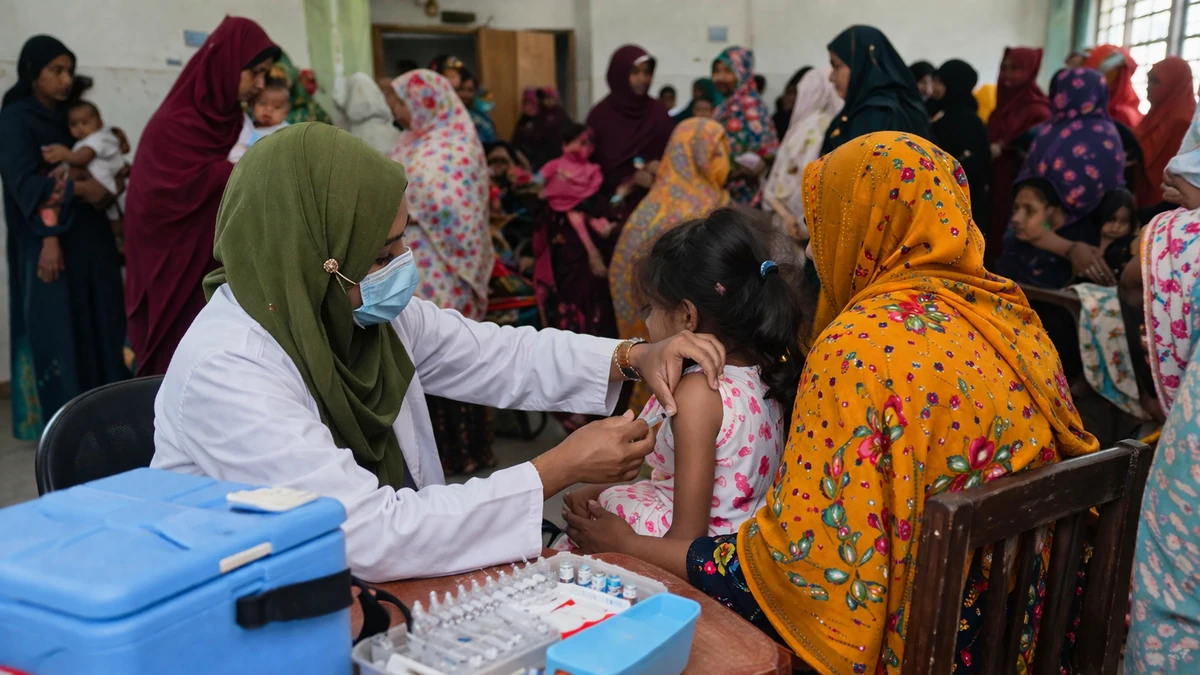
A preventable disease is killing again
Bangladesh is mounting an emergency vaccination campaign after a measles outbreak is believed to have killed more than 100 people, a stark reminder that one of the world’s most contagious diseases still exploits every weakness in public health systems. The reported death toll, while still described as an estimate rather than a fully verified official count, is high enough to signal something larger than a short-lived flare-up. It suggests sustained community transmission, missed opportunities for prevention and, likely, gaps in routine immunization that have been building for years.
For many Americans, measles can sound like a disease from another era — the kind of illness associated with black-and-white photos, pre-vaccine childhood and the public health victories of the mid-20th century. In the United States, widespread vaccination transformed measles from a near-universal childhood infection into a largely preventable disease. But recent outbreaks in the U.S. and Europe have already shown that the virus comes roaring back when vaccination rates slip. In lower-income countries, where health systems are under greater strain and where malnutrition, displacement and uneven access to care can make measles far more dangerous, the consequences can be deadly on a much larger scale.
That is what makes the Bangladesh outbreak more than a local tragedy. It is a warning about the fragility of global health gains, especially after the COVID-19 pandemic disrupted routine childhood immunization in many parts of the world. Bangladesh, one of the world’s most densely populated countries, sits at a crossroads of migration, commerce and humanitarian need in South Asia. When measles spreads there, it is not just a domestic health problem. It becomes a regional and international concern.
Officials’ move to launch emergency vaccinations is significant in itself. Public health authorities typically resort to such campaigns when normal immunization schedules are no longer enough to contain an outbreak. Measles spreads so easily — far more efficiently than many people realize — that once immunity gaps open up in a community, especially among children, cases can multiply with alarming speed. Emergency vaccination is designed to race ahead of that spread. But it also reflects a difficult reality: By the time such a campaign begins, the outbreak has usually already exposed deeper structural weaknesses.
The outbreak in Bangladesh is, in that sense, not only a health story but a systems story. It raises questions about access to vaccines, surveillance, treatment, nutrition, disaster preparedness and public trust. And it underscores a lesson public health experts have been repeating for years: Diseases do not need a new mutation or exotic origin story to become international headlines. Sometimes all they need is a lapse in basic protection.
Why measles remains so dangerous
Measles is sometimes misunderstood in countries where severe cases are uncommon. In wealthy settings with strong hospital systems and good baseline nutrition, it can be seen as unpleasant but manageable. That perception is misleading. Measles is not a harmless childhood rite of passage. It is a highly infectious viral disease that can trigger serious complications, including pneumonia, dehydration, encephalitis — a dangerous swelling of the brain — and, in some cases, death.
The virus spreads through the air and can linger in enclosed spaces after an infected person leaves. That makes it particularly hard to contain in crowded neighborhoods, schools, clinics, markets and transit hubs. Public health specialists often describe measles as a disease that quickly finds the unvaccinated. Because it is so contagious, preventing outbreaks requires consistently high immunization coverage across communities, not just acceptable national averages on paper.
That distinction matters. A country can post respectable vaccination numbers overall while still harboring local pockets of vulnerability. If certain neighborhoods, districts or social groups are routinely missed — because of poverty, displacement, geography, misinformation or weak health services — those communities can become ignition points for a wider outbreak. Measles does not care whether the national average looks reassuring if the local immunity gap is large enough.
In places where children are already vulnerable, the disease becomes more lethal. Malnutrition can worsen outcomes. Delayed treatment can worsen outcomes. Limited access to hospitals, antibiotics for secondary infections, oxygen support and basic hydration can worsen outcomes. So can a lack of timely diagnosis. This is one reason the estimated death toll in Bangladesh is so troubling. A death count in the triple digits points not only to viral spread, but also to the conditions that allow infections to become severe and fatal.
Americans have seen smaller versions of this lesson at home. In recent years, U.S. measles outbreaks have often spread through communities with lower vaccination coverage, sometimes because of vaccine hesitancy and sometimes because of barriers to access. Those episodes rarely resemble the scale or severity seen in lower-resource settings, but they illustrate the same core principle: Vaccines do not fail because the science stops working. Outbreaks happen when immunization systems leave too many people unprotected.
Why Bangladesh is especially vulnerable
Bangladesh faces a set of structural pressures that make infectious disease control especially challenging. It is one of the most densely populated countries in the world, and density changes the math of contagion. In packed urban settlements and low-income neighborhoods on the edges of fast-growing cities, an infected child can expose many others in a short period. Homes are close together. Families are large. Schools, markets and buses are crowded. Isolation is difficult. Contact tracing can quickly become overwhelmed.
Those vulnerabilities extend beyond the city. Rural areas may struggle with health care access, staffing shortages and transportation barriers. Families can miss vaccine appointments because clinics are too far away, because travel costs are too high, or because seasonal work and family obligations make repeat visits difficult. Measles protection usually depends on a sustained system that can reach children more than once, track who has been vaccinated and close gaps before they widen. That is not easy in any country, and it is especially difficult where resources are stretched.
Bangladesh also lives with recurring climate and disaster pressures. Flooding, storms and other emergencies can disrupt vaccine supply chains, damage clinics and force families into temporary shelters or crowded living conditions where infectious disease spreads more easily. Public health experts have long warned that disease prevention cannot be separated from infrastructure, housing and emergency preparedness. A vaccination program is only as resilient as the system around it.
Migration is another factor. South Asia sees extensive cross-border movement for work, family and humanitarian reasons. Bangladesh, in particular, occupies a region where population mobility is a constant reality, not an exception. That mobility can complicate vaccination tracking and follow-up care. When families move frequently, or when people live in informal settlements or camps, keeping records and ensuring second doses becomes far harder. Outbreak control depends not just on having vaccines, but on being able to find people, communicate with them and reach them repeatedly if needed.
There is also the broader demographic reality: Bangladesh has a large child population. That should be understood not as a liability in itself, but as a reminder of the scale of routine immunization required. A country with millions of children must maintain an enormous logistical operation simply to keep protection stable. Even a modest drop in coverage can translate into a large number of susceptible children. Over time, those children accumulate, creating the conditions for explosive spread.
The pandemic’s aftershocks are still being felt
It is difficult to understand the Bangladesh measles outbreak without looking at the long tail of the COVID-19 pandemic. Across the world, the pandemic interrupted routine childhood vaccinations, school health programs and basic primary care. Clinics closed or scaled back. Families delayed appointments. Health workers were redeployed. Public attention and public money shifted toward the emergency at hand. In some countries, vaccine misinformation also spread more widely during and after the pandemic, further complicating trust in public health campaigns.
Those disruptions did not disappear when the most acute phase of COVID-19 ended. They left behind what health experts often call immunity gaps — cohorts of children who missed one vaccine, missed a second dose, or aged into vulnerability without being caught up. Measles is one of the clearest diseases through which those gaps become visible. Because the virus is so contagious, even a few years of uneven immunization can produce outbreaks later on.
That is why this moment should be read as a delayed consequence as much as an immediate crisis. The Bangladesh outbreak may not simply be the result of a sudden breakdown in 2026. It may reflect several years of accumulated missed appointments, strained health services and hard-to-reach communities. In public health, cause and effect are often separated by time. A child who missed a routine vaccine years ago may only become part of an outbreak when enough other missed children create a chain of transmission.
This pattern is not unique to Bangladesh. International agencies have repeatedly warned that post-pandemic immunization recovery has been uneven across low- and middle-income countries. Some nations have made substantial progress in catch-up campaigns. Others continue to face financial pressure, staffing shortages, political instability or competing emergencies that make recovery slow. The result is a patchwork world: islands of strong coverage surrounded by districts where protection remains thin.
For American readers, there is a familiar analogy here. Think of a levee system after repeated storms. Even if a major breach is not visible every year, deferred maintenance and small weak points accumulate risk. Then one day, a predictable event causes catastrophic flooding. Measles works in a similar way. The virus is predictable. The outbreaks are, to a significant degree, predictable. What changes is whether public health systems have kept the protective barriers intact.
Emergency shots are necessary, but they are not the whole answer
The emergency vaccination drive now underway in Bangladesh is essential. In outbreak conditions, rapid immunization can save lives by protecting children who have not yet been exposed and by slowing further transmission. Such campaigns often focus on the highest-risk areas first: dense urban districts, underserved rural regions, informal settlements, refugee-hosting communities and places where routine coverage appears weakest.
But emergency vaccination alone is rarely enough. Public health authorities also need timely surveillance to determine where the outbreak is concentrated, who is getting sick and which communities are being missed. That requires reliable case reporting, laboratory support where available, field investigation and communication between local clinics and national health officials. If deaths are being counted as estimates rather than fully confirmed numbers, that can reflect the real-world difficulty of collecting data in the middle of an active outbreak.
Treatment capacity matters, too. Vaccination prevents future cases; it does not cure children who are already ill. Hospitals and clinics need the supplies and staffing to manage complications, especially pneumonia and dehydration. Nutritional support can be critical, especially for children whose health is already fragile. In lower-resource settings, the difference between a manageable outbreak and a mass-fatality event often lies in whether severe cases can be recognized and treated early.
Community trust may be just as important as logistics. Public health campaigns can stumble even when vaccine stocks are available if parents do not receive clear information, if clinics are too far away, or if daily survival takes priority over preventive care. In some communities, rumors and misinformation can discourage families from participating. In others, the obstacle is not skepticism but simple access: a parent cannot afford to lose a day’s wages, lacks transportation, or cannot navigate a confusing health system. From the outside, all of these may look like low uptake. On the ground, they are very different problems and require different solutions.
That is why experienced health responders often say vaccination campaigns succeed not just because of medicine, but because of delivery. The cold chain must work. The outreach teams must be trained. The messaging must be culturally and linguistically clear. The most vulnerable neighborhoods must be identified early rather than last. And follow-up is crucial, because a single emergency push cannot substitute indefinitely for a reliable routine immunization program.
Why the world should pay attention
There is a tendency in international news to treat outbreaks in lower-income countries as distant humanitarian episodes — tragic, important and somehow separate from the everyday concerns of readers in wealthier nations. That framing no longer fits the world as it is. International travel has rebounded. Global labor migration remains robust. Humanitarian crises cross borders. Disease surveillance in one country contributes to safety in another. What happens in Bangladesh will not stay relevant only to Bangladesh.
That does not mean Americans should panic about imported measles from one specific event. It does mean they should recognize that public health security is interconnected. Measles is a vaccine-preventable disease, but it is also a test of whether health systems are functioning well enough to reach children before infection does. When a country experiences a deadly outbreak, it exposes vulnerabilities that international institutions, donor governments and neighboring states cannot afford to ignore.
There is also a moral and economic case for paying attention. Preventing measles is generally far less expensive than responding to a major outbreak after the fact. Emergency campaigns, hospital care, aid mobilization and the broader social cost of illness all consume resources that could have been reduced through stronger routine immunization. Public health experts have made this argument for decades: prevention is not just more humane, it is more efficient. Yet prevention often struggles to compete politically with more visible crises.
That is especially true at a time when aid budgets are under pressure from wars, refugee emergencies, climate disasters and slowing economic growth. In that crowded field, a vaccine campaign can look unglamorous — basic, technical, easy to postpone. But measles outbreaks repeatedly show the cost of neglect. When a preventable disease kills at scale, it signals not only immediate suffering but a failure to sustain one of the most fundamental functions of public health.
For the broader Asian region, the outbreak also underscores how health risks travel along the same routes as commerce, labor and family ties. Cross-border coordination, information sharing and support for immunization systems are not acts of charity alone. They are part of regional stability. The same applies globally. An outbreak in South Asia should matter in Washington, London and Geneva not just because it is newsworthy, but because it reveals where the international safety net is fraying.
The lesson is bigger than Bangladesh
The immediate priority in Bangladesh is clear: contain the outbreak, protect children, treat the sick and get vaccines quickly to the communities most at risk. But the larger lesson reaches far beyond this one emergency. Measles is often described as a canary in the coal mine for public health. When it resurfaces, it usually means routine systems have weakened somewhere — not necessarily everywhere, but enough to let a highly contagious virus gain a foothold.
In that sense, Bangladesh is issuing a warning to the world. High national vaccination coverage figures are not enough if local gaps are ignored. Emergency response is not enough if routine immunization remains fragile. Vaccine supply is not enough if delivery systems, public trust and basic health care are weak. And outbreak control is not enough if the underlying drivers — poverty, displacement, urban crowding, malnutrition and disaster vulnerability — are left unaddressed.
For American audiences, the takeaway should be both global and local. Globally, the outbreak is a reminder that health security depends on sustained investment in systems that are easy to overlook until they fail. Locally, it should reinforce a truth the United States has had to relearn in its own measles flare-ups: vaccine-preventable diseases remain a threat wherever immunity erodes. No country is exempt from the biology of contagion. Wealth changes the odds of survival, but it does not eliminate the need for vigilance.
What happens next in Bangladesh will depend on how quickly the emergency campaign reaches vulnerable children, how accurately authorities can map the spread and how effectively treatment and surveillance systems can support the response. International agencies and donor governments will also be watching to see whether this outbreak becomes a short, contained emergency or a sign of deeper regional risk.
Either way, the message is already clear. Measles should not be killing children in large numbers in the 21st century. When it does, the problem is not just the virus. It is the accumulation of overlooked weaknesses that allowed the virus to win. Bangladesh’s outbreak is therefore not simply a national crisis. It is a global public health warning, arriving in the most painful way possible.
Comments
Post a Comment