Even Seoul’s Trophy Apartments Are Slipping as Taxes and Tight Credit Reshape South Korea’s Luxury Housing Market
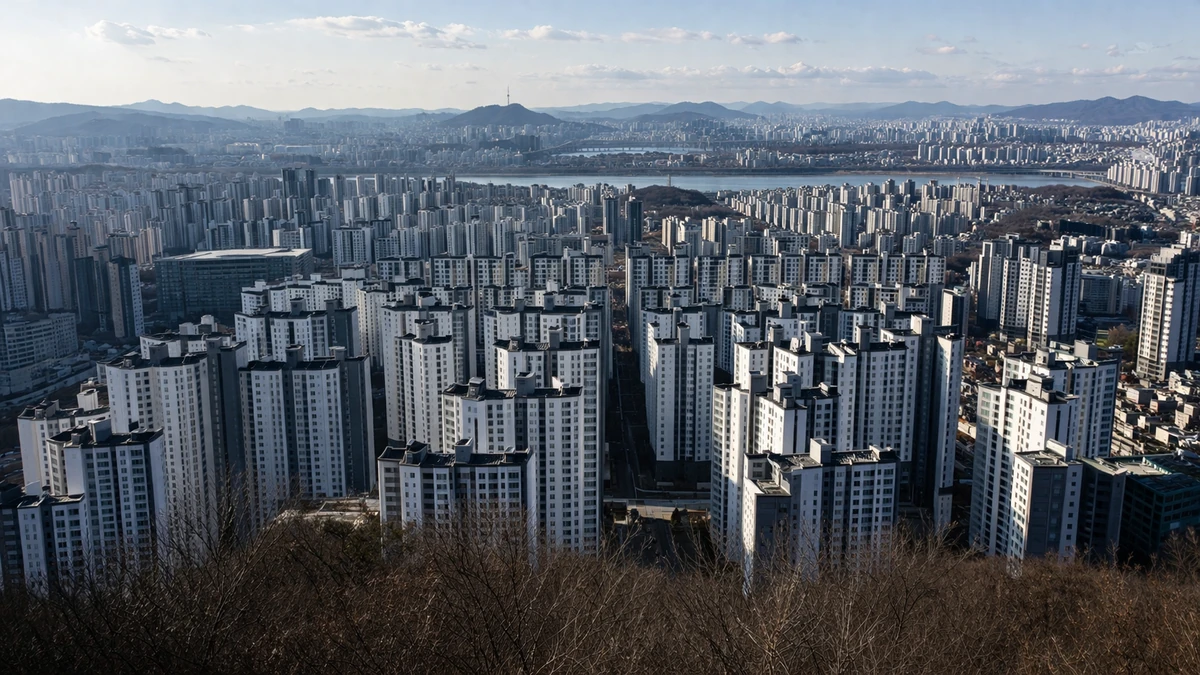
Seoul’s most coveted apartments are no longer immune
For years, South Korea’s luxury apartment market carried an aura of inevitability. In Seoul, a handful of marquee complexes — the kind Koreans often call “daejang” apartments, or the flagship, standard-setting homes of a neighborhood — were widely seen as the safest real estate bets in the country. These are the towers with top school districts, powerful brand names from major builders, strong transit access, expansive resident amenities and, just as important, social prestige. In the Korean housing market, where apartments function not just as shelter but as a central store of household wealth and social status, those properties have long been treated as the closest thing to blue-chip stock.
That is why the latest signs of price declines in some of Seoul’s elite apartment complexes are getting so much attention. The story is not simply that home sales have slowed. It is that the market’s traditional defensive line — the homes buyers and sellers assumed would hold firm even in a softer market — is beginning to bend. According to recent reporting in South Korea, the pressure is coming from two directions at once: ongoing property tax burdens on expensive homes and lending rules that make it harder for would-be buyers to finance purchases.
For American readers, one rough parallel might be the idea that even the most desirable Manhattan co-ops, Palo Alto single-family homes or top-tier condos in Boston’s Back Bay could no longer rely on reputation alone to resist a broader market cooling. But Seoul’s case has its own distinctly Korean dynamics. Housing in South Korea is deeply tied to family wealth, education strategy and retirement security. The apartment market, especially in greater Seoul, has become one of the country’s most emotionally and politically charged economic arenas.
The shift now underway does not necessarily mean the entire Seoul market is headed for a broad collapse. South Korea’s housing market is highly segmented, and the forces affecting expensive properties can differ sharply from those shaping midpriced homes or new-family housing demand. But what appears to be changing is something more subtle and, in some ways, more important: the limits of scarcity and prestige as shields against real carrying costs.
In other words, even trophy assets still have to clear the math.
Why these apartments matter so much in South Korea
To understand why this matters, it helps to understand what a “daejang” apartment means in Korea. The term is informal, but widely understood. It refers to the most representative and sought-after apartment complex in a district — the one that sets the price benchmark and often becomes shorthand for the area’s status. These are the homes featured in real estate chatter, the properties parents talk about when discussing school districts and the addresses investors watch for clues about broader sentiment.
That status is not built on aesthetics alone. In Seoul, residential value is often a bundle of factors that can be difficult to separate: proximity to high-performing schools, access to subway lines, neighborhood brand identity, redevelopment potential, community reputation and the quality of the building itself. In the city’s most expensive districts, these apartment complexes are often treated almost like financial products with a lifestyle component attached.
This differs in some respects from the way many Americans think about luxury housing. In the United States, high-end housing can also serve as a status symbol and investment, but Korea’s apartment-centered system gives certain complexes an outsized cultural and economic role. Detached houses are far less dominant in Seoul than in most major American metros. High-rise apartments are the mainstream form of middle-class and upper-middle-class housing, which means the top tier of that market has enormous symbolic power.
There is also a generational dimension. Korean families often make housing decisions with children’s education, inheritance planning and long-term asset preservation in mind. A home in the right district is not only a place to live; it can be viewed as a strategic foothold in a hypercompetitive society. That helps explain why owners of marquee apartments have historically been willing to “hold on” through market weakness, trusting that limited supply and enduring demand would eventually reward patience.
Now that assumption is being tested. The issue is not that these properties have suddenly become undesirable. It is that desirability, by itself, may no longer be enough to overcome the cumulative pressure of taxes, borrowing limits and weaker market psychology.
The tax burden is turning prestige into a cash-flow problem
One of the biggest forces weighing on Seoul’s expensive homes is the annual cost of holding them. In South Korea, property ownership can come with meaningful recurring tax obligations, especially at the high end. While wealthy homeowners may seem well positioned to absorb those bills, the practical effect can be more complicated. A valuable apartment does not necessarily generate liquid cash. Owners can be asset-rich but still sensitive to yearly tax payments, especially if they hold multiple properties or have much of their wealth tied up in real estate.
That is a familiar concept to many Americans living in high-tax jurisdictions. Someone who owns a longtime family home in suburban New Jersey, Westchester County or parts of California may have a valuable property on paper but still feel squeezed by recurring tax bills. The Korean version has its own policy structure, but the broader lesson is similar: a rising asset value does not automatically make annual ownership costs painless.
In a strong market, those costs can be rationalized. If homeowners believe prices will continue to rise, the tax bill can feel like a nuisance rather than a reason to sell. But when price appreciation slows, or when owners begin to suspect they may not be able to recoup those costs through future gains, the psychology changes. A recurring tax stops looking like a manageable expense and starts looking like a drag on returns.
That matters especially in the luxury segment because the absolute amounts are larger, and because many expensive homes are not held solely for day-to-day living needs. Some are part of broader household asset strategies. Some are second homes or investment holdings. In those cases, owners begin to compare not only whether a property is prestigious but whether it is efficient: Does it justify the taxes? Does it generate sufficient rental income? Does it still make sense relative to other investment options?
Even owner-occupiers can feel that strain. A family living in a single high-value apartment may not think of itself as speculative, but it still has to manage the annual bill. If taxes rise or remain burdensome while market momentum cools, even primary residents may begin to consider downsizing, relocating or delaying plans to move up within the same market.
What is crucial here is that taxes do not need to trigger a flood of immediate sales to affect pricing. Their role can be slower and more psychological. In a weakening market, owners become less confident about waiting indefinitely for the “right” price. Holding out for a peak valuation becomes harder when every additional year of ownership comes with a meaningful carrying cost.
Tight lending rules are shrinking the buyer pool
If taxes are squeezing owners from one side, lending restrictions are narrowing the field from the other. High-end apartments in Seoul are expensive enough that even affluent households often need financing to complete a purchase or bridge the timing between selling one property and buying another. South Korea has long relied on a web of lending regulations intended to manage household debt and cool speculative real estate buying. Those rules can be especially consequential in expensive neighborhoods, where the amount of cash needed to enter the market is already substantial.
For American readers, this is somewhat like combining higher mortgage rates with strict debt-to-income enforcement and lower effective leverage for expensive homes, all in a market where prices have already climbed far beyond median incomes. The result is predictable: the buyer pool gets thinner.
That thinning matters enormously in a luxury market because demand is never as deep as it is for lower-priced housing. There are simply fewer households capable of writing a large down payment, carrying a big loan and taking on ownership costs at the same time. When credit conditions tighten, a segment that was already exclusive becomes even more limited.
Once that happens, pricing power starts to shift. Sellers may continue listing properties at aspirational prices based on past peaks or the cachet of the building. Buyers, however, are calculating from present realities: financing capacity, interest burdens, tax exposure and the risk that values could soften further. When those views diverge too sharply, transactions freeze. And in thinly traded markets, a small number of discounted deals can have outsized symbolic impact.
That is one reason luxury housing often looks stable until it suddenly doesn’t. Prices may appear firm for a while because sellers refuse to cut asking prices. But beneath the surface, deal flow has dried up. Once a few motivated sellers accept lower bids — perhaps because of tax pressure, a relocation, inheritance planning or simple fatigue — those transactions can reset expectations across the market.
Lending restrictions also complicate so-called move-up demand. In Korea, as elsewhere, many buyers are not first-time entrants but households trying to sell one home and purchase a better one. When financing becomes more difficult, that chain slows down. Families become more cautious about timing. They worry about temporary cash gaps, the order of sale and purchase, and the chance of being stuck with two homes — or none. That hesitation further reduces activity and adds to downward pressure on transaction prices.
Why this does not automatically mean all of Seoul is falling
The temptation, especially in headline-driven coverage, is to treat weakness in Seoul’s most famous apartment complexes as a verdict on the city’s entire housing market. That would be too simplistic. Seoul is not one market. It is a dense and deeply stratified collection of submarkets shaped by school districts, redevelopment expectations, age of housing stock, commuting patterns, generational demand and different financing structures.
In some neighborhoods, redevelopment or reconstruction plans can support values even in a slower period. In others, demand from families focused on education remains unusually durable. Newly built apartments can behave differently from aging stock. Midpriced housing may be driven more by owner-occupier demand than by wealth management considerations. In short, the forces affecting a trophy property in an elite district do not translate neatly to every apartment in the city.
This is another area where American comparisons help. A softening in ultra-luxury condos in Miami or San Francisco would not necessarily tell you what is happening in starter homes in suburban Atlanta or entry-level condos outside Seattle. The same principle applies in Seoul, even though the city’s density and apartment culture can make the market appear more unified from the outside.
Volume is also critical. In slow markets, a handful of lower-priced transactions can create the impression of a dramatic slide, when in fact the data remain thin. Real estate professionals often caution against reading too much into isolated deals, especially if the seller was under unusual pressure. Was the sale urgent? Was the buyer paying in cash? Was the unit atypical within the complex? Those details matter.
That said, symbolic declines still count for something. If even the best-known apartment complexes are seeing price adjustments, it sends a message about the market’s hierarchy of resistance. It suggests that the old assumption — that premier homes can simply wait out any downturn untouched — is weaker than before. That is not the same as a citywide crash signal. But it is a meaningful change in market psychology.
What this says about the changing logic of Korean housing
The deeper story here is not just about prices. It is about how South Korea’s housing market is being forced to reckon with costs, liquidity and policy constraints in a more disciplined way. For much of the past decade, real estate in Seoul often seemed to operate under a powerful narrative: scarce, well-located apartments would continue to appreciate because demand for them was structurally overwhelming and alternatives were limited.
That narrative is not dead. Seoul remains one of the world’s most supply-constrained and education-focused urban housing markets. Land is limited, desirable school zones remain highly prized, and apartment complexes with strong brand value still enjoy a scarcity premium. But scarcity is no longer acting as an all-purpose shield. Policymakers have made clear that household debt and speculation remain concerns. Tax burdens have reminded owners that holding costs are real. And higher scrutiny over financing has made buyers more selective.
In practical terms, the market appears to be shifting from a prestige-driven standoff to a cost-sensitive negotiation. Sellers are being forced to think harder about how long they can hold. Buyers are asking whether the burdens attached to a premium property are already reflected in the price. That is a more sober, more transactional mindset than the one that often prevails during a boom.
There is also a lesson here about how luxury markets adjust. People sometimes assume expensive homes are buffered from policy because wealthy buyers can simply pay cash. But truly cash-only markets are rarer than they appear. Even affluent households use leverage, manage debt strategically and respond to tax policy. Wealth does not erase price sensitivity; it just changes the form it takes.
For South Korea, where housing policy regularly shapes political debate, this moment may also feed larger questions about fairness and market design. If top-end homes can be pressured by taxes and lending restrictions, policymakers may view that as evidence that intervention works. Critics, meanwhile, may argue that such measures reduce liquidity without solving underlying supply problems. Either way, the reaction in Seoul’s luxury segment will be watched closely because it often serves as an early indicator of how policy and sentiment interact.
What buyers and owners are likely to do next
For households that genuinely want to live in one of Seoul’s elite apartment complexes, the current environment offers both opportunity and caution. Opportunity, because price negotiations may now be more realistic than they were when sellers felt emboldened by relentless gains. Caution, because low transaction volume can make the market difficult to read. A buyer may secure a discount on one unit while finding that truly top-quality listings remain scarce and tightly held.
That means end users — families buying for schools, commute or long-term stability — may need to focus less on chasing a dramatic bargain and more on financial preparedness. Can they meet tighter financing conditions? Can they manage annual tax burdens? Are they buying a home they can comfortably hold, even if price appreciation is modest for a period? In a market like Seoul’s, those questions may matter more than trying to call the exact bottom.
For wealthy owners and investors, the strategic calculation is changing as well. The issue is no longer simply whether a property is “good” in the abstract. Owners are increasingly likely to rank holdings by utility, liquidity and cost efficiency. A highly prestigious apartment may still be worth keeping if it serves as a primary residence or retains exceptional long-term demand. But properties that are expensive to hold, difficult to rent profitably or less central to a household’s plans may come under closer review.
That does not mean the first properties to sell will be bad ones. In fact, some of the homes that hit the market first may be perfectly desirable assets that have simply become less compelling relative to their carrying costs. In thin markets, that distinction matters. The existence of a lower-priced sale does not necessarily mean a complex has lost its standing. It may simply mean one owner has become more realistic, sooner than others.
The broader takeaway for foreign observers is straightforward. South Korea’s luxury housing market is not collapsing, but it is being repriced by reality. In Seoul, even the apartments once treated as untouchable are proving vulnerable to the same forces that shape property markets everywhere: taxes, credit, timing and human psychology. Prestige still matters. Scarcity still matters. But when ownership costs rise and financing gets tighter, even the most famous address in town can no longer count on reputation alone.
And in a country where real estate has long been one of the clearest expressions of wealth, aspiration and social positioning, that is a significant shift.
Comments
Post a Comment