
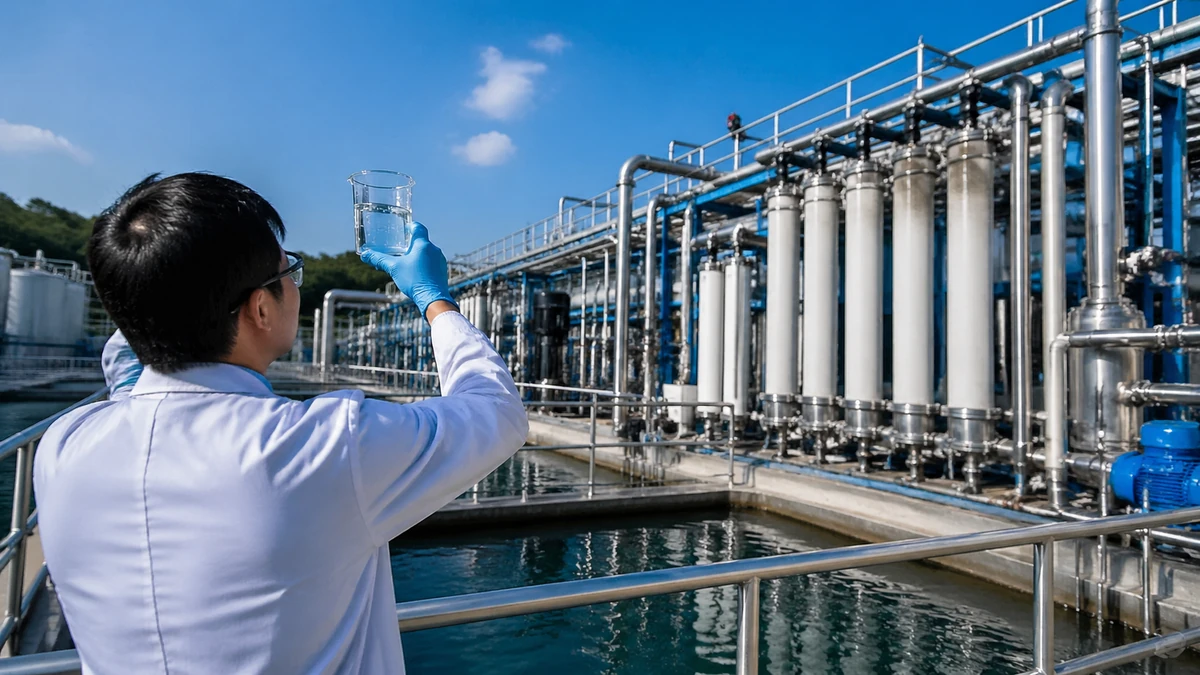
An invisible water problem gets a public health answer
For many people, water safety begins and ends with a simple assumption: if it comes out of the tap, it must be fine. That assumption is usually strongest in wealthy, industrialized countries with modern water systems, where attention tends to focus on dramatic crises — a lead contamination scandal, a boil-water order after a storm, or images of polluted rivers on television. But some of the most consequential threats to drinking water are quieter, slower and far less visible. They do not announce themselves with a bad smell or an odd taste. They can persist for years in groundwater, especially in rural areas that do not rely on large municipal treatment plants.
That is what makes a new announcement from South Korea’s North Gyeongsang Province, known in Korean as Gyeongbuk, worth attention. On April 26, 2026, the province’s Institute of Health and Environment said it had developed a technology capable of removing more than 99% of uranium from groundwater used for drinking and household purposes. According to the institute, the method reduced uranium concentrations from 644 micrograms per liter to about 2 micrograms per liter — well below South Korea’s drinking-water standard of 30 micrograms per liter.
That is not just a technical improvement on paper. It is the difference between water that exceeds a health-based standard and water brought down to a level that leaves a substantial margin of safety. In public health, that distinction matters. Meeting a legal threshold is one thing. Reducing exposure as much as realistically possible, especially when people may drink the water over many years, is another.
To many Americans, the word uranium instantly evokes nuclear weapons, power plants, Cold War anxiety, or headlines about radiation. But in drinking water, the issue is often less about a sudden radiation event than about chronic exposure through repeated consumption over time. Health authorities have long warned that long-term ingestion of uranium can affect the kidneys. That makes groundwater contamination a classic environmental health problem: easy to overlook, difficult for ordinary residents to detect on their own, and potentially serious if left unaddressed.
The Korean announcement also points to a broader reality that is not unique to South Korea. In any country, including the United States, debates over water safety often center on large urban systems because they serve the most people and generate the biggest headlines. Yet smaller communities, rural households and places dependent on wells can face a very different set of risks. Their water quality may vary according to local geology, maintenance capacity, infrastructure age and the resources available to test and treat contamination. In that sense, a locally adaptable uranium-removal technology is not just a science story. It is a story about health equity, public trust and whether people outside big cities receive the same level of protection from environmental hazards.
Why uranium in groundwater is a health issue, not just a scary word
Uranium is one of those substances that can be misunderstood because its public image is so dominated by fear. In popular culture, it sounds exceptional, exotic and catastrophic. In environmental health, though, the more relevant question is often much simpler: how are people exposed, how often, and what part of the body is at risk?
In the case of groundwater, the concern is long-term ingestion. The Korean institute said uranium in groundwater can cause kidney damage when consumed over an extended period. That framing is important because it shifts the issue away from sensationalism and toward risk management. This is not mainly about provoking panic. It is about recognizing a hazardous substance that may produce harm precisely because it can be consumed repeatedly, in small amounts, without obvious warning signs.
That dynamic is familiar to American readers who have followed domestic water-quality controversies. Not every major public health hazard arrives dramatically. Lead in old pipes did not make water glow. PFAS — the industrial compounds often called “forever chemicals” — typically cannot be detected by taste or smell either. The same is true of many contaminants that matter most to health professionals: they are dangerous not because they are theatrical, but because ordinary people may never know they are there.
Groundwater is especially important in this conversation because it sits somewhat outside the public imagination of water infrastructure. Large treatment plants, reservoirs and visible city systems are easier to picture. Private or local groundwater sources are not. Yet in many regions, groundwater remains an essential resource for drinking, cooking and daily life, particularly in rural or dispersed communities. South Korea has an extensive modern water system, but like many developed countries, it still has communities and facilities that rely on groundwater rather than a uniform municipal supply.
That matters because groundwater contamination is not distributed evenly. It can depend on regional geology as much as human pollution. Some areas are simply more prone to naturally occurring substances leaching into water. In practical terms, that means the burden of exposure may fall on smaller populations whose problems are less visible politically and less likely to dominate national news coverage. Public health experts often stress that rarity and seriousness are not opposites. A hazard can affect fewer people and still demand urgent attention if exposure is long-term, repeated and hard to detect.
That is one reason the Korean province’s announcement stands out. It acknowledges, at least implicitly, that protecting drinking water is not only about preventing dramatic emergencies. It is also about managing low-visibility risks before they become chronic health burdens. In a policy environment where elected officials are often rewarded for responding to immediate crises, that kind of preventative approach can be harder to sustain — but no less important.
What the 99% figure really means
The headline number in the Korean report — a removal rate of more than 99% — is impressive enough on its face. But the more meaningful detail is where the process started and where it ended. According to the institute, the treatment reduced uranium from 644 micrograms per liter to roughly 2 micrograms per liter. South Korea’s standard for drinking water is 30 micrograms per liter.
That difference is crucial. In environmental regulation, there is a world of difference between barely getting under the line and achieving a result that remains comfortably below it. Real-world water systems are not static. Source water can fluctuate. Equipment performance can vary. Maintenance lapses happen. Filters or treatment media wear down over time. Operators do not always confront identical conditions every day. A treatment method that only works under perfect conditions or only reduces contamination just enough to squeak by may be far less reassuring once deployed outside a lab.
By contrast, a process that drives concentrations down far below the standard creates a buffer. That buffer can matter for both health protection and public confidence. Residents tend to feel differently about water that is “technically legal” than water that is demonstrably well below a danger threshold. Anyone who has watched public reaction to water-quality disclosures in the United States knows that numbers are never purely technical. They shape whether communities believe officials are actually protecting them or merely complying with paperwork.
The institute also said the technology maintained removal efficiency above 99% consistently, highlighting not just peak performance but stability. That may be the most important part of the announcement. Environmental technology often lives or dies on reliability rather than on its best-case result. Many promising treatment methods can perform impressively in a controlled setting. Far fewer are easy to operate over time, at reasonable cost, under varying local conditions.
In plain terms, the claim here is not only that scientists found a way to strip uranium out of groundwater once. It is that they may have developed a process with enough consistency to be useful in the field. For public health systems, predictability matters more than spectacle. Water treatment is not a moonshot business. It is a daily business. People need something that works on ordinary Tuesdays, in ordinary facilities, long after the press release is forgotten.
This is where the Korean announcement intersects with a larger lesson in environmental policy. The public often notices breakthroughs when they sound dramatic — “99% removal” is the kind of phrase that grabs attention. But what communities actually need is something more mundane and more valuable: a dependable reduction in exposure over long periods. If the province can show that its treatment holds up outside the research setting, that would be the real measure of success.
A local technology with practical ambitions
According to the institute, the new method uses domestically produced aluminum hydroxide microparticles. To non-specialists, that may sound like a minor technical footnote. It is not. The choice of materials says a great deal about whether a technology is intended as a one-off academic achievement or as a practical system that can actually be deployed.
In the water-treatment world, practicality often hinges on the unglamorous details: where the materials come from, how expensive they are, how easily they can be replaced, whether local governments can procure them, whether operators can be trained to use them, and whether the system can be maintained without depending heavily on foreign suppliers or highly specialized equipment. A treatment process built around locally sourced materials can have a significant advantage when it comes to scaling up.
That point has resonance well beyond South Korea. American infrastructure debates are full of examples showing that the success of a technology depends not only on how well it works in theory, but on whether communities can afford to install and operate it. A town may be offered a cutting-edge solution, but if it requires constant expert intervention or costly imported components, it may never become a durable part of public service. Water treatment, like public transit or broadband, often reveals the gap between invention and implementation.
The Korean institute also said it identified the mechanism by which uranium is removed. Again, that may sound academic, but it is not merely an ivory-tower detail. Understanding why a process works is essential if policymakers and engineers hope to predict how it will perform under different water conditions. Will other minerals interfere? Does performance fall as water chemistry changes? How often must the treatment medium be replaced? Can the process be integrated with monitoring systems that detect when performance starts to decline?
These questions are not optional. They are what separates a scientific result from a public health tool. In environmental protection, communities do not benefit simply because a lab produced a promising graph. They benefit when a treatment method can be designed, installed, monitored and maintained in a way that ordinary institutions can sustain.
That is why the Korean announcement’s emphasis on domestic materials, verified removal mechanisms and stable efficiency matters so much. Taken together, those elements suggest the province is thinking not just about publication or recognition, but about field adaptation. That phrase — field adaptation — can sound dry, but it gets at the heart of environmental justice. A technology that works only under ideal circumstances tends to benefit the places that already have the most capacity. A technology designed for real-world variation has a better chance of reaching smaller, more vulnerable communities.
The rural water gap South Korea shares with other countries
One of the most important themes in the Korean report is easy to miss if readers focus only on uranium. The deeper issue is uneven water protection between communities. South Korea is often recognized internationally for its rapid modernization, advanced manufacturing and dense urban infrastructure. Americans may know Seoul as a hyperconnected global city, the home of K-pop, Samsung and some of the world’s fastest internet. But as in the United States, national modernity does not erase regional disparities.
North Gyeongsang Province is a large region that includes rural and mountainous areas, not just urban centers. In places where groundwater remains a key source of household water, the risks and responses can differ sharply from those in cities served by centralized treatment systems. That divide is familiar in the United States as well, where urban residents often assume water safety is handled by large utilities, while many rural families depend on wells, small systems or local treatment arrangements that can be more vulnerable to contamination and underinvestment.
That is part of why the Korean development has broader significance. It highlights a version of water inequality that does not always attract immediate national attention. A big-city contamination event can become front-page news overnight because so many people are affected at once. A groundwater issue in scattered communities may be more persistent yet less visible. But from a public health standpoint, those communities do not matter less. In some ways, they require more proactive government action because residents cannot reasonably be expected to detect or solve the problem on their own.
There is also a trust dimension here. When contamination cannot be seen or smelled, people are often forced to rely on official monitoring, technical reports and public communication. That means the credibility of institutions becomes part of the health response. Residents are not only asking whether the water is safe. They are asking whether the government knows enough, tests often enough and tells the truth clearly enough for them to believe the answer.
South Korea, like the United States, has spent years strengthening public expectations around health transparency. Citizens increasingly want data, not just assurances. They want to know what is being measured, what standards apply, how much safety margin exists and what happens if performance begins to slip. The province’s uranium-removal announcement could help build confidence, but only if it is followed by transparent implementation. In that sense, the technology itself is only half the story. The other half is governance.
For an American audience, perhaps the clearest comparison is this: a promising water treatment breakthrough matters, but people judge it through the lens of whether it reaches the households that need it most. A new method deployed only in a showcase facility is one thing. A system that reduces exposure in remote schools, farming communities and small residential clusters is something else entirely. That is where environmental innovation becomes public service.
What comes after the breakthrough announcement
If the Korean institute’s claims hold up in wider use, the harder phase may still lie ahead. Research institutions can prove a concept. Governments then have to decide how, where and in what order to deploy it. The institute said it plans to pursue practical application through an intelligent water-treatment system. That phrase suggests a future that goes beyond a simple treatment unit and toward a more integrated setup — one that combines purification with monitoring, operational control and maintenance management.
That matters because no water technology is self-executing. A uranium-removal process may perform extremely well when newly installed, but long-term public health protection depends on whether officials can track performance, detect degradation and respond before residents are exposed to rising contamination levels. “Intelligent” in this context likely means a system that can measure conditions, automate some controls and flag abnormal readings early. In modern infrastructure language, it is the move from a standalone machine to a managed network.
Three practical questions will likely determine whether the Korean development becomes a meaningful public health success. First, where will the technology be used first? Governments rarely have the money or staff to install new treatment systems everywhere at once, so prioritization matters. Ideally, deployment would begin in areas with the highest contamination risk and the greatest dependence on groundwater.
Second, how will long-term performance be verified? Initial removal rates are important, but communities need assurance that the same standards can be maintained month after month and year after year. That requires routine sampling, maintenance schedules and clear protocols for replacing treatment materials or suspending use if results deteriorate.
Third, how will the results be communicated to the public? Environmental health policy is full of technically sound decisions that failed to inspire confidence because officials explained them poorly or too late. Residents will want understandable answers to basic questions: What was in the water? How much was removed? Is the treated water merely compliant, or comfortably safe? How often is it being checked? What happens if a problem is found?
These questions are not unique to South Korea. They are the same questions communities ask anywhere when the safety of drinking water depends on scientific expertise they cannot independently verify. That is why the next stage of this story may be as much about public administration as engineering. A technology can reduce uranium. Only a functioning system can reliably protect people.
Cost and operational capacity also cannot be ignored. In water infrastructure, the true obstacle is often not the initial installation but the long-term burden of upkeep. Filters need replacing. Treatment media must be managed safely. Staff need training. Monitoring equipment must be calibrated and repaired. Data need interpretation. If local governments or facility operators do not have stable funding and technical support, even strong innovations can falter after the pilot phase.
The province’s announcement, then, should be read as a promising beginning rather than a final answer. It suggests South Korea is taking a more preventive approach to a class of environmental health problems that often stay below the political radar. For American readers, it also offers a reminder that water safety is not simply about dramatic disasters. It is about whether governments can find and reduce unseen risks before they become lifelong exposures.
Why this story resonates beyond Korea
There is a tendency, especially in international coverage, to treat local environmental stories as isolated or culturally specific. But this one has broad relevance because it sits at the intersection of science, infrastructure and fairness — three issues that shape water debates around the world. South Korea may have its own regulatory system, geography and public-health institutions, but the underlying challenge is widely recognizable: how do you protect people from contaminants they cannot detect themselves, especially when those people live outside the easiest-to-serve places?
For American readers, the significance of this story is not that Korea has discovered a single miracle technology that resolves all groundwater concerns. It is that a provincial public institute appears to be treating water safety as a matter of prevention, not just emergency response. That mindset is important. By the time contaminated water becomes an obvious crisis, the policy failure has usually already happened. The more difficult and less celebrated work is identifying chronic risks early and building systems that reduce them consistently.
There is also a cultural point worth making for readers less familiar with how South Korean regional governance works. Provincial research institutes in Korea often play a hands-on role in environmental monitoring and practical health protection, not just academic research. In that sense, this announcement reflects a model in which local government science can feed directly into public service. Americans might compare it loosely to the role that state environmental agencies, public health labs or university extension systems sometimes play in translating technical expertise into community-level solutions.
If the technology is successfully commercialized or adopted in the field, it could become a case study in how local governments address environmental inequality with targeted engineering rather than broad rhetoric alone. It could also influence future policy conversations about contaminants that, like uranium, are easy to neglect because they do not produce immediate symptoms or headline-grabbing visuals.
Ultimately, this is a story about what responsible government looks like when the threat is invisible. It means paying attention to people whose water does not come from the most modern centralized systems. It means recognizing that compliance is not always enough if deeper reduction is possible. It means investing in technology that is not only effective, but usable. And it means understanding that trust in public health depends on more than promising numbers — it depends on whether those numbers can be sustained, verified and explained.
North Gyeongsang Province has offered an encouraging answer to one specific water challenge. The real test now is whether that answer can move from the lab into daily life, where the stakes are measured not in press releases or performance charts, but in the quiet expectation that a glass of water should not carry a hidden cost.



0 Comments