A Record 64.2 Million Migrants Now Live in the EU, Underscoring Europe’s Economic Dependence and Political Strain
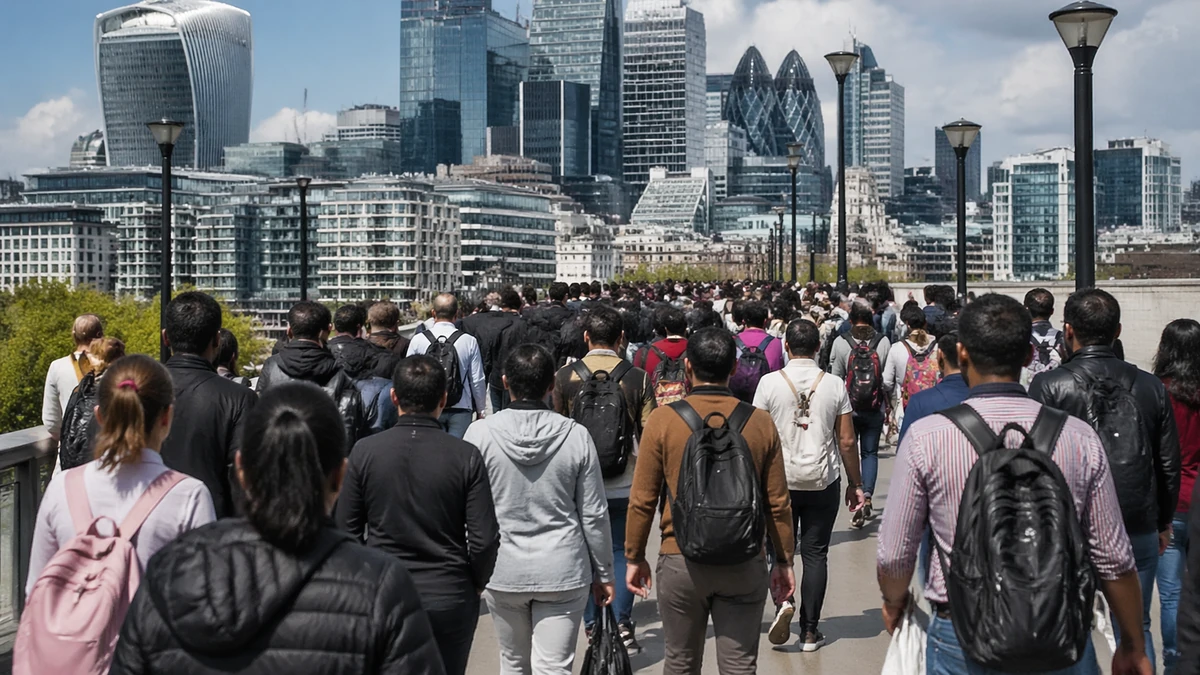
Europe’s new migration milestone is more than a demographic footnote
The European Union is now home to a record 64.2 million migrants, according to a report released April 22, 2026, by Germany’s RF Berlin Center for Migration Research and Analysis. That figure, up 2.1 million from a year earlier, may sound at first like the kind of dry statistical update that fills policy briefings and think tank reports. In reality, it says something much bigger about what Europe has become — and about the political pressures that are likely to define its next decade.
In the United States, immigration debates often swing between two familiar poles: the economy’s demand for workers and the politics of border control. Europe is confronting a similar dilemma, but in a different institutional setting. The EU is not a single nation with one immigration system, one welfare model or one political culture. It is a bloc of 27 countries, many of which share labor markets and legal obligations, but still answer to their own voters, local governments and national anxieties.
That makes this new milestone especially significant. The report suggests that migration is no longer a challenge concentrated in a handful of entry-point countries or a temporary emergency linked to one war, one labor shortage or one refugee wave. It has become a structural feature of European life. Migrants are woven into the bloc’s labor force, housing markets, classrooms, health systems and electoral politics. The numbers point to a Europe that continues to attract people, even as many of its societies remain uneasy about how fast those changes are unfolding.
The record also complicates simplistic narratives. To some policymakers, rising migrant populations signal economic resilience: Europe needs workers, taxpayers and younger residents in aging societies. To others, the same figures represent failed border management, frayed public services and a loss of political control. Both interpretations exist at once, which helps explain why migration has become one of Europe’s most combustible issues.
The key point is that the number itself is not the whole story. What matters is what it reveals about the EU’s economic model, demographic reality and political vulnerabilities. Europe is increasingly reliant on migrant labor to sustain industries and social systems, yet still struggles to build durable public consensus around migration as a long-term fact rather than a recurring crisis.
Germany stands at the center of Europe’s migration map
Perhaps the most striking detail in the report is not just the total EU figure, but where many of those migrants live. About 18 million of them are in Germany alone, meaning more than one in four migrants residing in the EU is concentrated in its largest economy.
That concentration matters. On paper, it makes intuitive sense that Germany — with its industrial base, large population and relatively strong job market — would attract outsized numbers of newcomers. The country has long served as one of Europe’s economic engines, much as states like California, Texas and New York tend to absorb large shares of new arrivals in the United States. Jobs pull people in. So do family networks, schools, public infrastructure and perceptions of stability.
But scale changes the meaning of the trend. Germany is not simply one destination among many. It is increasingly the central axis of Europe’s migration system. That places enormous pressure on its institutions, from housing offices and schools to asylum processing systems, municipal budgets and employers struggling to match workers to available jobs.
It also throws into relief the imbalance within the EU itself. Europe often speaks in the language of solidarity, shared responsibility and common values. In practice, however, member states vary widely in how many migrants they accept, how capable they are of integrating newcomers and how politically willing they are to do so. Some countries experience migration as a daily administrative challenge. Others experience it mainly as an ideological issue debated on television and during elections.
That unevenness is one reason the EU has repeatedly struggled to forge coherent migration policy. When the costs of reception, language training, legal processing and social integration fall disproportionately on a few countries, collective action becomes harder. The principle of burden-sharing sounds straightforward until it requires governments to spend money, absorb political backlash or alter domestic policy. Germany’s outsize share of the migrant population highlights that gap between Europe’s rhetoric and its operational reality.
For Berlin, the challenge is double-edged. Germany benefits enormously from migrant labor, especially as its native-born population ages and key sectors face worker shortages. But it also absorbs much of the social and political friction that comes with large-scale migration. The same country that needs workers for factories, hospitals and transportation networks must also manage local frustrations over housing shortages, crowded classrooms and bureaucratic delays. That tension is not unique to Germany, but Germany now embodies it more than any other EU member.
The most important number may be age, not just volume
If the headline figure is 64.2 million, the most revealing subtext may be this: In Germany, 72% of migrants are of working age, according to the report. That detail cuts through one of the most common misconceptions in migration politics — the idea that migrants are primarily a fiscal burden rather than a potential economic asset.
In country after country across Europe, demographic pressure is intensifying. Birth rates have fallen. Populations are aging. Employers in fields such as manufacturing, logistics, elder care, hospitality, construction and urban services have been warning for years that they cannot find enough workers. In that context, a large migrant population composed mostly of working-age adults is not incidental. It is central to how modern European economies continue to function.
Americans will recognize this dynamic. The U.S. has long depended on immigrants, whether in agriculture, health care, construction, food processing, tech or small business formation. Europe’s version is shaped by a more expansive welfare state and a more fragmented policymaking structure, but the underlying economic logic is familiar: A society with too few working-age people will eventually struggle to sustain its tax base, pension system and basic services.
Still, potential is not the same thing as policy success. A working-age migrant population helps only if those people can actually work, and that is where Europe’s institutional shortcomings become glaring. Employment authorization, credential recognition, language instruction, housing access and family reunification policies can either speed integration or stall it for years. A trained nurse who cannot get her qualifications recognized is not filling a labor shortage. A skilled mechanic stuck in legal limbo is not strengthening the economy. A family unable to secure stable housing is less likely to put down roots and more likely to remain socially isolated.
This is why the age profile matters so much. It suggests Europe’s migration debate is not really about whether migrants are useful to the economy; many clearly are. The real question is whether governments can convert demographic opportunity into social and economic stability. If they fail, the same population that could have eased labor shortages may instead become a symbol of bureaucratic paralysis, underemployment and public resentment.
That helps explain why migration arguments in Europe often feel so disconnected from the data. Politicians may campaign on border crackdowns, while employers quietly depend on foreign labor to keep operations running. Voters may hear the language of emergency, even as the economy increasingly runs on systems built around migrant participation. The contradiction is not accidental. It is the defining feature of the issue.
Economic necessity does not automatically produce political consent
For years, migration in Europe was framed largely as a moral and security question: How many asylum-seekers should be admitted? How should borders be enforced? What legal obligations do wealthy democracies have toward people fleeing war or persecution? Those questions remain important, but they no longer capture the entire reality. Migration is now also a question of economic governance.
That shift matters because economics and politics move at different speeds. Businesses and public services can identify labor shortages in real time. Voters respond to what they see in neighborhoods, schools and rental markets. Those are not always the same thing. A finance minister may view migration as a necessary buffer against demographic decline. A parent dealing with an overcrowded classroom or a renter watching prices rise may experience it very differently.
This mismatch is a major reason migration keeps destabilizing party systems across Europe. From Germany and France to Italy, the Netherlands and Sweden, anti-immigration parties or hard-line factions within mainstream parties have gained traction by focusing on the local and visible effects of rapid population change. Their message is often less about macroeconomics than about everyday strain: longer waits for public services, competition for affordable housing, cultural unease and fears — sometimes substantiated, sometimes exaggerated — about public safety and social cohesion.
That does not mean those arguments fully explain Europe’s migration reality. It does mean they resonate because they speak to daily life. The economic case for migration may be compelling in the aggregate, but democratic politics is rarely decided in the aggregate. It is decided block by block, school by school and municipality by municipality.
The new EU record exposes that gap with unusual clarity. Europe needs migration, particularly in aging, labor-hungry economies. But political systems remain deeply reluctant to say so plainly and consistently. Instead, governments often oscillate between recruitment and restriction, welcoming migrant labor in practice while speaking the language of deterrence in public. The result is a policy landscape that can feel contradictory even to the people implementing it.
In the American context, this tension is easy to recognize. The United States has repeatedly depended on immigrant workers while conducting fierce political battles over walls, deportations and asylum procedures. Europe’s version is complicated by the fact that its migration debate spans multiple nations with different histories of colonialism, citizenship and national identity. But the broader pattern is the same: Economic systems reward openness, while politics often rewards skepticism.
The harder challenge is not entry, but settlement
The report’s broader implication is that Europe may have moved beyond the point where migration can be treated chiefly as a question of inflow. Once tens of millions of migrants are already living in the EU — many of them of working age, many likely to stay for years or permanently — the central issue becomes not whether they arrived, but how they are incorporated.
That distinction is critical. Admitting migrants and integrating them are not the same thing. A country can be permissive or restrictive at the border and still fail at settlement. The mechanics of settlement are not glamorous, but they determine whether migration becomes a long-term asset or a lasting source of tension.
In practical terms, that means schools capable of absorbing new students quickly. It means language education that begins early and is tied to employment pathways. It means faster recognition of foreign degrees and job qualifications. It means local governments with enough money and staff to process residency applications, provide basic services and prevent administrative backlogs from turning into years of uncertainty. It means housing supply — perhaps the most politically sensitive issue of all — that can expand without setting off battles between newcomers and longtime residents.
In Korea, as in Japan, migration is often discussed against the backdrop of demographic decline and social homogeneity. Europe’s situation is different because many of its societies are already far along in their transformation into multiethnic, multi-origin democracies. Yet the political language has not always caught up to that reality. Public debates still often treat migrants as if they are temporary additions to an otherwise fixed national story. The data suggest otherwise. In many parts of Europe, migrants are no longer peripheral actors. They are central to how those societies work.
That makes integration policy less of a moral add-on and more of a test of state capacity. A government that cannot move newcomers into stable legal status, training and employment in a timely way is not simply failing migrants. It is failing employers, local communities and its own fiscal future. Prolonged insecurity in legal status or work eligibility tends to produce the worst of all outcomes: wasted labor potential, avoidable welfare costs and a political climate in which migration appears only as disruption.
If Europe’s debate evolves in the coming years, it will likely shift from the blunt question of whether to accept migrants toward the more demanding question of under what conditions settlement should be structured. That conversation is harder because it requires administrative competence, long-term planning and honest political communication — not just slogans about control or compassion.
A test of whether Europe can align its values with its needs
What the Reuters-reported findings ultimately underscore is that Europe is already deep into a structural transition. A population of 64.2 million migrants means the EU is not merely managing a temporary wave. It is living through a long-term social reconfiguration in which multiple identities, languages and origins are becoming a permanent feature of the European mainstream.
The question now is whether institutions and politics can catch up. Europe has long presented itself as a community built on human rights, free movement, rule of law and social protection. But migration exposes how difficult those principles can be to operationalize when resources are stretched and public opinion is divided. Migrants may be welcomed as workers one year, then cast as political liabilities the next. That inconsistency is becoming harder to sustain as the numbers grow and as their role in the economy becomes more obvious.
Germany’s centrality makes the stakes even sharper. If one country bears an outsized share of the responsibilities associated with reception and integration, debates over burden-sharing inside the EU are likely to intensify. Governments facing domestic pressure may push for tougher controls, more externalized border enforcement or stricter eligibility rules. At the same time, labor shortages and demographic decline will continue to limit how far Europe can realistically move toward closure. That leaves the bloc in a familiar but increasingly unstable position: needing migration while arguing endlessly about how much of it is politically tolerable.
This is why the record figure should be understood as a political stress test, not just a demographic marker. It measures how much Europe has changed, but it also measures how much adaptation remains unfinished. If policymakers continue to treat migration as an episodic emergency rather than a governing constant, the costs will rise — economically, socially and electorally.
For American readers, the lesson may sound familiar. Immigration debates are rarely just about newcomers. They are about what a society believes it is, what it fears losing and what it needs in order to keep functioning. Europe’s latest numbers do not settle those arguments. They sharpen them. They show a continent that is becoming more dependent on migrants even as its political systems struggle to explain that dependence honestly.
And that, more than the record itself, may be the most important takeaway. Europe is no longer deciding whether migration will shape its future. That future has already arrived. The real decision is whether European governments can design systems strong enough, fair enough and pragmatic enough to turn a structural reality into a stable one.
Comments
Post a Comment