In the United States, the biggest streaming wars have usually revolved around prestige dramas, NFL rights and the question of which platform can land the next must-watch series. In South Korea, however, one of the most revealing signs of where the entertainment business is headed is coming from a place many Americans might not expect: professional baseball.
Tving, a major South Korean streaming platform, said this week that viewership for its Korea Baseball Organization, or KBO, broadcasts surged 30% from the same period a year earlier. That followed an 8% increase the previous year. Even more striking, women accounted for 43% of users early this season, up 5 percentage points from a year ago, and among viewers in their 20s, women outnumbered men. Those figures matter not simply because baseball is growing, but because they suggest a broader shift in how entertainment is consumed in South Korea: away from appointment viewing built around a TV schedule and toward live, habit-forming experiences that viewers want to share in real time.
That shift has implications far beyond sports. In South Korea, where K-pop fandom, online communities and mobile-first media habits have reshaped everything from music marketing to television production, baseball is increasingly behaving less like a traditional sports product and more like what media executives would call live entertainment. In other words, it is no longer just a game. It is a recurring social event, a fandom engine and a powerful retention tool for streaming services trying to keep subscribers from drifting away after they finish the latest hit drama.
Baseball is doing what dramas cannot
Streaming platforms everywhere face the same core problem: getting people to sign up is only half the battle. Keeping them engaged month after month is harder. A buzzy drama can bring a wave of new subscribers, but the spike often fades once viewers binge all 10 or 12 episodes. Live sports work differently. They create routine. They create urgency. And they create fear of missing out.
That is a lesson American audiences know well from the NFL, March Madness and even the way live events like the Oscars or big political debates still punch through in an on-demand world. South Korea’s version of that logic is now playing out through the KBO, the country’s top baseball league. Unlike a scripted series, a baseball season unfolds daily over months, with new storylines, new controversies and new emotional stakes every night. A close game on Tuesday feeds directly into attention on Wednesday. A breakout rookie, a slumping veteran or a heated rivalry can keep fans returning not for a finale, but for an ongoing serialized experience.
That rhythm is especially valuable in the streaming era. For Tving, baseball is not just content sitting in a library. It is a recurring trigger for app opens, push notifications, clips, chat activity and cross-platform engagement. It helps explain why a 30% jump in users this season is more than a healthy sports number. It signals that the platform is benefiting from a behavior change. Viewers are not merely interested in baseball; they are consuming it in ways that are more native to streaming.
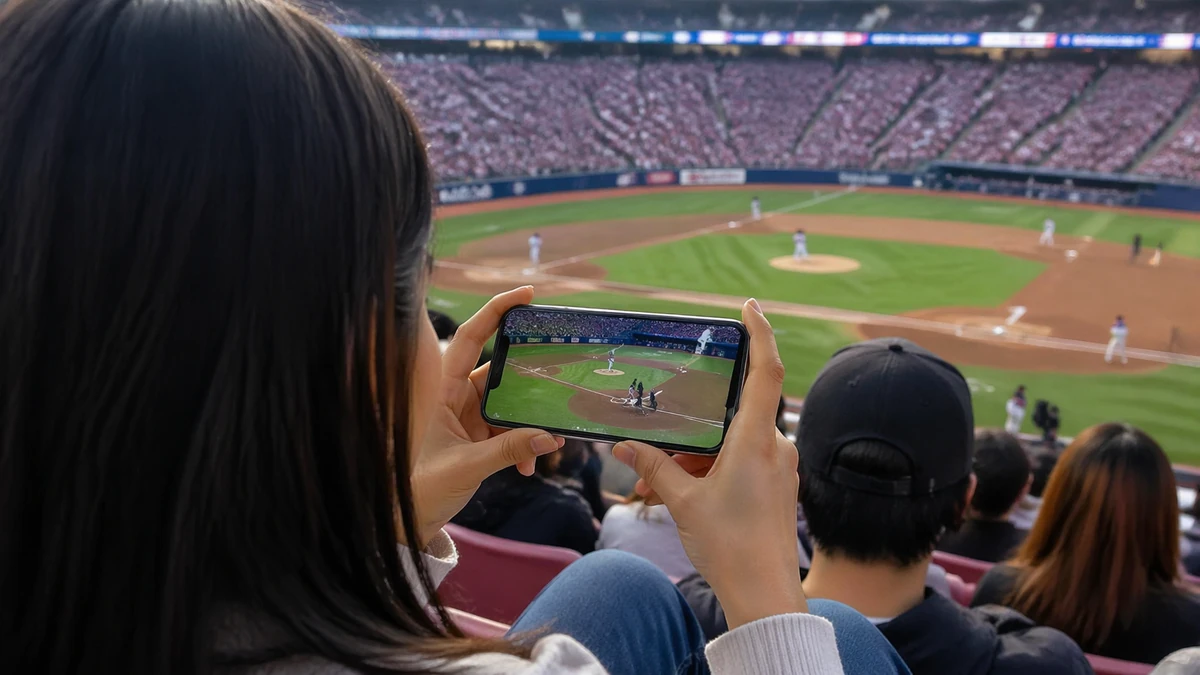
That includes watching on phones, moving between devices, checking highlights instantly and following games as part of an everyday digital routine. In the past, a fan might catch up through a newspaper recap, a TV sports segment or next-morning online coverage. Now the expectation is immediacy. The game is not something you hear about later. It is something you experience as it happens, often with thousands of other people responding in parallel.
The new audience is changing the business
The most revealing part of Tving’s data may be who is watching. The platform said women made up 43% of early-season users, and among people in their 20s, women surpassed men. For an American audience, that may sound less surprising than it once would have. U.S. sports leagues have spent years trying to broaden their audience beyond the stereotype of the male superfan. But in South Korea, the speed and visibility of this demographic shift has become a major cultural talking point.
Baseball in Korea has long been popular, but it was often discussed in more traditional terms: team loyalty, stats, rivalries and family outings. What has changed is not just the size of the audience, but the culture around attendance and viewing. Younger women have become a conspicuous presence at stadiums, and that shift is now showing up in streaming data. That matters because it suggests the appeal of baseball is no longer confined to the conventional sports frame. It is expanding as a social and lifestyle experience.
To understand why, it helps to know that Korean sports culture has some features that may feel different to Americans. KBO games are known for highly organized cheering sections, songs customized for individual players and a participatory atmosphere that can feel closer to a pep rally or concert than a quiet afternoon at the ballpark. Fans do not simply watch. They chant, sing, wave branded merchandise and often treat the stadium as a highly social environment. Add in photogenic food, team merchandise, online fan communities and the social-media habit of documenting outings, and the ballpark becomes part spectator event, part content backdrop, part group activity.
That does not mean young women are watching baseball for reasons that are somehow less serious or authentic than men. It means the category of what counts as sports fandom is broadening. The same viewer may care deeply about a team’s standing, follow a specific player’s performance, enjoy the in-stadium atmosphere, buy merchandise and share clips online. The old binary between the “real sports fan” and the “casual lifestyle consumer” no longer explains much. In digital media, those identities often overlap.
For advertisers and platforms, that overlap is gold. It expands sponsorship categories, changes marketing strategy and opens the door to campaigns that borrow tactics long used in K-pop and entertainment: character-driven storytelling, collectible goods, fan engagement and community-building. If the streaming service sees that younger female viewers are a major growth segment, it will shape everything from promotion and interface design to which clips are surfaced and how games are packaged.
Sports now looks a lot like fandom entertainment
One reason this story resonates so strongly in South Korea is that the country has spent the past two decades building one of the world’s most sophisticated fandom economies. K-pop did not just produce stars. It refined a whole commercial language around participation: fan cams, collectible photo cards, voting campaigns, livestreams, behind-the-scenes content and direct-to-fan merchandising. Korean entertainment companies became experts in turning emotional investment into repeat engagement.
Baseball is increasingly tapping into some of those same mechanics. Fans attach themselves not only to teams, but to individual players with distinct public personas. They collect uniforms and branded items. They circulate clips and reaction videos. They build inside jokes and online rituals. They create communities that make following the sport feel like being part of something larger than the scoreboard.
The difference, and it is a crucial one, is that sports adds true uncertainty. A pop group’s comeback may be carefully choreographed, but a baseball game cannot be scripted. The drama is real, the ending unknown. That combination — fandom intensity plus live unpredictability — is incredibly powerful in streaming. It generates the emotional hooks of entertainment and the urgency of news. Viewers cannot fully substitute a recap for the real thing, because the value lies partly in witnessing the moment as it happens.
That is why the phrase “live entertainment” is so useful here. It captures how sports has moved beyond the older idea of a broadcast you passively receive. On a streaming platform, the game is a hub for multiple forms of engagement. Viewers can jump to highlights, track other matchups, react on social media and consume short clips before, during and after the game. The product is no longer just nine innings. It is the entire digital ecosystem surrounding those innings.
For media companies, that makes sports uniquely resilient. Scripted shows still matter, of course. Korean dramas remain one of the country’s most successful cultural exports. But from a platform economics standpoint, baseball offers something dramas usually cannot: steady frequency. You do not need to wait a year for the next season. The next episode is tomorrow.
Tving’s numbers point to a bigger streaming strategy
Tving is not the only player in South Korea’s crowded online video market, but the KBO data gives a clear glimpse into what streaming platforms increasingly need in order to compete. In a market saturated with dramas, reality shows and imported content, live rights can function as a strategic anchor. They give viewers a reason to return regularly, and they reduce the risk that a service becomes something people subscribe to only temporarily.
That logic mirrors developments in the United States, where sports rights have become central to the ambitions of major media and tech companies. Amazon wants Thursday Night Football. Peacock leans on the Olympics and the NFL. ESPN is still one of the most durable brands in American media because live sports remain one of the few products viewers are reluctant to time-shift. South Korea’s media environment is smaller, but the principle is the same. Live sports help answer the streaming industry’s most urgent question: How do you become indispensable, not just interesting?
In the Korean case, baseball may be especially well suited to that role because its season is long, its fan loyalties are deeply rooted and its cultural footprint extends beyond pure athletic competition. The rise in users from 8% growth last year to 30% this year suggests acceleration, not just stability. That points to an audience becoming more comfortable with streaming sports as a default habit rather than an occasional convenience.
It also hints at a broader redefinition of content value. For years, streaming success was often discussed in terms of blockbuster originals. But a service does not thrive on headline-making premieres alone. It thrives on routine, and routine is where sports shines. A baseball fan who checks in several times a week can be more valuable over time than a viewer who signs up for one marquee series and leaves. The metrics that matter are not just starts, but repeat usage, watch time and retention. Baseball serves all three.
And because the audience is diversifying, the upside is broader than old industry assumptions would suggest. If women in their 20s are increasingly central to KBO streaming, that alters how executives should think about who sports is for and how it should be presented. It becomes easier to imagine baseball coverage integrated with entertainment-style storytelling, personality-driven features and broader lifestyle partnerships. In short, the product gets wider without necessarily getting shallower.
The ballpark has become a cultural venue
Part of what makes the Korean baseball boom so notable is that it is not happening only on screens. Stadiums themselves have been evolving into destinations where the game is one component of a larger cultural experience. That change helps explain why online viewing and in-person attendance can reinforce each other instead of competing.
Americans have seen versions of this trend in the transformation of sports venues into entertainment districts, complete with upscale food options, branded activations and social-media-friendly design. In South Korea, the shift has taken a distinct local form. Going to a KBO game can involve coordinated cheering traditions, team songs, mascot culture, merchandise browsing and a strong element of communal performance. It is an outing that blends sports with spectacle.
When Tving notes that growing numbers of women in their 20s at stadiums are now reflected in viewing data, that suggests a feedback loop. Fans who first connect with baseball as an event space may go on to become regular digital viewers. Fans who watch online may be drawn to the stadium experience because it looks fun, expressive and socially shareable. Either way, the boundaries between offline and online fandom are getting thinner.
This is one place where Korean culture offers a useful case study for the rest of the media world. The country has been especially quick to merge physical and digital fan experiences. K-pop perfected that model, with concerts, merchandise, livestreams and online communities all feeding one another. Baseball now appears to be benefiting from a similar ecosystem. The sport is no longer just something consumed in isolated chunks. It is part of a networked experience that follows fans from the stadium to the smartphone and back again.
That matters because media consumption is increasingly shaped by habits, not isolated choices. Viewers do not wake up each day and make a fresh, neutral decision about what to watch. They follow patterns. They open the same apps. They check the same updates. They move through familiar fan communities. If baseball secures a place inside those routines, it becomes much more than one genre among many. It becomes a platform’s heartbeat.
What this says about the future of Korean entertainment
The most important takeaway from Tving’s baseball surge may be that the old lines separating sports, entertainment and fandom business are fading. In South Korea, that convergence is particularly visible because the country already has a highly developed culture of participatory media. Fans are used to not just consuming content, but organizing around it, reacting to it and making it part of their identity. Baseball now fits neatly into that pattern.
For the broader Korean entertainment industry, this is a signal worth watching. It suggests that the future will not belong only to whoever produces the best scripted content, but to whoever can create the most durable forms of emotional return. Live sports, reality competition, fan communities and event-driven programming all have an advantage in that environment because they invite ongoing, repeated attention.
That does not diminish the importance of dramas, films or variety shows. Rather, it changes the hierarchy. For years, the prestige conversation in Korean media often centered on hit series and celebrity-driven entertainment. Now sports is making a strong case that the most strategically valuable content may be the kind that keeps people checking in every day. In a world of abundant choice, habit beats novelty more often than executives like to admit.
For American readers, the closest analogy may be the way football dominates U.S. television not simply because it is popular, but because it is communal, recurrent and resistant to delay. What is different in South Korea is the way baseball is being woven into a broader fandom and lifestyle economy that looks, at times, surprisingly close to the machinery of pop culture. That fusion helps explain why the growth story is not just about sports fans behaving as they always have. It is about new audiences reshaping what sports means in the first place.
If Tving’s data holds through the season, the message to the industry will be difficult to ignore. Baseball is no longer just helping fill a programming schedule. It is becoming one of the clearest examples of what modern streaming needs: live, social, repeatable entertainment that people build into their lives. In South Korea’s rapidly evolving media landscape, the hottest show on a streaming service may not be a drama at all. It may be first pitch.
Comments
Post a Comment