
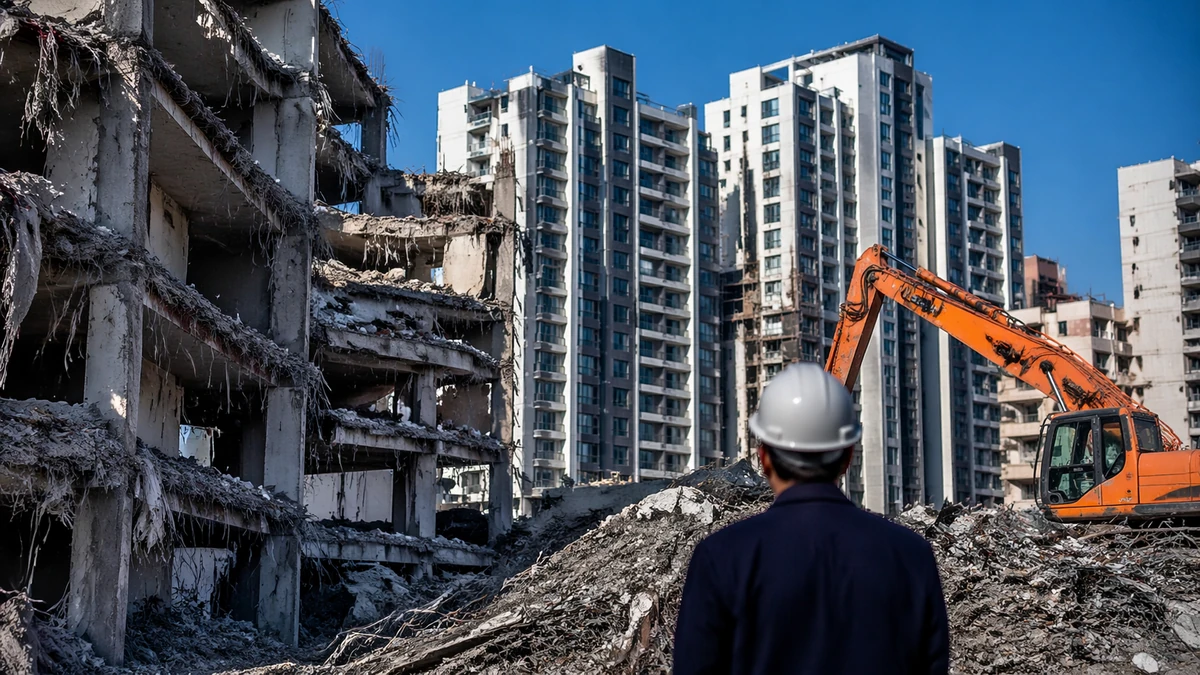
A regional construction group’s downfall becomes a national warning sign
A South Korean court’s decision to end rehabilitation efforts for three key affiliates of Yutop Group, a mid-sized construction company based in the country’s southwest, is more than a bankruptcy story. It is a snapshot of a broader economic strain spreading through one of Asia’s most property-dependent economies.
The Seoul Bankruptcy Court recently moved to terminate court-led rehabilitation proceedings for Yutop Construction, Yutop D&C and Yutop Engineering, effectively steering the companies away from a last-ditch recovery process and toward liquidation. In practical terms, that means the court concluded the businesses were worth more if their assets were sold off than if they were kept alive in hopes of a turnaround.
For American readers, the distinction is similar to the difference between a company entering Chapter 11 bankruptcy protection in an attempt to reorganize and survive, versus heading toward a breakup and sale because the underlying business no longer appears viable. The legal systems are different, but the central question is familiar: Is there enough future business left to justify rescue, or is it better to cut losses now?
That question matters because Yutop was not a tiny contractor. It was a notable regional player with business lines that stretched across homebuilding, hotels, large logistics centers and solar power projects. Its affiliates also covered development, rental management and engineering, a structure that made the group more than just a builder. It was part of the connective tissue of a regional economy.
In the United States, the nearest comparison might be a midsize developer-contractor in a fast-growing Sun Belt market that also runs related design, project management and property operations businesses. If a company like that collapses, the impact does not stop at its headquarters. Subcontractors, lenders, municipal projects, commercial tenants and local workers can all feel the blow.
That is why the Yutop case is drawing attention in South Korea. It speaks to the fragility of the country’s mid-tier construction sector, especially outside the capital region, at a time when financing is tighter, unsold housing inventory remains a risk and investors are less willing to fund projects on faith alone.
Why this matters in Korea’s economic geography
To understand the significance of Yutop’s troubles, it helps to understand how South Korea’s economy is organized. The country is often seen abroad through the lens of Seoul, K-pop, Samsung and high-speed trains. But much of the nation’s economic life depends on regional hubs, where local builders and developers play an outsized role in shaping employment, investment and infrastructure.
Yutop was rooted in Gwangju and South Jeolla, an area in the southwest that is politically and culturally important but often economically overshadowed by the Seoul metropolitan area. In many provincial cities and surrounding regions, a handful of medium-sized companies can play roles that would be divided among many firms in a larger market. They build apartments, manage developments, coordinate with local governments, hire local subcontractors and help anchor financing for projects that may not attract the biggest national conglomerates.
In South Korea, construction has long carried unusual economic weight. Real estate development is not just a private-sector activity; it is deeply entangled with household wealth, local tax bases and regional growth strategies. Apartment construction in particular has had an importance in Korean society that can be hard for outsiders to grasp. In a country where housing prices have been both a political flashpoint and a key store of middle-class wealth, builders are not simply contractors. They are participants in a system that affects everything from family finances to local elections.
That helps explain why the failure of a regional construction group resonates beyond the balance sheet. When a mid-sized builder falters in a smaller metropolitan market, it can destabilize an entire web of economic relationships. The company may owe money to steel suppliers, concrete producers, small architecture firms, equipment renters and specialty subcontractors. Local lenders may be exposed. Projects promised to residents or local governments may stall. Jobs disappear not only on construction sites but in restaurants, trucking services, lodging and maintenance work that depend on ongoing development.
The shock can also feel more severe outside Seoul because regional markets usually have fewer replacement players. In the greater Seoul area, if one developer exits, another may be positioned to step in. In provincial markets, the bench is thinner. That makes the loss of a single established company more disruptive.
The court’s message: Future earning power no longer looks credible
The most important part of the court’s decision is not merely that the legal process changed course. It is the reasoning behind it. By ending rehabilitation, the court signaled that Yutop’s remaining “going concern” value, or the value of the company as an operating business, had eroded below its liquidation value.
That is a harsh judgment in any industry, but it is especially consequential in construction, where a company can appear asset-rich on paper while still being cash-poor in reality. A builder may hold land, claims on future payments, unfinished project rights and partially completed developments. Yet those assets do not necessarily produce immediate cash, and in a downturn they can become difficult to sell or finance at acceptable values.
For readers in the U.S., this is somewhat akin to a real estate-heavy company whose books show substantial holdings, but whose actual cash flow has dried up because projects are delayed, buyers have vanished and lenders are no longer willing to extend credit. On paper, there may still be value. In practice, the business may not have enough oxygen to keep going.
That appears to be the conclusion the Korean court reached. A restructuring process assumes that a company is facing a temporary squeeze, not a permanent collapse in earning power. It assumes that if creditors give management time and legal protection, the business can generate new orders, collect revenue and rebuild trust. But courts are not there to preserve companies for sentimental reasons. They are there to judge whether recovery is realistic.
In Yutop’s case, the answer appears to have been no. That sends an unmistakable signal to the market: South Korea’s construction downturn has reached a stage where extensions, bridge loans and patience may no longer be enough for some mid-sized firms. Even a company with name recognition, a diversified portfolio and meaningful regional presence may not survive if it cannot convincingly show where future orders, apartment sales and cash collections will come from.
For an industry built on confidence, that matters enormously. Construction is not just about pouring concrete. It is about persuading lenders, suppliers, buyers and public agencies that a project will be completed and paid for. Once that confidence breaks, recovery becomes much harder.
Why mid-sized builders are getting squeezed first
One of the clearest lessons from the Yutop case is that mid-sized construction firms often occupy the most vulnerable position in a weakening market. They are too large to operate with the lean simplicity of a small local contractor, but too small to enjoy the financial flexibility and brand power of national giants.
Large Korean construction companies have several advantages. They tend to have broader financing channels, stronger banking relationships, more recognizable apartment brands and wider geographic diversification. A major builder can sometimes absorb a weak project because it has other profitable operations or can refinance through deeper capital-market connections.
At the other end of the spectrum, very small firms may be more nimble. They often have lower fixed costs and more limited exposure. They can shrink quickly, focus on niche work or survive on smaller contracts.
Mid-tier companies are trapped between those poles. They are often expected to handle complex, capital-intensive projects, but they do not always have the same access to cheap funding or the same ability to reassure apartment buyers and creditors. They may depend more heavily on project financing, a structure in which loans are tied to the future revenue of a specific development. That model works well in a rising market, when sales are strong and refinancing is available. It becomes dangerous when housing demand softens, financing costs rise and projects take longer to convert into cash.
Yutop’s business mix illustrates the point. Housing, hotels, logistics centers and solar facilities can all look like sensible diversification during boom years. But they also require substantial upfront capital and can leave companies exposed to multiple forms of delay and demand risk. In a downturn, having many project types is not always a cushion. It can become a management burden, especially if one troubled project starts draining resources from others.
That is a dynamic American readers may recognize from past real estate cycles. During the U.S. housing crash and its aftermath, many developers discovered that diversification across asset classes did not guarantee safety. Instead, overlapping debts and timing mismatches could spread stress from one corner of a business to another. A delayed condo project could affect a hotel financing package; a weak commercial market could complicate residential borrowing. Complexity became contagion.
That is essentially what South Korea’s struggling mid-sized builders are confronting now. The problem is not only bad management at one firm or another. It is a broader environment in which asset values, funding costs and future revenue assumptions no longer line up the way they did during years of easy money and aggressive development.
The regional ripple effects go far beyond one company
Yutop’s significance also comes from the kinds of work its affiliates handled. The group’s construction arm was involved in residential and commercial projects. Its development and management unit dealt with property development and housing rental management. Its engineering affiliate had a track record tied to notable regional and public projects, including work connected to sports facilities, cultural sites and government infrastructure.
That kind of integrated structure is common in regional development ecosystems. When it works, it can be highly efficient. A single corporate group can identify opportunities, navigate permits, oversee design and supervision, complete construction and then manage assets after completion. During expansionary periods, that internal coordination can accelerate growth and reduce transaction costs.
But in a slump, the same integration can magnify risk. If development stalls, the construction arm loses momentum. If construction slows, engineering and supervisory work can suffer. If completed or partially completed assets are hard to lease, sell or manage profitably, cash flow tightens further across the group.
That matters because regional economies tend to rely on dense but relatively narrow business networks. A metropolitan area like New York or Los Angeles can absorb a company failure with less systemic disruption because there are more lenders, more contractors and more alternative project sponsors. In a smaller market, the network is tighter and the substitution options are fewer.
As a result, the end of rehabilitation for a company like Yutop can quickly become a problem for local subcontractors trying to collect unpaid bills, material suppliers facing stretched receivables and workers wondering whether jobs on active sites will continue. Creditors will be forced to calculate how much they can recover from whatever assets remain. Smaller vendors, which usually have the least bargaining power, often suffer first and most.
There can also be practical complications for projects already in progress. If a company involved in development, management and engineering begins to unwind, questions can arise over who takes over design supervision, who manages completed units or facilities and how existing project commitments are transferred. A corporate bankruptcy may be handled one legal entity at a time, but the market experiences it site by site, invoice by invoice and worker by worker.
In that sense, the collapse of a regional builder is never just a corporate story. It is a local labor story, a supply-chain story and, increasingly, a financial stability story.
What this says about South Korea’s property economy
At a deeper level, the Yutop case reflects a structural stress in South Korea’s property-driven growth model. For years, construction and real estate development helped power investment, employment and household wealth. But that growth model also created dependencies: on continued access to credit, on strong apartment demand and on the expectation that projects delayed today could still be profitable tomorrow.
Those assumptions look shakier now. Higher financing costs, weaker market confidence and concerns about unsold housing stock have made it harder for developers and builders to bridge the gap between long-term assets and immediate obligations. The issue is not only whether real estate prices fall or rise. It is whether companies can keep financing projects long enough to realize value from them.
This is why the court’s liquidation-oriented decision is so revealing. It suggests not just temporary distress but a loss of confidence in future earnings. Markets can forgive a short-term cash crunch. They are less forgiving when they start to doubt whether a company can win new business, complete projects on schedule or convert its asset base into usable liquidity.
South Korea has been here before in broader form. The country’s economy has periodically confronted the risks of debt-fueled expansion, especially when global financial conditions tighten. But what makes the current moment notable is how clearly the pressure is emerging in the middle of the construction industry, among companies that once looked big enough to survive but not strong enough to dominate.
That middle tier matters because it links national financial conditions to local economic reality. It is where bank lending, property sales, regional politics and everyday employment often meet. If more companies in that tier fail, the impact could be felt not only in court filings and creditor losses but in slower local development, more cautious lending and weaker demand across related industries.
The bigger question is whether Korea can manage an orderly shakeout
The immediate question after Yutop’s setback is not simply how many similar cases may follow, though that concern is real. The bigger question is whether South Korea can manage a more disciplined restructuring of its construction sector without inflicting unnecessary damage on regional economies.
In many downturns, policymakers and lenders try to buy time. Sometimes that is wise. A temporary slowdown does not always justify liquidation. But there comes a point when delayed decisions make problems worse, especially in an industry where unfinished projects and unpaid suppliers can generate broader distrust.
An orderly shakeout would mean finding ways to transfer viable assets, preserve continuity on workable projects, reduce collateral damage to subcontractors and protect creditors from a chaotic race for recovery. It would also require a more sober acceptance that not every builder can be saved, even if it is regionally prominent or politically visible.
The Yutop decision suggests South Korea may be moving from a period of endurance to a period of selection. In other words, the question is no longer who can merely hang on for another quarter, but who can prove a credible business future under harsher conditions. Courts, lenders and investors appear increasingly unwilling to rely on reputation or scale alone.
That shift carries a blunt message. In construction, size is not the same as resilience. A company can rank among the country’s more prominent builders, maintain a diversified portfolio and still be judged better off in pieces than as a going concern if the financing and trust needed to complete projects have evaporated.
For American readers, the lesson may sound familiar. Real estate booms often create the illusion that growth can outrun financing risk indefinitely. But when the cycle turns, the decisive issue is rarely just the value of land or buildings. It is whether the system still believes the projects can be finished, occupied and paid for. In South Korea, as in the United States, construction ultimately runs on confidence as much as concrete.
That is what makes the fall of Yutop more than a local business failure. It is a warning that South Korea’s regional property economy is entering a tougher phase, one in which courts are less inclined to preserve struggling firms for hope’s sake and more inclined to ask a cold financial question: Is this company still worth saving?
For Yutop, the answer now appears to be no. For South Korea’s broader construction sector, the more unsettling question is how many other mid-sized firms may soon face the same verdict.


0 Comments