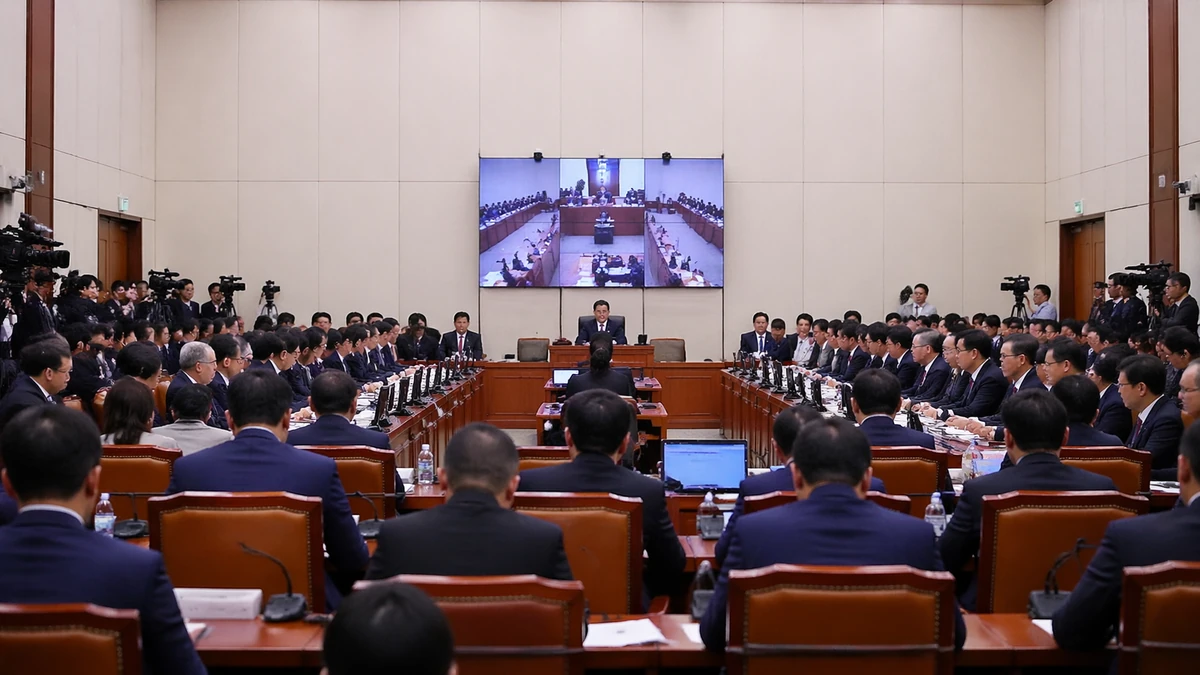
A hearing about investigations — and a larger fight over power
South Korea’s National Assembly held a high-stakes hearing on April 21 that, on paper, was supposed to examine a series of politically explosive allegations tied to the administration of former President Yoon Suk Yeol. In practice, it became something broader and, in some ways, more revealing: a public struggle over how Koreans should understand the use of prosecutorial power, the legitimacy of past investigations and the meaning of accountability after a change in government.
The hearing was conducted by a special parliamentary committee created to investigate what the ruling Democratic Party describes as suspected politically motivated indictments and manipulated prosecutions under the Yoon government. Lawmakers argued over several separate controversies, including the fatal 2020 shooting of a South Korean fisheries official by North Korean forces in waters near the western sea border, allegations of manipulated government statistics and a case involving allegedly false reporting tied to claims of defamation against Yoon.
But the significance of the session did not come from the number of cases under review. It came from the way South Korea’s two major political camps used the same hearing room to present radically different versions of the country’s recent past. For the Democratic Party, the issue was not simply whether one investigation or another was flawed. It was whether prosecutors — among the most powerful actors in South Korea’s legal and political system — were turned into instruments of a presidency. For the conservative People Power Party, the entire inquiry looked like an effort to recast criminal suspects and political allies as victims of persecution while undermining the judiciary and law enforcement.
To American readers, the closest comparison might be a congressional hearing that simultaneously tries to revisit a disputed national security episode, an alleged manipulation of official economic data and a fight over media freedom — while both parties use those issues to argue not just about the facts, but about whether the justice system itself has been weaponized. The details are uniquely Korean. The political logic is not unfamiliar.
That is why this hearing matters. More than a search for factual findings, it served as a “frame war” — a contest over who gets to define the terms of the debate before voters, institutions and history do it for them.
Why prosecutors occupy such a central place in Korean politics
To understand the heat surrounding the hearing, Americans need some context about South Korea’s prosecution service. In the United States, power in criminal justice is divided among local district attorneys, state attorneys general, federal prosecutors, police departments and a large, decentralized court system. In South Korea, prosecutors have historically exercised unusually broad authority over investigations, indictments and some of the most politically sensitive cases in the country. That has made the prosecution service a recurring target of reform efforts — and a recurring subject of suspicion.
These tensions intensified because Yoon himself is a former prosecutor general. Before entering politics and winning the presidency, he built a reputation as a hard-charging prosecutor involved in corruption cases. To supporters, that background suggested toughness and independence. To critics, it raised longstanding fears that prosecutorial institutions in South Korea are too politically influential and too easily pulled into factional conflict.
That broader history helps explain why the Democratic Party has leaned so heavily on the phrase often translated as “political prosecution.” The term does more than accuse prosecutors of making a bad judgment in a specific case. It implies a structural abuse of state power: that investigations were designed, sequenced or framed to serve political objectives rather than neutral law enforcement. In a country where prosecutors have long been both feared and influential, that is among the most damaging charges one can level.
This is also why the hearing’s rhetoric was so sweeping. Rather than narrowing the discussion to whether an individual indictment was supported by evidence, Democratic lawmakers argued that the pattern itself was the story. They suggested that prosecutors selectively used statements, documents and public narratives to build politically convenient conclusions. In that telling, the issue is not only guilt or innocence in a legal sense. It is whether South Korea’s justice apparatus was bent toward protecting a power center and targeting perceived enemies.
For Americans, it may help to think of this less as a technical committee hearing and more as a fight over whether one side gets to say, “the system worked,” while the other says, “the system itself was the problem.” Once the argument reaches that level, every disputed case becomes evidence in a larger moral and political indictment.
Why the Democratic Party is attacking the system, not just the cases
At the hearing, Democratic lawmakers appeared less interested in definitively resolving each individual allegation than in building a narrative about how investigations were initiated and shaped. One lawmaker, according to Korean reports, argued that materials related to an earlier savings bank scandal pointed to the conclusion that past investigations had effectively been softened or shut down, and that subsequent inquiries were launched on the basis of false testimony. The underlying accusation was not merely that prosecutors got something wrong. It was that they began from a political destination and built backward.
That distinction is important. When parties are confronted with multiple controversies that are legally and factually dissimilar, it can be difficult to persuade the public to see them as connected. One involves national security and the government’s response to a killing by North Korean troops. Another concerns whether official statistics were manipulated. Another involves questions about allegedly false reporting, defamation and the boundary between press freedom and prosecutorial overreach. On the surface, these are separate matters. Politically, however, they can be bound together if one argues that they all reveal the same operating method by the state.
That is what the Democratic Party is trying to do. Its argument is essentially structural. Rather than asking voters to master the details of every controversy, it is offering a unifying theory: that under Yoon, prosecution power became aligned with political objectives, and that different cases were expressions of the same governing instinct. In that framework, “political prosecution” functions as the adhesive that binds unrelated episodes into a single storyline.
There is strategic logic in that approach. A case-by-case defense is often messy and vulnerable to factual rebuttal. A structural critique can be more durable because it appeals to public distrust of concentrated power. It also allows the party to speak in a language that resonates beyond any one legal proceeding. South Koreans have spent years debating prosecution reform, elite impunity and whether powerful institutions are truly neutral. By placing this hearing within that larger debate, Democrats are making an argument not only about Yoon’s presidency, but about the kind of republic South Korea wants to be.
For an American audience, this resembles the way U.S. politicians sometimes move from disputing a single FBI investigation, inspector general finding or leak inquiry to making a much larger claim about “weaponization” or “deep state” behavior. Once the conflict is framed that way, the conversation shifts from evidence in a particular case to the nature of institutional power itself.
Why conservatives chose counterattack over simple defense
The People Power Party, Yoon’s conservative camp, did not simply answer by insisting that prosecutors followed the law. Instead, it moved aggressively to redefine the hearing as an attempt to politicize crime and rehabilitate allies. Conservative lawmakers argued, in essence, that the Democratic Party was trying to turn people facing criminal suspicion into political martyrs — figures akin to “prisoners of conscience” rather than defendants subject to legal scrutiny.
That rhetorical move matters because a purely technical defense would likely cede political momentum. If conservatives responded only by saying the investigations were lawful, they would remain on terrain chosen by their opponents: the legitimacy of prosecutorial conduct. By accusing Democrats of shielding wrongdoers and converting legal liability into political theater, conservatives tried to move the center of gravity. The question then becomes not “Did prosecutors abuse power?” but “Is the opposition refusing to accept lawful accountability?”
It is a familiar tactic in democracies where trust in legal institutions is uneven. Legal arguments are often too intricate to dominate public opinion on their own. The broader public may not follow the evidentiary disputes in a defamation-related case, or the procedural steps in an administrative data controversy, or the exact chain of command in a national security decision. But voters do understand blunt moral contrasts. “Who is protecting the public?” and “Who is covering for allies?” are simpler questions than “Was prosecutorial discretion properly exercised?”
In that sense, the People Power Party’s response was not just defensive. It was an attempt to seize the offensive in the arena of public common sense. South Korean politics, like American politics, is heavily influenced by messaging that compresses complexity into emotionally legible frames. Conservatives appear to believe that if this inquiry becomes a seminar on prosecution reform, they could lose ground. If it becomes a referendum on whether Democrats are trying to relitigate criminal allegations for partisan gain, the terrain shifts in their favor.
That is why the hearing felt less like a courtroom and more like a campaign rehearsal. Each side was speaking to multiple audiences at once: core supporters, swing voters, legal elites, the media and the bureaucratic institutions whose reputations were on the line.
Why these unrelated controversies were put on one table
One of the most striking aspects of the hearing was the decision to place very different controversies under the umbrella of a single special committee. The shooting of a government employee by North Korean forces involves national security, military judgment and crisis response. Allegations of manipulated statistics involve the integrity of public administration and policy evaluation. Claims involving allegedly false reporting and defamation prosecutions touch on press freedom, political speech and the line between falsehood and criminalization.
In ordinary circumstances, each of these matters could generate its own discrete inquiry. Bringing them together creates a different political effect. It invites the public to interpret them not as isolated incidents, but as chapters in a common story about how state power was exercised during the previous administration. That broadens the stakes. A hearing like this is no longer just about determining whether a specific official acted improperly. It is about judging an entire style of governance.
That, too, has a recognizable analogue in U.S. politics. Congressional committees often bundle issues together to suggest a larger pattern — whether involving executive overreach, intelligence failures, politicized law enforcement or media manipulation. The details differ, but the logic is similar: a mosaic is more powerful than a set of disconnected tiles.
For South Korea’s governing party, the advantage is obvious. By grouping controversies together, it reduces the burden of proving each one in exhaustive detail before making a broader political case. It can argue that, taken together, the episodes reveal a consistent disposition toward controlling narratives and institutions. For the opposition, the same bundling creates an opportunity to say the inquiry is overreaching, ideologically loaded and designed to convert every past dispute into evidence of a predetermined verdict.
There is also a deeper pattern at work in Korean politics. After changes in power, South Korea often undergoes intense periods of retrospective judgment aimed at the immediately preceding administration. These moments are not quite truth commissions in the historical sense, but they do function as political reckonings. The question is not only what happened. It is what the last government should come to represent in the public mind.
This committee appears to be operating in precisely that space. It is investigating recent controversies, but it is also participating in a larger struggle over whether the Yoon years will be remembered mainly as a period of legitimate law enforcement or as a period of institutionalized political prosecution.
What this says about institutional trust in South Korea
The danger in this kind of confrontation is that both sides can damage the institutions they claim to defend. When Democrats argue that prosecutors functioned like the private instrument of a president, they cast doubt on the neutrality of one of the country’s most important law enforcement bodies. When conservatives suggest the parliamentary inquiry itself is little more than a partisan shield for suspected wrongdoing, they risk diminishing faith in the legislature’s oversight role.
That matters because both institutions are central to South Korean democracy. The prosecution service, whatever its flaws, remains a key actor in enforcing the law in a country that has repeatedly prosecuted former presidents, corporate tycoons and senior officials. The National Assembly, for its part, is one of the few arenas where executive conduct can be publicly investigated in a highly visible way. If public faith erodes in both at once, the result is not balance. It is institutional exhaustion.
Americans will recognize this problem. In the United States, years of partisan conflict over the Justice Department, FBI, special counsels, impeachment inquiries and congressional oversight have produced a familiar pattern: every investigation is seen by many voters as either a heroic act of accountability or a political hit job. South Korea now appears to be wrestling with a comparable dilemma, intensified by its more centralized prosecution system and its history of hard-fought battles over democratic institutions.
Reports from the hearing described clashes not only over substance but over procedure, including protests by People Power Party members over how the committee chair was conducting the session. That detail may sound technical, but it is politically important. In highly polarized environments, process becomes substance. Fights over speaking time, witness selection, meeting order and committee authority become proxies for a deeper argument over fairness itself.
In other words, the hearing was not just a dispute over the truth. It was also a dispute over who has the legitimate right to determine the truth. Once politics reaches that stage, resolution becomes much harder. Even credible findings can be dismissed as procedurally tainted; even careful oversight can be denounced as partisan theater.
A democracy arguing over its next rules
It is too early to say what legal or political consequences this special committee will ultimately produce. A single hearing rarely settles complex disputes, and there is not yet enough from the public record to declare that the accusations against past investigators have been proved or disproved. But the immediate outcome is already clear enough: the hearing exposed that the central struggle is not only over past events, but over the standards by which future Korean politics will operate.
That is why the phrase “frame war” is so useful here. In politics, the side that defines the frame often gains an advantage before the evidence is even fully digested. If the Democratic Party succeeds in persuading the public that these controversies reveal systemic abuse by a politicized prosecution service, it will have strengthened its case for reform and for a harsher judgment on the Yoon era. If the People Power Party succeeds in convincing voters that the inquiry is a cover for allies and a partisan attack on legitimate criminal investigations, then the committee may end up reinforcing conservative arguments about opposition irresponsibility.
For American readers, the broader lesson is that South Korea’s democratic battles are not merely local dramas, nor are they opaque rituals best left to specialists. They reflect pressures facing many democracies: how to hold power accountable after a transfer of power, how to keep law enforcement credible when politics is intensely polarized and how to distinguish genuine oversight from partisan score-settling when every side claims the mantle of democracy.
South Korea remains one of the world’s most vibrant democracies, with a fiercely competitive press, highly engaged voters and institutions strong enough to stage these confrontations in public rather than suppress them. But vibrancy has a cost. The more politics becomes a contest over whether core institutions are fundamentally trustworthy, the harder it becomes to rebuild consensus after the cameras are gone.
The hearing at the National Assembly was supposed to revisit a set of disputed cases. Instead, it revealed something larger and more consequential: South Korea is debating not just what happened under the last government, but who gets to define abuse, legitimacy and justice in the next one. That is a fight over memory, law and power all at once — and it may outlast any single headline, committee report or round of parliamentary fireworks.
Comments
Post a Comment