A comeback that means more than a reunion
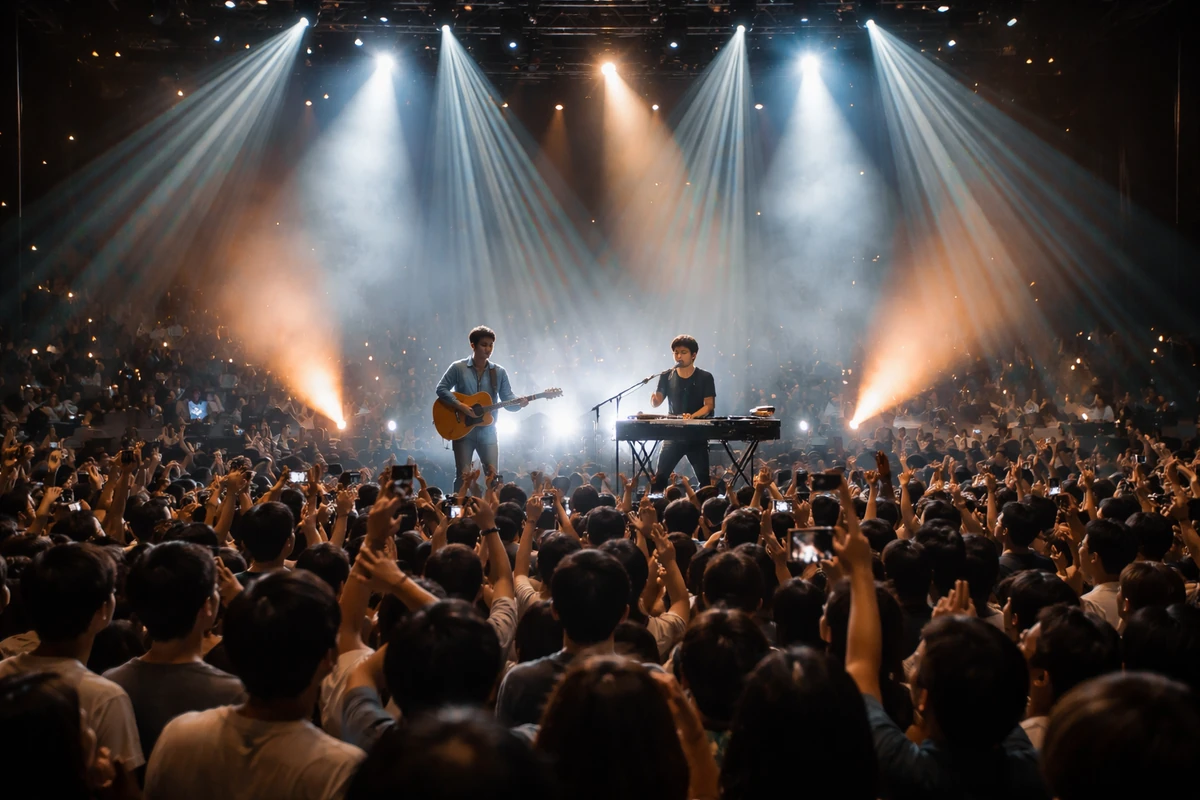
In South Korea’s pop landscape, where the spotlight often belongs to the newest idol group, the most consequential live music moment this month did not come from a flashy debut. It came from a name that had been absent for so long that, for some younger listeners, it may have felt closer to legend than a working band. According to Korean media reports, the duo Panic returned to the stage on Nov. 16 at Seoul’s LG Arts Center with a solo concert titled “Panic Is Coming,” their first domestic performance under the Panic name since 2006. For a country that moves quickly through music trends, that kind of gap is not just a hiatus. It is nearly a generational divide.
That is what made the show significant. This was not simply a reunion designed to stir up memories and sell tickets on sentiment. In South Korea, as in the United States, reunion concerts can sometimes function like museum exhibits: beloved, profitable and emotionally satisfying, but fundamentally backward-looking. Panic’s return appears to have landed differently. The significance was not only that the duo came back after 20 years, but that it reportedly returned with enough force, chemistry and relevance to make the night feel like a present-tense event rather than a commemorative exercise.
For American readers unfamiliar with Panic, the pair occupies an unusual place in Korean popular music history. The group, made up of singer-songwriter Lee Juck and rapper-performer Kim Jin-pyo, debuted in 1995 and developed a reputation for combining melodic sophistication, literary lyrics, irony and a kind of off-center social skepticism. That mix gave them a distinct identity during a transformative period in Korean pop, when the industry was modernizing rapidly but had not yet become the globally scaled K-pop machine many international fans recognize today. If today’s Korean music exports are often understood through polished choreography, fandom platforms and tightly managed idol branding, Panic belongs to an earlier and somewhat messier lineage: one rooted in songwriting, experimentation and personality.
By all accounts, the concert’s emotional power came from more than hearing old favorites again. It came from seeing whether a duo associated with a different era could still make its art feel alive. That question matters in Korea’s cultural economy, where speed is everything and where artists are under pressure to remain constantly visible. The achievement of Panic’s return, if the response to the concert is any indication, was not simply that the duo reappeared. It was that the group managed to turn absence into dramatic weight and memory into renewed meaning.
Why Panic matters in Korean music history
To understand why this comeback resonated, it helps to know what Panic represented in the first place. In the mid-1990s, South Korea’s mainstream music scene was broadening fast. Dance music was booming, ballads were central to the market and the foundations of modern K-pop were being laid. Yet Panic stood apart. Lee Juck brought a resonant voice and the instincts of a serious songwriter; Kim Jin-pyo contributed rap, performance energy and, notably, saxophone, helping create a sound that could feel both melodic and unstable in interesting ways. The result was a duo that was never entirely easy to categorize.
That matters because Korean pop music, much like American pop, has long rewarded artists who can fit neatly into commercial boxes. Panic did not always do that. The duo was accessible without being simplistic, clever without becoming self-satisfied and emotionally direct without losing its edge. In an American frame of reference, Panic’s role may be easiest to understand by imagining an act that could appeal to a general audience while still retaining the sensibility of alternative rock, literate songwriting and socially observant pop. It was music that could work on radio but still make listeners feel like they were in on something sharper and stranger than mainstream convention usually allowed.
The group is especially remembered for songs such as “Snail,” “Left-Handed Person,” “UFO” and “The Sea in My Old Drawer,” tracks that have endured across generations. Those songs remain familiar not only because of melody, but because of the perspective embedded in them. Panic’s writing often examined alienation, prejudice, social absurdity and the private shadows people carry through ordinary life. That approach gave the duo a durability that many trend-driven acts never achieve. Listeners did not simply consume Panic songs as seasonal hits. They lived with them.
In South Korea, where social conformity has often been a powerful cultural force, Panic’s sensibility also carried a particular charge. The song “Left-Handed Person,” for instance, became iconic in part because it turned a literal trait into a wider metaphor for difference and stigma. For American audiences, the closest equivalent may be the way certain singer-songwriters or alternative bands become shorthand for a generation’s unease with the rules it inherited. Panic’s catalog offered a language for people who felt slightly out of step with the social script. That made the group important then, and it helps explain why its music can still speak now.
More than old hits: Why the songs still connect
The easiest way to market a comeback concert is to lean on recognizable titles and promise a trip back in time. Panic certainly had the material for that. Its best-known songs are the kind that can fill a venue with instant recognition. But focusing only on the hits would miss the deeper story. What appears to have impressed concertgoers was not simply the thrill of hearing familiar songs, but the realization that the songs still had interpretive power in the present.
That is a harder achievement than it sounds. Nostalgia is one of the most reliable products in modern entertainment, but it has limits. A song can revive a memory without saying anything new to the listener who has aged along with it. Panic seems to have cleared that hurdle because the themes in its music were never confined to youthful longing. The duo’s work dealt with social contradiction, personal discomfort, irony and emotional estrangement — subjects that do not disappear as a generation moves from adolescence into middle age. If anything, those ideas often become more complicated over time.
This is one reason the comeback appears to have avoided the feel of a retro package. In Korea, as in the United States, successful revivals usually require more than accurate reconstruction. They require translation — taking the emotional logic of the past and making it intelligible in the language of the present. Panic arguably had an advantage there. The issues its songs wrestled with, from bias to absurdity to the hidden burdens of modern life, are not period pieces. They remain current, even if the context has changed. South Korea in 2024 is wealthier, more globally influential and more digitally connected than it was in the 1990s, but it is also a society still grappling with fierce competition, generational anxiety, pressure to conform and widening debates over identity and inequality.
That gives Panic’s catalog renewed relevance. Songs that once captured the mood of one era can now be heard as commentary on a different one. In that sense, the concert seems to have functioned not merely as a replay of remembered music but as a test of whether old material could still illuminate current life. By that standard, the show’s success matters. It suggests that Panic’s songs have outlived the moment that produced them and entered a smaller, more durable category: music that keeps finding new listeners because it keeps finding new meanings.
What middle age changes — and what it does not
Part of the fascination around the concert lies in who Lee Juck and Kim Jin-pyo are now. Korean media noted that Lee is 52 and Kim 49. That detail matters because Panic was never just a youthful act, but youth was inevitably part of its early aura. Rebellion sounds different when it comes from artists in their 20s than when it comes from artists with decades of public and personal history behind them. The question facing any comeback like this is whether age softens the original edge into harmless memory, or refines it into something deeper.
By reports from the show, Panic chose the latter path. Rather than trying to imitate the exact posture of their younger selves, the duo appears to have embraced a more mature version of its identity. That distinction is crucial. There is often something faintly sad about veteran performers trying to cosplay their own past. But there can be something powerful about artists revisiting the same themes with the accumulated weight of experience. If Panic’s early work was fueled by alertness to hypocrisy and emotional dislocation, those instincts may be even more credible now, not less.
Lee Juck reportedly told the audience that the concert was precious to him and that being welcomed so warmly was a great blessing for someone who makes music. That kind of remark may sound simple, but it helps explain why the event seems to have felt emotionally real rather than strategically engineered. In the current music business, where every major event risks looking like a carefully optimized brand maneuver, sincerity can be its own disruptive force. Panic’s return appears to have carried that quality.
The duo’s internal chemistry also remains central. Panic was always defined by the productive tension between two very different artistic personalities. One brought compositional depth and lyrical subtlety; the other brought performance contrast, rap cadence and sonic unpredictability. In any reunion, chemistry is more important than chronology. Fans can forgive the years apart if the old spark still generates something new. The real question is not whether two artists can stand onstage together again, but whether their differences still create friction worth hearing. The enthusiastic response to this concert suggests that Panic answered that question in the affirmative.
For American readers, there is a familiar pattern here. Some of the most compelling comeback stories in U.S. music are not those in which artists prove they are unchanged, but those in which they show how the original core of their work has survived transformation. Middle age can hollow out a band’s mythology, but it can also rescue it from cliché. Panic’s concert appears to have done the latter, presenting rebellion not as adolescent swagger but as a continued refusal to look away from life’s distortions.
In an idol-driven market, a different kind of success
Panic’s return also says something broader about the state of South Korea’s concert industry. Much of the global attention on Korean music rightly centers on K-pop’s industrial scale: stadium tours, digital fandoms, elaborate merchandising systems and a relentless content cycle that keeps artists in constant circulation. That ecosystem has been astonishingly effective, and it has reshaped how the world understands Korean culture. But it is not the whole story of Korean music, nor does it define every form of artistic value in the market.
The Panic concert highlights an alternate measure of significance. Not every notable show is the biggest show. Some performances matter because they revive a piece of shared cultural memory and prove it still has the ability to organize feeling in the present. In the United States, legacy acts often survive by trading on familiarity alone; in South Korea, where the mainstream ecosystem skews younger and more accelerated, older names face an even steeper challenge. A long-absent act cannot rely on prestige by itself. It has to demonstrate that its identity can still be embodied live — through performance quality, song durability and emotional connection with the audience.
That appears to be why this comeback drew such notice. It was not only a story about two musicians returning. It was also a reminder that Korean popular music has a history broader than the idol system and that audiences still make room for artists whose authority comes from craft, repertoire and intellectual temperament rather than nonstop exposure. In a marketplace structured increasingly around visibility metrics, Panic’s success suggests that scarcity can create its own kind of power, provided the work itself remains persuasive.
There is also an industry lesson here for other veteran artists. A comeback built purely on name recognition risks becoming a one-night exercise in emotional recycling. But when older material still speaks to current anxieties, return can become reinvention. Panic’s concert seems to have modeled that possibility. It offered a version of legacy that did not require shrinking into self-parody or competing directly on the terms of younger acts. Instead, it asserted a different value proposition: that songs with staying power, performed with conviction, can cut across generations even in a market obsessed with the next release.
What American audiences can learn from this moment
For English-speaking readers who primarily encounter Korean music through K-pop exports, Panic’s comeback is a useful reminder that South Korea’s cultural history is richer and more stylistically diverse than the global shorthand often suggests. There is a tendency in the American imagination to treat Korean music as synonymous with idol groups, synchronized choreography and hypermodern pop spectacle. Those elements are real and important. But they sit alongside a long tradition of singer-songwriters, bands, hip-hop artists and hybrid acts that speak to different corners of Korean life.
Panic belongs to that wider story. The duo’s music is not best understood as an earlier version of K-pop, but as part of a broader Korean popular music tradition that valued sharp writing, genre mixing and emotional intelligence. That may be one reason its return resonates even for people who do not follow every twist of the Korean entertainment industry. The questions Panic raises are not uniquely Korean. What does it mean for music to age well? How does rebellion evolve once the rebels grow older? Which songs remain useful after the social world that produced them has changed?
Those are questions American audiences know well, whether through legacy rock acts, folk revivalists, politically minded hip-hop veterans or singer-songwriters whose catalogs deepen as listeners age. What makes Panic’s story distinct is the Korean context: a society that has transformed at extraordinary speed over the past three decades, and an entertainment industry that has become one of the country’s most visible global exports. In that environment, a 20-year return by an act associated with wit, skepticism and lyrical depth carries symbolic force. It suggests that even in a hyperaccelerated culture, there remains an appetite for artists who can slow down the cycle and reintroduce complexity.
The biggest takeaway from Panic’s comeback may be its rejection of a false choice between nostalgia and relevance. Too often, older acts are expected to serve one function or the other: either preserve the past or prove they still belong in the present. Panic appears to have done both. The concert reportedly gave longtime fans the emotional recognition they came for, while also making a case that the duo’s core artistic concerns — alienation, contradiction, prejudice, emotional endurance — remain urgent. That is a rare balancing act in any music culture.
Whether this performance leads to new music or more sustained activity remains unclear. But even without a larger campaign attached, the concert seems to have accomplished something meaningful. It showed that a band can disappear for decades and still return not as a relic but as a live argument — an argument for the durability of good songs, for the value of artistic friction and for the idea that music rooted in honest observation can outlast the market conditions that first shaped it. In a year crowded with polished spectacle, Panic’s comeback offered something harder to manufacture: proof that time away does not have to mean irrelevance, and that the most moving return is the one that tells listeners not just who they were, but who they are now.
Comments
Post a Comment