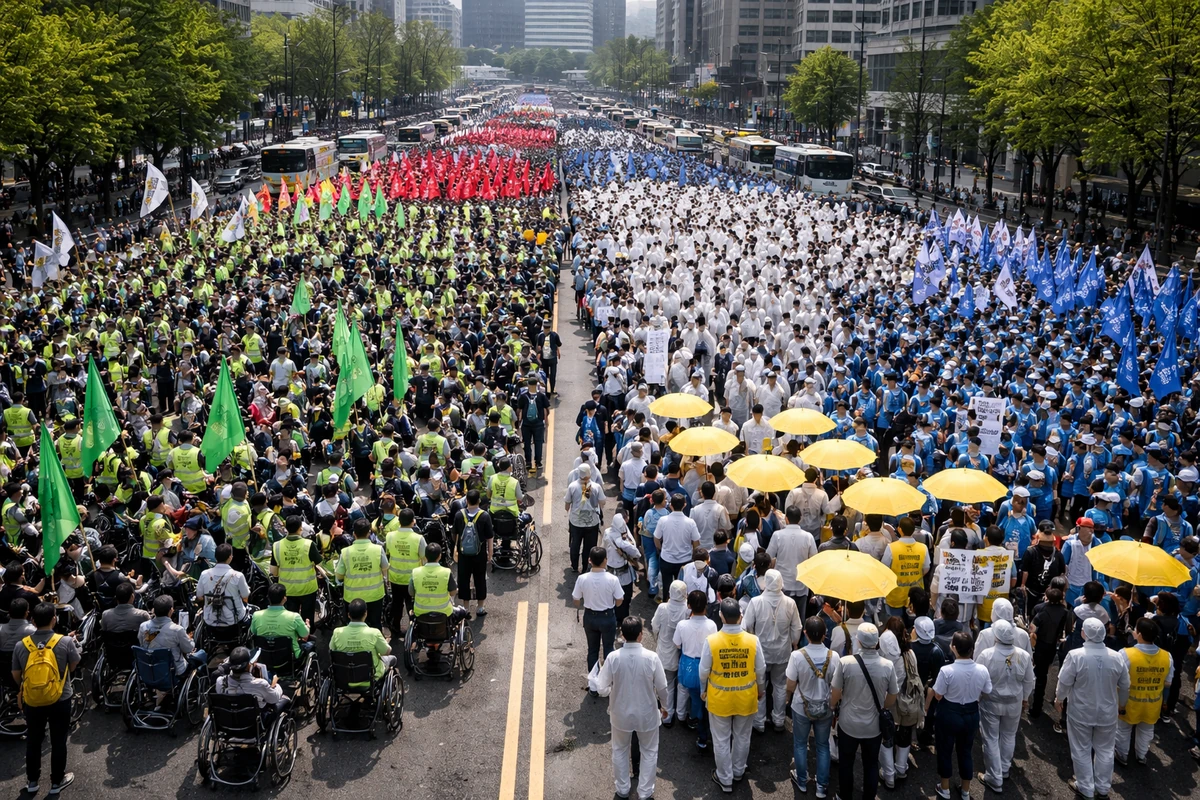
A day meant for recognition became a day of reckoning
SEOUL — On paper, Disability Day in South Korea is supposed to be a moment of national recognition — an annual marker intended to affirm that disabled people are not objects of charity but citizens with rights. In practice, this year’s observance in Seoul looked less like a celebration than a public argument over what those rights actually require.
On April 20, three separate demonstrations unfolded in central Seoul within hours of one another, each claiming to speak for disabled people and each pressing the government for change. Near the National Assembly subway station in western Seoul, a parents’ advocacy group called for a parliamentary investigation into abuse allegations at residential facilities for disabled people. Around the same time, a major association representing disability welfare facilities gathered in front of the National Assembly to defend the rights of people currently living in those institutions and to push back against rapid moves toward deinstitutionalization. Later in the afternoon, a coalition of 207 civic and disability rights groups rallied in the historic Gwanghwamun area, demanding broader action against discrimination in transportation, education, employment and housing.
The scene captured a turning point in South Korea’s disability debate. The broad principle — that disabled people deserve full rights and equal standing — is no longer the central point of dispute. The deeper argument now is about where those rights are best secured: inside institutions that promise care and supervision, in community-based living arrangements that emphasize autonomy, or in some more complicated system that rejects an all-or-nothing choice.
For American readers, the debate may sound familiar. It echoes long-running arguments in the United States over nursing homes, psychiatric institutions, group homes, Medicaid-funded community care and the meaning of independent living after the Americans with Disabilities Act and the Supreme Court’s 1999 Olmstead decision, which recognized the right of many disabled people to receive services in the most integrated setting possible. South Korea’s legal and political landscape is different, but the underlying question is much the same: When governments say they support dignity, who gets to define what dignity looks like in daily life?
That question was visible across Seoul on Monday. The demonstrations were different in tone, symbolism and policy demands. But together they suggested that South Korea’s disability politics have entered a more difficult, more mature phase — one where slogans are no longer enough and where competing claims of care, safety, autonomy and choice are colliding in public.
Why April 20 matters in South Korea
In South Korea, Disability Day is not merely ceremonial. It carries the weight of an unfinished civil rights project. For years, activists have argued that disabled Koreans have been treated too often through the lens of welfare, pity or family burden rather than as equal participants in public life. That distinction matters in a country where disability policy has historically been shaped by a mix of rapid economic development, strong family responsibility norms and a welfare state that expanded more slowly than in many Western democracies.
To understand the significance of this year’s demonstrations, it helps to understand how disability has often been framed in Korea. Public discourse has long swung between two poles: disabled people as recipients of care and disabled people as rights-bearing citizens. The first frame can produce services, but it can also reinforce hierarchy and dependency. The second foregrounds equal access to schools, jobs, transit, housing and political participation, but it also forces the government to confront expensive structural reforms that are harder to deliver than symbolic gestures.
That tension is especially visible on Disability Day. The date can function as a feel-good occasion featuring speeches and pledges. But for many activists, it is closer to a test: Are public officials willing to tackle inaccessible subway stations, underfunded support services, exclusion from workplaces and schools, and the lack of safe alternatives to institutional care?
This year, the answer from the streets appeared to be no — or at least not enough. Each protest pointed to a different failure. One side said the state has not prevented abuse in closed institutional settings. Another said the state is pushing policy change without securing the rights and stability of current residents. A third argued that the entire conversation must be located within a broader fight against discrimination, not reduced to a narrow administrative debate about facilities.
In other words, what happened in Seoul was not simply a policy disagreement. It was a struggle over the language of citizenship itself.
The parents’ march and the demand for a national investigation
The day’s most striking image came from members of the National Solidarity of Parents of Persons with Disabilities, who staged an act of protest known in Korea as “ochetuji,” a form of full-body prostration in which demonstrators lower themselves to the ground repeatedly as they move forward. For Americans unfamiliar with the term, it is a physically punishing act often associated with moral urgency and humility, a way of conveying that ordinary petitions have failed and that only the most desperate public appeal remains.
The parents’ group used that tactic to call for a formal National Assembly investigation into abuse cases at disability residential facilities. Their message went beyond any single allegation. They were asking lawmakers to examine whether the broader system of oversight, staffing, reporting and protection is fundamentally inadequate.
That demand speaks to a recurring problem in institutional settings, in Korea as elsewhere. Facilities are often designed as places of protection and support, especially for people with high care needs or families who cannot provide round-the-clock assistance. But institutions can also become opaque environments where residents have limited outside contact, family members struggle to monitor conditions and abuses are difficult to detect quickly. When complaints do surface, they may be handled as isolated incidents rather than signs of systemic risk.
The parents’ argument, as reflected in the demonstration, is that such abuse cannot be dismissed as the misconduct of a few workers or a handful of bad facilities. If abuse keeps appearing in settings that are supposed to provide safety, then the problem may lie in the structure itself: how residents are placed, how workers are trained and supervised, how complaints are investigated, and how much power residents actually have to refuse mistreatment or leave.
That is why a parliamentary investigation matters politically. In South Korea, a National Assembly probe signals that the issue has moved beyond local administration and into the realm of state accountability. It asks not only whether crimes were committed, but whether the system was built in a way that made those harms more likely and easier to hide. For parents who have spent years navigating care systems with little transparency, the demand is also an indictment of delay — a claim that routine administrative responses have not been enough.
There is a poignant paradox here. Families often turn to institutions because they fear what will happen without them: isolation, unmet medical needs, caregiver exhaustion or outright neglect at home. Yet some of those same families now say the institutions themselves have become sites of danger. That contradiction is not uniquely Korean. It has haunted disability and elder care systems in the United States for decades, from state-run institutions exposed for abuse to more recent scandals in nursing homes and group homes. The Korean protest, then, was not merely local. It tapped into a global anxiety about what happens when care is delivered behind closed doors.
The counterargument: Institutions, rights and the fear of being pushed out
If the parents’ protest highlighted the dangers of institutional life, the demonstration in front of the National Assembly highlighted a different fear: that in the rush to embrace deinstitutionalization as a moral imperative, policymakers may overlook the wishes, needs and daily realities of people who currently live in facilities.
The Korea Association of Disability Welfare Facilities argued that the rights of institutional residents must not be ignored. That position can sound, to outside ears, like a defense of the status quo. But the language used by the group points to a more complicated concern. For many residents, a facility is not merely an abstract policy problem; it is where they sleep, eat, receive medical attention and maintain routines that, however imperfect, shape the stability of their lives.
In American terms, imagine the debate around closing long-term care institutions without first ensuring accessible apartments, personal care attendants, transportation, local health services and emergency support are all in place. The idea of “community living” can sound unquestionably humane in principle. In practice, it depends on whether communities are actually prepared to support people with complex disabilities. If they are not, then a policy meant to expand freedom can produce displacement, confusion and new forms of risk.
That appears to be at the heart of the facilities association’s argument. Its message is not simply that institutions should remain forever untouched. Rather, it is that rights do not disappear the moment someone is labeled an institutional resident. If people are currently living in facilities, then their immediate rights to safety, dignity, routine, health care and meaningful choice still have to be protected. A transition plan that treats them as numbers in a reform agenda rather than individuals with different needs and preferences can itself become a rights violation.
This is one reason the institution-versus-community framework can be misleading. Not every facility is the same, and not every resident faces the same options. Some disabled people and their families want to leave institutions but cannot because community supports are inadequate. Others may fear leaving because family caregivers are aging, housing is inaccessible or neighborhood-based services are too thin. Some may not have been given a real choice at all.
The risk, critics of rapid deinstitutionalization say, is that a policy built around an admirable principle could devolve into ideological simplification. Closing facilities is easier to announce than building a robust network of supported housing, personal assistance services, respite care, mental health care and inclusive local infrastructure. If the state does the first without the second, it may simply relocate hardship from one setting to another.
That does not resolve the moral problems institutions pose. But it does complicate them. And that complication was plainly visible in Seoul, where one group was demanding structural scrutiny of facilities while another was insisting that the people inside those facilities not be erased by reform rhetoric.
A broader movement says the real issue is discrimination
The third gathering of the day, held near Seosipjagak in the Gwanghwamun area, widened the lens. Organized by a coalition known as the April 20 Joint Struggle Group for the Elimination of Disability Discrimination and involving 207 organizations, the rally did not focus on just one institutional controversy. It framed disability policy as a broad civil rights issue spanning mobility, education, labor and housing.
That distinction matters. In South Korea, some of the most visible disability activism in recent years has centered on transportation access, especially protests involving subway systems. Those demonstrations have been disruptive, controversial and highly effective in forcing public attention. The point has been simple: If disabled people cannot reliably use public transportation, then promises about employment, education and social participation are hollow. Civil rights begin with the ability to get where life happens.
The Gwanghwamun rally drew on that larger rights tradition. By bringing together hundreds of groups — including disability organizations, parents’ groups, rights advocates and civic organizations — it underscored that the argument over facilities is only one part of a wider failure to build an inclusive society. A country can debate where disabled people should live, but if schools remain inaccessible, employers discriminate, wages are low, buses and subways are difficult to use and support services are inconsistent, then “choice” becomes a largely theoretical concept.
Gwanghwamun itself is symbolically important. It is one of the civic and political hearts of Seoul, a place associated with large-scale demonstrations and national debates. Holding a disability rights rally there sends a clear message: This is not a fringe welfare issue to be handled quietly by ministry officials. It is a central democratic question about who counts as a full member of society.
For American readers, there is a familiar pattern here as well. Disability rights movements often have to resist being boxed into a charity framework. Once an issue is defined only as care for a vulnerable group, the public may support limited aid while avoiding harder questions about unequal access, exclusionary design and political power. By contrast, when disability is framed as a civil rights issue, the conversation expands to include budgets, infrastructure, labor markets and the design of public space.
That appears to be what the 207-group coalition was insisting on Monday: that abuse prevention, residential policy and anti-discrimination enforcement are not separate topics but interconnected signs of how incomplete South Korea’s social contract remains for disabled citizens.
Why people using the same word — rights — still sound opposed
Perhaps the most revealing aspect of the day was that all sides were speaking the language of rights. The parents’ group was demanding the right to safety and accountability. The facilities association was invoking the rights of current residents to stability and dignified living conditions. The larger coalition was calling for equal access across public life. Yet those demands, voiced under the same sky in the same city, appeared to pull in different directions.
That is not because one side supports rights and the other opposes them. It is because rights can come into tension when the state has failed to build enough capacity to honor them all at once. If community services are weak, the right to leave an institution may collide with the need for dependable care. If institutional oversight is poor, the right to protection may collide with the reality that some families still rely on those settings. If public systems remain inaccessible, then the formal right to inclusion may ring hollow regardless of where a person lives.
This is a familiar pattern in social policy. Scarcity turns moral principles into zero-sum fights. When governments underinvest in support services, housing, staffing, transit and oversight, affected groups are pushed to defend the piece of the system they know, even when they recognize its flaws. Under those conditions, “choice” can become a slogan covering for the absence of real options.
South Korea’s disability debate is also shaped by its own social structure. Family caregiving has historically borne a heavy burden, and public welfare expansion has often lagged behind social need. Rapid aging, rising care demands and economic pressure on households intensify the stakes. In that environment, arguments about institutional care are not abstract philosophical disputes. They are about who will provide labor, who will pay, who will monitor conditions and what happens when families can no longer absorb the strain.
There is also a deeper cultural and political layer. Korean social movements have a long history of using street protest to force recognition from institutions seen as slow or indifferent. The use of prostration, the choice of the National Assembly and Gwanghwamun as protest sites, and the focus on state responsibility all reflect that tradition. These are not merely symbolic locations; they are pressure points in a democracy where public visibility is often necessary to move policy.
So when the day’s demonstrations looked contradictory, they were also revealing something more fundamental: rights discourse has expanded, but the policy architecture needed to reconcile competing rights has not kept pace.
What this moment says about South Korea’s next test
The most important takeaway from Seoul’s Disability Day protests may be that South Korea can no longer treat disability policy as a matter of small adjustments around the edges. The old model — offering limited welfare support while avoiding deeper structural reform — appears increasingly untenable. Too many constituencies are now insisting, from different vantage points, that the existing system is failing.
If there is a path forward, it likely cannot rest on slogans such as “protect institutions” or “abolish institutions” alone. A credible agenda would have to include several things at once: stronger and more transparent oversight of facilities; real investigative power when abuse allegations surface; expansion of community-based housing and personal support services; sustained consultation with disabled people themselves, including current residents of institutions; and a broader anti-discrimination framework that connects housing and care to transportation, education and work.
That kind of agenda is difficult and expensive. It also requires political patience and administrative competence — commodities in short supply in many democracies, not just South Korea. But the alternative is visible in the fractured geography of Seoul’s protests: multiple groups speaking urgently to the state because each believes the current system recognizes only part of their reality.
For Americans following South Korea mostly through K-pop, film, technology and geopolitics, this may be a reminder that the country’s domestic social debates are as consequential as its global cultural exports. South Korea is often described as modern, hyperconnected and fast-moving. Yet like the United States, it is still wrestling with basic questions about dependency, public obligation and who gets to live with autonomy and respect.
On a day meant to honor disabled citizens, Seoul instead showcased an unresolved democratic challenge. The parents bowing their bodies to the pavement, the facilities advocates defending residents’ immediate lives, and the coalition filling Gwanghwamun with demands for equal access were not engaged in separate stories. They were contesting the same question from different angles: What does it take for a society to mean it when it says disabled people have rights?
Until South Korea can answer that with more than ceremony, Disability Day is likely to remain what it was this year — not a celebration of inclusion achieved, but a public ledger of promises still unmet.
Comments
Post a Comment