A Korean star’s next move says a lot about where Korean entertainment is headed
In Hollywood, the usual playbook after a breakout hit is easy to recognize: sign the franchise, chase the sequel, stay inside the image that made you famous. South Korea’s entertainment industry, now deeply tied into that same global attention economy, often creates similar pressure. Once an actor becomes associated with a viral role, the temptation — from studios, platforms and fans alike — is to keep serving the same thing in slightly different packaging.
That is why Ahn Hyo-seop’s latest career move stands out.
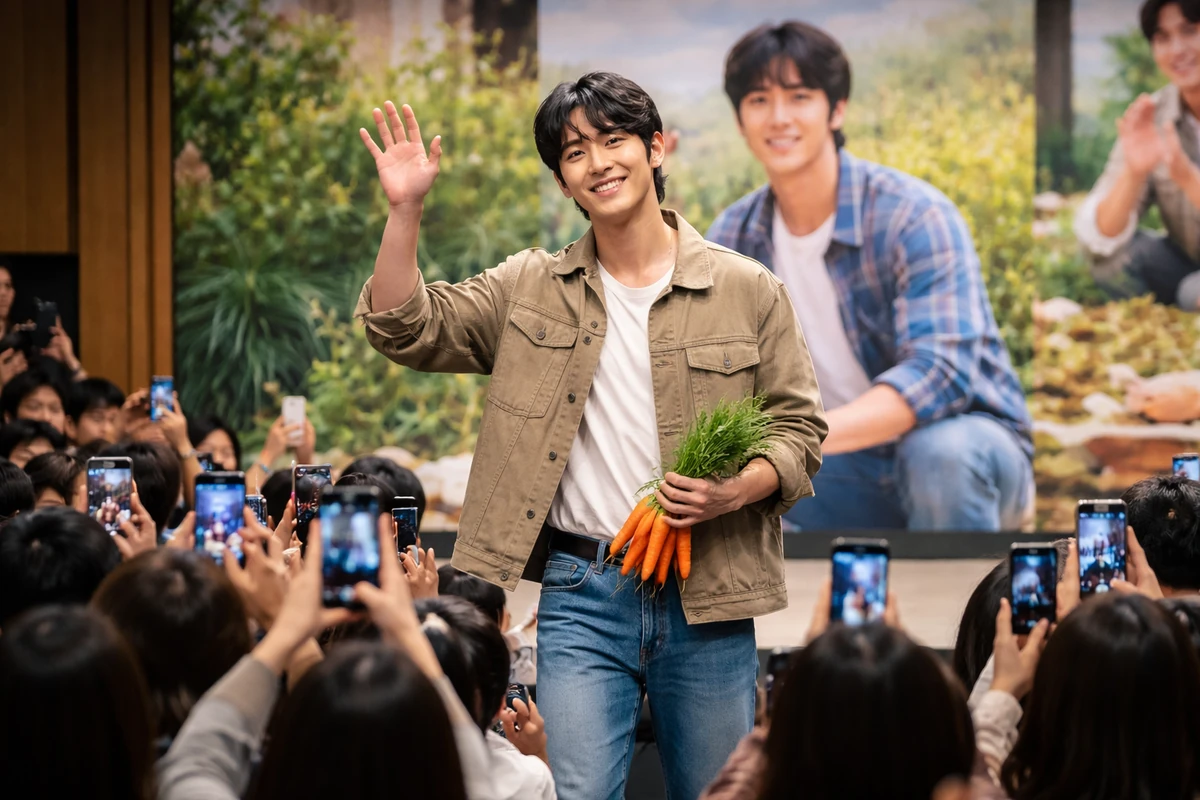
At a production presentation in Seoul on April 15 for the new SBS Wednesday-Thursday drama “Today, We’re Sold Out Again,” Ahn appeared not as a slick fantasy lead or a stylized K-pop icon, but as the star of a grounded television drama centered on a young farmer. The moment was about more than a new series launch. It was, in effect, a public statement about what comes after international success.
Ahn arrives at this point with unusual momentum. He recently drew major attention through the Netflix animated film “K-pop Demon Hunters,” a project that pushed him into the kind of global conversation few Korean actors reach so quickly. According to reports from the Seoul event, he even referenced attending the Academy Awards in the United States in connection with that project’s success. For an actor who had just been associated with a flashy, globally legible piece of pop spectacle, his choice to return to a traditional Korean broadcast network drama — and one rooted in rural life, no less — reads less like a retreat than a recalibration.
For American audiences, it may help to think of the contrast this way: imagine an actor who has just become internationally recognizable through a genre juggernaut, maybe a superhero-adjacent streaming hit or a massively successful animated musical, then choosing next to star in a small-town network drama about labor, family and local community. Not as an ironic detour, not as awards bait, but as a serious career move. That is the kind of turn Ahn is making.
His decision also says something broader about Korean entertainment in 2026. Even as Korean content becomes more global, the people at the center of it still have to navigate two overlapping audiences: international viewers who may know them through a single breakout title, and domestic viewers who expect range, relatability and emotional credibility over the long haul. Ahn’s return to broadcast television puts both audiences into the same frame.
And for SBS, one of South Korea’s three major terrestrial broadcasters, the casting is a test of whether old television institutions can still turn global fame into durable local storytelling.
Why broadcast TV still matters in South Korea
To many Americans, the phrase “broadcast television comeback” might sound almost nostalgic, as if an actor were stepping back from the future into legacy media. In South Korea, the calculation is more complicated.
Streaming platforms such as Netflix have transformed the Korean content business, helping turn K-dramas and Korean films into global exports in a way that would have been hard to imagine a decade ago. But the country’s broadcast networks — especially SBS, KBS and MBC — still carry cultural weight. They remain major launchpads for stars, major venues for mainstream recognition and, perhaps most important, important homes for dramas built around the rhythms of ordinary life.
Korean broadcasters are not simply old-media leftovers. They are institutions with their own style, audience expectations and grammar. Where a streaming project may emphasize a bold concept, a tightly marketable genre or the kind of visual hook that travels well on social media clips, broadcast dramas have often specialized in something less immediately flashy but deeply durable: making viewers care about how people live. That means relationships, daily routines, regional life, intergenerational tension, work, exhaustion, family obligation and the social texture of contemporary Korea.
That distinction matters here. “Today, We’re Sold Out Again” is not being introduced as another high-concept fantasy world. Its emotional center, based on the Korean reporting, is closer to the pulse of everyday life. Ahn’s role as a young farmer carries symbolic weight because farming in South Korea is not just an occupation; it evokes rural depopulation, generational transition, questions about youth opportunity and the widening gap between Seoul’s hypermodern image and the realities of life elsewhere.
For Americans, a useful comparison might be the difference between prestige fantasy and a character-driven regional drama set in farm country or a declining industrial town. The latter may not generate the same instant meme culture, but when done well, it can reveal a society’s anxieties more clearly than spectacle can. In South Korea, where audiences are acutely aware of overwork, housing pressure, urban concentration and burnout, stories rooted in labor and locality can feel especially resonant.
So Ahn’s return to SBS should not be read merely as a move “down” from global streaming visibility. It is better understood as a strategic shift into a format where he can prove he is more than the afterglow of a hit character. Broadcast TV in Korea still offers one crucial thing that global virality often does not: the chance to become a lasting actor rather than a temporary phenomenon.
From demon-hunting idol to young farmer
The jump from “K-pop Demon Hunters” to a drama about a young farmer is so striking that it almost feels engineered to make a point.
In the Netflix film, Ahn was associated with a stylized entertainment product built for international consumption — one that fused K-pop aesthetics, genre thrills and the kind of heightened worldbuilding global audiences now expect from export-ready Korean content. Even the title signals maximum concept. It is easy to imagine why such a role would travel: it is legible, colorful and instantly marketable to viewers who may know little about South Korea but understand the language of pop spectacle.
His new role sits on the opposite end of that spectrum. A young farmer is not a fantasy archetype. He is not a devilishly charismatic antihero, a supernatural heartthrob or the leader of a fictional idol group. He is, by design, a person with a body in space, a daily routine, work to do and a place in a local social world. That difference matters because it changes what the audience is asked to notice.
In a high-concept project, viewers often remember the role first and the performer second. In an everyday drama, the equation flips. The audience has to believe the actor as a person — in gesture, breath, fatigue, awkwardness, tenderness and silence. There is less room to hide behind scale.
That is one reason the move looks smart. In Korean entertainment, where stars can get trapped inside a single successful image, the fastest way to protect a long career is often to veer away from the image before it hardens. Rather than spend the next several years trying to outdo the same global sensation, Ahn appears to be broadening the frame around himself. He is letting the hit remain part of his identity without letting it become the whole thing.
At the Seoul event, he reportedly joked that he had never “left” the fictional idol group associated with his earlier role. On one level, that is classic star management: acknowledging fan attachment instead of resisting it. But the line also captures how celebrity works in the platform era. Fans are encouraged to collapse character and actor into one emotional package, and companies have every incentive to keep that bond alive as long as possible. The risk is obvious. The stronger the attachment to one character, the harder it becomes for the actor’s next role to breathe.
Ahn’s answer, at least for now, is not to reject the previous role but to coexist with it. He is not announcing a dramatic reinvention in the old-fashioned sense. He is attempting something more subtle: carrying the visibility of a global hit into a role that has different emotional temperature and social meaning. That is less about escape than about range.
In practical terms, it also reflects how careers are actually built. Ahn reportedly explained that he had already completed his recording work for “K-pop Demon Hunters” before filming this new drama. That timeline matters because audiences often experience fame as a sudden explosion, while actors live through it as a staggered sequence of overlapping projects. What looks from the outside like an immediate pivot may have been planned long before the world caught up.
That disconnect between production time and public perception is increasingly central to modern stardom. The audience sees a phenomenon and assumes the actor is reacting in real time. In reality, the most successful careers are usually managed as portfolios, not impulses. Ahn’s path suggests exactly that kind of long-game thinking.
The power of everyday stories in an era of burnout
One phrase associated with the new drama stands out: “You don’t have to live so hard.”
That sentiment helps explain why a story about a young farmer might land at this particular moment, not just in South Korea but far beyond it. Over the past several years, popular culture across many countries has become saturated with the language of exhaustion. Burnout, hustle culture, self-optimization, emotional fatigue and quiet withdrawal from hypercompetitive life are no longer niche concerns. They are defining themes.
South Korea experiences those pressures in an especially intense form. It is a society often described through the lenses of academic competition, relentless work culture, beauty standards, class anxiety and urban concentration. Young people face extraordinary pressure around career success, housing and social status. The resulting fatigue has become one of the country’s major cultural undercurrents, shaping everything from variety shows to essays to scripted dramas.
In that context, a drama that pushes back on the command to always strive harder is not simply soft or sentimental. It is topical. It is engaging directly with a mood that many viewers already inhabit.
The choice of a farming backdrop deepens that mood. Rural settings in Korean television can function as more than scenery. They often represent a different clock — slower, more physical, more communal, sometimes idealized but also burdened by economic reality. A young farmer character can hold two ideas at once: escape from the pressures of urban ambition and confrontation with another kind of hardship, one tied to labor, land and the future of local communities.
For American readers, this duality may feel familiar. U.S. audiences have long responded to stories set outside major cities when those stories are about more than rustic charm — when they become ways of talking about class, precarity, dignity and the search for a livable pace. Korean dramas are doing something similar here, but in a Korean social register. The setting may feel local, yet the emotional logic travels easily.
This is one reason Korean dramas continue to resonate internationally even when their cultural specifics are unfamiliar. Beneath the local customs, speech patterns and social etiquette, many of the core tensions are recognizably modern: How hard should a person have to push in order to deserve stability? What does success cost? What happens when people get tired of trying to be exceptional all the time?
The new Ahn drama appears poised to enter that conversation. Instead of promising ever-bigger stakes, it seems to offer viewers a different kind of fantasy — not invincibility, but permission to slow down.
What 100 fans at a Seoul press event reveal about modern fame
The production presentation reportedly drew about 100 domestic and overseas fans who came to see Ahn in person. On paper, that may sound like an ordinary celebrity turnout. In reality, it points to a major shift in how Korean dramas are marketed and consumed.
There was a time when a Korean broadcast drama’s fate was discussed mainly through ratings, time slots and domestic buzz. Those metrics still matter, especially for terrestrial networks. But now a show begins generating value before the first episode airs, through a complex web of teaser clips, fan-shot photos, translated social posts, message-board chatter and international reaction loops. A press event in Seoul can function simultaneously as a local promotional stop and a global fan activation.
That is especially true for actors who first gained fresh momentum through platform-driven international projects. Ahn’s presence brings with it an audience already primed to circulate images, decode remarks, compare roles and create a sense of momentum online. In that sense, his casting is not just a creative decision; it is an infrastructure decision. He arrives with built-in visibility.
For networks like SBS, that matters enormously. Broadcast television no longer promotes itself only through trailers and magazine coverage. It now depends on attention ecosystems that operate across borders. A star with global name recognition can raise a project’s profile before a single plotline has proved itself.
But there is also a catch. Fandom can open the first door; it cannot guarantee the audience stays. The Korean reporting around the event correctly points to that tension. A star’s scale raises not only awareness but expectation. If the role, writing or emotional logic of the show fails to persuade, the same online energy that helped launch it can quickly turn skeptical.
That is why the mood around Ahn’s return carries a double edge. His international recognition is changing how a domestic broadcast drama is introduced to the world. At the same time, it places more pressure on the series to justify itself as a work, not just an event.
This is becoming the norm across Korean entertainment. The local and global are no longer separate stages. They now happen at once. A drama may be rooted in highly Korean realities — regional life, farming, youth fatigue, ordinary relationships — while being watched, discussed and packaged as an international cultural object from day one.
Ahn is not just stepping into a new role. He is stepping into that hybrid system, where local storytelling has to survive global scrutiny without losing its specificity.
A test for Ahn, and a test for Korean broadcast drama
At the center of all this is a simple question: What should an actor do after a worldwide hit?
One option is repetition. Stay close to the image that worked, preserve the fantasy and give audiences more of what they already loved. Another is total rupture — a dramatic break designed to prove seriousness, often at the cost of accessibility. Ahn seems to be choosing a middle route: preserve the momentum, keep the fans close, but redirect the spotlight toward a role that asks different things of him.
That strategy is not guaranteed to work. It depends on whether viewers can follow him from a role built on concept and cool into one built on texture and trust. It depends on whether the production can turn his fame into dramatic credibility rather than simple novelty. And it depends on whether SBS can do what terrestrial Korean broadcasters increasingly need to do: create stories that feel familiar to domestic audiences while remaining inviting to international viewers who may be encountering a more grounded side of Korean drama for the first time.
This is where the stakes become larger than one actor.
As streaming giants continue to shape what gets exported, broadcast networks face a real challenge. They must find ways to use globally visible stars without flattening their shows into generic international products. The advantage broadcast still holds is precisely its fluency in emotional realism and social detail. If SBS can harness Ahn’s reach while letting the drama remain unmistakably Korean in setting, rhythm and feeling, it may offer a model for how legacy networks survive in the platform age.
That means resisting the urge to mimic streaming spectacle at all costs. Korean broadcast drama does not need to out-Netflix Netflix. It needs to do what it has often done best: turn the textures of ordinary life into something intimate, persuasive and quietly addictive.
The appeal of many beloved Korean dramas has never depended solely on twists or scale. It has depended on the ability to make meals, weather, errands, workplace politics, family expectations and neighborhood routines feel emotionally loaded. Those details create immersion of a different kind. They let international viewers learn a society through its habits, not just its headlines.
If “Today, We’re Sold Out Again” succeeds, that may be the deeper story: not simply that Ahn Hyo-seop returned to broadcast TV, but that broadcast TV remains one of the places where Korean culture can still be translated through everyday life rather than blockbuster shorthand.
The next chapter is not bigger. It is closer.
There is a tendency, especially in the United States, to treat international crossover as the final measure of success. Once an actor breaks through globally, the assumption is that everything that follows should be larger, louder and more legible to the widest possible audience. But that framework misses how many careers actually endure.
Sustained stardom is not just about expansion. It is also about proportion. It is about knowing when to step away from the biggest possible stage and toward a role that restores depth, texture and unpredictability. Ahn’s post-breakthrough move suggests an understanding that global fame can be both an asset and a trap. The larger the audience, the easier it is to become simplified for it.
By choosing a role rooted in farming, locality and the emotional register of ordinary life, Ahn appears to be making an argument about what should come next after a worldwide pop-cultural moment. Not necessarily another global phenomenon. Not necessarily a harder-edged reinvention. Instead, something closer to the ground.
That choice also fits the broader direction of Korean pop culture right now. Across television and streaming, there is growing interest in stories that question relentless striving and speak to emotional weariness. In that landscape, a line like “You don’t have to live so hard” is not incidental marketing copy. It is a cultural signal.
For English-speaking audiences who know Korean entertainment mainly through its most exportable forms — survival thrillers, glossy romances, monster stories, stylized action or high-concept fantasies — this drama may offer a useful reminder. Korean culture’s global rise has not erased its local preoccupations. If anything, it has made them more visible. Beneath the polished machinery of Hallyu, the Korean Wave, there remains a strong appetite for stories about work, community, exhaustion and the search for a humane pace of life.
Ahn Hyo-seop’s next chapter, then, is not merely about a celebrity changing projects. It is about how a Korean star chooses to remain a real actor in an era designed to turn everyone into a brand. And it is about whether Korea’s traditional broadcasters can still take the energy of global attention and funnel it into stories that feel rooted rather than generic.
The press event in Seoul offered a glimpse of that balancing act: the international fandom, the network backdrop, the jokes about a previous role, the new character waiting in the wings. It was a promotional appearance, yes. But it was also a statement of intent.
After the demon hunters, after the worldwide buzz, after the awards-season glow, the next move was not toward something more fantastical. It was toward a young farmer on broadcast television.
In 2026, that may be one of the boldest choices a Korean star can make.
Comments
Post a Comment