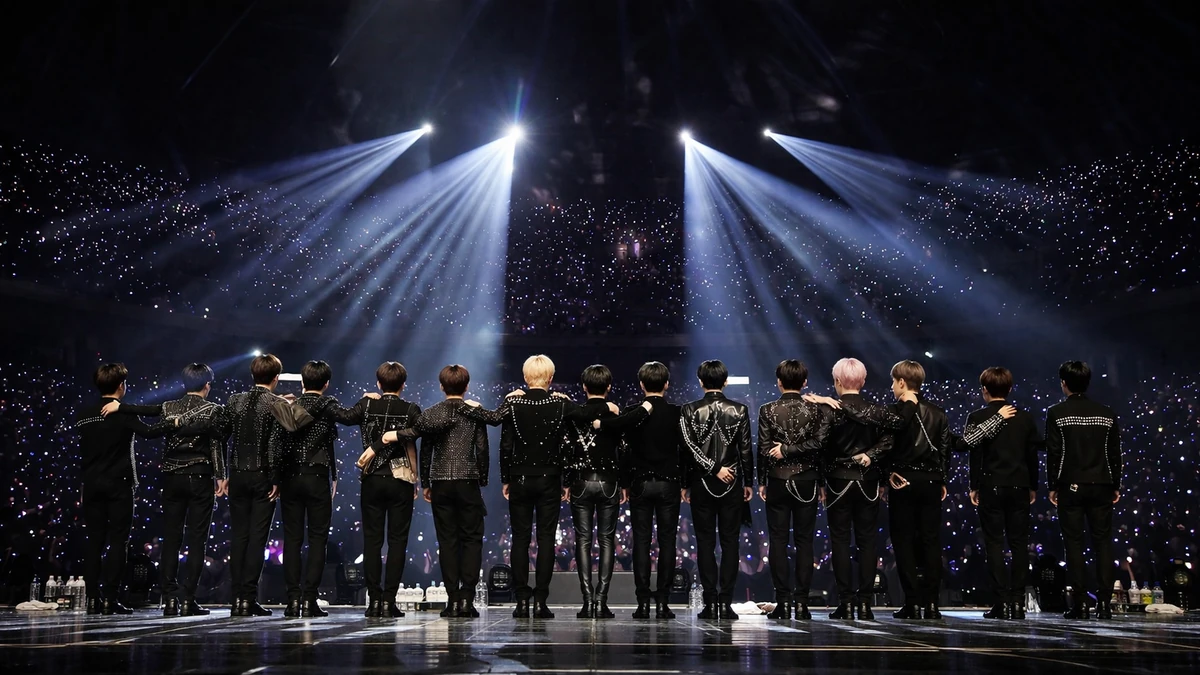
A rare kind of K-pop stability
In an industry built on relentless turnover, Seventeen has delivered the kind of news that can feel almost radical: all 13 members of the group have renewed their contracts again and plan to continue promoting together. The announcement, reported April 6, 2026, by South Korea’s Yonhap News Agency and confirmed by the group, is notable not simply because Seventeen remains active, but because every member is staying on for what amounts to a second major renewal.
For readers in the United States, where pop groups often break up, splinter or quietly fade after a few album cycles, it helps to understand why this stands out. K-pop contracts are not just about recording music. They cover touring, merchandise, fan events, brand endorsements, streaming content, global promotion and, increasingly, direct-to-fan digital platforms. Multiply that by 13 members, each with different ambitions, schedules and earning potential, and the odds of everyone choosing the same path start to look slim.
That is why the phrase being used in South Korea matters. This is not being treated as a routine extension. It is a renewed recommitment by all 13 members of one of K-pop’s biggest and most structurally complex acts. In practical terms, it reduces the immediate risk of lineup changes that can alter everything from vocal distribution to choreography to the group’s identity itself. In symbolic terms, it suggests that Seventeen has managed something the music business rarely does well: keeping a large ensemble intact deep into its career.
There are still important unknowns. The full contract terms have not been publicly disclosed. Neither have details about duration, revenue sharing, rights arrangements or how future solo and unit activities will be coordinated. That means caution is warranted. But the confirmed fact alone, that all 13 members chose to stay, is enough to make this one of the most consequential K-pop business stories of the year.
Why a 13-member renewal is such a big deal
Seventeen is not a typical pop group. Debuting in 2015 under Pledis Entertainment, now part of HYBE, the act built its reputation on synchronized performances, self-production and a highly organized structure that divides members into specialized teams, often referred to as units. That framework has helped the group handle its unusually large lineup without losing coherence. It has also made Seventeen one of the clearest examples of how K-pop can turn scale into a creative advantage rather than a liability.
Still, scale cuts both ways. In the American music industry, audiences are used to bands and vocal groups negotiating around one or two breakout stars. In K-pop, that dynamic exists too, but it plays out inside a much more coordinated system. When a group has 13 members, each person brings a different level of public visibility, different creative interests and different offstage opportunities. Some may want to act. Some may want to write and produce more. Some may want solo albums, television work or overseas schedules. Others may prioritize rest, privacy or simply a different pace of life.
That is what makes full-group renewals difficult, especially beyond the first major contract turning point. The first renewal often tests whether a group has enough momentum to continue. The second, or what Korean media often frame as a renewal after the initial renewal, can be even more revealing. By then, members usually have a clearer sense of their individual market value and their long-term career goals. In other words, everyone has more leverage, and more reasons to choose differently.
For Seventeen to emerge from that stage with all 13 members still aligned suggests that the group’s value proposition remains unusually strong. That does not necessarily mean every member has identical priorities. It means the team appears to offer enough creative, financial and emotional upside that staying together still makes sense. In a market where even successful acts often struggle to balance individual growth with collective identity, that is no small feat.
What American readers should know about K-pop contract culture
To understand the significance of this moment, it helps to step back from the fan excitement and look at how K-pop works as an industry. South Korean idol groups typically operate under a more integrated entertainment model than most Western acts. Agencies are often involved in training, music production, image development, touring, sponsorships and fan-platform strategy all at once. Contracts therefore shape not only album releases but the entire ecosystem around an artist’s career.
That can make renewal periods especially consequential. Fans in South Korea and across the global K-pop audience closely watch these milestones because they often determine whether a group continues intact, shifts to a looser arrangement or enters an extended period of partial activity. A renewal is not always a guarantee of nonstop group promotions, but it is often seen as the strongest available signal that the act still has a shared future.
There is also a cultural piece that may be less familiar to U.S. readers. K-pop fandom is built around continuity in a way that differs from many corners of American pop. Fans do not just follow albums; they follow the ongoing relationship between members, the internal chemistry of the group and the recurring rituals of fan culture, from livestreams and variety content to special events and collectible releases. In that environment, the question is not only whether the music continues, but whether the team itself remains whole.
That matters even more for a group like Seventeen, whose appeal has long rested on collective interplay. The act’s humor, internal dynamics and polished large-scale stage design are part of the product. If one or more members were to leave, the effects would be more profound than a simple headcount change. Think less of replacing a soloist’s backing band and more of rewriting the geometry of the entire show.
Another factor unique to South Korea is military service. Most able-bodied South Korean men are required to serve, and for male idol groups that reality can complicate long-term scheduling in ways unfamiliar to many U.S. pop audiences. It does not automatically derail a group, but it does require careful planning around enlistments, staggered activities and fan expectations. For veteran boy groups, long-term survival often depends on how well management and members adapt to those timing pressures while keeping the group brand alive.
Seventeen’s model: team identity without erasing individuality
Part of what has made Seventeen more durable than many peers is the group’s ability to present itself as both a unified act and a collection of distinct creative identities. Its unit system, which divides the members broadly into hip-hop, vocal and performance teams, has given the group a built-in mechanism for flexibility. That structure allows Seventeen to showcase different strengths without abandoning the brand that fans recognize.
In business terms, that matters. A large ensemble can be hard to manage if every career move becomes a zero-sum fight between individual opportunity and group activity. Seventeen has spent years trying to avoid that trap. The group has maintained high-profile full-group releases and major tours while also giving members room for variety appearances, special projects and forms of authorship that help distinguish them from performers who are seen only as interchangeable parts in a corporate machine.
That self-produced image has been central to Seventeen’s appeal. The group is often credited, by fans and industry observers alike, with taking a more active role in songwriting, production and performance design than outsiders might expect from a large idol act. Whether that perception is grounded in every detail is less important than the broader reality: Seventeen has successfully branded itself as a group with internal creative stakes. That tends to deepen member investment and fan loyalty at the same time.
It also means the group has something to lose if the full lineup fragments. In some pop acts, individual star power can absorb personnel changes. In Seventeen’s case, the choreography, unit balance, vocal texture and interpersonal chemistry are woven into the identity of the brand. The very things that make the group commercially attractive are tied to its full-member architecture. Keeping all 13 members together preserves that architecture.
From the outside, this can look almost like a sports franchise keeping its championship core intact rather than rebuilding around a few marquee names. It protects the fan experience. It preserves the production formula. And it sends a message to promoters, advertisers and platform partners that the asset they have been investing in remains stable.
What this means for the K-pop business
Seventeen’s renewal is important not just because of the group’s celebrity, but because of what it says about K-pop’s economics. The industry often appears obsessed with debuting the next big thing, and there is truth to that. New acts arrive constantly, competition is fierce and audience attention moves fast. But the most dependable revenue frequently comes from established groups with large, organized fandoms.
For those acts, the value extends beyond music sales. World tours, branded merchandise, fan-club memberships, livestream events, licensing deals and proprietary online communities can all become more efficient over time if the group remains active. In other words, longevity itself becomes a business asset. The longer an act stays intact, the more infrastructure can be built around it.
That is especially true for K-pop, which increasingly operates as a platform economy as much as a music business. Agencies and their partner companies are not just selling songs. They are selling recurring access, emotional continuity and a steady flow of content. A stable lineup makes all of that easier to plan and market. It helps reassure ticket buyers, sponsors and international promoters that the group fans are paying to see next year will still resemble the group they love now.
Seventeen’s decision also underscores an important point for the industry at large: large-member groups are not inherently unsustainable. They are harder to manage, certainly, but not impossible to maintain if the incentives are structured well enough. That likely includes compensation, scheduling flexibility, meaningful creative participation and a management system capable of handling individual careers without letting the group disappear.
Still, this should not be mistaken for a universal blueprint. What works for Seventeen may not transfer neatly to every other act. Each group has its own internal dynamics, market position and agency structure. The lesson here is not that all large K-pop groups can or will follow the same path. The lesson is narrower, and perhaps more useful: under the right conditions, a large idol group can stay commercially viable and personally workable much longer than skeptics assume.
What fans gain, and what remains uncertain
For fans, the most immediate effect is a reduction in uncertainty. Contract seasons in K-pop are often marked by anxiety, rumor and endless parsing of public appearances, social media posts and vague comments from industry insiders. Those periods can affect everything from album-buying enthusiasm to travel plans for concerts. A full-group renewal does not solve every question, but it removes the biggest one: whether the group is still committed to existing as a unit.
That clarity can have real market effects. Concert demand tends to benefit when fans believe a group has a reliable future. So do memberships, merchandise and engagement with paid digital content. For organizers and sponsors, long-term confidence can shape how aggressively they invest in events and campaigns. In a touring market still defined by escalating ticket prices and global competition for arena dates, certainty matters.
But there are limits to what this announcement tells us. A contract renewal does not automatically mean more albums, more frequent comebacks or an immediate world tour. In K-pop, the word “comeback” refers to a new promotional cycle rather than a return from absence, and the pace of those cycles can vary widely depending on health, scheduling, military service and strategic priorities. Fans hoping that renewal guarantees nonstop activity may need to temper expectations.
The more meaningful test will come later, in the execution. Will Seventeen release a new album soon? Will the group announce another major tour? How will unit and solo activities be expanded or balanced? How will the company handle the logistical strain that comes with a veteran act whose members are no longer at the same life stage they were at debut? Those questions will determine whether this renewal becomes a true model of sustainable longevity or simply a reassuring headline.
There is another issue American audiences may overlook: endurance in pop culture is not only about staying visible. It is also about managing wear and tear. A large-performance act carries substantial physical demands. Over time, scheduling, recovery, health management and career pacing become just as important as chart results. If Seventeen and its management can navigate those pressures while preserving both the group’s quality and the members’ individual ambitions, that may be the most convincing sign yet that K-pop has entered a more mature phase of artist management.
A benchmark, not a final verdict
It would be premature to call Seventeen’s announcement a turning point for the entire K-pop industry. Trends are rarely set by one contract decision alone, and the details that would allow a fuller evaluation remain private. But it is fair to call this a benchmark. At a minimum, Seventeen has shown that one of K-pop’s largest and most visible boy groups still sees enough value in its collective identity to keep all 13 members under the same umbrella.
That matters in a genre where longevity often looks fragile from the outside. It matters in a global music business that still tends to underestimate how disciplined and durable the K-pop model can be when it works. And it matters because Seventeen is no longer a promising act proving itself. It is a veteran group navigating the difficult transition from peak-era dominance to sustained relevance, a phase where many pop institutions begin to loosen at the seams.
For now, the biggest takeaway is straightforward. The facts on the table are limited, but significant: Seventeen says all 13 members have renewed and intend to continue as a team. In an industry where group cohesion becomes harder to maintain with every passing year, that alone is newsworthy.
The next chapter will be written not by the announcement itself, but by what follows: the release schedule, the touring plans, the balance between personal ambition and group loyalty, and the practical management of a large act trying to remain both profitable and creatively alive. If those pieces fall into place, Seventeen may not just be extending its own story. It may be helping define what a long-running K-pop group can look like in the years ahead.
Comments
Post a Comment