Road Sinking in Busan Exposes a Bigger Problem: How Much Trust Can Cities Place in Aging Infrastructure?
A traffic disruption in South Korea quickly became a public safety story
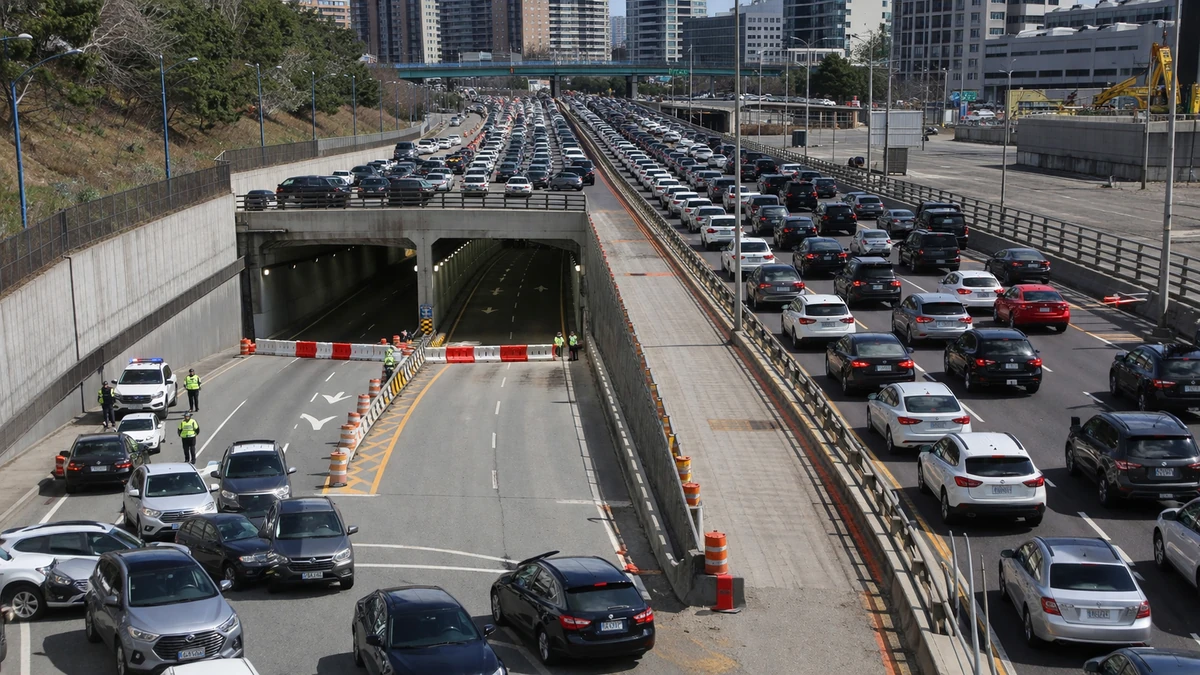
When authorities in Busan, South Korea’s second-largest city, moved to control traffic after ground subsidence was reported at two underpasses on April 6, the immediate result was familiar to anyone who has lived through a major urban shutdown: long backups, missed appointments, delayed commutes and mounting frustration. But the significance of the incident reached beyond the traffic jam itself. In a dense, highly connected city, even a localized infrastructure problem can shake public confidence in the systems that make ordinary life possible.
According to the Korean news summary, subsidence was identified at the Naeseong and Suyeong underpasses in Busan, prompting vehicle controls and severe congestion in the surrounding area. Those are the confirmed facts available so far: a roadbed problem occurred, officials restricted traffic and the disruption spread quickly. What has not yet been established, at least based on the summary, is the precise cause of the subsidence, the full extent of any structural risk or how long repairs and inspections may take. That distinction matters. In infrastructure stories, especially those involving possible collapse hazards, the difference between verified information and early interpretation can shape public perception as much as the event itself.
Still, the larger civic meaning is already clear. Underpasses are not side streets. They are engineered arteries, often designed to keep traffic moving through dense neighborhoods where intersections, surface roads and transit lines compete for space. When one closes, the effects ripple outward fast. In Busan, where geography already complicates mobility, a shutdown can reorder the rhythms of an entire workday.
For American readers, the easiest comparison may be a sudden closure on a tunnel approach in Pittsburgh, an underpass feeding commuter traffic in Los Angeles or a key connector near the entrance to Manhattan. The problem is not just inconvenience. It is that modern city life depends on countless pieces of infrastructure working as expected, largely unnoticed, until one of them doesn’t.
Why an underpass matters more than it may sound
For readers unfamiliar with Korean urban design, the term “underpass” in this case refers to a below-grade roadway section that allows traffic to pass beneath an intersection or surrounding road network without stopping. In South Korea’s largest cities, these routes often serve as pressure valves for traffic congestion, especially during rush hour. Their function can be deceptively simple: keep vehicles moving. But because they sit below ground level, any sign of roadbed sinking, drainage trouble, wall instability or void formation underneath the pavement tends to be treated with heightened caution.
That caution is not bureaucratic overreaction. Structurally, enclosed or semi-enclosed road spaces carry different risks than a typical open stretch of pavement. Water drainage becomes critical. Retaining walls, buried utility lines and the integrity of the soil beneath the road surface all matter at once. A small crack or subtle sagging in the pavement can be more concerning in such spaces because it may point to problems that are hidden from view: leaking pipes, eroded soil, weakened support layers or underground cavities.
That is one reason officials often choose traffic control first and detailed diagnosis second. The public sometimes sees lane closures and asks why authorities are acting before they know exactly what caused the problem. But from a safety standpoint, the logic is straightforward. If the risk involves unknown conditions underground, the cost of waiting for perfect information can be far higher than the cost of a frustrating detour.
In the Busan case, the Korean summary underscores that point. Before the cause is determined, the priority is prevention: block access if necessary, reroute vehicles and reduce the chance of a secondary incident. That is especially important in an underpass, where a worsening depression in the road surface could create hazards not only for drivers but also for emergency responders and nearby infrastructure.
Busan’s geography makes transportation disruptions hit harder
To understand why this incident drew public attention, it helps to understand Busan itself. The city is not laid out like a flat inland metro area with endless alternative routes. Busan is built along a rugged coastline, with hills, dense development, bridges, tunnels and tightly packed commercial and residential districts. That means transportation corridors are often highly interdependent. When one critical segment is impaired, traffic cannot always disperse smoothly.
Americans who know San Francisco’s topography, Seattle’s bottlenecks or Boston’s older, constrained street network will recognize the dynamic. In those kinds of cities, the map may show alternative roads, but practical alternatives can be limited when geography, legacy street design and concentrated commuter flows collide. A blocked segment sends vehicles onto roads that may already be near capacity.
That appears to be what happened in Busan. Once traffic controls were put in place, severe congestion spread through nearby roads. This is not just a story about drivers sitting in traffic. When a key corridor is restricted, buses run late, delivery schedules slip, service workers fall behind and parents trying to get children to school or activities lose time they often do not have. Small businesses can feel the effects, too, particularly in a city where timing and route efficiency matter for deliveries, appointments and customer access.
South Korea’s urban life is often described through its speed and efficiency: fast internet, fast transit, fast delivery, fast adaptation. But that efficiency depends on infrastructure networks that are both dense and tightly synchronized. The flip side is vulnerability. A disruption in one place can trigger a chain reaction in many others.
Why sinkholes and subsidence generate outsized fear
Among infrastructure failures, ground subsidence occupies a special category of public anxiety. Fires are visible. Floods can often be tracked in real time. But a failing roadbed is unnerving precisely because the danger is hidden until it is not. People drive over the same pavement every day with no way of seeing what is happening beneath it. When the ground sinks, even slightly, it raises a disturbing question: Was the risk there all along?
That fear is not unique to South Korea. In the United States, public alarm spikes whenever sinkholes open in residential streets, highways buckle after storms or old utility lines undermine roadways. Images of swallowed cars or collapsed pavement spread quickly because they dramatize something basic: the idea that the ground under ordinary life may not be as solid as assumed.
In technical terms, subsidence can result from multiple overlapping factors. Heavy rainfall can wash away supporting soil. Aging water or sewer lines can leak and gradually hollow out the ground. Nearby excavation or construction can disturb underground conditions. Voids can expand over time. Repeated stress and weakened sublayers beneath pavement can also contribute. In many real-world cases, no single cause fully explains the event.
That is why infrastructure officials and journalists alike have to be careful. It may be tempting to attribute a subsidence incident immediately to “aging pipes” or “poor maintenance” or “construction nearby.” Sometimes those factors are involved. Sometimes they are not, or not in isolation. In the Busan case, the summary makes clear that the exact cause remains to be determined through inspection and investigation.
Even without a final diagnosis, though, the anxiety is understandable. Many residents do not experience infrastructure risk as a technical matter. They experience it psychologically, through daily routines. If one road appears unstable, people begin thinking about the route they take to work, the street their children cross near school, the bus corridor they rely on or the underpass they drive through in heavy rain. A single incident can cast doubt over a much wider zone of everyday trust.
The real story may be about maintenance, not just one emergency
As with bridge closures in the United States or repeated water main breaks in older cities, the broader issue raised by the Busan incident is not only what happened on one day, but what it says about the burden of managing aging infrastructure over time. South Korea built much of its modern urban infrastructure at extraordinary speed during decades of rapid industrialization and growth. That achievement helped transform cities like Busan into globally connected economic centers. It also created a long-term maintenance challenge now facing many developed societies: what happens when a vast system built in one era begins aging all at once in another?
American cities are deeply familiar with this problem. Deferred maintenance, constrained budgets and the political difficulty of funding invisible repairs have created recurring vulnerabilities from coast to coast. Water systems age underground. Pavement looks fine until it doesn’t. Bridges and tunnels require constant inspection. And because voters tend to notice new projects more than preventive maintenance, governments often face pressure to deliver expansion and service at the same time they are trying to preserve what already exists.
The Korean summary points to this exact tension. Local governments are tasked with maintaining roads, bridges, underpasses and water systems simultaneously, often with limited budgets and finite technical staff. The most difficult problems are not always visible. It is one thing to patch a pothole the public can see; it is another to invest in detecting hidden voids, buried leaks or subtle structural weakening before failure occurs.
That makes prioritization essential. Which sites get inspected first? High traffic volume? Prior incident history? Age of nearby utilities? Ongoing construction? Repeated citizen complaints? The answer is usually some combination of all of the above. And that is where infrastructure governance becomes as important as engineering. Good systems do not simply react to emergencies; they build reliable ways of identifying weak points before a crisis forces the issue.
What good emergency response looks like in cases like this
One of the more important points in the Korean summary is that traffic control itself should not be dismissed as a mere inconvenience. In incidents involving possible roadbed instability, restricting access is often the first proof that authorities are taking uncertainty seriously. Public officials are making a judgment call: inconvenience many people now to reduce the chance of injury later.
There is also a communications challenge. If warnings are vague, drivers get angry and confused. If they are overly frequent or imprecise, people start to ignore them. South Korea, like many countries, relies heavily on emergency text alerts and digital public information systems. Those messages can generate fatigue, especially in a society where public alerts are common for weather, safety and civil emergencies. But in a fast-moving traffic event, concise and accurate information can substantially reduce secondary harm.
For the public, the most useful questions are often practical ones: What exactly is closed? Which routes are affected? What are the recommended detours? Are buses delayed? Is the closure expected to last hours, days or longer? Those details are not secondary. In dense urban environments, good information is part of the emergency response itself.
There is a lesson here that travels well beyond Busan. In many American cities, infrastructure response still struggles with fragmented authority. Transportation departments, utility agencies, police, emergency managers and local governments may each control pieces of the response without always sharing data quickly or clearly. The Korean summary notes the importance of linking information across departments — road managers, water agencies, disaster officials and traffic police. That kind of coordination can determine whether a manageable disruption stays contained or expands into citywide confusion.
What investigators will likely be looking for next
Although the final findings were not included in the summary, incidents like this usually trigger a sequence of technical questions. How extensive is the subsidence zone? Is the road surface merely depressed, or is there evidence of a larger underground cavity? Are drainage systems functioning properly? Did nearby pipes fail or leak? Has construction activity nearby altered soil conditions or groundwater flow? Are retaining structures or walls affected? And perhaps most importantly, is the condition stable or worsening?
Engineers today have more tools than in the past to answer those questions. Ground-penetrating radar can help detect voids beneath the pavement. Sensors and monitoring systems can track movement over time. Imaging, core sampling and subsurface inspections can offer more detail. Drones and digital mapping may assist in documenting site conditions and planning repairs. But technology alone does not solve the public-policy challenge. Data still has to be interpreted, prioritized and turned into repair schedules, budget decisions and long-term prevention plans.
That is where public confidence can either recover or deteriorate. If authorities reopen lanes quickly but offer little explanation, residents may suspect that the city has simply covered the problem rather than addressed it. If officials are transparent about what was found, what remains unknown and what steps will prevent recurrence, they stand a better chance of restoring trust.
In the American context, this is similar to what communities often demand after bridge scares, rail incidents or water contamination alerts: not just a fix, but a credible explanation. People want to know that the failure was understood and that the system has learned from it.
An infrastructure warning for cities far beyond South Korea
The Busan underpass incident is, in one sense, a local Korean story. It unfolded on specific roads in a specific city and affected residents dealing with very immediate travel disruptions. But it also belongs to a much broader global story about urban vulnerability in mature, heavily built societies.
As cities age, the most serious threats are not always dramatic disasters arriving from outside. Sometimes they are internal stresses accumulating quietly within the systems cities depend on every day: drainage networks, buried pipes, pavement layers, retaining structures and traffic corridors designed for another era’s demands. The warning signs can be subtle until they become impossible to ignore.
For American readers, the takeaway is not that Busan is uniquely fragile. If anything, the opposite is true. What happened there illustrates pressures that many U.S. cities would recognize immediately. Aging infrastructure often fails in public before it fails in policy. By the time a road sinks, a bridge closes or a water main bursts, the deeper issue has usually been developing for years.
The unanswered questions in Busan will matter. Investigators will need to determine what caused the subsidence, whether nearby systems are at risk and what repairs or longer-term upgrades are needed. But even before those conclusions arrive, the event has already exposed a central fact of modern urban life: infrastructure is not merely physical hardware. It is a trust relationship between a city and the people who move through it.
When that trust is disrupted, even for a day, the consequences spread far beyond a traffic jam. Commutes lengthen. Deliveries stall. Public anxiety rises. And the city is forced to confront a difficult but necessary question: not just how to reopen the road, but how to make sure the ground beneath daily life remains dependable in the first place.
Comments
Post a Comment