A milestone at a festival Americans know well
At a music festival that has become shorthand for global pop relevance, South Korean singer Taemin used his Coachella appearance to do more than debut a new set. He made an argument about where K-pop is headed next.
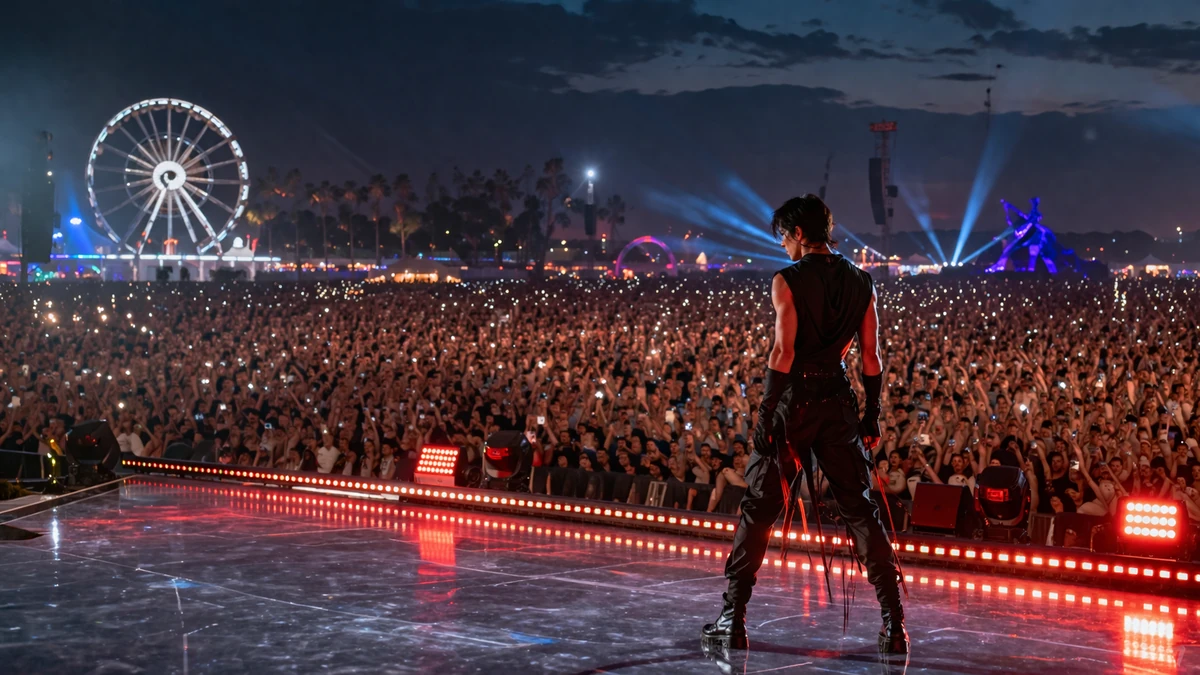
According to his agency, Galaxy Corporation, Taemin appeared at the Coachella Valley Music and Arts Festival on April 11 local time, becoming the first male K-pop solo artist to perform for the festival crowd in person. On paper, that can sound like one more industry milestone in a genre that has collected many of them over the past decade. In practice, it lands differently. Coachella is not simply another overseas booking. For Asian artists, and especially for Korean pop acts trying to reach beyond their most committed fan bases, the festival remains one of the most visible American proving grounds.
That matters because K-pop has largely built its international profile through groups, not solo performers. For many American listeners, the genre is associated with tightly synchronized choreography, multiple-member ensembles and fandoms organized at a scale that rivals major sports teams. Those features helped K-pop break through in the United States, from BTS selling out stadiums to BLACKPINK headlining Coachella. But they also created a kind of default assumption: that K-pop travels best when it arrives as a collective spectacle.
Taemin’s performance challenged that assumption. Instead of relying on the energy of a group, he walked onto one of the world’s most-watched festival stages carrying the entire narrative himself: the vocals, the movement, the visual concept and the burden of keeping a mixed crowd engaged, including people who may have stumbled upon the set with little knowledge of Korean pop history. That is a different test from a standalone arena concert, where most ticket buyers already know the songs and the story. At Coachella, the artist has to win over the curious, not just satisfy the converted.
For American audiences, there is a familiar parallel here. Think of the difference between a legacy pop act doing a hometown arena date for fans and a breakout star trying to own a slot at Lollapalooza or Bonnaroo. The latter demands instant readability. You have limited time, a distracted crowd and no guarantee people know your catalog. What Taemin did at Coachella was use that environment not as a risk to survive, but as a stage on which to redefine himself.
Why Taemin matters inside K-pop
For readers less familiar with the Korean music industry, Taemin is not a new name suddenly arriving in America. He is one of the best-known performers to come out of second-generation K-pop, the wave of acts that helped transform the industry from a regional powerhouse into a global export machine. He debuted as a member of SHINee, one of the most influential boy bands of its era, and over time built a separate identity as a solo artist known for stylized choreography, dark pop concepts and a stage presence that often feels more theatrical than conventional.
In K-pop, being called a performer is not casual praise. It usually implies a specific kind of credibility: an artist whose command of movement, expression and stage design is central to their appeal, not just an accessory to the songs. Taemin has occupied that lane for years. He has moved between group activities and solo work while steadily shaping a reputation as the kind of artist who treats performance as storytelling. That background made Coachella especially meaningful. The question was never whether he could dance or sing on a major stage. It was whether his particular style of performance, honed in Korean music shows and solo concerts, could register with a multinational festival audience in the California desert.
The answer, at least from the way this moment is being framed in South Korea, is yes. The significance of the phrase first male K-pop solo artist is not just about a record book entry. It points to a possible shift in how the industry imagines expansion abroad. If earlier stages of K-pop globalization were driven by groups demonstrating the power of the format, Taemin’s set suggests a later phase in which individual performers can stand on international stages with enough artistic identity to command attention without backup from a team-based brand.
That distinction may sound technical, but it has real consequences. A solo performer has fewer places to hide. There are no rotating members to distribute the energy, no built-in contrasts of personality to create variety, no collective chorus line to create scale by default. Everything depends on whether one artist can establish a mood, maintain momentum and leave behind a memorable image. That is what American festivalgoers respond to, too. Whether it is Beyoncé turning Coachella into a culture-defining event or Harry Styles using his catalog and charisma to dominate a field, the solo set is always a referendum on individual command.
A setlist built for both newcomers and loyal fans
One of the most telling parts of Taemin’s Coachella strategy was the setlist. He reportedly performed songs including Sexy In The Air, WANT, Permission and PARASITE, blending established solo material with songs that signal his current direction. That mix is important at a major festival, where a setlist functions less like a greatest-hits package and more like a compressed introduction. The artist is deciding, in real time, how a first-time viewer should remember them.
Taemin also reportedly unveiled six new songs, including Let Me Be The One, Sober and 1004. That is an aggressive choice for a festival audience. Most artists on a big American stage would be tempted to lean heavily on proven material, especially if they are crossing over from another market and trying to maximize immediate response. New music is a gamble in that setting. People cheer loudest for what they know. Yet by foregrounding unreleased or less familiar tracks, Taemin appeared to treat Coachella not as a victory lap, but as the opening scene of a new chapter.
That kind of move serves two audiences at once. For existing fans, it turns the set into a reward: a first look at what comes next. For casual festivalgoers, it sends a different message, one that matters just as much in the American market. It says this is not an artist living off older reputation or legacy-group prestige. It says the project is active, evolving and aimed at the future.
In American pop terms, this is closer to the logic of an artist using a high-profile festival slot to launch an era than to relive one. It is a distinction U.S. readers will understand. Think of the difference between a catalog-celebration set at a nostalgia festival and a headline-making appearance designed to reposition an artist ahead of a new album cycle. Taemin’s choices suggest he was after the second model. The goal was not simply to remind the crowd who he has been. It was to shape how they think about who he is now.
That is especially important in a genre where international audiences sometimes encounter artists through viral fragments, isolated performances or fan-edited clips rather than a full narrative arc. A festival set can become the first real résumé a viewer sees. In that sense, Taemin’s Coachella performance appears to have been structured like a deliberate portfolio: familiar enough to anchor attention, new enough to generate momentum.
The egg, the breakout and the message behind the staging
The most talked-about visual from the performance was the opening image: Taemin emerging from a giant egg-shaped structure. His agency described it as a visualization of self-liberation, and that explanation matters because it gives the staging a narrative function beyond simple spectacle. At a festival like Coachella, where artists are competing with sensory overload from every direction, a clear symbolic image can do more work than a lengthy concept statement ever could.
For audiences unfamiliar with Korean entertainment culture, stagecraft is often central to how K-pop communicates identity. Korean music shows, year-end awards programs and arena concerts are known for elaborate visual themes, precise transitions and conceptual world-building. But festival performance is a different animal. There is less room for slow-burn storytelling. The first image has to land fast. It has to be understood even by someone who has never heard the artist’s name.
The egg image succeeded on those terms because it is immediately legible across cultures. Breaking out of an egg suggests birth, transformation, reinvention and release. It does not require subtitles. It does not depend on preexisting lore. It works in the same way iconic pop staging often works in America: a single picture strong enough to circulate on social media, strong enough to become the shorthand for the whole performance.
In Taemin’s case, that symbolism also intersected with timing. He recently signed with Galaxy Corporation, a new agency home that also represents major Korean entertainers including G-Dragon and Kim Jong-kook. In South Korea’s entertainment industry, agency changes are not viewed as routine paperwork. They often signal a broader reset involving branding, creative direction, promotional strategy and international networking. For an artist with a long-established identity, the first public performance after a high-profile move can become a statement about continuity or rupture. Taemin’s opening suggested both. He arrived as the same intensely physical performer audiences know, but framed the moment as emergence rather than repetition.
That is why the stage image resonated beyond aesthetics. It offered a concise narrative about career control. It implied that this was not just a new contract, but a recalibration of how he wants to be seen. In an era when pop stars from Taylor Swift to The Weeknd increasingly treat visuals as narrative argument, Taemin’s Coachella opening fits a very contemporary global language of reinvention.
A new agency, a fast rollout and what the industry sees
The speed of the rollout has become part of the story in South Korea. Taemin signed with Galaxy Corporation last month, and within a little over a month he was onstage at Coachella, one of the most visible music festivals in the United States. That quick sequence has attracted attention not just as entertainment news, but as evidence of strategy. It suggests the new partnership is thinking beyond domestic reorganization and moving quickly to place Taemin inside a global conversation.
This is increasingly how K-pop operates at the top level. An album release is no longer the only, or even the primary, event around which an artist’s momentum is built. The larger strategy often involves context: which platform, which audience, which visual language and which media cycle will frame the next phase. In that sense, Coachella is not just a venue. It is a brand, a signal to industry insiders, fans and casual observers that the artist belongs in a certain tier of cultural visibility.
For American readers, it may help to think of how artists use Saturday Night Live, the Grammys or a surprise Super Bowl tie-in. The performance itself matters, but so does what the platform communicates before a note is sung. Coachella tells the market that this artist is meant to be watched internationally, discussed across borders and measured against global peers, not just local competitors.
There is another practical dimension as well. A new company taking on a performer with Taemin’s profile faces immediate questions: What changes? What stays? How will the next era connect to the last one? How do you satisfy loyal fans while expanding the audience? Often those questions are answered piecemeal in interviews and teaser campaigns. Here, they were answered onstage first. The themes of self-liberation, the introduction of multiple new songs and the choice of Coachella as the launchpad together functioned like a mission statement.
Taemin is also scheduled to perform at Coachella again on April 18. In the logic of major festivals, that follow-up appearance could matter almost as much as the first. One strong debut can generate headlines. A second strong outing can turn buzz into reliability. In entertainment industry terms, repetition matters. It suggests that the initial impact was not an accident of novelty, but the beginning of a sustainable live proposition.
What this says about the next phase of K-pop abroad
For years, the central story of K-pop in the United States has been expansion through scale: bigger groups, bigger fan mobilization, bigger tours, bigger social media reach. That story is still true. But as the genre matures globally, the more interesting question may be about diversification. Can K-pop support a broader range of export models, including solo performers, bands and producer-led acts, each with a distinct approach to international audiences?
Taemin’s Coachella appearance is significant because it arrives in that next-stage conversation. It suggests that K-pop no longer needs to present itself to the world in just one format. The group model remains powerful, but it does not have to be the only model that travels. A solo artist with a clear performance identity, a strong conceptual frame and the discipline to compress a story into a festival set can also compete.
That matters because festival audiences are different from fandom audiences. They are more fragmented, less patient and less likely to grant context upfront. In that environment, success depends on three things that Taemin’s set appeared designed to deliver: a memorable visual hook, a concentrated performance style and just enough mystery to make the audience want more. His decision to debut new songs fits that grammar. Rather than over-explaining himself, he seems to have left space for curiosity.
There are implications here for the Korean entertainment business, too. The old benchmark for global success was often blunt and quantifiable: overseas tours, chart entries, album sales, social metrics. Those markers still count. But increasingly, the question is qualitative. What kind of first impression does an artist leave on a major international stage? What narrative are they attaching to their expansion? And how well does that narrative translate outside the Korean system that first produced them?
Taemin’s performance appears to have offered one possible answer. Instead of trying to make himself legible by flattening his identity, he leaned into the very thing that made him distinctive inside K-pop in the first place: performance as narrative. That may be the more durable way forward for Korean solo acts in the West. Not by pretending to be generic global pop, but by presenting a highly specific artistic language clearly enough that a global audience can read it.
More than a first: a test of staying power
After the performance, Taemin said through his agency that he had waited a long time to stand on the Coachella stage and was happy to share the moment with so many people, adding that he hopes to repay that support with even better music and performances. The quote reads like a standard post-show statement, but it also captures where he is in his career. This was not a random booking or a ceremonial checkpoint. It was a moment prepared for over years, now being used to launch the next run of work.
That is ultimately why this performance matters beyond the headline of first male K-pop solo artist. It crystallized several changes at once: a new agency, a renewed artistic frame and a growing belief that the global audience for Korean pop is ready to engage with more than just group spectacle. Taemin did not simply appear at Coachella. He used the festival to argue that a solo K-pop performer, armed with the right visual language and enough command, can hold one of the most demanding stages in American music culture.
Whether that becomes a larger turning point will depend on what comes next. One set can make a statement. A sustained run of performances, releases and audience growth is what turns a statement into a shift. But if Coachella has often served as a place where pop careers are reframed in public, then Taemin’s appearance belongs in that tradition. He arrived not as a novelty from a now-familiar genre, but as a mature artist testing how far that genre can expand through individual presence.
For American viewers who still associate K-pop mainly with blockbuster groups, that may be the real takeaway. The genre is not only getting bigger. It is getting more granular, more flexible and more confident about sending different kinds of artists into the same global arena. On one desert stage, under one of pop music’s brightest spotlights, Taemin made that evolution easier to see.
Comments
Post a Comment