BTS Returns to U.S. Stadiums With Tampa Launch, Underscoring How K-pop Has Become a Citywide Event in North America
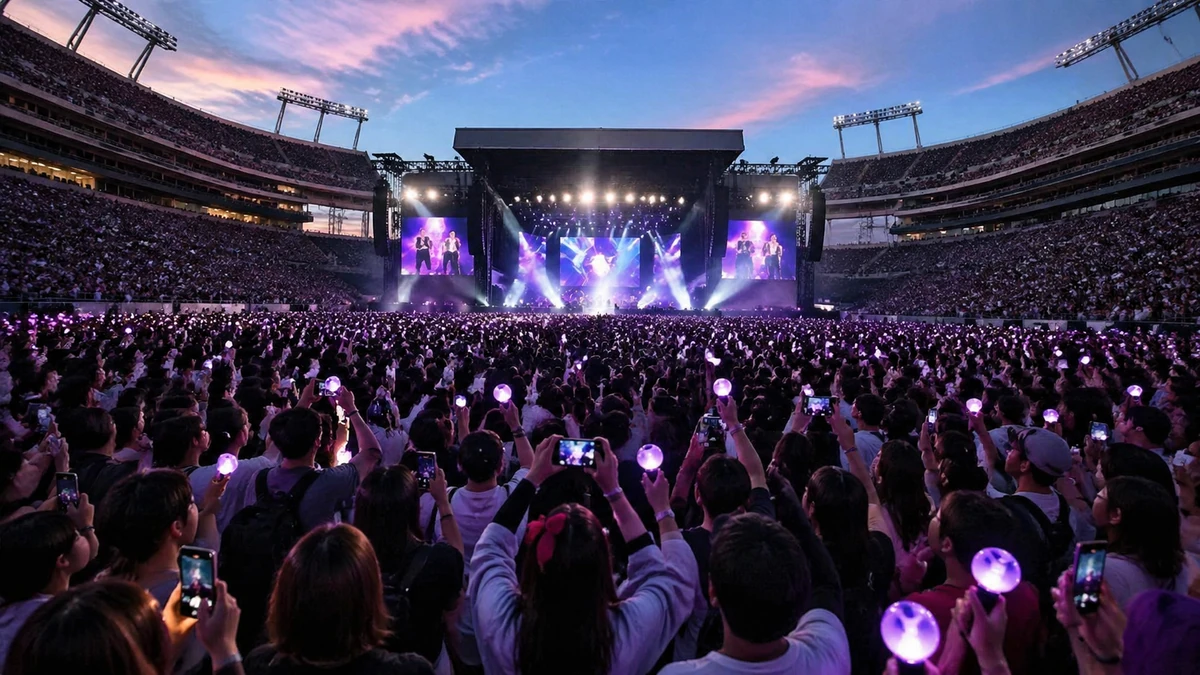
A comeback measured in stadiums, not just songs
BTS is set to open the North American leg of its new world tour in Tampa, Florida, with performances scheduled for July 25, 26 and 28 at Raymond James Stadium, according to South Korea’s Yonhap News Agency and the group’s label, BigHit Music. The dates mark the start of a 31-show run across 12 cities in North America, an itinerary that includes stops in places such as El Paso, Mexico City and New York.
For American readers, the headline may sound straightforward: one of the biggest pop acts in the world is heading back onto U.S. stages. But in South Korea, and increasingly in the United States, the significance goes beyond a touring announcement. BTS’ return is being read as a broader signal about the place K-pop now occupies in the North American entertainment economy — not simply as imported music with a devoted niche audience, but as a large-scale cultural force that affects local television programming, hotel demand, traffic patterns, restaurant business and civic buzz.
That framing matters because BTS has long been more than a successful boy band. Since breaking through in the American mainstream in the late 2010s, the seven-member South Korean group has become one of the most recognizable Korean cultural exports in modern history, alongside films like “Parasite,” the survival drama “Squid Game,” and, more broadly, South Korea’s global soft power push through entertainment, beauty, food and fashion. In the United States, where many fans first encountered Korean pop through YouTube clips, reaction videos and social media choreography challenges, BTS helped move K-pop from internet phenomenon to stadium business.
Now, after what reports describe as their first U.S. concerts since a Las Vegas run in April 2022, the group’s return is being treated as news in itself. That time gap gives the Tampa kickoff added weight. In a music industry where visibility is constant and attention spans are short, a four-year absence from American concert stages can create both suspense and symbolism. For BTS, it appears to have done both.
Why Tampa matters
The choice of Tampa as the first North American stop is notable for reasons that go beyond geography. Raymond James Stadium is home to the NFL’s Tampa Bay Buccaneers, and for many Americans it is the sort of venue associated with major league sports, headline touring acts and events that pull in tens of thousands of out-of-town visitors. When an artist books multiple nights in a stadium like that, the story stops being only about ticket sales and starts becoming about scale.
That is especially true in a region like Tampa Bay, where event tourism is a familiar economic engine. A multiday concert stop can reshape an entire weekend. Airlines see a bump in passengers. Hotels benefit from fans arriving from other states and countries. Restaurants and bars fill up before and after the show. Rideshare demand spikes. Downtown retail gets a lift from visitors who turn a concert into a short vacation. Anyone who has watched what Taylor Swift’s Eras Tour did to local economies in U.S. cities will understand the template. The difference here is that the same model is now being applied, very explicitly, to a Korean pop group.
That is a telling marker of where K-pop stands in the American live entertainment ecosystem. A decade ago, even successful Korean acts often played arenas or theaters in select coastal markets with large Asian diaspora populations. Today, the biggest names can anchor multiday stadium engagements in parts of the country not traditionally seen as gateways for foreign-language pop. Tampa is not New York or Los Angeles, and that is precisely the point. A BTS launch there suggests a level of confidence that demand extends far beyond the usual cultural capitals.
The three-date schedule also helps turn the stop into something more like a temporary festival than a one-night appearance. Fans do not simply attend and go home; many build trips around the event, meet online friends in person, trade merchandise, visit fan-organized pop-ups and spend days participating in a broader communal experience. In K-pop fandom, concert-going often functions less like a casual night out and more like a convention, reunion and pilgrimage rolled into one.
The Korean Wave, explained for an American audience
To understand why this tour is being watched so closely, it helps to understand the broader context of the Korean Wave, or “Hallyu,” a term used to describe the international spread of South Korean popular culture. What began decades ago with TV dramas and film gradually expanded into music, online fandom culture, cosmetics, food and fashion. In the United States, many people first felt Hallyu through “Gangnam Style,” then through Oscar recognition for “Parasite,” and then through streaming-era hits and K-pop fandoms that became impossible to ignore.
BTS has been central to that expansion. Their rise in America was not built only on radio play, though they eventually got that too. It was built through a highly networked, digitally native fan community — known as ARMY — that used social media, streaming platforms and grassroots organizing to amplify the group’s reach. That fan infrastructure became one of the most discussed case studies in modern pop culture: decentralized, multilingual, intensely organized and capable of mobilizing around chart campaigns, charity drives and ticket sales with extraordinary speed.
For readers less familiar with K-pop, fandom in South Korea and among global K-pop fans often operates differently from the model associated with many American pop acts. It is more participatory and more ritualized. Fans often coordinate colors, chants and synchronized light sticks, turning concerts into a carefully choreographed exchange between artist and audience. Official merchandise is a central part of the experience, but so is fan-made culture: banners, handmade gifts, slogan events and social media campaigns that make each concert feel communal and highly produced even outside the stage itself.
BTS, in particular, has come to symbolize a version of Korean popular culture that is polished, export-ready and emotionally legible across borders. Their music has blended hip-hop, pop and introspective themes about youth, mental health, ambition and alienation — subjects that travel well globally. So when they return to U.S. stadiums, the event is not being interpreted only as a music business milestone. It is also being read as another chapter in the ongoing normalization of Korean culture in mainstream American life.
A four-year gap that turns a concert into a headline
One of the most important details in the South Korean reporting is the timeline: these are described as BTS’ first U.S. concerts since April 2022, when they performed in Las Vegas. In celebrity terms, four years may not sound like a lifetime. In pop music, it can feel enormous. Entire trends come and go in that span. Streaming habits shift. Touring costs rise. New stars emerge. Fan communities age, expand and change shape.
That is why the return itself carries symbolic value. It tells the market that demand remains strong enough to support a dense stadium-level routing across North America. It also gives fans a narrative they understand instinctively: the long-awaited return. In entertainment journalism, timing can be as important as content, and a comeback after a notable pause often generates a deeper emotional response than a routine tour announcement would.
For the U.S. live music industry, there is another layer. Post-pandemic concert economics have become increasingly dependent on blockbuster tours. Promoters and venues alike have leaned on the biggest acts to drive outsized revenue. In that landscape, a BTS tour is not just another line on a concert calendar. It is the kind of event that can anchor a season, attract sponsors, dominate local news segments and influence how a city markets itself for a week.
That helps explain why this North American leg is being discussed in unusually broad terms. The story is not merely that BTS is popular; it is that the group’s return is measurable in ways local institutions care about. A comeback is not just emotional or artistic. It is logistical. It is commercial. It is civic.
Thirty-one shows across 12 cities signal a mature North American strategy
The raw numbers attached to the tour are among the clearest indicators of its scope: 12 cities, 31 performances. That is not the itinerary of an act testing the waters. It is the schedule of an artist with a proven regional footprint and confidence in repeat demand.
In the concert business, there is a big difference between a single high-profile stop and a sustained, multicity run. A one-off stadium date can be a prestige play. A 31-show schedule requires a deeper operating assumption: that there are enough fans across multiple markets to support not just attendance, but repeated attendance, travel demand and ancillary spending. It reflects confidence not only in name recognition, but in the durability of the fan base.
The city list mentioned in Korean reports is also revealing. Tampa, El Paso, Mexico City and New York do not represent a narrow corridor of culturally predictable markets. They suggest a broader North American strategy that treats the continent as interconnected rather than coastal and fragmented. Mexico City, in particular, points to one of the longstanding realities of K-pop’s global rise: its audience has never been limited to English-speaking markets. Latin American fans have played a major role in sustaining K-pop’s international momentum, often with levels of passion and digital engagement that rival any market in the world.
For American audiences accustomed to thinking of touring through a domestic lens, that matters. A North American tour in the K-pop context often means a transnational audience crossing borders, booking flights, coordinating with fan communities and engaging in concert culture as a destination event. In other words, this is not just a string of local shows. It is a regional network of cultural gatherings.
It is also worth noting what the available reports do not claim. They do not, at least from the information provided, detail a new album rollout, stage concept or additional project tied to the tour. Even without those details, the scale alone makes the industrial significance clear. You do not need a splashy concept announcement to understand what 31 shows mean. In live entertainment, repetition is its own language of confidence.
When local television programs around K-pop, it says something bigger
One of the more striking details from the Korean coverage is that local media in Tampa is reportedly treating BTS’ visit as programming, not just as an item in the weekend events roundup. According to the report, the local station FOX 13 Tampa Bay aired a special titled “K-pop: The Seoul Reach” over two days timed to the group’s arrival.
For those who have covered the Korean Wave for years, that detail stands out. It suggests that K-pop in the U.S. is no longer being handled solely as an exotic curiosity or internet subculture. It is being translated, contextualized and packaged for a general local audience. That is a different stage of cultural assimilation.
In media terms, this is a meaningful shift. When a local station produces or schedules explainer-style content around a visiting act, it is making a judgment that enough viewers either care already or want to understand why others care. That is one of the clearest signs that a cultural export has moved into mainstream conversation. The station is effectively saying: this is not too niche for our audience; this is part of what is happening in our city.
There is also an interpretive function at work. K-pop often arrives in American communities carrying its own vocabulary, aesthetics and social norms — from fandom terminology to concert etiquette to merchandise culture. Local media helps decode that for broader audiences. Why are fans traveling across states? Why do they line up early? Why are there light sticks and fan chants? Why does one band generate the sort of citywide anticipation usually associated with a Super Bowl-adjacent weekend? Those are the kinds of questions local news can answer, and in doing so it becomes part of the broader cultural translation.
That translation matters because it shapes how nonfans understand the event. Instead of viewing it as simply a concert for a specific demographic, they may begin to see it as a major local happening — one with implications for business, transportation and civic identity. In that sense, the media coverage is not peripheral to the concert. It is part of the concert’s public meaning.
The economics of fandom are now impossible for cities to ignore
Another local outlet, 10 Tampa Bay, reportedly said the concerts could generate between $800 million and $900 million in economic impact for the Tampa area. That figure should be treated carefully, as all economic impact estimates should be. Such projections often rely on modeling assumptions about visitor spending, hotel occupancy, transportation, dining and secondary activity, and they are not the same as final audited outcomes.
Still, the precise number is less important than the fact that local media is using an economic-impact frame at all. That is a sign that BTS’ presence is being understood in the same category as other major event drivers. This is how cities talk about mega-events: through rooms booked, tax revenue, consumer spending and brand visibility. Once a concert enters that conversation, it has moved well beyond the entertainment pages.
American readers have seen versions of this story before. The Eras Tour was widely credited with boosting hospitality spending in multiple cities. Major sports championships routinely come with splashy local forecasts about economic benefits. Even large conventions, from Comic-Con to Art Basel, are described through their ripple effects on local business. What is notable here is not that BTS can generate spending, but that a Korean pop act is now so fully embedded in that familiar American event-economy logic.
That reflects the maturation of K-pop as a commercial presence in North America. For years, skeptics treated the genre as internet loud but economically uncertain — a fandom that could trend worldwide while remaining hard to translate into conventional market terms. Stadium tours and city-level economic projections challenge that old assumption. They suggest that at the top end of the market, K-pop is not only culturally resonant but financially legible to the institutions that matter most in local planning: venues, tourism boards, broadcasters and business associations.
It also highlights something fans have understood for a long time. K-pop audiences are highly mobile and unusually willing to build travel around live events. That makes them especially attractive to host cities. A fan who flies in for a show may stay multiple nights, eat out repeatedly, purchase merchandise, use local transport and post about the experience to a global audience in real time. In a media environment where visibility matters almost as much as direct spending, that kind of attention is valuable.
What this says about BTS, and about where K-pop goes next
There is a reason this tour feels bigger than a set of concert dates. It brings together three storylines that increasingly define K-pop’s place in the West. First, there is the performance itself: a major act launching a wide-reaching stadium run. Second, there is the comeback narrative: a return to U.S. concert stages after a notable gap. Third, there is the local response: television specials, economic forecasts and city-level anticipation that treat the event as part culture, part commerce, part civic spectacle.
Taken together, those layers offer a snapshot of where BTS sits in the American imagination. The group is no longer merely a successful foreign act that occasionally breaks into U.S. charts. It is a name that can anchor mainstream news coverage, justify explanatory local programming and alter the business expectations of a city preparing for a multiday influx of fans. That is what maturity looks like for a global pop phenomenon.
It also says something important about the Korean Wave itself. South Korean popular culture has spent years moving from the margins of American awareness to the center of global entertainment. But mainstreaming is not only about chart positions or awards. It is also about whether local institutions know how to respond. Do city broadcasters make room for it? Do tourism and hospitality sectors prepare for it? Do people who are not already fans understand why it matters? In Tampa, at least according to the reporting surrounding the tour launch, the answer increasingly appears to be yes.
For longtime followers of BTS, that may feel like the continuation of a story they have been telling for years. For casual American observers, it may be a moment of realization: K-pop is not arriving anymore. It has arrived. The music may originate in Seoul, but the effects now unfold in places like Tampa with a familiarity that would have been difficult to imagine a decade ago.
As the tour moves on to other cities, the key question will not simply be how loudly fans cheer or how quickly tickets move. It will be whether this Tampa opening confirms a new normal — one in which the movement of a top-tier Korean group is covered not just as entertainment news, but as regional economic news, media content and a marker of how deeply global pop culture now shapes local American life.
That, more than any single set list or stage production detail, may be the most revealing part of the story. BTS’ return is certainly a music event. But it is also a measure of how far K-pop has traveled, how thoroughly it has integrated into the North American marketplace, and how a genre once treated as foreign or specialized is now capable of changing the tempo of an American city for days at a time.
Comments
Post a Comment