South Korea’s Rival Parties Find Rare Common Ground After Shooting Scare Near White House Press Event
A rare bipartisan message from Seoul
South Korea’s two main political parties, which spend much of their time locked in bitter combat at home, delivered an unusual message of unity this week after reports of a shooting scare near a high-profile Washington event tied to the White House press corps. According to South Korea’s Yonhap News Agency, both the liberal Democratic Party and the conservative People Power Party said violence and terrorism cannot be justified under any circumstances, responding in near-identical terms to an armed incident near the venue of the White House Correspondents’ Association’s annual dinner in Washington.
For American readers, that may sound like a routine statement of sympathy from an ally. In the South Korean political context, it is more striking than that. The country’s major parties rarely miss an opportunity to turn even small issues into partisan warfare. So when leaders from both camps use almost the same language, on the same day, about an event overseas, it signals that they see the matter as larger than day-to-day politics. Their response was not just about a security scare in the U.S. capital. It was also about defending a broader idea: that democratic societies depend on safe public spaces where elected officials, journalists and citizens can gather without fear of armed intimidation.
The statements also underscored how closely South Korea watches political developments in the United States. Washington is not simply a faraway capital to Seoul. The U.S. is South Korea’s most important ally, its central security partner and a constant reference point in debates over democracy, public institutions and national resilience. When a violent incident appears to touch a symbolic American political event, Korean politicians know their response will be read not only at home but abroad, especially in a relationship as scrutinized as the U.S.-South Korea alliance.
That is what makes this episode worth attention beyond the immediate facts of the incident itself. The Korean reaction offers a window into how one of America’s closest Asian allies interprets threats to the public square in the United States, and how allied democracies increasingly see such threats as shared rather than purely domestic problems.
What happened in Washington, and why it resonated abroad
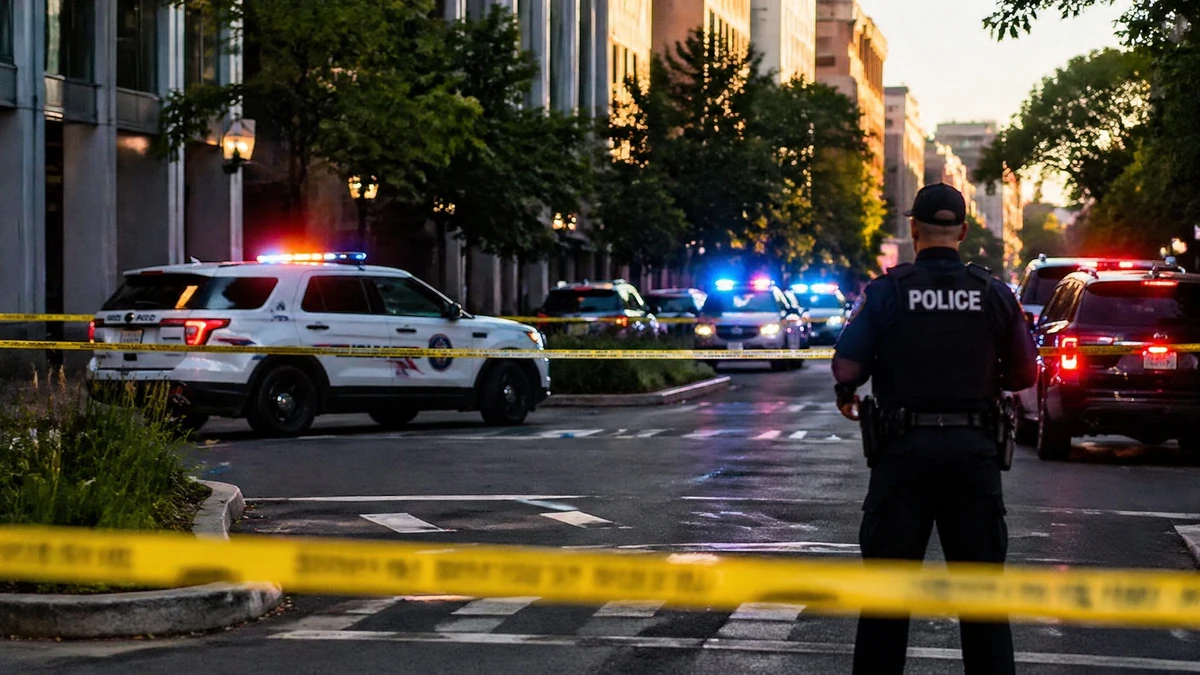
According to the Korean account, the incident took place on April 25 local time in the area around the Washington Hilton, where the White House Correspondents’ Association dinner was being held. Yonhap reported that an armed person fired shots and attempted to enter the area, prompting a major police response. The reports cited by Korean media said there was no major injury to key attendees and that the situation did not escalate into a larger bloodshed.
Because the details available in the Korean summary remain limited, it is important not to go beyond what has been publicly described there. What is clear from the response in Seoul is not the full investigative picture of the incident, but the symbolic weight attached to its location. The White House Correspondents’ Association dinner is one of those peculiarly American civic rituals that can look glitzy from the outside but carry real institutional meaning. It is where presidents, administration officials, reporters and political insiders share the same room in a highly public setting. In ideal form, it is meant to symbolize the uneasy but essential coexistence of power and scrutiny in a democracy.
That symbolism matters overseas. In South Korea, the event is often understood less as a celebrity-heavy Washington dinner and more as an emblem of American democratic openness: the press near the presidency, the presidency exposed to public questioning, and politics taking place not only in back rooms but on visible stages. When violence appears to breach or threaten that kind of space, the reaction abroad can be immediate because the target is understood not just as individuals in attendance, but as a democratic process unfolding in public view.
American audiences are familiar with the way mass shootings and armed threats can turn almost any gathering into a scene of panic. Yet for foreign observers, especially in allied democracies, such incidents can carry a second meaning. They are read as tests of whether the institutions Americans often champion abroad, including a free press and open political culture, are becoming more vulnerable at home. That helps explain why Korean politicians responded so quickly and so forcefully.
Why South Korea’s response stands out
To understand the significance of the Korean reaction, it helps to understand just how polarized South Korean politics has become. The Democratic Party and the People Power Party are ideological rivals with sharply different instincts on domestic policy, prosecution, media controversies and how to manage relations with North Korea, China, Japan and the U.S. They agree on less than outsiders might assume. Even matters of state ceremony, national investigations and foreign policy often become extensions of domestic political trench warfare.
That is why the statements from both parties drew notice. Kang Jun-hyun, a senior spokesperson for the Democratic Party, said in a written briefing that it was fortunate the incident did not develop into a more serious bloodbath and expressed sympathy to those who would have felt fear, including President Donald Trump and White House officials, according to the Korean summary. The conservative People Power Party, through spokesperson Cho Yong-sul, similarly described the shooting as a grave crime that must be strongly condemned regardless of political position, while also offering condolences to American citizens and those shaken by the event.
The phrasing is revealing. Both parties emphasized two ideas at once: first, that violence has no legitimate place in political expression; and second, that the emotional shock to ordinary people and public officials matters. This was not framed as a narrow law-and-order statement. It was framed as a moral and civic one. Korean politicians were effectively saying that when a public event linked to democratic debate is threatened by gunfire, the injury is not only physical. It is also institutional and psychological.
That kind of bipartisan language tends to emerge in South Korea during moments involving national security, wartime memory, major disasters or events that touch alliance politics. It is less common in matters that can be folded easily into domestic blame games. Here, the target of concern was not another Korean party or a domestic protest movement. It was the principle that democratic competition must remain nonviolent. In a political system where rhetorical escalation is common, that principle was made unusually explicit.
The alliance dimension: more than a condolence note
The United States and South Korea have one of the most deeply institutionalized alliances in the world. For Americans, the relationship is often discussed in terms of North Korea’s nuclear threat, trade, military exercises and advanced technology supply chains. In Seoul, those issues matter, too, but so does the symbolic health of American democracy. South Korea’s postwar history, its anti-authoritarian struggles and its eventual democratic consolidation all shape how its political class reads events in Washington.
That is part of why the Korean statements can be interpreted as more than expressions of sympathy. They also function as diplomatic signaling. When both major parties condemn political violence in the U.S. in nearly the same language, they are affirming that the alliance rests not only on defense interests but on a shared commitment to democratic rules. The message is subtle but important: America’s stability matters to South Korea, and democratic norms are part of the alliance vocabulary.
There is also a practical reason for that emphasis. South Korea lives under constant pressure from a nuclear-armed North Korea and in a region where authoritarian models of governance are visible and influential. That makes democratic legitimacy a strategic asset as well as a moral one. When Korean politicians speak against political violence abroad, they are not merely commenting on another country’s tragedy. They are also drawing a line around the kind of political order they want to defend at home and among their partners.
The Democratic Party’s reported call for an end to attempts to express political views through terrorism fits squarely into that logic. So does the conservative party’s insistence that the incident be condemned regardless of political alignment. Put differently, both parties were saying that no ideological grievance, partisan loyalty or political cause excuses the use of force against the public sphere. In an era when political anger often spills across borders through social media and transnational rhetoric, that message is meant to travel.
Why an attack near a press event carries extra weight
There is another layer here that would resonate strongly with American news consumers: this was not just a threat near a political venue, but near an event associated with the press. The White House Correspondents’ Association dinner, for all the criticism it gets as a Washington spectacle, remains linked to a basic democratic reality: reporters must be able to work in proximity to power. Presidents may resent the press, joke with it, spar with it or try to shape it, but the system assumes that journalism belongs near the center of government, not at its margins.
That is one reason threats around such events feel especially jarring. Violence aimed at or near a gathering of journalists and officials is not simply a security issue. It can also be understood as an attack on the space where accountability happens. In democracies, the public does not personally witness most policy decisions, intelligence briefings or internal debates. Citizens rely on the press to gather facts, ask uncomfortable questions and connect the actions of government to the people affected by them. Threatening that ecosystem, even indirectly, has a chilling effect that goes beyond the event itself.
South Korea knows something about that vulnerability. Its modern democracy was shaped by years of political repression, state violence and struggles over press freedom. Even after democratization, debates over media independence, prosecutorial power and the politicization of public broadcasting have remained intense. So when Korean politicians see violence intruding on a press-linked event in Washington, they are not likely to treat it as a random American crime story. They are more likely to interpret it through a wider lens: the fragility of public institutions in polarized times.
That does not mean the Korean response was ideological or anti-American. On the contrary, it was broadly sympathetic to the United States and framed in universal terms. But it did suggest that events Americans may process through the familiar vocabulary of security failures, gun violence and partisan tension are increasingly viewed abroad as indicators of democratic resilience. Allies are watching not only whether American institutions endure, but whether they can function openly without intimidation.
Violence, polarization and the limits of what is known
There is a temptation in moments like this to treat any violent incident near a political event as proof of a larger ideological trend. The Korean summary, however, does not provide verified information about the attacker’s motive, background or broader affiliations. That restraint matters. Responsible reporting requires distinguishing between what is known, what is suspected and what remains unclear. At this stage, the central documented development from Seoul is the political response: a rare, bipartisan denunciation of violence tied to a symbolic event in American public life.
Still, the broader anxieties behind that response are understandable. In both the U.S. and South Korea, politics has become more emotionally charged, more digitally amplified and more vulnerable to extreme rhetoric. Public officials face threats. Journalists face harassment. Conspiracy theories travel quickly. Polarization does not automatically produce violence, but it can lower the threshold for justifying it in the minds of a small number of people. That is why democratic leaders often speak in absolutes after such incidents. They are trying to preserve a bright moral line before it blurs.
In that respect, the Korean statements read as part warning, part reassurance. The warning is that democracies cannot normalize armed intimidation around political or media events. The reassurance is that, at least on this point, rival parties still know how to defend a common rule. For South Koreans, who are used to seeing their politicians frame nearly everything through partisan advantage, that in itself sends a message: some principles should survive electoral conflict.
American readers may hear echoes of their own debates in that idea. The U.S. has long struggled to separate vigorous political disagreement from dehumanizing political hatred. The challenge is not eliminating conflict; democracies need conflict, dissent and opposition. The challenge is keeping that conflict inside constitutional and civic boundaries. When allies like South Korea speak up after a violent threat in Washington, they are effectively urging the United States to hold that line.
What Seoul’s reaction says about democracy now
The most important takeaway from the Korean response may be the simplest one: political violence in one democracy increasingly registers as a shared concern among others. That is especially true when the location under threat represents more than bricks and security perimeters. A public event involving the presidency and the press is not just another gathering. It is a stage on which democratic norms are performed, tested and made visible.
South Korea’s reaction also illustrates how global the language of democratic solidarity has become. The rival parties in Seoul did not use the incident to score points against one another. They did not filter it through a narrow ideological lens. Instead, they reached for a set of values Americans would recognize immediately: public safety, nonviolence, institutional continuity and sympathy for those caught in the fear of a possible attack. In that sense, their message was not foreign at all. It was a reminder of the civic consensus democratic societies are supposed to maintain, even when almost everything else is contested.
There is a lesson here for both countries. In the U.S., where political identity is often fused with anger and spectacle, it is worth remembering that allies are paying attention not only to elections and foreign policy but to the health of the democratic public square itself. In South Korea, where domestic politics can be relentlessly adversarial, the episode demonstrates that bipartisan language is still possible when leaders decide a principle is bigger than a party fight.
For now, the facts publicly available in the Korean account remain limited. But the reaction from Seoul is clear. Across ideological lines, South Korea’s major political forces chose to say the same thing at nearly the same moment: violence is not a legitimate political language, terrorism cannot be excused, and the spaces where democracy and journalism meet must be protected. In an age when even basic norms can feel negotiable, that kind of clarity stands out.
Comments
Post a Comment