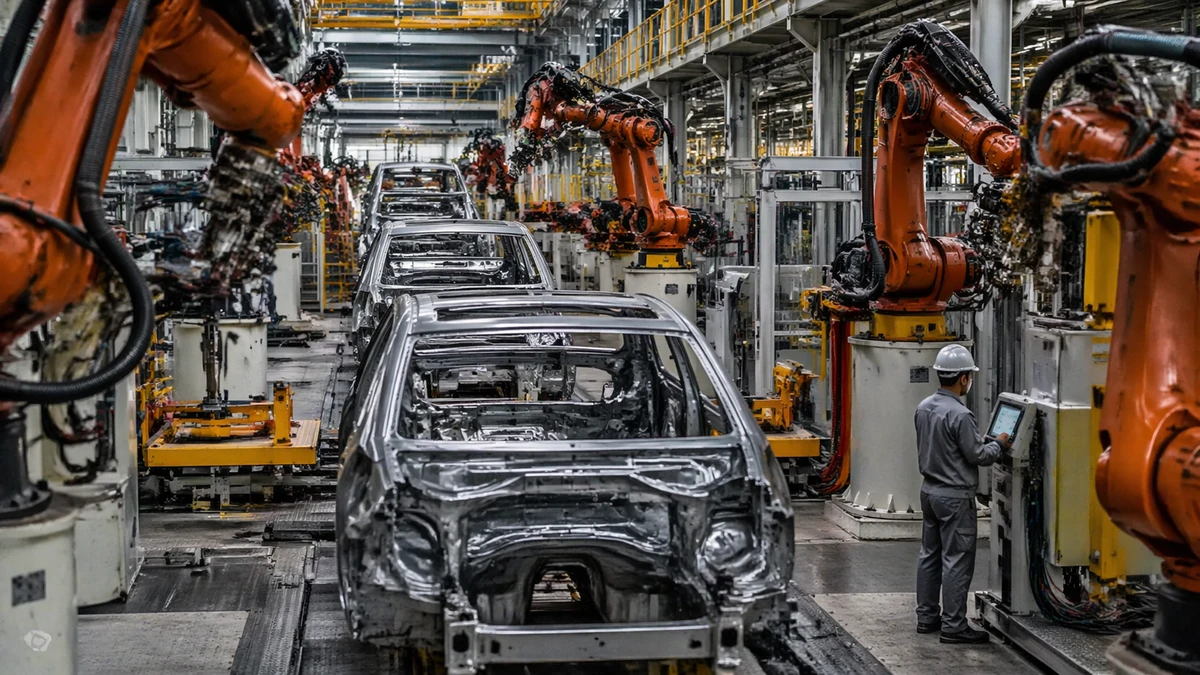
China’s biggest car market is no longer a guaranteed money machine
For years, China’s auto industry lived by a simple formula: build more cars, sell them at scale and let the country’s enormous consumer market do the rest. That model helped turn China into the world’s largest automobile market and a central force in the global auto business. But the equation is changing fast, and the warning signs are getting harder to ignore.
China’s domestic auto sales fell 20.3% in the first quarter from a year earlier, according to figures cited by Chinese media and industry data. In any market, that would be a jolt. In China, where the industry has long relied on sheer volume to offset thin margins and massive fixed costs, it is a flashing red light.
The problem is not simply that fewer people are buying cars right now. The deeper issue is that the business model that sustained many automakers for years is breaking down at the same moment the industry is being forced into an expensive technological transition. Carmakers are spending more on electric vehicles, batteries, software, digital features and marketing, even as overall sales soften and price competition intensifies.
To American readers, the closest comparison may be the U.S. auto industry during moments of major technological upheaval, when established Detroit brands had to absorb the cost of reinventing themselves while defending their legacy business. But China’s situation is unfolding faster, on a larger scale and in a market where the competitive landscape is shifting almost in real time.
That matters not only for China. What happens inside the Chinese auto market affects global supply chains, commodity demand, battery production, export strategies and the competitive pressure facing American, Japanese, South Korean and European automakers. China is no longer just a huge car market; it is one of the main laboratories for the future of the automobile.
The latest downturn suggests the industry has entered a more unforgiving phase: less about growth for growth’s sake, and more about survival, profitability and speed.
A sales slump exposes the cost of overcapacity
When auto sales fall in an industry built around scale, the damage spreads quickly. Carmaking is a capital-intensive business. Factories, tooling, logistics systems, dealer networks and supplier contracts all carry heavy fixed costs. When fewer vehicles move off lots, those costs do not disappear. Instead, automakers often respond with discounts, incentives and price cuts designed to keep volume moving.
That may protect market share in the short term, but it also eats into profit on every vehicle sold. If inventories rise, companies must then decide whether to cut production, offer deeper incentives or pressure dealers to absorb more stock. Those choices can ripple through the entire industrial chain, from parts suppliers and battery makers to local dealers and finance arms.
In the United States, Americans are familiar with the idea that a slowdown in auto demand can hit far more than the companies whose names are on the hood. It can affect jobs, regional economies and manufacturing sentiment well beyond the showroom. China faces the same kind of multiplier effect, only across a much larger production system and in a market that has become central to the worldwide industry.
The sales decline also changes the nature of competition. In a growing market, established companies and newer challengers can often expand at the same time, each finding room to add customers. In a shrinking market, companies are no longer sharing new demand; they are fighting over a smaller pie. Under those conditions, brand loyalty, financing strength, pricing flexibility, technology development and execution speed become much more important.
That is one reason the current weakness is more troubling than a routine cyclical slowdown. The pressure is arriving not during a stable period, but during a historic industry pivot toward electric and so-called new energy vehicles, a broad category in China that generally includes battery electric cars, plug-in hybrids and fuel-cell vehicles. As the market contracts, the costs of getting that transition wrong become much higher.
The EV transition is expensive, and state-backed automakers are feeling it
Some of the most closely watched pressure points are at large state-owned automakers such as Guangzhou Automobile Group and SAIC Motor. These companies long benefited from scale, government support, broad manufacturing capacity and, in many cases, profitable partnerships with foreign brands. But the transition to a new generation of vehicles is forcing them into a difficult balancing act.
Move too slowly into electric and smart vehicles, and they risk losing relevance to younger, more agile competitors. Move too quickly, and they take on soaring research, development and marketing costs at a moment when profits are already under strain.
This is one of the defining tensions in China’s current auto market. The old internal combustion engine business can no longer be relied upon as a steady profit center in the way it once was. Yet the new business requires heavy upfront spending on battery technology, vehicle platforms, software systems, connected-car services and consumer-facing features that go well beyond traditional engineering.
That last point is particularly important. In the old auto world, companies could often defend their position through manufacturing efficiency, dealership reach, brand reputation and incremental improvements in performance and fuel economy. In the new environment, cars are increasingly judged the way consumers judge smartphones or other connected devices: by user interface, digital ecosystem, update capability, battery range and the perceived sophistication of the overall experience.
For legacy manufacturers, especially large organizations with older assets and more layered decision-making, the cost of adapting can be steep. They are not merely launching new models. They are trying to rewire the logic of the company while still keeping the traditional business alive. That creates a double burden: preserving near-term earnings while funding long-term survival.
Recent weak earnings from major Chinese automakers suggest this transition cost is no longer theoretical. It is already showing up in financial statements. In other words, the industry is now paying the bill for a transformation that, until recently, could still be described mostly in strategic terms.
The old joint-venture playbook is losing its edge
Another sign of how fundamentally China’s auto market is changing can be seen in the weakening position of joint-venture brands. For decades, partnerships between Chinese automakers and foreign companies such as Volkswagen and Toyota were among the pillars of the industry. They offered Chinese consumers trusted global names, perceived quality assurance and a stable path for technology transfer in the earlier decades of China’s economic opening.
For many middle-class Chinese buyers, especially in major cities, those joint-venture brands once carried the same kind of status and confidence that Japanese and European brands came to represent for generations of American consumers. Buying one signaled quality, reliability and a step up in lifestyle.
That advantage is fading. As Chinese domestic manufacturers have improved design, engineering, battery integration and digital features, the old foreign-brand premium no longer carries the same automatic weight. Consumers shopping in China’s highly competitive auto market are increasingly comparing not just badge prestige, but software experience, voice controls, entertainment systems, battery performance, charging convenience and value for money.
This is where some joint ventures appear vulnerable. Their decision-making can be slower, in part because product planning and strategic choices must align across corporate cultures and ownership structures. That may work well in a mature market where product cycles are long and incremental changes are sufficient. It is much less ideal in a market where technology expectations shift quickly and a delay of even one model cycle can matter.
The challenge is also psychological. For years, the presence of a foreign partner was itself a selling point. Today, in many parts of China’s new energy vehicle market, local consumers increasingly view domestic brands as innovators rather than followers. That is a profound reversal. It means foreign-linked brands are no longer automatically seen as the future; in some segments, they risk being viewed as slower-moving incumbents.
For the global industry, this is one of the biggest takeaways from China’s recent auto evolution. China is no longer merely a place where international brands expand sales. It is now a battlefield where local innovation can define the terms of competition.
This is not just a price war. It is a structural profit crisis
It is tempting to describe China’s auto troubles as a simple price war, because price cuts are the most visible sign of distress. Consumers see discounts. Rivals trade blows in headlines. Market observers tally who lowered sticker prices and by how much. But focusing only on price misses the larger story.
The real crisis is structural. Automakers are facing three pressures at once. First, overall sales are weakening. Second, the cost of technological transition is rising. Third, some of the intangible assets that once supported profits, such as brand prestige and legacy market position, are losing value faster than expected.
That combination is dangerous in any capital-heavy industry. It is especially dangerous in auto manufacturing, where profits can turn sharply once scale works in reverse. A company that once relied on large volume to spread costs suddenly finds that each unit sold carries less margin, while the business still requires continued investment just to stay competitive.
Americans have seen versions of this dynamic in retail, media and consumer electronics, where companies discovered that market share alone did not guarantee durable profits once technology changed consumer expectations. The auto sector is different because the costs are far larger, product cycles are longer and mistakes are harder to unwind. A failed software push or a late EV lineup cannot be fixed as easily as an app update.
That is why the current moment in China matters beyond quarterly earnings. If profitability deteriorates long enough, the effects could touch hiring, factory utilization, local government planning, supplier stability and future capital spending. In a country where industrial policy and manufacturing capacity remain central to economic strategy, the health of the auto sector is not just a corporate issue. It is a policy issue.
And because China’s auto industry is tied closely to exports and to global manufacturing networks, a profitability crunch at home could reshape how aggressively Chinese companies push vehicles abroad. That could affect competitive dynamics in Europe, Southeast Asia, Latin America and, eventually, any market where Chinese brands seek broader presence.
The competition inside China has changed from scale to speed
Perhaps the clearest way to understand the shift is this: China’s auto industry is moving from a contest over who can make the most vehicles to a contest over who can change the fastest.
That may sound subtle, but it is a major transformation. In the earlier era of China’s auto boom, success often depended on expanding factory capacity, building distribution networks and leveraging foreign ties or production scale. Today, those advantages still matter, but they are no longer enough on their own.
What matters more now is the ability to push new-energy models to market quickly, invest heavily in research and development, and deliver features consumers can feel immediately. That includes battery performance, cabin software, digital interfaces, semi-autonomous functions, connected services and overall user experience.
In practical terms, automakers are being asked to operate less like traditional manufacturers and more like technology companies that also happen to build cars. The vehicle is no longer just a machine; it is a rolling digital platform. Consumers increasingly expect it to evolve, respond and integrate with the rest of their digital lives.
That favors companies built for speed. It can disadvantage firms with larger bureaucracies, older platforms and more internal resistance to change. For long-dominant players, the challenge is not only strategic but cultural. The habits that produced success in the last era can become liabilities in the next one.
The increase in spending on research, development and marketing reflects exactly that reality. Carmakers are spending more not simply because they want to, but because they must. They need to signal relevance, defend brand awareness and prove they can keep up in a market where novelty and functionality increasingly drive consumer attention.
In that sense, falling sales are not the whole story. They are the backdrop. The more important development is that the industry’s internal rules have changed.
What this means for the global auto race
China’s auto market remains enormous, and no one should confuse a painful transition with collapse. The country still has manufacturing depth, policy tools, a huge domestic customer base and a strong position in several parts of the electric-vehicle supply chain, especially batteries. Many Chinese automakers are likely to survive and some could emerge stronger, leaner and more globally ambitious.
But the era when scale alone could mask weak profitability appears to be ending. That has implications for investors, policymakers and rival automakers around the world. If Chinese firms become more disciplined about profits, the market could see consolidation, sharper strategic focus and a more selective approach to spending. If they fail to stabilize margins, competition could become even more brutal, with more aggressive discounting and stronger pressure to expand overseas.
For American readers, this is worth watching for at least three reasons. First, China remains one of the most important centers of EV innovation and manufacturing. Second, pricing and production decisions made in China can influence the economics of the global auto business. Third, the Chinese market offers a preview of what the next phase of industry competition may look like elsewhere: a world in which software, batteries and digital ecosystems matter as much as horsepower and brand heritage.
There is also a broader geopolitical angle. Autos are not just consumer products. They sit at the intersection of industrial policy, national competitiveness, energy transition and trade strategy. A weaker profit picture for Chinese automakers could shape how Beijing thinks about subsidies, market structure, exports and the future role of state-owned industry.
None of that means the winners are already clear. In fast-moving technology transitions, today’s advantage can erode quickly, and legacy firms are often capable of adaptation when pressured. But China’s current auto slowdown sends a message that the industry can no longer assume that bigger automatically means stronger.
The country built the world’s largest car market on expansion, scale and relentless production growth. It now faces a harder test: whether its automakers can make money in a market being remade by electrification, software and domestic competition at breakneck speed. That is a much tougher challenge, and one that will help determine not only the future of China’s carmakers, but the direction of the global auto industry itself.
Comments
Post a Comment