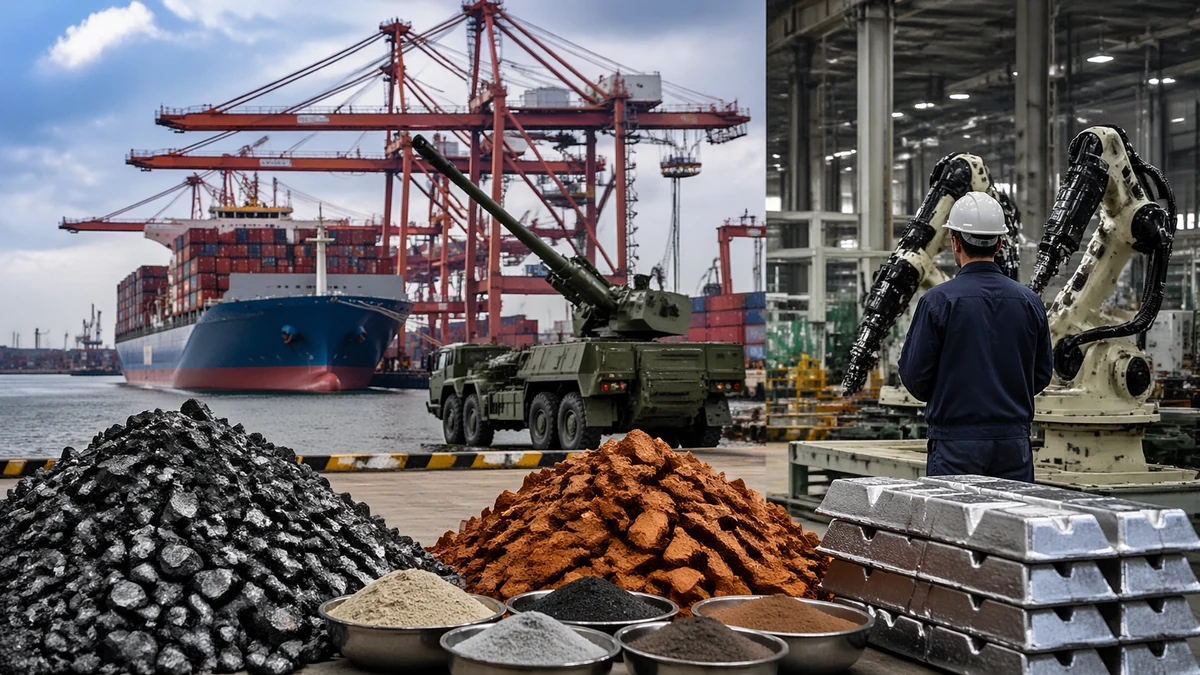
Beijing widens a familiar dispute into a broader economic warning
China’s latest move against seven European defense-related companies may look narrow on paper, but the signal is much larger: Beijing is increasingly using trade controls to punish, deter and shape foreign behavior on Taiwan.
China’s Commerce Ministry said it is placing seven companies from Belgium, Germany and the Czech Republic under export controls covering so-called dual-use items, a category that includes goods and technologies with both civilian and military applications. The list includes Belgium’s Herstal and FN Browning, Germany’s Hensoldt, and Czech firms including Omnipol and Excalibur Army, along with a Czech branch of SpaceKnow and the Aerospace Research and Test Establishment.
Under the measure, Chinese exporters are barred from shipping dual-use goods to those firms. Overseas organizations and individuals are also prohibited from providing Chinese-origin dual-use items to them. Beijing says the companies were involved in arms sales to Taiwan or other Taiwan-linked activities.
That language matters. China is not merely objecting to a single transaction or a technical licensing issue. It is tying access to critical industrial inputs to one of the most politically sensitive issues in Chinese foreign policy. In effect, Beijing is telling European companies that Taiwan is no longer only a diplomatic question discussed in foreign ministries and military briefings. It is now a supply-chain and cost-management problem for corporate boards and procurement teams.
For American readers, one way to understand this is to think about how Washington uses export controls, sanctions and tariff threats to pursue strategic goals beyond straightforward commerce. China is increasingly doing something similar, though with its own tools and political priorities. And because China dominates parts of the global processing chain for rare earths and other critical materials, even a limited action can create a chilling effect well beyond the companies named in the announcement.
The move also underscores how the Taiwan issue is evolving internationally. For years, Beijing has treated Taiwan as a core sovereignty issue and reacted sharply to foreign military support, official contacts and symbolic gestures. But the new pressure campaign suggests China is broadening the field of consequence. European businesses, not just governments, are being told they may pay a commercial price for involvement with Taiwan.
Why rare earths and dual-use goods matter far beyond defense
The terms at the center of this dispute can sound technical, but they go to the heart of modern manufacturing. Rare earths are a group of minerals essential to many advanced technologies, including magnets, sensors, guidance systems, optics, telecommunications components and high-performance electronics. Despite the name, they are not always geologically scarce. The strategic issue is refining, processing and supply-chain control, areas where China holds enormous leverage.
That is why a restriction aimed at defense firms does not stay neatly inside the defense sector. Rare earth inputs and dual-use components can affect aerospace, electronics, advanced machinery, industrial sensors and precision manufacturing. In a global economy built on specialized suppliers and exacting certification standards, even small disruptions can ripple through production schedules and contract obligations.
The phrase “dual-use” is especially important. In plain English, it means products that can serve both civilian and military purposes. That sounds like a narrow category, but in reality it is sprawling. Semiconductor manufacturing tools, advanced measurement devices, specialty chemicals, aerospace parts and certain materials can all fall into that bucket. For companies, the uncertainty can be as damaging as an outright ban. If a firm cannot quickly determine whether a component will be caught in a new restriction, it may delay orders, seek legal review, search for substitutes or avoid a transaction altogether.
That uncertainty is not a side effect. It is often part of the pressure. Even when the formal scope of a trade measure appears limited, businesses may respond conservatively, especially when they fear compliance risks or future escalation. In the United States, companies have long adjusted behavior because sanctions and export-control rules are complex and the penalties for getting them wrong can be severe. Beijing appears to be pursuing a similar deterrent effect here.
Defense manufacturers are particularly vulnerable because changing suppliers is rarely simple. A substitute material or part often requires testing, certification, government approval and renegotiation of existing contracts. In sectors tied to national security, a delay is not just an inconvenience; it can affect readiness, delivery obligations and political commitments. So while China’s announcement targets seven firms, the real audience includes a much broader group of European manufacturers and policymakers now being asked to price “China risk” into future decisions.
Taiwan is becoming a business risk, not just a foreign-policy debate
For years, many European governments have tried to strike a balance on Taiwan. Most do not recognize Taiwan as a sovereign state, in keeping with their one-China policy. At the same time, they have expanded unofficial ties in trade, technology, education and, in some cases, security-related cooperation. That balancing act has become harder as tensions in the Taiwan Strait rise and as China reacts more forcefully to what it sees as outside interference.
What Beijing is doing now is translating that political tension into commercial consequences. The message to Europe is clear: support for Taiwan, especially in areas touching defense or strategic technology, may carry a material cost. That is a significant escalation in practical terms, because companies can often ignore geopolitical rhetoric until it affects inputs, financing, shipping, insurance or market access. Once that happens, the issue moves from diplomatic talking points to quarterly earnings and long-term capital planning.
This is not just about one weapons sale or one research arrangement. In the defense world, symbolism matters as much as volume. A relatively small transaction involving Taiwan can be read by Beijing as political recognition or strategic alignment. By responding with trade controls, China is trying to change behavior before more deals happen. The goal may be less about punishing one company after the fact and more about making others think twice beforehand.
That logic will be familiar to Americans who have watched corporations navigate geopolitical red lines involving China, Russia, Iran or advanced technology exports. In today’s economy, the question is often not whether a company can technically complete a deal. It is whether the reputational, regulatory and supply-chain fallout makes the deal too expensive or too risky. China seems to be betting that if it raises that cost early enough, some European firms and perhaps some governments will quietly pull back.
The choice of only seven companies also appears calibrated. Beijing did not launch an economywide offensive against Europe. Instead, it created a case study. That gives China room to tighten or loosen pressure later while allowing the broader European business community to absorb the warning. From Beijing’s perspective, that is efficient coercion: establish a precedent, create uncertainty and encourage self-restraint without triggering an immediate full-scale rupture with the European Union.
Europe now faces the collision between strategic values and industrial costs
European leaders have spent the last several years talking about supply-chain resilience, de-risking and strategic autonomy. Those phrases gained urgency after the pandemic exposed vulnerabilities in global production networks and after Russia’s invasion of Ukraine highlighted the danger of overdependence in energy and security matters. But strategy becomes real only when a government must choose between political principles and economic pain.
This is one of those moments.
The companies named by China come from three different EU member states with different industrial profiles and political sensitivities. Germany is a manufacturing powerhouse with major stakes in advanced industry and technology. Belgium occupies an important place in Europe’s industrial and defense network. The Czech Republic has built a growing profile in defense production and exports, particularly as the war in Ukraine has pushed European governments to replenish stockpiles and rethink military capacity.
That diversity makes a unified European response more difficult. Not every country will calculate the risks the same way. Some governments may want a strong common statement defending commercial freedom and warning against coercive trade practices. Others may prefer a more cautious line that protects room for diplomacy with Beijing and avoids exposing domestic companies to retaliation.
For the EU, this is the central dilemma: Can Europe uphold its political stance on Taiwan-related issues without imposing unbearable costs on individual firms and sectors? If Brussels responds too aggressively, trade tensions with China could escalate. If it responds too softly, Europe may appear divided and vulnerable to pressure, reinforcing Beijing’s belief that selective economic measures can shape European behavior.
That tension is not unlike debates in Washington over how far to decouple from China in strategic industries without inflicting damage on American companies and consumers. The difference is that Europe often has less appetite for blunt confrontation and must manage a wider range of national interests within a single bloc. In practice, that can make EU responses slower, more cautious and harder to sustain.
Still, the broader direction is unmistakable. Europe is learning, as the United States has, that national security and economics can no longer be cleanly separated. A diplomatic position on the Taiwan Strait may now come with downstream effects on sourcing, compliance, insurance, delivery schedules and investment decisions. That is exactly the linkage Beijing appears intent on reinforcing.
The notice before the blow shows both communication and constraint
China has said it informed the EU through a bilateral export-control dialogue channel before implementing the measure. That detail may sound procedural, but it reveals something important about the current state of relations. Even as tensions rise, Beijing and Brussels still maintain channels to communicate on highly sensitive trade and technology matters.
That is not meaningless. In an era of growing mistrust, prior notice can help governments and companies prepare, assess exposure and limit panic. It also suggests China wants to present this as a rule-based action rather than an impulsive act of retaliation. By emphasizing process, Beijing can argue that it is enforcing its laws and policy principles, not simply lashing out.
But notification is not the same as coordination, and it certainly is not the same as consent. International trade disputes are filled with examples where governments were warned in advance and still could not stop the action. In that sense, the dialogue channel is both a safety valve and a reminder of limited leverage. Europe may have been informed, but it was not able to prevent the measure from going forward.
For Beijing, that may be part of the strategy as well. A formal notice allows China to frame future measures similarly, building a record that these actions are predictable, procedural and tied to stated policy concerns. That matters if Beijing wants to normalize selective export controls as a recurring instrument of statecraft.
For Europe, the test is whether those channels can do more than soften the landing. Can they narrow the interpretation of what counts as Taiwan-related involvement? Can they prevent additional companies from being listed? Can they stop the covered items from expanding over time? At the moment, the existence of communication lines is a modest positive, but not evidence of effective control over the dispute.
What this means for global supply chains and for the United States
This episode is not just a Europe story. It is another sign that the Taiwan question is moving deeper into the operating logic of the global economy. Companies once treated geopolitical exposure as a secondary matter, something for risk memos and occasional investor calls. That era is ending. For firms involved in defense, semiconductors, aerospace, advanced materials or precision manufacturing, geopolitical alignment is increasingly a live commercial variable.
American companies should pay attention for two reasons. First, many U.S. and European supply chains are intertwined. If a European defense or technology firm faces delays or sourcing problems because of Chinese restrictions, U.S. suppliers, partners and customers may feel the consequences. In industries with long production timelines and tight compliance standards, a disruption in one country can travel quickly across borders.
Second, the basic playbook is relevant far beyond this case. Washington has spent years expanding the use of sanctions and export controls to pursue national security aims. China is building its own capacity to do the same. That means multinational firms are increasingly trapped between competing legal regimes and political expectations. A company may satisfy one government’s strategic goals only to trigger another government’s economic punishment.
The result is a global business environment where resilience is no longer just about finding a backup supplier. It is about understanding which transactions might be read as political acts and which dependencies can be weaponized in a crisis. Rare earths are a prime example: They are physical materials, but also diplomatic leverage. The same is true for advanced manufacturing tools, chips and specialized components.
There is also a deeper strategic point. Beijing is signaling that third countries cannot assume the Taiwan issue is confined to relations between China and Taiwan. If foreign governments or companies become involved in ways China opposes, Beijing is prepared to widen the circle of consequence. That does not necessarily mean a sweeping confrontation every time. It may mean something subtler and, in some ways, more effective: targeted measures designed to reshape incentives without closing every door.
For Europe, the immediate challenge is managing the fallout while preserving policy coherence. For the United States, the lesson is that allies may face growing pressure not only through military signaling or diplomatic disputes, but through the industrial arteries that keep advanced economies running. And for companies on both sides of the Atlantic, the warning is straightforward: Taiwan is no longer only a geopolitical headline. It is a boardroom issue, a sourcing issue and an insurance-against-disruption issue.
That is the larger significance of China’s move. The action may have begun with seven companies and a familiar dispute over Taiwan. But the real message extends much farther — into Europe’s factories, into global technology supply chains and into the future rules of economic statecraft in a more fragmented world.
Comments
Post a Comment