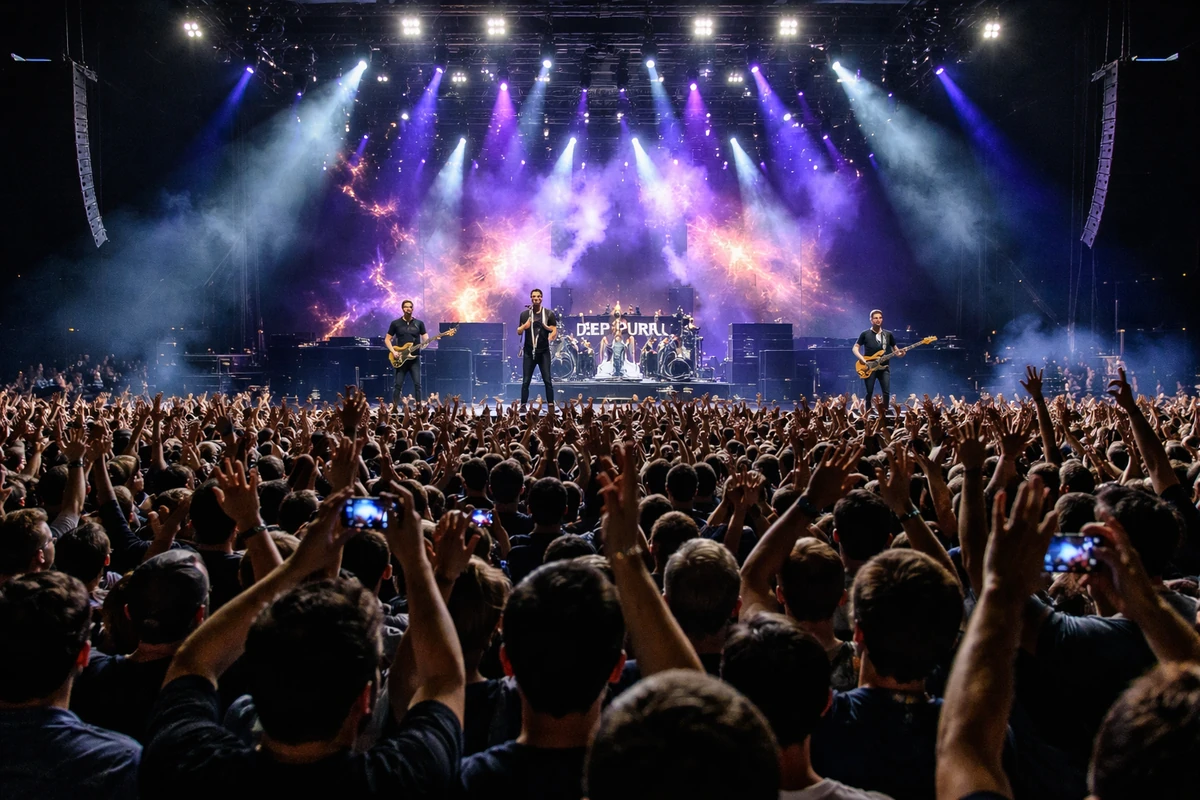
A roar from another era, still loud enough to shake the present
For a band whose most famous riff has been echoing through arenas, garages and guitar stores for more than half a century, Deep Purple’s recent concert in South Korea could have easily been framed as a nostalgia play: a veteran British hard rock act revisiting an overseas market after a long absence, giving aging fans one more chance to hear the classics. But by most accounts from the scene in Incheon, just west of Seoul, that is not what happened.
At an outdoor venue in Paradise City’s Culture Park on Yeongjong Island on April 18, Deep Purple returned to Korea for the first time in 16 years. And when frontman Ian Gillan, now 81, urged the audience to sing louder, the crowd answered with a full-throated chorus to “Smoke on the Water,” turning the chilly, wind-swept evening into something closer to a communal ritual than a heritage-rock recital.
That distinction matters. In much of today’s music business, especially one shaped by streaming, social media virality and weekly chart churn, older acts are often treated like museum pieces — respected, historically important, but somehow outside the pulse of contemporary listening. What unfolded in Incheon suggested something else. Deep Purple did not appear as a relic dusted off for one more lap around the globe. The band showed, in a very physical way, that live music can still collapse time: a song released decades ago can feel immediate when thousands of people know exactly when to clap, shout and sing.
For American readers, there is a familiar comparison here. Think of the way audiences still erupt when the opening piano notes of Billy Joel’s “Piano Man” land, or how a stadium full of fans can turn Queen’s “We Will Rock You” into a participatory event rather than a performance. The point is not simply that the song is beloved. It is that certain songs have migrated from recorded music into shared public memory. In Incheon, “Smoke on the Water” functioned exactly that way.
And in South Korea, where the live music economy is often discussed through the lens of K-pop, mega-fandoms and digital metrics, the show also made a broader argument: not all musical relevance is measurable by what is new, trending or optimized for the algorithm. Some of it is measured by what still works in a field, under stage lights, in front of a crowd that knows every beat.
Why a 16-year gap mattered — and why it disappeared once the music started
A 16-year gap between visits is long enough to alter the social meaning of a concert. Fans get older. Music scenes shift. New genres dominate. A country’s concert infrastructure changes. South Korea today is not the same market Deep Purple last visited in the late 2000s. Since then, the country has further established itself as a global pop powerhouse, with K-pop becoming one of its most visible cultural exports and large-scale touring becoming more sophisticated, brand-driven and international.
That is precisely why Deep Purple’s return drew interest beyond the band’s core fan base. In a market saturated with highly choreographed pop spectacles and fandom-intensive events, there was something striking about a hard rock group, formed in the late 1960s, commanding a mass singalong with little more than a handful of canonical songs, practiced stagecraft and the force of accumulated reputation.
But the concert’s emotional impact, based on reports from the venue, did not come simply from the elapsed time. If anything, the years vanished once the signature riff began. That is one of live music’s great powers: to turn absence into buildup rather than decay. A long wait can make a familiar song feel fuller, not older. What might look, on paper, like a break in continuity can become proof that the bond survived anyway.
American audiences know this pattern well. Legacy acts from Bruce Springsteen to the Eagles to Paul McCartney often draw multigenerational crowds not despite the age of the material, but because those songs have lived alongside people’s own biographies for decades. South Korean concertgoers are increasingly participating in that same kind of legacy market. Some in the crowd likely encountered Deep Purple in real time or through classic rock radio, imported records and earlier concert culture. Others almost certainly came to the band through YouTube clips, streaming playlists, older relatives, or the sort of cultural osmosis that turns a riff into global shorthand.
What makes the Incheon concert notable is that the audience response reportedly bridged those different listening histories. Younger and older fans may have arrived for different reasons — curiosity, devotion, bucket-list fulfillment, musical education — but once the chorus kicked in, they were no longer segmented demographics. They were simply a crowd.
In South Korea, the singalong is more than crowd noise
One Korean term that often appears in concert reporting is “ttechang,” usually written in English-language fan circles as “singalong” or “group chanting,” though neither translation fully captures the scale or emotional intensity of the phenomenon. In the Korean concert context, ttechang refers to a mass audience vocal response so unified that it becomes part of the event itself. It is not background enthusiasm. It is a co-production between artist and audience.
American readers might compare it to a packed ballpark singing “Sweet Caroline,” or a college football stadium locking into a chant with near-perfect timing. But in Korea, especially at major concerts, there can be an added layer of intentionality. Audiences often take pride in the quality of their collective response, whether through fan chants, synchronized cheering or thunderous singalongs. The crowd’s participation is not merely spontaneous; it can be a kind of performance of its own.
That helps explain why the reports from Incheon emphasize not just that fans liked “Smoke on the Water,” but that the song transformed the venue into a giant chorus. As Gillan reportedly waved both arms and pushed the crowd to get louder, the audience response was framed less as polite appreciation than as a force that reset the rhythm of the whole show. The spectators were not just consuming the concert. They were helping drive it.
That matters in the context of classic rock, a genre sometimes stereotyped as music to be admired from a historical distance. Deep Purple’s performance appears to have challenged that assumption. The song’s structure itself helps: an instantly recognizable guitar line, a chorus simple enough for mass participation and enough rhythmic propulsion to convert memory into motion. People jump, clap and shout almost before they have time to think about whether the material is old.
In other words, ttechang in this setting was not just evidence of fandom. It was evidence of present-tense relevance. A song becomes contemporary again when a crowd can still inhabit it.
What Deep Purple proved about music that outlives the charts
The modern music industry loves numbers because numbers travel cleanly. They can be ranked, compared, packaged into headlines and fed into investor decks. First-week sales, streaming peaks, chart debuts, video views, social engagement and sellout speed all help define who matters now. Those metrics are not meaningless; in many cases they are genuinely useful indicators of cultural momentum.
But they are not the whole story, and they are especially bad at explaining the long life of songs that have already escaped their original commercial moment.
Deep Purple’s show in South Korea underlined a simple truth that applies far beyond one band or one country: chart performance and cultural durability are not the same thing. Plenty of songs explode online and vanish just as fast. Others settle into public consciousness so deeply that they no longer depend on release cycles to prove their value. The audience at Incheon reportedly came, in large part, to hear music they already knew. In a market that often prizes novelty, the power here came from repetition, memory and recognition.
That is not a contradiction. It is a different value system. In streaming culture, newness is often treated as the key driver of attention. In the live market, familiarity can be a superpower. The more a song has been lived with, the more explosive it can become in performance. Every previous listen becomes stored energy.
American concert promoters have known this for years. It is why classic acts continue to fill arenas and amphitheaters even when they are nowhere near the top of current radio formats. It is why reunion tours, anniversary shows and catalog-heavy set lists remain commercially potent. What audiences buy is not only music, but also embodiment — the chance to hear songs in the air, in real time, among other people for whom they mean something.
South Korea, despite its reputation abroad as a hyper-modern pop marketplace, is no exception. The country has a deep and evolving live culture that includes idol concerts, indie scenes, hip-hop, festivals and a steady appetite for overseas acts. Deep Purple’s performance served as a reminder that Korea’s concert economy is broader than the K-pop image often projected overseas. There is room there, too, for legacy acts whose commercial prime passed decades ago but whose live power still converts.
More than age: the difference between an elderly band and an experienced one
Whenever older rock bands tour, coverage tends to slide toward a predictable narrative: Can they still do it? The age of the performers becomes the headline, sometimes at the expense of what actually happens onstage. To be fair, Gillan performing at 81 is objectively notable. Longevity in a physically demanding genre is newsworthy. But if reports from Incheon are any guide, focusing only on age would miss the point of why the concert landed.
The important question is not whether the band merely endured. It is how decades of experience translated into command: pacing, crowd control, song arrangement, dynamic shifts, timing and the ability to sense exactly when to push an audience and when to let it carry the moment. That kind of expertise is not sentimental. It is technical.
In this sense, Deep Purple’s strength was not just musical stamina but stage literacy. A veteran act that still works in the present tense understands that audiences come for the standards but stay emotionally invested when those songs feel alive rather than embalmed. The goal is not to reproduce a recording with perfect historical fidelity. It is to reactivate it.
That appears to be what happened in Incheon. The significance of the show was not simply that a legendary band performed famous songs competently. It was that the performance reportedly generated tension, release and crowd movement in ways that made those songs feel current again. For legacy artists, that is the line between reputation and relevance.
This distinction is also increasingly relevant in South Korea’s own music industry. K-pop, once viewed largely as a youth genre, now has artists and groups with careers long enough to raise questions about longevity, catalog value and how experience can remain marketable without depending solely on nostalgia. Deep Purple’s concert, while coming from a different musical tradition, offered a useful case study: a long career only matters if it can still be converted into real-time performance power.
That is a lesson American audiences may also recognize. The most successful veteran performers are rarely the ones who lean only on prestige. They are the ones who know how to make history feel urgent.
South Korea’s concert market is changing, but not in only one direction
To many international observers, South Korea’s live music business can appear dominated by K-pop blockbusters: stadium runs, synchronized light sticks, merchandise ecosystems, livestream tie-ins and fan communities organized at an almost industrial scale. That image is not inaccurate, but it is incomplete.
The country’s concert market has become more diversified, not less. Even as major idol acts and global pop stars command the largest headlines, there remains sustained demand for veteran international musicians, particularly those with recognizable catalogs and a strong live reputation. These are not necessarily the loudest stories in the market, but they can be among the most stable.
That stability comes from a different kind of audience relationship. When fans attend a concert by a legacy act, they are often buying scarcity rather than trend participation. Streaming has made recorded music infinitely available, but a live appearance by an older, internationally touring artist is still finite. It can feel unrepeatable in a way that digital listening never does.
Deep Purple’s return demonstrated that point clearly. In a crowded entertainment environment where attention is constantly fragmented, a band built around riffs, musicianship and catalog strength still drew a strong enough response to turn an outdoor venue into a collective memory machine. That suggests the Korean live market is not simply following youth-driven momentum. It is also capable of sustaining niche-seeming events with high loyalty and high satisfaction.
For American readers, a useful analogy might be the difference between a blockbuster Marvel opening weekend and a long-running Broadway revival that reliably fills seats because people know exactly what experience they are paying for. One is driven by urgency around the new. The other is driven by trust in something already canonized. Both can thrive, but they operate on different emotional economies.
South Korea’s concert business increasingly contains both models. Deep Purple’s show belonged squarely to the second — and succeeded on those terms.
Why this night resonated beyond one band
At first glance, a classic rock concert in Incheon might seem like a small cultural story, interesting mainly to fans of British hard rock. But there is a broader reason it resonated. It offered a snapshot of how music travels across generations and borders long after its original commercial moment has passed.
Deep Purple is not Korean. Hard rock is not the dominant sound shaping South Korea’s global cultural image right now. And yet the response in Incheon reportedly showed a large Korean audience investing emotionally and physically in a song that predates much of the modern global music infrastructure. That is a reminder that cultural globalization does not move only through whatever is newest. It also moves through long memory, imported canon, intergenerational sharing and the strange durability of songs that are simple enough to survive format changes.
It also says something about how audiences want to feel in an era of digital abundance. Streaming can make music ubiquitous, but it can also flatten listening into a private and endlessly scrollable activity. A concert like this restores friction and scale. You have to be there. The wind is cold. The speakers are loud. The crowd around you knows the chorus. A song you have heard a hundred times becomes singular because this version will only happen once.
That may be why the Incheon performance, as described in Korean coverage, was difficult to dismiss as mere nostalgia. Nostalgia tends to imply retreat — a longing for a sealed-off past. What happened there sounded more active than that. The crowd did not just remember an old song. It used the song to produce a present experience.
That is a subtle but important distinction, especially for journalists trying to explain why legacy acts still matter. The story is not that aging musicians continue to exist, nor even that their old hits remain familiar. The story is that under the right conditions, live performance can pull those songs out of the archive and make them social again.
In Incheon, Deep Purple appears to have done exactly that. Sixteen years after its last Korean visit, the band turned a famous riff into evidence that music’s lifespan cannot be reduced to a chart run, a release date or an artist’s age. Sometimes its truest measure is simpler: whether a crowd still knows when to sing, and whether it still wants to sing together.
A classic-rock lesson for a global pop era
If there is a final takeaway from Deep Purple’s return to South Korea, it is not simply that the band remains beloved. It is that live music still has the ability to reorder cultural priorities. For one night in Incheon, the dominant logics of the modern music business — novelty, velocity, metrics, youth branding — gave way to something older and arguably more durable: shared memory activated in real time.
That is not an argument against new music or pop innovation. South Korea remains one of the most dynamic music markets in the world precisely because it is constantly producing and exporting the new. But the Deep Purple concert suggests that even in a market shaped by rapid change, there is strong appetite for music that has already proven it can last.
For Americans watching from afar, there is another lesson here as well. It is easy to view Korea only through the frame of K-pop, just as it is easy to view classic rock only through the frame of boomer nostalgia. Both shortcuts miss the deeper story. Korean audiences are more musically varied than their export image suggests. And legacy rock, at its best, can still function as a living language rather than a preserved artifact.
On April 18, that language was spoken fluently in Incheon. A crowd facing the sea wind sang back one of rock’s most durable choruses. An 81-year-old singer lifted his arms and asked for more. And for at least a few minutes, a song older than many people in the audience stopped sounding old at all.
Comments
Post a Comment