A troubling number returns
South Korea has crossed back over a line that carries outsized political and emotional weight: more than 1 million unemployed people on average in the first quarter. According to employment data released April 19, the country recorded an average of 1.029 million unemployed people from January through March, up 49,000 from the same period a year earlier. On paper, economists can argue about seasonal distortions. Early-year labor figures are often affected by graduation cycles, delayed hiring and winter slowdowns. But in a country where employment is closely tied to family stability, social status and long-term life planning, the return to seven digits matters far beyond a statistical footnote.
The symbolism is powerful because this is the first time in five years that quarterly average unemployment has risen back above 1 million. In the United States, a headline number on unemployment usually lives inside a broader debate about inflation, interest rates and consumer confidence. In South Korea, it also lands inside a much more personal conversation: whether young adults can afford to move out of their parents’ homes, marry, have children or build any meaningful savings in one of the world’s most expensive urban housing markets. When the job market weakens there, the shock does not stop at the worker. It moves through households, local businesses and the country’s already anxious demographic outlook.
That helps explain why this data has resonated so sharply. South Korea is not dealing simply with “people out of work.” The official unemployed are people who want jobs, have looked for work and still have not found one. That distinction matters. It means the increase reflects not passivity, but frustration at the labor market’s front door. The people counted in this figure are trying to get in. They are sending resumes, studying for exams, interviewing and waiting, often for months, only to remain shut out.
Why young people are at the center of the story
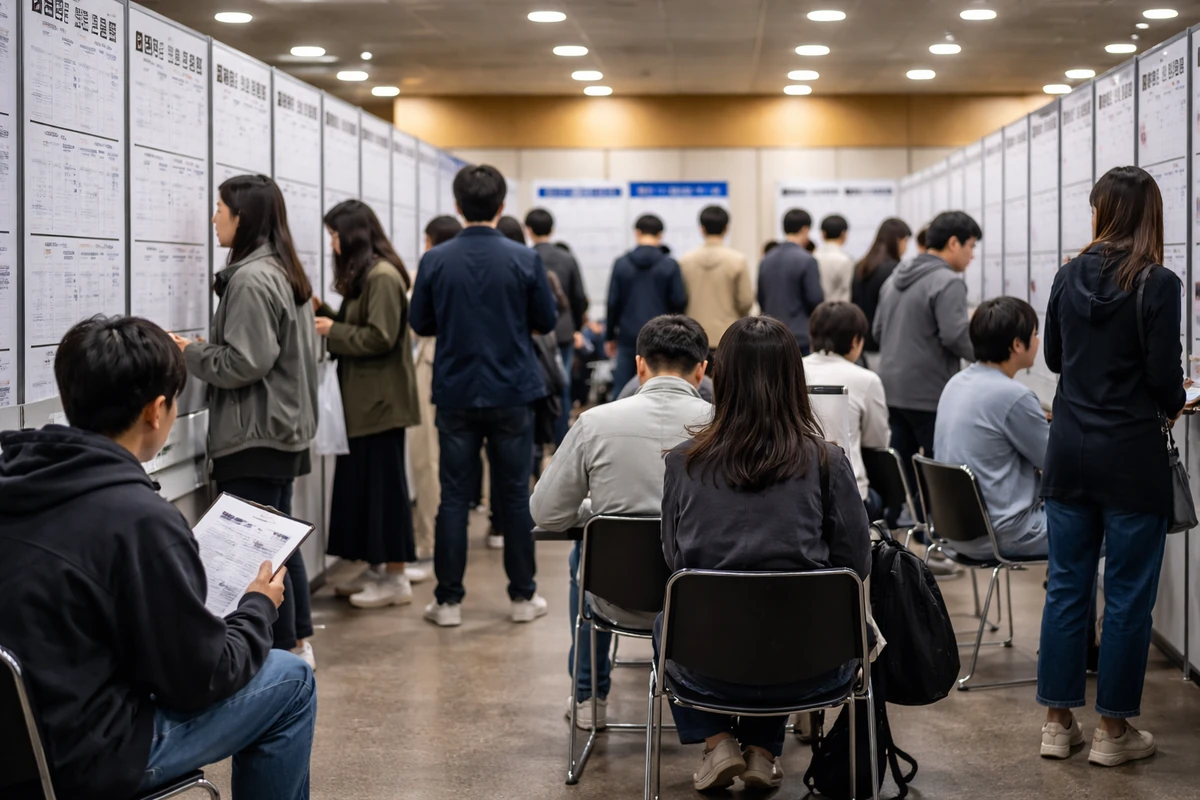
The most alarming part of the report is not the top-line number. It is who is making up so much of it. One in four unemployed people in South Korea is young, and the youth unemployment rate climbed to 7.4%, up 0.6 percentage point from a year earlier. That is a warning sign in any advanced economy. In South Korea, it is especially serious because the transition from school to work is highly competitive, socially loaded and often unforgiving. For many young adults, a first job is not just a paycheck. It is the gateway to adult independence.
American readers may hear “youth unemployment” and think of summer work, part-time service jobs or recent graduates bouncing between internships. South Korea’s version often looks different. Many college graduates spend long stretches in what the country calls “job preparation,” a period that can involve language tests, professional certificates, unpaid study time and repeated applications to a narrow set of employers considered stable or prestigious. Those can include major conglomerates known as chaebol, such as Samsung, Hyundai and LG, or public-sector jobs that offer strong benefits and security. When hiring slows, the bottleneck can be brutal because so many candidates are aiming for a limited number of entry points.
That dynamic turns early-career unemployment into something more lasting than a rough patch after graduation. Delayed entry can hold back wages, reduce opportunities for skill development and make future job changes harder. Economists sometimes call this a “scarring effect,” meaning a bad start can echo for years. In South Korea, where educational attainment is high and family investment in children’s schooling is intense, the disappointment can feel even sharper. The issue is not simply that young people are jobless now. It is that many fear they are falling behind on the entire timeline of adulthood.
More than a downturn, a sense of a frozen labor market
The report describes a particularly worrying combination: youth employment is falling while youth unemployment is rising. Those two trends together suggest a labor market that is not merely producing lower-quality jobs, but offering fewer openings altogether. If only the unemployment rate were rising, some analysts might argue that more young people had become newly active in searching for work. If only the employment rate were falling, it could imply some had stepped out of the labor force. But when employment drops and unemployment rises at the same time, the message is more straightforward: job seekers are still trying, and the market is absorbing fewer of them.
In South Korea, that has fed a phrase increasingly used in local coverage: an “employment ice age” for young people. It is a vivid expression, and not hard to understand in an American context. Imagine a generation of graduates facing a labor market where the usual first rungs of the ladder have narrowed, permanent jobs are harder to land and the cost of waiting keeps rising. Now layer that onto a society where housing prices in and around Seoul remain a major barrier, where family expectations around career stability remain strong, and where a resume gap can carry a heavier stigma than in more fluid labor markets.
The people hidden inside the averages are easy to picture. They are students delaying graduation because the job market looks too weak. They are young applicants retaking certification exams or English proficiency tests to gain an edge. They are recent graduates cycling through temporary jobs while holding out for something more secure. They are applicants who give up on their preferred field and accept work unrelated to their training just to begin earning. None of those paths is unusual in South Korea. What is unusual, and increasingly troubling, is how normal prolonged uncertainty has become.
Why unemployment in South Korea quickly becomes a family issue
One reason these figures carry so much social weight is that unemployment in South Korea rarely stays confined to the individual. The country’s economic culture ties work closely to family transitions. A stable job is often seen as the prerequisite for moving out, getting married, planning children and even choosing where to live. When job entry is delayed, those milestones are delayed with it. That matters in any society. It matters even more in South Korea, which already has one of the world’s lowest birth rates and a growing sense of demographic emergency.
For many families, a son or daughter’s prolonged job search means more than emotional stress. It can mean extended financial support for rent, food, exam fees, transportation and training. In practical terms, parents absorb costs that might otherwise have shifted to an employed adult child. Middle-aged households, in turn, may postpone their own retirement preparation or cut spending elsewhere. In the United States, parents helping adult children has become more common, too, particularly in expensive metro areas. But in South Korea, where competition for first jobs can be especially concentrated and social expectations around career launch remain intense, that dependence can last longer and feel more consequential.
The burden is psychological as well. Young adults can feel they are failing to keep pace with peers. Parents can feel powerless watching children do everything “right” on paper and still struggle to find stable work. The longer the search lasts, the narrower choices can become. That is one reason local reporting increasingly frames youth unemployment not simply as an economic indicator, but as a social stress test. It reaches into mental health, family finances and the country’s future confidence all at once.
The regional divide and the pull of Seoul
The pain is not distributed evenly across the country. South Korea’s economy is highly concentrated in the greater Seoul area, where the largest employers, best-known universities and most sought-after professional networks are clustered. That creates a familiar pattern for Americans who have watched opportunities gravitate toward New York, San Francisco, Washington or a few other metro magnets. But because South Korea is geographically compact and economically centralized, the pressure can be even more intense. Young people in smaller cities and provincial areas often feel they must move toward Seoul for better odds, even if the cost of doing so is daunting.
When employment weakens, that concentration can worsen regional inequality. Some young workers leave hometowns in search of opportunity, draining smaller communities of talent and spending. Others remain, but face a thinner local job market and fewer pathways into stable work. Either way, local economies suffer. Fewer employed young adults means less consumer activity, less household formation and less long-term commitment to a region. In a country already worried about “regional extinction” — the fear that some areas could hollow out as populations age and decline — weak youth employment becomes part of a much larger national anxiety.
This is one reason a headline unemployment figure can ripple so widely. It affects whether neighborhoods retain young residents, whether local businesses can count on steady demand and whether communities can imagine a sustainable future. In South Korea, jobs are not just about output and wages. They are tied to settlement patterns, family formation and the viability of life outside the capital region. A labor market squeeze among young adults can therefore deepen both the country’s demographic divide and its geographic one.
What the numbers say about South Korea’s economic model
The latest data also raises uncomfortable questions about how inclusive South Korea’s recovery has really been. The country remains a major exporter, a technology powerhouse and one of Asia’s most dynamic economies. Americans know South Korea globally through semiconductors, Hyundai cars, K-pop, Oscar-winning cinema and the streaming success of shows such as “Squid Game.” The image is modern, innovative and fast-moving. But national success at the industrial level does not automatically translate into broad labor-market security, especially for young people trying to break in.
That mismatch is part of the story. South Korea has world-class companies and highly educated workers, yet many younger job seekers still face a narrow funnel into secure employment. Large firms are coveted because they tend to offer better pay, benefits and prestige. Small and midsize companies often struggle to compete for talent, while some young applicants are reluctant to accept roles they see as less stable or less rewarding. The result can be a labor market where openings exist, but not necessarily in the places, industries or terms many workers are seeking. That does not make the unemployment problem less real. It shows how structural it has become.
There is also a generational fairness issue. Older workers may have entered the labor market at a time when economic growth was faster and social mobility felt more attainable. Today’s young adults face a far more expensive housing market, slower wage gains and a tougher contest for elite openings. In that sense, the return of unemployment above 1 million is not just a cyclical warning about this quarter or this year. It is a signal that the ladder into middle-class stability may be pulling farther out of reach for a generation already burdened by delay.
What comes next, and why it matters beyond South Korea
The central policy challenge is not merely to reduce a headline number for one quarter. It is to rebuild reliable entry routes into work, especially for young adults. Temporary hiring subsidies or short-term public jobs may soften immediate pain, but they do not necessarily solve the deeper problem if the transition from education to stable employment remains clogged. South Korea needs more than a statistical improvement. It needs a labor market in which first jobs are attainable, skill-building is rewarded and a bad start does not become a long-term sentence.
That will likely require a mix of measures: encouraging private-sector hiring, strengthening pathways into smaller firms, reducing mismatches between education and employer demand, and making it easier for young workers to build careers without having to win a handful of ultra-competitive lotteries at big-name employers. It may also require confronting cultural expectations around prestige, security and what counts as an acceptable first step. None of that is easy. But the cost of failing is visible in the current data: delayed independence, widening inequality within the younger generation, heavier family burdens and more strain on regions already struggling to keep young residents.
For American readers, the broader lesson is familiar even if the local details are distinct. A labor market can look resilient in headline terms and still leave a generation feeling locked out. When that happens, the effects spread beyond economics into politics, family life and national mood. South Korea’s latest unemployment figures are a warning from one of the world’s most advanced economies that growth alone is not enough if young people cannot find a way in. The return to 1 million unemployed is not just a big number. It is a sign that for too many South Koreans, the future is arriving later than it used to — and at a much higher price.
Comments
Post a Comment