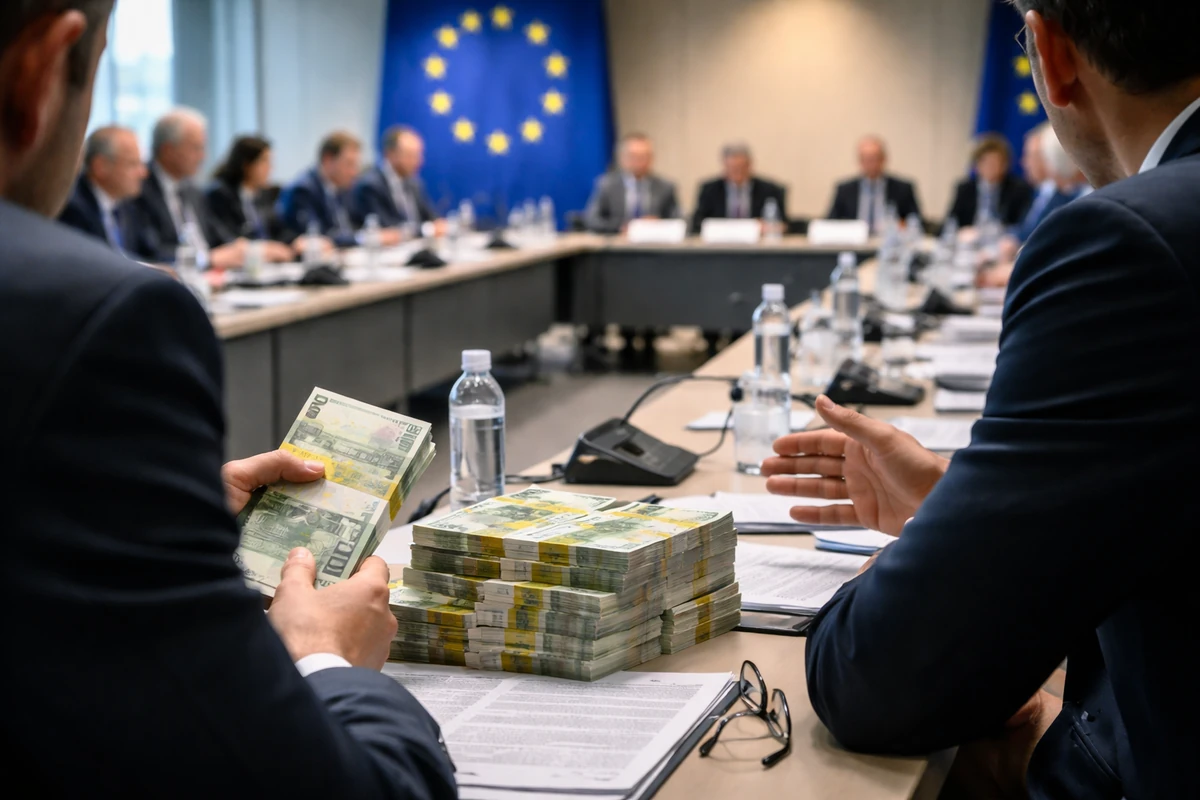
Brussels turns up the pressure on Serbia
BRUSSELS — The European Union delivered one of its clearest warnings yet to Serbia this week: If the country’s democratic decline continues, it could lose as much as 1.5 billion euros in financial support, a sum worth roughly $1.7 billion at current exchange rates. For Americans, the closest analogy might be Washington telling a strategic partner that future aid, development money and access to a preferred political relationship are all now at risk unless core democratic standards are restored.
That warning, issued April 20 in Brussels, is not simply about budget lines or bureaucratic procedure. It marks a sharp escalation in a long-running struggle between the EU and Serbia over what it really means to seek membership in the European bloc. For years, Brussels has expressed concern about democratic erosion in parts of the Balkans. But directly tying those concerns to such a large amount of money gives the dispute new force — and raises the political stakes both in Belgrade and across Europe.
Marta Kos, the EU commissioner for enlargement, told the European Parliament’s foreign affairs committee that the bloc is becoming “increasingly concerned” about developments in Serbia and is reviewing whether the country still meets the conditions for EU financial assistance. That language matters. Enlargement, in EU terms, refers to the long process through which aspiring countries adopt the legal, political and economic standards required to join the union. It is not unlike an extended accession process to a tightly regulated club — one in which the rules are supposed to be nonnegotiable, especially on democracy, courts and media freedom.
In Serbia’s case, the issue has now widened from a dispute over reforms to a broader crisis of trust. Brussels is signaling that democracy, rule of law and freedom of the press are no longer just aspirational talking points in speeches and summit communiques. They are becoming hard conditions attached to real money and to Serbia’s long-term European future.
That is why the warning carries significance beyond the headline number. The message from Brussels is not only that Serbia could lose funding. It is that Serbia may be drifting far enough from European democratic norms that its credibility as a candidate country is coming under question. In a region where great-power competition, nationalism and institutional fragility still shape politics, that is a serious development.
Why the EU is focusing on courts and the press
The EU’s criticism is not vague. Brussels has zeroed in on two areas that, in any democracy, are among the clearest measures of whether power is truly constrained: the judiciary and the media.
First, the EU wants Serbia to align its judicial laws fully with recommendations from the Venice Commission, an advisory body of the Council of Europe made up of constitutional law experts. Americans may not know the Venice Commission by name, but in European political life it carries substantial weight. Its opinions are not the same as binding court orders, but they function as a major benchmark for whether a country’s legal and constitutional arrangements meet accepted democratic standards. When the Venice Commission raises concerns, European institutions listen.
Judicial independence is one of those concepts that can sound abstract until it is translated into daily life. In practical terms, it means judges and prosecutors must be able to do their jobs without fear of political retaliation, partisan pressure or executive interference. If courts can be influenced by ruling parties or powerful officeholders, then corruption cases, election disputes and civil rights claims can all be skewed. To American readers, imagine concerns that prosecutors and judges in a U.S. state were no longer seen as independent from the governor’s office. The legal machinery may still exist on paper, but public trust would erode quickly if people believed outcomes were politically managed.
The second issue is media independence. Here, too, the EU is looking for more than rhetoric. It wants to see whether critical journalism can function in practice — whether reporters can investigate those in power, whether opposition voices can reach the public and whether media outlets can operate without undue political or financial coercion.
That matters not just for civil liberties but for markets and diplomacy. In countries where press freedom is under pressure, investors often read media conditions as a warning sign about broader political risk. If journalists cannot report freely, outside observers may conclude that corruption, favoritism or institutional abuse is harder to detect. In other words, a weak press is not only a democratic problem; it is often a business climate problem, too.
For the EU, these two areas are measurable and politically sensitive at the same time. Elections can be held on schedule and institutions can still appear intact, but if the courts are bent and the press is constrained, the democratic system underneath can be hollowed out. That is why Brussels is focusing here. These are not side issues. They go to the core of whether Serbia is converging with European norms or moving away from them.
The real meaning of the 1.5 billion euro threat
On paper, 1.5 billion euros is a large financial figure. In political terms, it is even larger. This is not framed as a one-off penalty or a symbolic slap on the wrist. It concerns the future of Serbia’s relationship with the EU, which has for years been built on a bargain: reforms in exchange for money, market access, institutional support and the eventual possibility of membership.
That model has long been central to how the EU projects influence, especially in neighboring regions. Unlike the United States, which often leans on military power or security partnerships, the EU’s strongest tools are regulatory pressure, financial assistance and access to the world’s largest integrated market. Brussels shapes behavior by making benefits conditional. Countries that want to move closer to Europe are expected to align their institutions with European standards.
Serbia has been one of the most closely watched tests of that model. It is a major country in the Western Balkans, strategically important, politically complex and often seen as pivotal to regional stability. Yet it has also maintained a balancing act: seeking ties with the EU while emphasizing sovereignty at home and preserving room to maneuver internationally. That strategy becomes much harder to sustain when Brussels starts attaching concrete consequences to democratic concerns.
For Serbia, EU money is not just foreign cash arriving in government accounts. It supports infrastructure, administrative modernization and policy reforms that help the state function more effectively and move closer to EU standards. If those funds are suspended or reduced, the damage would not be purely economic. It could also weaken Serbia’s European integration path, slow reform efforts and create a perception that the country is no longer a credible candidate for eventual membership.
That, in turn, affects domestic politics. Serbian leaders have to manage two competing pressures. One is the practical need to maintain working ties with the EU, Serbia’s biggest economic partner and an essential source of investment and funding. The other is the political appeal of resisting outside pressure and presenting Brussels as overreaching or insensitive to national sovereignty. As long as EU criticism remained mostly diplomatic, Belgrade had more room to maneuver. Once money and accession prospects are clearly tied to reforms, the space for ambiguity narrows.
There is a wider message here, too. The EU is demonstrating that “conditional integration” — the idea that countries earn deeper access by meeting specific standards — is still the backbone of its enlargement strategy. Brussels appears to be saying that if it fails to enforce those conditions in Serbia, then its own rulebook starts to lose credibility.
The Venice Commission’s role is technical — and deeply political
One reason this latest warning carries extra weight is that it is not emerging from politics alone. It is linked to an institutional review process involving the Venice Commission, which visited Serbia last month and met with political leaders and judicial officials. According to AFP, the commission is expected to issue an urgent opinion within weeks.
That matters because the EU can now point not just to general unease but to an external evaluation framework with legal and constitutional authority. The Venice Commission is not a legislative body, and it does not impose sanctions. But in European governance, expert review often serves as the basis for political decisions. When a country’s laws are judged against shared democratic norms, those findings can then be used by EU institutions when deciding whether reform benchmarks have been met.
For American readers, this may sound unusual, because the U.S. system does not have an equivalent transnational constitutional advisory body tied to membership in a broader political union. But in Europe, where countries voluntarily pool sovereignty through institutions like the EU and the Council of Europe, these expert bodies play a major role in defining what counts as democratic backsliding and what reforms are considered credible.
The significance is this: Serbia is not just facing political criticism that can be brushed off as ideological or hostile. It is facing scrutiny under a shared European standards regime. That is much harder to dismiss. If the Venice Commission concludes that Serbia’s judicial arrangements fall short of accepted norms, the government would be under pressure to do more than issue statements or offer partial fixes. It would need to revise laws, adjust institutions and show that the changes are real and enforceable.
In that sense, the next phase may be less about rhetoric and more about verification. Can Serbia demonstrate, in ways that outside institutions can measure, that courts are insulated from political control? Can it show that media freedom is improving in practice rather than just in official pronouncements? Those questions are likely to define the country’s near-term relationship with Brussels.
President Aleksandar Vucic now faces a harder political choice
The warning also lands at a sensitive moment in Serbian domestic politics under President Aleksandar Vucic, whose rule has often been associated with centralized authority and a strong emphasis on stability. To supporters, that governing style can look efficient and disciplined. To critics in Europe and beyond, it can look like excessive concentration of power.
This is where the EU’s focus on the judiciary and the media becomes especially pointed. These are precisely the institutions meant to check executive authority. If independent courts and a free press are weakened, then claims of political overconcentration become more plausible. That is why Brussels’ message can be read as not merely a critique of one policy area but as a challenge to the broader way power is exercised in Serbia.
Belgrade is likely to face two competing responses at home. One camp will frame the EU’s pressure as foreign interference, arguing that Serbia should not let outside actors dictate its internal arrangements. That kind of argument can resonate strongly in the Balkans, where questions of national sovereignty and historical grievance remain politically potent. The other camp will argue that Serbia cannot afford to jeopardize EU funds, investment confidence and its long-stated European future simply to defend a system that is drawing mounting criticism from abroad.
Both positions have political logic. But what is changing is that Serbia may no longer be able to manage this simply as a matter of adjusting its distance from Brussels. The conflict is becoming more explicit: values versus expediency, sovereignty versus integration, and domestic control versus international legitimacy.
What ordinary citizens make of all this may ultimately be decisive. Terms like “judicial independence” and “media pluralism” can sound remote, especially compared with bread-and-butter concerns such as wages, public services and inflation. But these democratic issues shape whether corruption allegations are investigated, whether public contracts are scrutinized and whether citizens can trust that institutions serve the public rather than political patrons. In any country, including the United States, democratic decay often becomes visible first in the everyday sense that the system is rigged for insiders.
If opposition parties and civic groups in Serbia can connect Brussels’ warning to those day-to-day concerns, the issue could gain wider public traction. If not, the government may still have room to portray the EU’s intervention as elitist or detached from people’s immediate needs.
A test case for the Balkans and for Europe itself
Serbia’s standoff with the EU is about more than one candidate country. It is also a test of whether Europe can maintain a credible enlargement policy at a time of growing geopolitical strain.
The Western Balkans have long occupied a special place in European strategy. The region sits at the intersection of security concerns, post-conflict state-building and competition for influence among outside powers. For decades, the EU has argued that the best way to stabilize the area is to draw countries gradually into its legal, economic and political orbit. That approach depends on the promise that reform will be rewarded — and that backsliding will have consequences.
The problem for Brussels is that enforcing those consequences can be politically costly. Push too hard, and the EU risks alienating a strategically important country and opening space for rival influences. Push too little, and the bloc sends the message that democratic standards are flexible when geopolitics gets complicated.
That tension is hardly unfamiliar to Americans. Washington, too, has often struggled to reconcile values-based foreign policy with strategic necessity. The EU is facing its own version of that dilemma in Serbia. If it wants to present itself as a community built on law and democratic norms, it cannot appear indifferent when a candidate country is accused of undermining those very principles. But if it escalates too sharply, it may weaken its influence on the ground.
Still, Brussels appears to have concluded that the greater risk now is inconsistency. If democratic decline is tolerated in the name of stability, the credibility of the enlargement process suffers not just in Serbia but across the region. Other candidate countries will watch closely to see whether the EU follows through. If the warning ends in little more than another round of statements, it may reinforce the belief that European conditions are negotiable. If it leads to real financial or political penalties, it will set a precedent that could reshape calculations well beyond Belgrade.
What comes next
The immediate next steps are likely to revolve around the Venice Commission’s forthcoming opinion and the EU’s assessment of whether Serbia still meets the terms attached to financial assistance. That process will matter because it can transform a political warning into an institutional decision.
For Serbia, the window to respond may be narrowing. A serious response would require more than public assurances. It would likely involve revising judicial legislation to align with European recommendations, taking visible steps to protect media independence and persuading skeptical partners in Brussels that reforms are not cosmetic. In European politics, implementation matters as much as promises.
For the EU, the challenge will be to show that its conditions are real while leaving room for Serbia to course-correct. The bloc does not simply want to punish Belgrade; it wants to influence its trajectory. That means pressure will probably be paired with a continued offer of closer integration — provided Serbia demonstrates credible change.
The broader lesson is that this confrontation has moved beyond a dispute over aid. It has become a referendum on what kind of political system Serbia intends to be and how seriously the EU is prepared to defend its own standards. Money is the immediate lever, but trust is the deeper issue. And once trust starts to erode in accession politics, it can be far harder to rebuild than any suspended funding line.
That is why the warning from Brussels matters. It is not just about euros, budgets or technical benchmarks. It is about whether Europe’s promise to expand while upholding democratic norms still carries force — and whether Serbia still wants to meet the terms that promise requires.
Comments
Post a Comment