
A K-pop hitmaker faces a very public breaking point
The legal dispute surrounding The Boyz, a long-running South Korean boy band with a sizable international following, has become more than a contract fight between performers and their management company. In South Korea, where the group’s conflict has dominated entertainment coverage, the case is being read as another warning sign that one of the country’s most successful cultural exports still rests on a fragile and often opaque business model.
According to the Korean news summary, the group has demanded termination of its exclusive contract with its agency, One Hundred Label, and has also filed a criminal complaint against the company’s chief executive on embezzlement allegations. The company disputes the demand to end the contract. The conflict had already escalated in February, when nine members sought a court injunction to suspend the validity of their exclusive contracts. By April, the fight had broadened from a civil dispute over contractual rights into something more serious and more public.
For American readers, it may help to think of an “exclusive contract” in K-pop not simply as a recording deal in the narrow U.S. sense. It is closer to an all-encompassing agreement that can govern management, music releases, touring, endorsements, fan events, international appearances and sometimes even the basic structure of an artist’s day-to-day career. In a system built around intensive training, group branding and highly coordinated schedules, those contracts function as the operating spine of the business. When they fracture, the impact goes beyond one album cycle or one canceled appearance.
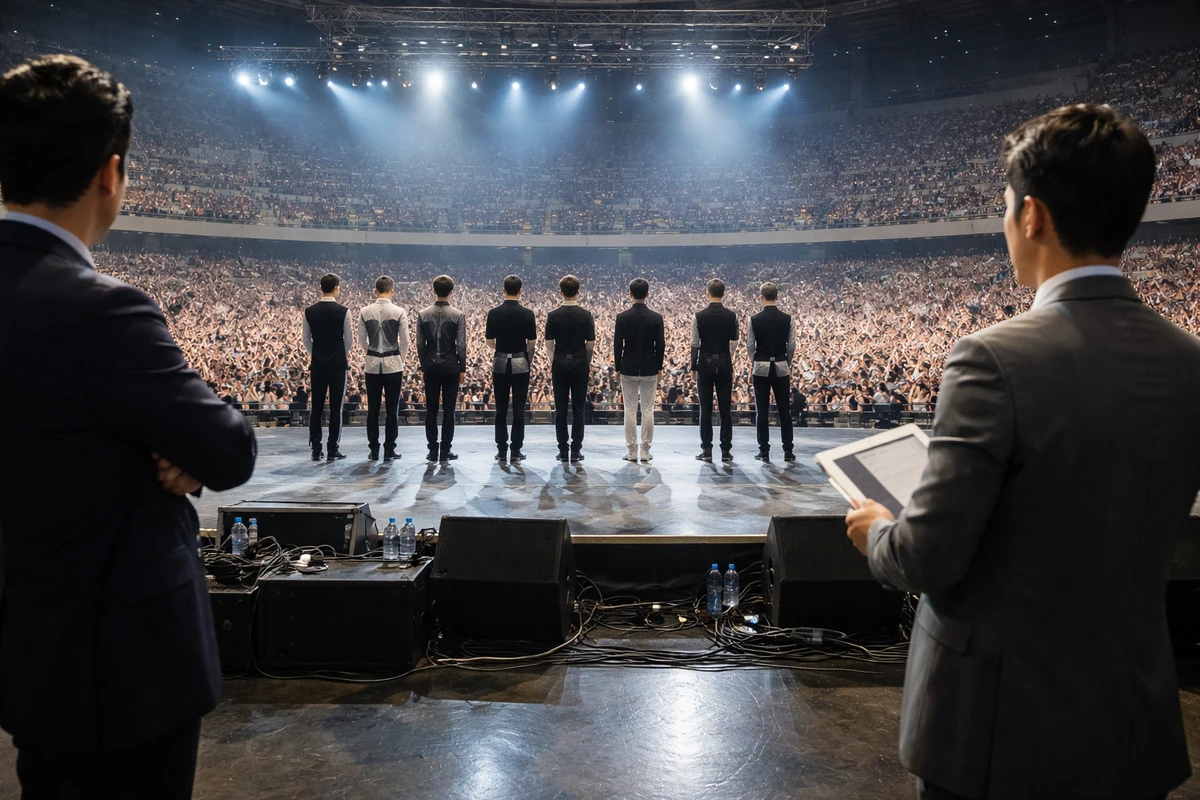
What makes the dispute particularly striking is that it has unfolded in direct collision with one of the group’s biggest scheduled commitments: a three-night solo concert run at Seoul’s KSPO Dome, one of the city’s most prominent indoor venues. The shows are still set to go on. That fact alone says a great deal about how K-pop works. Even when the relationship between artist and company appears to be collapsing, the machinery around the performers often keeps moving. Tickets have been sold. Production teams have been booked. Merchandise has been manufactured. Fans have planned travel. In K-pop, the market often continues demanding a polished performance long after trust behind the scenes has begun to erode.
The Boyz are hardly the first Korean pop act to become entangled in a bitter contract clash, and that history matters. For years, the K-pop industry has faced criticism over power imbalances between agencies and performers, especially around contract length, accounting transparency and control over schedules and revenue. South Korea has made reforms over time, and the industry is more global, more legally sophisticated and more profitable than it was a generation ago. But every new dispute raises the same uncomfortable question: Has the system truly matured, or has it simply become better at packaging the same tensions for a bigger worldwide audience?
The accounting fight at the center of the case
At the heart of the dispute is a subject that rarely generates fan excitement but often determines whether an artist-management relationship survives: settlement payments and access to financial records. In the Korean summary, the members claim the company did not pay settlement funds starting in July of last year and refused requests to inspect materials needed to verify whether the accounting was accurate. The company, for its part, has rejected the members’ demand to terminate the contract.
That may sound technical, but in entertainment, accounting is often where loyalty finally breaks down. Fans see albums, music videos, world tours, livestreams and social media content. They see sold-out venues and glossy promotional campaigns. What they usually do not see is how the money is actually divided after all the costs are deducted: production expenses, trainee investment, management overhead, marketing budgets, travel, staffing, music video costs, platform fees and a long list of other items that can dramatically affect what an artist takes home.
In the U.S., readers might compare this to the difference between a blockbuster movie’s box office haul and the studio accounting that determines whether participants receive backend compensation. Gross revenue can look enormous from the outside while the internal math remains difficult to parse. In K-pop, that complexity is magnified because artists often operate across multiple streams at once: group releases, solo activities, overseas concerts, brand endorsements, fan-club memberships, paid online content, merchandise and appearances on television or digital platforms. The question is not merely whether money came in; it is how every category was defined, allocated and explained.
That last part is crucial. The issue described in the Korean reporting is not simply, “Were the members paid?” It is also whether they had adequate access to the records needed to determine if the settlement process was fair and accurate. Once artists believe they cannot verify the books, disputes over dollars quickly become disputes over trust. At that point, the argument is no longer just about a delayed payment. It becomes a battle over who has the authority to interpret the financial reality of the group’s success.
This matters because K-pop agencies do more than distribute music. They build and maintain the infrastructure that turns a trainee or rookie act into a global brand. Agencies often argue, with some justification, that the system requires heavy upfront spending and coordinated management. Artists and their representatives, meanwhile, increasingly insist that such complexity cannot be used as a shield against scrutiny. As K-pop has expanded into a multibillion-dollar export industry with major footprints in the United States, Europe and Latin America, demands for clearer accounting have only grown louder.
In that sense, the dispute involving The Boyz reflects a broader industry shift. Transparency is no longer a talking point deployed only in scandal or reform campaigns. It has become central to how artists evaluate whether their careers are sustainable. If performers generate the value that powers the machine, the modern expectation is that they should also be able to see, and meaningfully understand, how that value is calculated.
When contract disputes turn into criminal allegations
The temperature of this case rose sharply because the conflict did not remain confined to civil litigation. The nine members who previously sought an injunction have also filed a criminal complaint accusing the company’s chief executive of embezzlement, according to the Korean summary. That does not establish wrongdoing; in any legal system, an accusation is not the same as a conviction. But the move carries a message that goes well beyond ordinary contract wrangling.
In plain terms, an injunction request asks a court for urgent relief while a larger dispute is unresolved. It is a way of saying the situation cannot wait for the full pace of litigation. A criminal complaint, by contrast, asserts that the other side’s conduct may rise to the level of a crime. When both tracks are active at once, it signals that the relationship has likely deteriorated past the point where quiet negotiation can easily restore it.
That escalation is significant in the context of Korean entertainment. Agencies and artists do not always see eye to eye, but many disputes are handled quietly because both sides have strong incentives to avoid reputational damage. A K-pop group’s value depends not only on songs and choreography but also on a carefully maintained sense of cohesion. Once a fight becomes public, it can alter consumer confidence, complicate advertising deals and inject uncertainty into everything from fan meetings to global tour planning.
That is why industry observers in South Korea are reading the seriousness of the legal tactics as a sign of how deeply trust may have collapsed. The issue is no longer simply one interpretation of a contract versus another. The underlying allegation suggests questions about how money and company operations were handled, even as the agency maintains that the demand to terminate the exclusive contract is unacceptable. In journalism, it is important to be precise here: the claim has been made, but the legal process has not reached a final determination. Still, the public nature of the accusation changes how the story is understood.
American audiences have seen versions of this pattern in other entertainment industries. Pop groups, television ensembles and even startup founders often present a unified front until internal disputes become impossible to contain. The moment allegations move from boardroom frustration to courthouse filings, the conflict enters a different phase. It becomes not only a legal battle but also a reputational contest over credibility, stewardship and public sympathy.
For K-pop, that reputational dimension is especially potent because the genre’s global appeal rests partly on its image of precision. Fans are sold a world of carefully synchronized performance, relentless professionalism and intimate but controlled access to idols, the Korean term widely used for highly trained pop stars. When disorder breaks through that polished exterior, it can be jarring. The system looks less like a frictionless cultural export and more like what it is: a high-pressure entertainment business with real financial and human fault lines.
Why the concerts are still happening
If there is one detail in this dispute that best captures the paradox of modern K-pop, it is this: The Boyz are still expected to perform their scheduled concerts from April 24 to April 26 at KSPO Dome in Seoul, despite the legal battle surrounding them. To outsiders, that may seem surprising. In many industries, a dispute this severe might lead immediately to a shutdown or postponement. In K-pop, the calculus is rarely that simple.
A major concert is not just a night of music. It is a dense web of obligations and revenue streams. There are venue contracts, stage crews, choreographers, lighting and sound teams, security staff, transportation logistics, vendors, insurers and promotional commitments. There are fan packages, merchandise sales, streaming tie-ins and social media activations. There are also thousands of fans who may be traveling from other parts of South Korea or from overseas. Calling off a show can trigger financial losses and legal headaches large enough to make even bitterly opposed sides tolerate a temporary truce.
KSPO Dome, formerly known to many fans by its old Olympic Gymnastics Arena name, is not just any venue. It is one of the symbolic proving grounds of Korean pop. Playing there signals scale, demand and industry stature, much as a sold-out Madison Square Garden date can serve as a marker of major-league visibility in the United States. To cancel such a run on short notice would be more than a scheduling change. It would be a public rupture with commercial, symbolic and emotional costs.
There is also a distinctive feature of K-pop fandom at work here. Fans are not passive consumers who simply notice a cancellation and move on. They are organized communities that invest time, money and identity in supporting a group. They buy physical albums in bulk, collect merchandise, vote in online polls, trend hashtags, coordinate charitable projects and often build entire social networks around a fandom. In Korean pop culture, the organized fan community around a group is often referred to as a “fandom,” but it operates with a level of structure and mobilization that can feel unusually intense to newcomers.
That means a concert becomes more than a product delivery. It becomes a site where fans seek reassurance, solidarity and firsthand evidence of how the artists are doing. The stage, in other words, is not outside the dispute. It is one of the places where the dispute becomes visible. Are the members performing under stress? Do they address the situation, directly or indirectly? Does the agency’s continued involvement feel routine, strained or adversarial? Every gesture can be read for meaning.
The continuation of the shows, then, should not be mistaken for proof that the crisis is overblown. If anything, it illustrates how hard it is for K-pop’s commercial engine to stop once it is in motion. The machine can continue producing spectacle even when the internal foundation is shaking. That contradiction is one reason disputes like this carry such weight. They reveal how much of the industry depends on performers continuing to meet fan expectations while fundamental questions remain unresolved backstage.
The deeper problem: K-pop’s dependence on trust and opacity
It would be easy to frame this solely as a story about one group and one company. That would also miss the larger significance. The reason the dispute is resonating in South Korea is that it touches a structural vulnerability within K-pop itself: an industry that is extraordinarily good at producing value but often much less convincing when asked to show, in plain terms, how that value is governed.
K-pop agencies are not merely labels in the American sense. They typically function as talent developer, financier, manager, producer, marketer, tour coordinator and global strategist all at once. Trainees can spend years inside this ecosystem before debuting. Once active, a successful group may split time among music releases, variety appearances, brand campaigns, overseas promotions and fan-platform content. In such a vertically integrated system, the company provides the infrastructure that makes stardom possible. But that same integration can leave artists heavily dependent on the company for information, leverage and access.
During periods of growth, that interdependence can look like efficiency. Everyone appears to be winning: fans get constant content, agencies expand internationally and performers achieve levels of visibility that would have been difficult to imagine two decades ago. But if trust deteriorates, the same structure can amplify conflict. The company may hold the records, the scheduling power and the operational network. The artists, meanwhile, may hold the public face, the fan loyalty and the core brand value. Neither side can easily disentangle itself without incurring serious losses.
That is one reason settlement disputes so often emerge late. Fans experience the glamorous front end of the business first. Accounting sits in the back office, hidden behind the choreography, fan service and chart headlines. It takes time for concerns about payments, expense allocation or access to documents to become public, and by the time they do, the underlying relationship may already be badly damaged. The Korean summary captures that dynamic well: the flashy part of the business is visible immediately, while the numerical foundations of the business often remain obscure until conflict forces them into view.
There is also a generational factor. Today’s K-pop artists are operating in a far more global environment than many of their predecessors. They are watched by fans who are familiar with labor-rights debates, corporate accountability language and the broader entertainment industry’s battles over ownership, compensation and transparency. They also know that public opinion can be mobilized quickly across borders. That does not erase the power imbalance between agency and artist, but it does change the stakes. A financial dispute that might once have remained an internal Korean entertainment matter can now ricochet across global fan communities in hours.
For an industry that has long marketed itself on discipline, innovation and seamless execution, that creates a new challenge. It is no longer enough to be efficient behind the scenes. Companies increasingly need to be legible. Artists want explanations, not just numbers. Fans want assurance that the stars they support are not trapped inside a system too complicated for outsiders to question. And the global market, especially in English-language media, is becoming more willing to treat K-pop not as an exotic spectacle but as a mainstream entertainment industry subject to the same scrutiny as Hollywood, Nashville or Silicon Valley.
What American audiences should watch next
For readers in the United States, the dispute involving The Boyz is worth following not only because of the group itself but because it speaks to the next phase of K-pop’s global integration. Korean pop is no longer a niche import for devoted fans. It is a central part of the international music business, with chart success, festival appearances, retail partnerships and touring footprints that place it firmly within mainstream pop culture. As that expansion continues, so will questions about how the business operates under pressure.
The most immediate issue is legal clarity. Courts and investigators, not fan communities or social media posts, will determine how much of the competing narrative holds up. The allegations need to be tested. The company’s denials need to be weighed. It is important to resist the online tendency to treat every filing as a verdict. At the same time, the filings themselves tell us something meaningful: the relationship appears to have deteriorated to a point where both sides see public legal action as preferable to private compromise.
The second issue is industry response. South Korea’s entertainment sector has confronted these kinds of crises before, and each episode tends to renew debate over best practices. Should artists have stronger guaranteed rights to inspect records? Should standard contracts be revisited again? Should there be more independent auditing mechanisms or dispute-resolution systems built specifically for entertainment labor? Those questions matter because K-pop’s global scale means its labor norms are no longer just a domestic concern. They shape a transnational business with audiences and revenue partners far beyond Korea.
The third issue is fan behavior. Fandoms can become pressure blocs, advocacy communities and real-time interpreters of industry signals. They can also intensify volatility by spreading rumor as fact. How fans react to the KSPO Dome concerts, and to future court developments, may influence the practical room each side has to maneuver. In K-pop, the audience is not simply watching the crisis. In some respects, it becomes part of the environment in which the crisis unfolds.
Finally, there is the broader cultural lesson. The Korean Wave, often referred to by the Korean term “Hallyu,” has transformed how the world consumes Korean entertainment, from music and television to film and beauty products. That success story is real. But global influence can create an illusion that the system producing it is inherently stable. The dispute involving The Boyz is a reminder that behind the immaculate performances and export triumphs lies a more ordinary reality: contracts can sour, accounting can be contested and institutions can strain under the pressure of rapid growth.
In that sense, this is not just a K-pop story. It is a story about what happens when a highly profitable creative industry built on image, speed and intense loyalty is forced to answer a basic question. Who creates the value, and who is accountable for explaining where that value goes? Until K-pop can answer that question more clearly and more consistently, disputes like this one will continue to puncture the shine of one of South Korea’s most powerful cultural brands.


0 Comments