Europe weighs work-from-home mandates, transit subsidies as war-driven energy shock revives old fears
Europe turns back to a familiar playbook
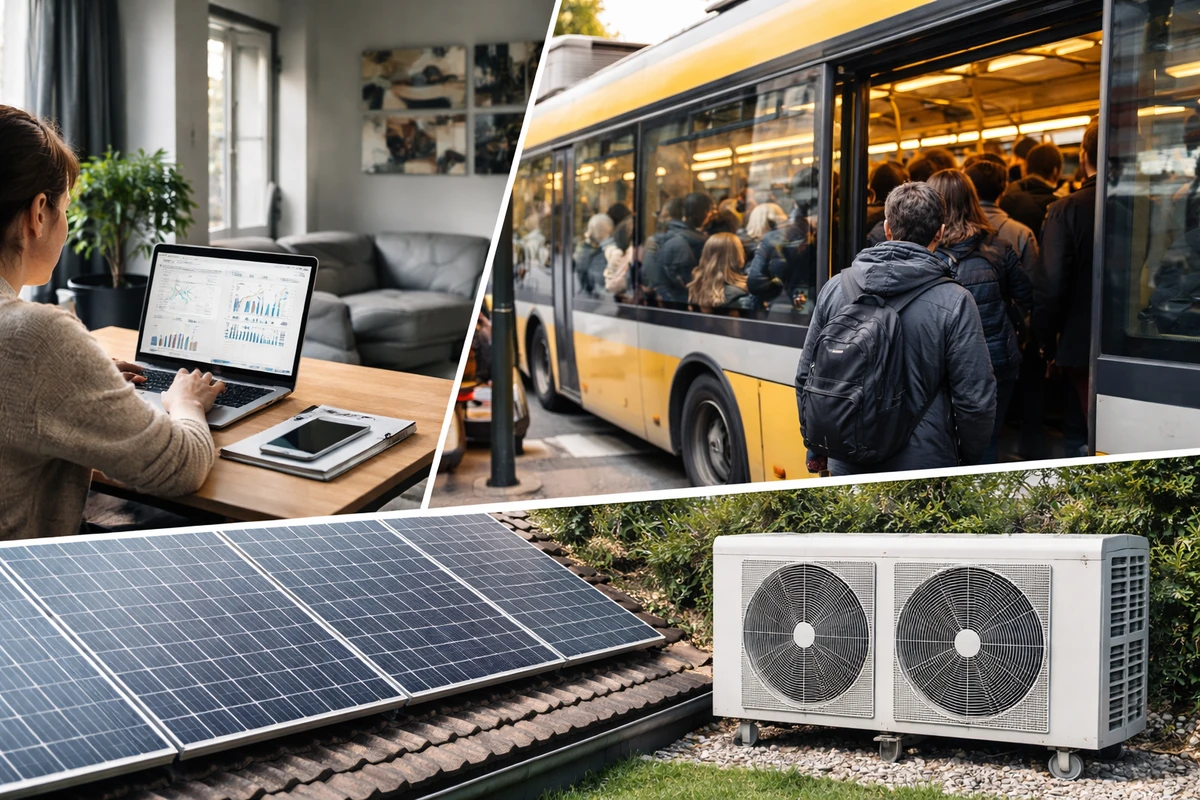
Europe is once again reaching for a tool kit it hoped had been put away: asking people and businesses to use less energy, not just find more of it. According to details reported by the Financial Times from a European Commission document, European Union officials are preparing to present member states with a package of ideas aimed at softening the blow from a fresh surge in energy prices linked to war involving Iran. The proposals reportedly include requiring companies to allow at least one day of telework a week, subsidizing public transportation and cutting value-added taxes on heat pumps and solar panels.
On paper, none of those ideas is especially radical. Americans have seen versions of all three. Remote work became mainstream during the COVID-19 pandemic. Transit subsidies are a staple of urban policy from New York to Washington. Tax breaks for cleaner home energy technology resemble rebates and incentives in the United States for rooftop solar, electric appliances and energy-efficient upgrades. What makes the European discussion notable is that these measures are being bundled together as emergency economic policy, not merely climate policy or workplace reform.
That matters because it signals how Brussels is reading the moment. European policymakers do not appear to see the latest oil shock as a short-lived bump at the gas pump. They appear to view it as a broader threat that can spread through household budgets, industrial costs, inflation and political stability. If war disrupts energy supplies or even raises the risk of disruption, prices can spike long before any physical shortage becomes obvious to consumers. Governments then face a familiar problem: by the time families notice the hit in their utility bills and transportation costs, the economic damage is already moving through the system.
For American readers, the easiest comparison may be the 1970s oil crises, when energy suddenly stopped being an invisible background input and became a front-page political fact. In the United States, that era produced everything from lower highway speed limits to fuel-efficiency rules and a lasting awareness that geopolitical conflict abroad can show up in domestic prices almost overnight. Europe is confronting its own version of that reality again, with a modern twist: Instead of focusing only on how to secure more supply, officials are emphasizing how to curb demand quickly and make the economy less vulnerable over time.
That dual approach is central to understanding why telework, transit aid and equipment tax cuts belong in the same conversation. One affects commuting behavior immediately. One changes what transportation people choose when prices rise. And one tries to alter the underlying way homes and businesses consume energy over the next several years. Together, they form a strategy built around buying time now while reducing dependence later.
Why working from home is back, this time as energy policy
The most eye-catching proposal is the idea of mandating at least one work-from-home day each week for companies where that is feasible. During the pandemic, remote work was primarily framed as a public health measure and, later, as a question of office culture, worker flexibility and downtown recovery. In the new European debate, it is being recast as something else: a lever of national energy policy.
That shift is significant. It suggests policymakers are looking not only at the electricity consumed in office buildings but also at the fuel burned during the daily commute. In a continent with major metropolitan corridors, extensive cross-border business activity and large numbers of office workers traveling into city centers, even one less commute day per week can add up when applied at scale. The logic is straightforward: fewer trips mean less gasoline and diesel consumed, less congestion and, potentially, lower pressure on transportation networks during expensive energy periods.
For Americans, the proposal may sound unusually direct. In the United States, governments more often encourage rather than require corporate workplace behavior, especially outside emergencies. Europe, however, has a longer tradition of labor rules and state coordination in economic life, and the European Commission often works through member states to steer broad policy goals. Even so, the idea is unlikely to land evenly across sectors. Factory workers, nurses, delivery drivers, retail staff and many service employees cannot do their jobs from a kitchen table. The policy is inherently easier for office-heavy industries such as finance, consulting, administration and parts of technology.
That unevenness is one reason the telework proposal is best understood less as a universal mandate than as a targeted demand-reduction measure. It would not eliminate commuting; it would shave off part of it where the cost of doing so is relatively low. It also reflects a political reality. Asking workers to work from home one day a week may be more palatable than asking households to accept outright fuel rationing or broad restrictions on driving. It preserves a sense of normalcy while still seeking measurable reductions in energy use.
There is also a symbolic element. By reviving telework in the context of energy security, European officials are effectively saying that personal routines once treated as private choices now have macroeconomic consequences. In a period of high energy prices, how often people commute is no longer just a management decision. It becomes part of the wider question of how resilient an economy is when external shocks hit.
Transit subsidies aim to make the cheaper choice easier
If remote work is the headline-grabbing measure, public transportation subsidies may be the more politically sensitive one. That is because higher energy prices are felt most immediately not in policy papers but in everyday transactions: filling a gas tank, buying a train pass, paying for a bus ride or calculating whether driving to work still makes financial sense. Transit aid addresses the problem where households feel it first.
The reasoning is both economic and behavioral. Governments can tell people to use less fuel, but behavior changes faster when the alternative is affordable and convenient. Subsidizing buses, subways and regional rail can push commuters away from private vehicles at exactly the moment when oil prices make car-dependent habits more costly. In that sense, transit aid is not only social relief; it is also an incentive structure. It tries to change what people do by changing what they pay.
American readers may think of experiments like reduced-fare transit programs in major U.S. cities or temporary efforts to lower commuting costs during spikes in inflation. Europe’s transit systems, especially in big capitals and dense urban regions, are often more extensive and more central to daily life than in much of the United States. That gives transit subsidies more immediate reach. They can affect workers, students, pensioners and lower-income residents all at once, making them a broad-based response rather than a niche urban intervention.
There is an important political dimension here as well. Energy policy can unravel quickly if voters experience it mainly as sacrifice. A government that asks people to bear higher living costs without offering visible relief is inviting backlash. Europe has learned this lesson before, whether in debates over fuel taxes, inflation or household utility bills. Transit subsidies help policymakers show that they are not simply instructing the public to endure an energy shock. They are trying to cushion it in a way that feels tangible.
That could be especially important if high prices persist. Families can absorb a brief spike by cutting discretionary spending elsewhere. A prolonged energy crunch is different. It changes monthly budgets, commuting decisions and even job choices. In that environment, subsidizing transit serves two goals at once: reducing fuel demand and preserving social acceptance for broader energy policy. Put another way, it is hard to build public support for efficiency if the immediate result feels like punishment.
Heat pumps and solar panels point to a longer game
The reported plan to cut value-added taxes on heat pumps and solar panels reveals the European Commission is thinking beyond the next few weeks of price volatility. Telework and transit subsidies can dampen consumption fairly quickly. Tax relief for equipment is slower by design. It is meant to change what kind of energy system households and businesses rely on in the first place.
For readers less familiar with the technologies involved, a heat pump is an electric system that can heat and often cool buildings more efficiently than conventional fossil-fuel-based systems. Solar panels, of course, allow homes or buildings to generate some of their own electricity. Neither is new, but both often come with significant up-front costs that discourage adoption even when long-term savings are attractive. Reducing VAT, a broad consumption tax common across Europe, is one way to lower that barrier without designing a brand-new subsidy system from scratch.
The larger message is that Europe wants to do more than temporarily spend its way through another shock. Officials appear to be arguing that each crisis should also be used to accelerate structural change. If war-driven price spikes expose how vulnerable households are to fossil-fuel dependence, then making clean and efficient equipment cheaper becomes part of national resilience, not only environmental ambition.
This distinction matters. In the American political conversation, clean energy is often framed in partisan terms or as a long-term climate investment. In the European context described here, it is also being framed as insulation against geopolitical turmoil. A household with a more efficient heating system or access to distributed power generation is less exposed to swings in imported fuel prices. That does not make it immune, but it can reduce the severity of the shock.
The approach also acknowledges a limit to pure conservation. Governments can ask people to consume less, but there is only so far that strategy can go before it collides with comfort, productivity and public patience. Structural efficiency offers a more durable solution because it lowers consumption without necessarily asking people to accept a lower standard of living. In that sense, Europe’s response aims for two kinds of resilience at once: a society that uses less energy and a society that is less easily rattled when global energy markets lurch.
The bigger vulnerability Europe is trying to manage
The war-linked energy surge is exposing a long-standing European weakness: events far beyond the continent’s borders can still move directly into European homes and factories through the price of fuel. Even when a conflict does not occur on European soil, its economic consequences can arrive quickly if oil and gas markets tighten or traders begin to price in risk. Europe has spent years trying to diversify supply and strengthen energy security, especially after the shocks that followed Russia’s invasion of Ukraine. But the latest developments underscore that diversification is not the same as immunity.
What makes this sort of shock especially difficult is that it hits multiple parts of the economy at the same time. Households face higher heating and transportation costs. Businesses see operating expenses rise, from shipping and manufacturing to office overhead. If companies pass those costs on to consumers, inflation worsens. If they absorb them, margins shrink and investment can slow. Either way, growth comes under pressure.
That is why the Commission’s apparent focus on “demand management,” to use the language often employed in energy policy, is so important. When additional supply cannot be summoned quickly, governments have fewer tools than they would like. They can subsidize consumers, dip into reserves, seek new imports or try to alter behavior. The last option is often politically unpopular, but it can be one of the fastest available, especially when paired with financial incentives.
For Americans, this may sound like a technocratic version of a simple idea: if you cannot control the war, control how exposed your own economy is to the fallout. Europe cannot dictate the military trajectory of a conflict involving Iran. What it can do is try to reduce the speed with which an external shock spreads into domestic pain. Telework trims commuting demand. Transit subsidies nudge travelers toward lower-fuel options. VAT cuts on efficient equipment try to make the next shock less damaging than the current one.
There is also a monetary policy subtext. Central banks can respond to inflation, but interest rates are a blunt instrument against an energy-driven price spike. Higher borrowing costs do little to pump more oil or make a bus pass cheaper. That leaves governments looking for more granular interventions in daily economic life. The fact that Brussels is discussing tools this specific suggests officials believe the problem has moved beyond abstract market turbulence and into the realm of household survival and industrial competitiveness.
Execution will depend on Europe’s many political realities
However coherent the package may look on paper, Europe’s challenge has never been only designing policy. It is getting 27 member states with different economies, labor systems and political climates to move in roughly the same direction. A proposal that makes immediate sense in one country may be awkward in another. Nations with strong public transit networks can turn subsidies into visible relief quickly. Countries where car use is more entrenched or alternatives are thinner may see weaker results. The same is true for telework: a service-heavy urban economy will not experience it the same way an industrial region will.
That diversity means implementation could become the real test. A mandatory work-from-home day may be welcomed by some white-collar workers and employers already operating hybrid schedules. Others may see it as government overreach or as an ill-fitting rule for sectors where physical presence remains essential. VAT cuts on heat pumps and solar panels may be easier to announce than to translate into rapid adoption if supply chains, installers or household financing become bottlenecks. Transit subsidies, meanwhile, can quickly raise questions about cost, fairness and how long emergency support should last.
There is also the risk of uneven burden-sharing. Policies that save energy in theory can deepen frustration if people believe the pain is falling on those with the fewest options. Office workers who can telework are not the same people as warehouse workers or health care staff who must show up in person. Homeowners who can take advantage of tax cuts for new equipment are not the same as renters who have little control over the buildings they live in. If governments do not account for those differences, measures designed to stabilize the economy can inflame class tensions instead.
Still, the fact that European officials are even considering this mix of policies tells a larger story about the current moment. The continent is no longer treating energy shocks as isolated commodity events. It is treating them as social and political emergencies that require intervention across work, transportation and household infrastructure. That is a broader and more muscular view of economic policy than many governments prefer in calmer times.
Whether the plan ultimately succeeds will depend less on any single measure than on whether the package feels credible, fair and workable. Citizens are more likely to accept changes in behavior if they can see both immediate relief and a longer-term purpose. That may be the logic tying the proposals together. The message, in essence, is this: use less now where possible, make alternatives cheaper where necessary and invest in technologies that reduce dependence before the next shock arrives.
A new crisis, but an old lesson
The most striking aspect of Europe’s response is how old-fashioned its central insight is. Energy is not just another commodity. It is a foundation under modern life, and when its price surges, the consequences spread much further than utilities or fuel stations. They shape how people commute, where they work, what businesses can afford and how much political pain governments can withstand.
That is the lesson Europe seems to be relearning as it prepares its latest package of measures. The proposals under discussion do not promise a dramatic breakthrough, nor do they pretend policymakers can wish away a war-driven oil shock. Instead, they reflect a sober recognition that resilience often looks less like a grand solution and more like a series of practical adjustments: one less commute, one cheaper train ride, one more household upgrade that lowers dependence on volatile fuel markets.
For an American audience, there is something familiar in that. The United States, too, has repeatedly discovered that geopolitical turmoil abroad can reach Main Street through energy prices. What differs is the form of the response. Europe’s answer, at least for now, appears to lean more openly on coordinated public policy and collective behavior change. That may not suit every political culture, but it reflects Europe’s own institutional habits and hard-earned experience from previous energy crises.
If these ideas move forward, they will be watched closely not only as emergency measures but as a test of whether democracies can manage scarcity without panic and shift habits without losing public consent. In that sense, the European debate is about more than a temporary spike in oil prices. It is about whether governments can turn a moment of vulnerability into a push for greater efficiency, fairness and economic self-protection.
And that may be the deeper significance of the Commission’s reported plan. Europe is not just trying to survive another energy shock. It is trying to prove that when outside conflict threatens domestic stability, policy can still shape the outcome — not by controlling the war, but by reducing how much power the war has over everyday life.
Comments
Post a Comment