
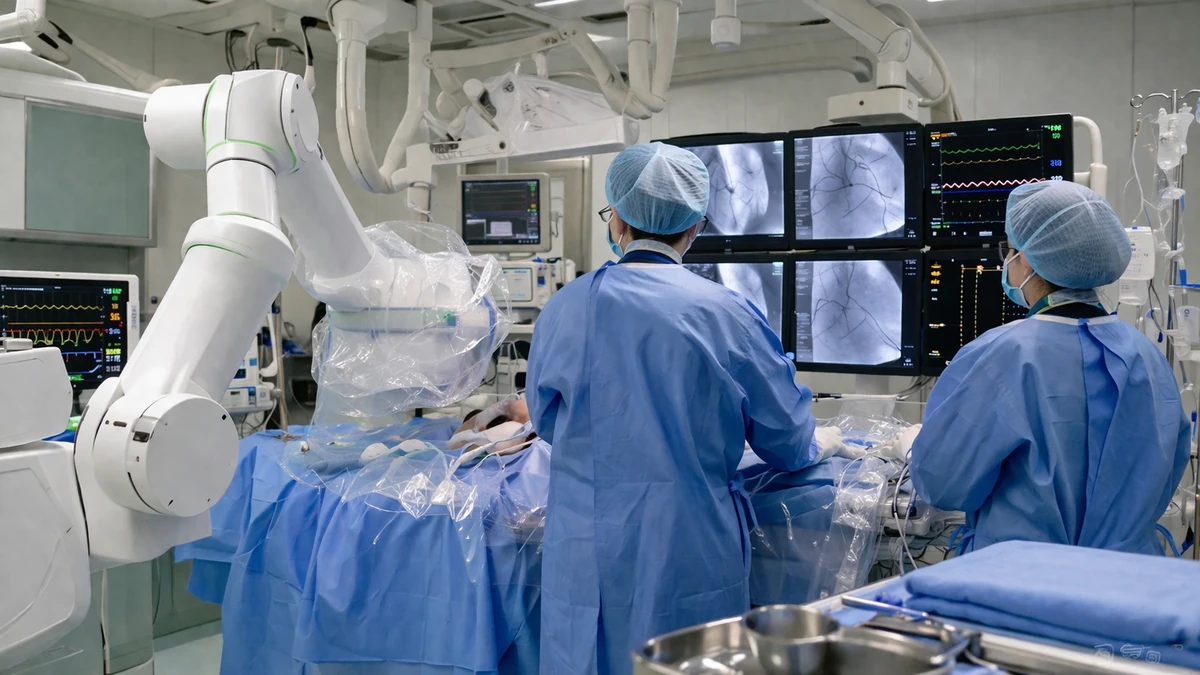
A high-tech debut in one of Asia’s busiest hospitals
South Korea has crossed an important threshold in medical technology: A domestically developed robotic system for cardiovascular intervention has now been used in actual patient care at Seoul Asan Medical Center, one of the country’s largest and most influential hospitals. That may sound, at first glance, like a straightforward product launch. It is not. In medicine, there is a major difference between unveiling a device in a lab, demonstrating it at a trade show, or describing it in a research paper — and putting it into a hospital procedure where a real patient’s outcome is on the line.
That distinction is what makes this development noteworthy. Cardiovascular intervention refers to minimally invasive procedures used to open narrowed or blocked blood vessels, often in patients with angina or heart attacks. Physicians typically thread a tiny guidewire and catheter through blood vessels to reach the blockage, then use tools such as balloons or stents to restore blood flow. In the United States, many readers would recognize this as part of the world of cardiac catheterization labs, where interventional cardiologists perform procedures that can save heart muscle and lives within minutes.
Robotic systems have long been discussed as the next frontier in this field, but most of the attention globally has centered on foreign-made equipment and limited adoption. South Korea’s announcement matters because it suggests the country is no longer only consuming imported high-end medical technology; it is trying to build it, validate it and use it in one of the most technically demanding parts of hospital care.
Seoul Asan Medical Center is not a small community hospital experimenting on the margins. It is a flagship tertiary-care institution, the kind of hospital that handles highly complex cases and sets standards for the broader medical community. When a hospital of that stature decides to bring a new device into clinical care, it generally means the system has passed at least an initial internal test of safety, workflow compatibility and physician confidence. Hospitals do not place novel equipment into real treatment settings lightly, especially not in cardiac care, where seconds matter and complications can turn serious quickly.
Still, the milestone should be understood for what it is: a beginning, not a verdict. The robot’s entry into clinical use does not yet prove it is better than established manual techniques. It does not mean hospitals across South Korea — let alone abroad — are about to rush to buy it. It means that a technology once confined to development and evaluation has now stepped onto the main stage of patient treatment. That is progress. It is also the point at which the real scrutiny begins.
What a cardiovascular robot actually does — and what it does not do
For many readers, the word “robot” may conjure an image shaped by science fiction or by highly publicized surgical systems in U.S. hospitals, where robotic arms help surgeons operate through small incisions. Cardiovascular intervention robots are different. They do not replace the physician, and they do not independently perform a heart procedure. Instead, they serve as a highly specialized platform that helps a trained doctor manipulate wires, catheters and other devices with greater mechanical precision from a control station.
That distinction is crucial. In a heart vessel procedure, an interventional cardiologist must navigate extraordinarily small tools through complex anatomy. Success depends on a combination of technical skill, judgment under pressure and the ability to make tiny adjustments over long stretches of time. Human dexterity remains central. But human operators also face limits: fatigue, repetitive strain and the subtle tremor or inconsistency that can come with long or difficult cases.
A robot in this setting is best understood as an assistive tool. Its promise is that it may allow more stable micro-movements and more consistent handling of delicate devices. In theory, that could be especially helpful in cases where a lesion — a narrowed or blocked segment of an artery — is technically challenging, or where repeat fine adjustments are required. If the system reduces tiny hand-motion variability or helps operators maintain precision late into a procedure, that could be meaningful. But “could” is the operative word. Precision in engineering terms does not automatically translate into better patient outcomes.
There is another important potential benefit: distance from radiation. These procedures are performed under continuous imaging, often fluoroscopy, which lets physicians see where devices are moving inside the body in real time. The tradeoff is that doctors and staff spend years working in environments with repeated radiation exposure. They also often wear heavy lead aprons and other protective equipment, which can contribute to chronic neck, back and joint strain. Any American physician who has spent time in a cath lab or interventional suite would immediately recognize that burden.
A robotic system may allow the operator to work farther from the radiation source, seated at a console rather than standing right next to the patient table throughout the procedure. That does not eliminate exposure for everyone in the room, and it does not remove the need for the care team. But even a meaningful reduction in cumulative radiation for the primary operator could become a significant occupational health advantage over time. For physicians who perform these procedures daily, the issue is not theoretical. It is about career longevity, physical wear and tear, and reducing a hazard that has been treated for decades as part of the job.
From a patient’s perspective, however, the main question is simpler: Is it safer, and does it improve the outcome? On that point, early enthusiasm must give way to evidence. A robot can assist a skilled physician. It cannot erase the realities of anatomy, disease severity, preexisting conditions or emergency circumstances. Nor can the mere presence of a sophisticated machine guarantee fewer complications or faster recovery. In medicine, new technology often arrives surrounded by bold language. The harder task is proving that it delivers measurable benefit beyond what experienced clinicians already achieve by hand.
Why South Korea cares so much about “homegrown” medical technology
To American readers, the emphasis on this being South Korea’s first domestically developed cardiovascular intervention robot may sound partly nationalistic. In South Korea, it is also intensely practical. The country has spent years trying to move up the value chain in advanced manufacturing, biotechnology and health technology. In sectors from semiconductors to batteries, South Korea has built global strength through industrial policy, export ambition and close ties between major institutions and private companies. Medicine is harder, especially in complex devices where regulation, clinical validation and physician trust can take years to build.
Cardiovascular care has been an area where many hospitals, including those in South Korea, have relied heavily on foreign companies for major equipment, consumables and specialized systems. That includes imaging devices, catheters, guidewires, stents and procedural platforms. A successful homegrown entry into even one part of that ecosystem could matter for supply chains, pricing leverage and local responsiveness.
That point has resonance well beyond South Korea. Americans learned during the pandemic how fragile medical supply chains can be, from masks and ventilators to drugs and diagnostic tools. Hospitals around the world also deal with currency swings, geopolitical tensions and pricing decisions made by multinational manufacturers. A domestic option does not eliminate those pressures, but it can give hospitals more bargaining power and more flexibility when overseas logistics become unpredictable.
There is also a less visible advantage to local development: speed of feedback. Medical devices are rarely “finished” when they receive approval. They evolve through repeated use, clinician complaints, software updates and redesigns that address workflow problems discovered in real-world settings. If doctors at a Korean hospital identify a cumbersome interface, a sterilization issue, a setup bottleneck or a compatibility problem with existing imaging systems, a local manufacturer may be able to respond faster than a company operating an ocean away. In a robot-assisted platform, where software, accessories and hardware integration all matter, that shorter feedback loop could prove valuable.
For South Korea, this is also about industrial ambition. The country has made visible gains in diagnostics, digital health and some imaging-related technologies. But high-complexity procedure robots sit in a tougher category, with steep technical barriers and no guarantee of commercial success. Entering this field signals that Korean manufacturers want to compete not only in consumer electronics and automotive technology, where the nation is already a major player, but in the elite tier of medical equipment as well.
Still, national pride cannot substitute for clinical performance. If anything, the “domestic first” framing creates additional pressure. The device will be watched not only as a medical tool but as a test of whether Korea can turn engineering capability into durable clinical credibility. That is a far more difficult challenge than building an impressive prototype.
The patient question: Better technology is not automatically better care
Whenever hospitals introduce a highly advanced device, especially one with “robotic” in the description, patients and families naturally ask whether it means safer treatment. The honest answer is often more complicated than marketing materials suggest. In cardiovascular intervention, outcomes depend on a web of factors: the location and length of a blockage, the shape of the blood vessel, the patient’s age and overall health, whether diabetes or kidney disease is involved, how quickly care begins, and the experience of the medical team.
That means the use of a robot alone cannot tell a patient much about their odds of success. A skilled physician performing a conventional manual intervention may be the best option in many circumstances. In other cases, a robotic platform may provide helpful support. In the earliest stages of adoption, the likely path is gradual and selective use rather than universal application.
That matters because new medical technology rarely enters practice in an all-at-once way. Hospitals usually start with cases that are relatively standardized and technically appropriate for the device, allowing the team to learn the system and refine procedures without adding avoidable risk. Particularly complex anatomy or emergency cases may still be better handled manually, at least until the team has more experience and stronger evidence about where the robot truly adds value.
In other words, one of the most important early jobs is not proving the robot can do everything. It is determining where it should and should not be used. That kind of boundary-setting is not glamorous, but it is essential. Every meaningful medical innovation has limits, and good medicine depends as much on understanding those limits as on celebrating the technology’s strengths.
Then there is cost. Americans are familiar with the way hospitals tout cutting-edge devices while insurers and patients ask who will pay for them. South Korea has a different health care system, with national insurance and different reimbursement structures, but the underlying question is surprisingly similar: Will this add cost, and if so, who absorbs it? A hospital may be willing to invest in a robot if it believes the system brings strategic value, operational efficiencies or reputational benefit. But widespread adoption depends on whether the economics make sense at scale.
If the device raises procedural costs without clear evidence of better outcomes, lower complication rates, less radiation exposure or improved workflow, administrators may hesitate. If reimbursement rules do not adequately support its use, even enthusiastic physicians may struggle to incorporate it broadly. Patients, meanwhile, will want clear explanations of what, if anything, the robot changes for them personally — not in futuristic terms, but in the practical language of safety, recovery, and out-of-pocket burden.
That is one reason why sober communication matters. In South Korea, as in the United States, the public is often introduced to medical technology through headlines that emphasize novelty. But “advanced” and “useful” are not synonyms. For patients facing heart disease, what matters is not whether a machine sounds impressive. It is whether it helps the right doctors deliver better care in the right situations.
The operational reality inside the hospital
Even when a device is clinically promising, hospitals face a set of practical barriers that can determine whether it becomes a routine part of care or remains an occasional showcase tool. Cardiovascular intervention is not a solo act. It is team-based medicine, involving doctors, nurses, radiology technologists, technicians and support staff who must move in coordination, often under time pressure. Introducing a robot changes workflow, and workflow is where many hospital innovations either succeed or stall.
Training is the first hurdle. Physicians must become comfortable with the robot’s controls, timing and limits. Nurses and technicians must learn how the setup differs from standard procedures, how sterile preparation changes, how devices are loaded, and what to do if the case needs to convert quickly back to fully manual operation. In a field where emergency escalation can happen fast, backup plans are not optional. They are part of safe adoption.
Maintenance is another issue that outsiders often overlook. Buying a sophisticated medical device is only the beginning. Hospitals need reliable service, rapid troubleshooting, stable software updates, replacement parts and seamless compatibility with existing information systems and imaging platforms. A robot can be technically impressive and still become operationally frustrating if support is slow or if the system causes friction in an already crowded procedural environment.
This is where a domestic manufacturer could have an edge — but only if it can build a robust service network. Fast maintenance and close coordination with hospitals are frequently cited advantages of local production. But those advantages must be demonstrated in practice, not assumed. When a device is used in a high-stakes procedure, downtime and uncertainty are expensive in every sense.
Hospital administrators will also assess the technology through a business lens. Beyond the purchase price, they must consider the space required for installation, the time needed for staff training, consumables, maintenance contracts, the effect on case turnover and how often the system will actually be used. A large tertiary hospital that treats many complex cardiovascular patients may find strategic value in adopting a robot even if the economics are initially tight. A smaller hospital may decide the cost-benefit calculation is much less favorable.
That tension is familiar in American health care, where flagship academic centers often adopt cutting-edge systems first, while smaller hospitals watch and wait. South Korea’s hospital landscape has its own dynamics, but the pattern is broadly comparable. Elite hospitals can serve as test beds and credibility builders. The harder question is whether the technology can move beyond those top-tier institutions into wider, sustainable use. That transition depends not only on science, but on training systems, reimbursement, technical support and plain old institutional confidence.
What still needs to be proven
At this stage, the verified fact is narrow but meaningful: Seoul Asan Medical Center has begun clinical use of South Korea’s first domestically developed cardiovascular intervention robot. That is enough to justify attention. It is not enough to justify sweeping conclusions.
The key evidence still lies ahead. First, how many patients are being treated with the robot, and what types of cases are being selected? Early case mix matters. If the robot is used primarily for straightforward lesions, that says something different than if it proves effective in difficult anatomy. Second, how does procedure time compare with conventional manual intervention? A system may offer improved precision but still require longer preparation or setup, especially during the learning phase.
Third, does the robot meaningfully reduce radiation exposure in the real-world clinical environment, not just under idealized conditions? That question is central because operator safety is one of the strongest arguments for robotic assistance. Fourth, what do physicians and staff report about fatigue, ergonomics and workflow once the novelty wears off? Long-term occupational health benefits could be substantial, but they need careful measurement.
Fifth, and most importantly, how do patient outcomes compare? Are complication rates reduced? Is stent placement more accurate in ways that matter clinically? Are repeat procedures less common? Do certain subgroups benefit more than others? Those are the kinds of questions that determine whether a new device becomes a genuine advance rather than an expensive experiment.
Regulators, professional societies and insurers all have roles to play here. In South Korea, as in the United States, approval is only one step in a longer process of evidence-building, practice guidance, training standards and payment decisions. If policymakers want to support domestic medical technology without compromising patient safety, they will need to resist the temptation to oversell early success. The healthiest path is rigorous evaluation, transparent reporting and disciplined adoption.
That may be the broader lesson of this moment. South Korea’s medical technology sector is clearly trying to claim a bigger role in advanced care, and this robot’s clinical debut is a sign of that ambition. But medicine is full of innovations that looked promising until the data arrived. The technologies that last are the ones that survive contact with everyday clinical reality — not just because they are new, but because they prove useful, safe and worth the cost.
For now, the story is less about triumphant transformation than about an important opening move. A domestic robot has entered one of the country’s most demanding treatment settings. That is a milestone for South Korean industry and for the hospital that chose to use it. The next chapter, however, will be written not by press releases or patriotic enthusiasm, but by outcomes, workflow, maintenance logs, reimbursement decisions and the accumulated judgment of the clinicians who use it. In heart care, as in most of medicine, the technology that matters is the one that stands up to time, evidence and the unromantic pressures of the real world.
Why this matters beyond South Korea
For readers outside Korea, this development is worth watching because it sits at the intersection of several global trends: aging populations, rising rates of cardiovascular disease, competition over advanced manufacturing, and a growing push to use robotics not only in surgery but in image-guided procedures. The United States, Europe, Japan and South Korea are all wrestling with versions of the same problem: how to improve care while facing workforce strain, higher costs and demands for better technology.
Heart disease remains a leading cause of death worldwide. Any tool that can improve precision, reduce occupational hazards for clinicians or make complex procedures more reproducible will draw interest. But the future of such systems likely will not be determined by a single dramatic breakthrough. It will depend on whether they fit into the daily realities of hospitals, whether physicians trust them, and whether health systems can justify their price.
That makes South Korea’s experience potentially instructive. The country often serves as an early indicator in sectors where digital infrastructure, industrial policy and high-volume medical institutions converge. If a domestic cardiovascular robot can gain traction there, prove its value and refine itself through close collaboration with major hospitals, that could eventually make it a contender in the broader international market. If it stumbles on evidence, economics or usability, the lesson will be just as important.
Either way, this is more than a niche hospital story. It is a window into how nations try to build medical sovereignty in a globalized industry, how hospitals test the promises of automation, and how the meaning of innovation is negotiated at the bedside. For all the futuristic language surrounding robots, the core issue remains deeply human: whether a new machine helps doctors do a difficult job better, more safely and more consistently for the people who need them most.



0 Comments