A breakthrough that meant more than three points
For most American sports fans, the easiest comparison might be this: imagine a big-market franchise that has spent year after year walking into one particular arena or stadium and finding some new way to lose, no matter the roster, no matter the coach, no matter the stakes. Then imagine that same team finally returning and not just sneaking out with a narrow win, but dominating from the opening whistle and leaving no doubt.
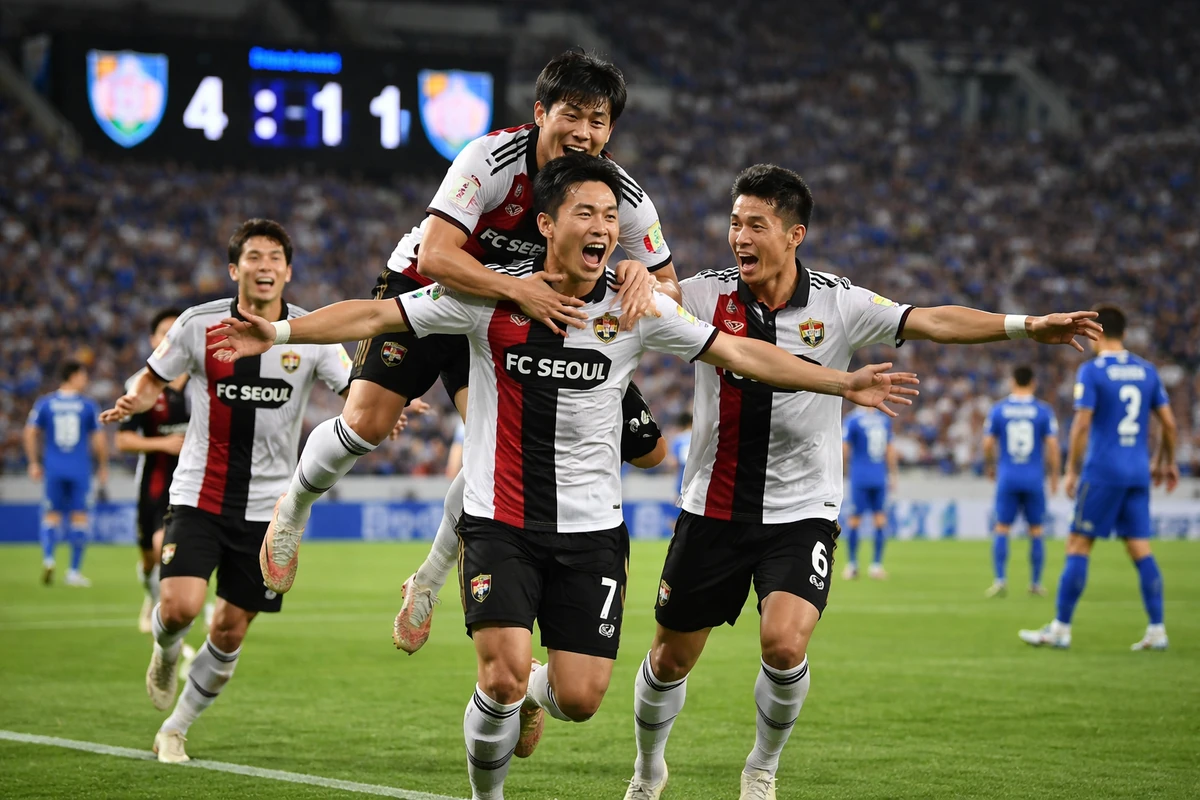
That was the significance of FC Seoul’s 4-1 victory over Ulsan HD on April 15 at Ulsan Munsu Football Stadium in South Korea’s top-flight K League 1. On paper, it goes into the standings as a single regular-season win in a rescheduled Round 2 match. In practice, it was far bigger than that. Seoul snapped an away winless streak at Ulsan that had lasted 3,643 days — just shy of 10 years — and did so against one of the league’s standard-bearers, a club that has long made life miserable for visitors.
For Seoul, one of the K League’s most prominent and historically recognizable clubs, the result also carried emotional and symbolic weight. Korean soccer fans often talk about a “jinx” when a team repeatedly fails in a specific setting or matchup. In this case, Seoul’s inability to win in Ulsan had become more than a quirky stat. It was the kind of recurring narrative that begins to hang over a team, shaping how players, coaches and supporters interpret every missed chance and every defensive mistake. Over time, those patterns can feel almost structural, even when the actual lineups and tactics change.
That is why the score line mattered. Seoul did not merely end the drought. It dismantled it. Four goals on the road against a heavyweight opponent is a statement in any league, and this one arrived with added significance because Seoul entered the match as the K League 1 leader. Without inventing broader conclusions from a single night, it is fair to say this performance strengthened the impression that Seoul is not simply surviving near the top of the table early in the season. It is there with intent.
If there was one face on the breakthrough, it was Song Min-kyu. The 26-year-old attacker scored twice and added an assist, delivering the kind of all-around performance that turns a difficult road match into a showcase. It had been 46 days since his previous goal, a dry spell that can loom especially large for forwards, whose form is often judged in the bluntest terms possible: whether the ball is going in or not. Against Ulsan, Song did more than score. He reset the mood around himself and helped redefine the ceiling for Seoul’s attack.
Why winning in Ulsan has been such a problem
To understand why this result resonated, it helps to understand Ulsan’s place in South Korean soccer. Ulsan HD is one of the country’s powerhouse clubs, backed by the Hyundai business empire and accustomed to operating near the top of the domestic game. In recent years, Ulsan has been synonymous with consistency, organization and pressure. Trips to Ulsan Munsu are not just long road assignments on the schedule. For many clubs, they are tests of nerve as much as quality.
South Korea’s soccer culture is intensely regional, and away matches can carry a particular edge. Travel is not as grueling as it can be in American leagues spread across a continent, but certain grounds develop identities of their own. Ulsan Munsu has long been one of those places. The venue was built for the 2002 FIFA World Cup, the tournament that transformed soccer’s profile in South Korea and remains a touchstone in the country’s sporting identity. Stadiums from that era still carry an aura, especially when attached to clubs with high expectations and demanding fan bases.
For Seoul, repeated failures there gradually became a story bigger than any one season. In American sports language, this was somewhere between a road losing streak and a psychological block. Every year that passed made the number larger and the burden heavier. That burden is especially notable for a club like Seoul, which is not some plucky underdog punching above its weight. Seoul is a glamour club from the capital, playing in the country’s largest city and carrying the expectations that come with money, history and visibility. When a team of that size repeatedly cannot solve one opponent’s home field, the question eventually becomes not just what is going wrong tactically, but what is happening mentally.
That is why Wednesday’s result could be read as a release. It removed a talking point that had followed Seoul into Ulsan for years. Just as important, it gave the club a fresh reference point. Instead of the next trip to Ulsan being framed around what had not happened in nearly a decade, it can now be framed around what did happen: a composed, ruthless, multi-goal road win delivered under pressure.
In leagues around the world, championship contenders are often defined not by their ability to beat weaker opponents at home, but by their capacity to win in places where winning has historically been rare. That does not guarantee anything in April. But it does reveal something about a team’s maturity, its preparation and its willingness to play forward instead of protecting itself from old fears.
Song Min-kyu’s night changed the match and the conversation
Song was the clear difference-maker, and he did his damage in ways that showed the breadth of his game. His first goal came in the 30th minute, when he latched onto a long through ball from Barbet and broke into the left side of the penalty area before finishing powerfully with his right foot. The move was quick, direct and clinical. Against a team as strong as Ulsan, those moments matter because space rarely stays open for long. The quality is not just in the finish but in the timing of the run, the weight of the pass and the decisiveness to attack the opening before it disappears.
His second goal came early in the second half, in the 53rd minute, this time with a left-footed finish from central space near the top of the box. The contrast between the two goals was notable. The first highlighted vertical movement and the ability to exploit the channel. The second suggested composure and balance in a more crowded area. For a forward, scoring with both feet in different situations is more than a personal flourish. It signals unpredictability, and unpredictability is a nightmare for defenders.
Song also recorded an assist, underlining that he was not simply the final touch on Seoul’s attacks but a central link in the team’s broader offensive flow. That distinction matters. Many forwards can have a good day when service arrives perfectly. More valuable are the attackers who help shape the attack itself, who can finish one move and start the next. On this night, Song looked like both.
The timing of the performance mattered as much as the content. Forty-six days without a goal is not a crisis in the grand scheme of a long season, but forwards live in compressed emotional time. A few scoreless weeks can feel far longer because their role is so publicly measurable. Every shot that drifts wide becomes its own little referendum. A multi-goal outing against one of the strongest opponents on the schedule is exactly the sort of performance that can break that cycle. It restores rhythm, confidence and trust — not just for the player, but for teammates who begin looking for him more aggressively in dangerous areas.
For American audiences less familiar with K League, Song is the kind of player who can alter the emotional temperature of a match. He is old enough to be expected to deliver, young enough to remain in a prime-growth phase, and versatile enough to influence the game beyond one narrow role. Seoul needed a leading figure on a night when history, form and pressure all intersected. Song gave them one.
The coach’s imprint was visible all over the game
One of the more revealing details to emerge after the match came from Song himself, who said coach Kim Gi-dong told him, in effect, that what the team had practiced showed up exactly in the game. It was a simple remark, but a telling one.
In modern soccer, especially in high-level domestic leagues, the best performances often look spontaneous to casual viewers while being deeply rehearsed underneath. A diagonal run between center back and fullback, a certain pressing trigger near midfield, the exact angle of a through pass into the half-space — these are usually not accidents. They are patterns drilled repeatedly on the training ground until players can recognize and execute them at speed under pressure.
That appears to have been the case here. Seoul’s attack did not feel improvised. It felt coordinated. The first goal, with Barbet’s long pass and Song’s perfectly timed run into the left side of the box, was the kind of sequence that reflects more than individual inspiration. It reflects a shared picture of where the space will be and when to attack it. The same can be said of Seoul’s ability to continue threatening in central areas rather than relying on one-off counters or low-percentage chaos.
Kim, one of the most closely watched managers in South Korean soccer, has built a reputation as a tactically detailed coach. In Korean sports media, managers with a strong, recognizable stylistic imprint are often discussed almost like auteurs in film — figures whose teams carry a visible signature. If American readers want a rough analogy, think of the way fans talk about an NFL coach scripting the opening drive, or an NBA coach whose spacing principles are obvious within the first five possessions. That does not mean every move is pre-programmed. It means the players are operating inside a clear framework.
That framework seemed to free Seoul rather than restrict it. On the road, against a team with Ulsan’s pedigree, many sides become conservative by instinct. Seoul instead looked purposeful. It pressed with commitment, used space aggressively and finished its chances with authority. Those are not small details. A team does not score four away from home against an opponent like Ulsan simply by wanting it more. It usually happens because desire is paired with a coherent plan and players capable of carrying it out.
For a team trying to sustain a leadership position in the standings, that may be the most encouraging part of the result. Hot finishing can fluctuate. Tactical clarity tends to travel better over the long haul.
What this says about Seoul’s place in the title race
It is still too early, and frankly too responsible, to turn one April match into a championship coronation. Long league seasons punish overreaction. Injuries happen. Form changes. The pressure of playing from the top can weigh differently in summer than it does in spring. Even so, this was the sort of result that shifts perception around a team.
Before this match, Seoul’s status as the league leader could be described in one way: impressive, but still requiring larger proof points. After this match, the conversation changes. Winning at Ulsan is a proof point. Winning there 4-1 after nearly a decade without an away victory there is a very loud one.
The practical value, of course, is straightforward: three points, momentum and a stronger hold on first place. But the less measurable value may matter just as much. Seoul now has tangible evidence that it can handle a heavy occasion away from home against elite opposition. In league races, that sort of evidence becomes part of a team’s internal memory. The next time Seoul faces a difficult road environment or a match loaded with narrative pressure, the players can point to Ulsan and say: we have already done this, and not by accident.
That confidence can be contagious, but it can also be misleading if not managed carefully. The next challenge for Seoul is repetition. One excellent night breaks a curse. A season of excellent nights turns into a title challenge. The real test is whether the intensity, movement and finishing that surfaced in Ulsan can show up again against opponents who present different tactical questions. Breaking through one wall is not the same as running the whole race.
Still, if you are Seoul, this is exactly the kind of result you want on your résumé. It suggests not only talent but competitive range. Strong teams beat the teams they are supposed to beat. Potential champions also win the games that carry extra emotional freight. Seoul did that, and did it emphatically.
Why this mattered beyond one night in the K League calendar
Korean soccer often exists in the shadow of Europe for global audiences, especially English-speaking ones who are more likely to watch the Premier League, Champions League or major international tournaments than domestic action in Asia. But matches like this are a useful reminder that the K League is not just a developmental pipeline or a footnote to bigger competitions. It has its own histories, grudges, stylistic debates and emotional landmarks.
Within that landscape, Seoul’s victory over Ulsan felt like a chapter turn. It blended several story lines that sports fans anywhere can recognize: a long-standing road curse, a star attacker rediscovering his finishing touch, a coach seeing his game plan validated, and a title contender proving itself in one of the hardest settings on the schedule. Those themes translate across borders because they are the core of sports storytelling, whether the game is played in Seoul, Ulsan, Boston or Dallas.
There is also something distinctively Korean about the way this match will be remembered. Korean sports culture places a premium on momentum, preparation and the idea that pressure can either reveal or erode collective discipline. Much of the post-match discussion is likely to focus not simply on the score but on how the score was achieved — the pattern of the goals, the evidence of training-ground repetition, the sense that Seoul solved both a tactical puzzle and a psychological one. In that sense, the result becomes a case study, not just a celebration.
Song’s performance embodies that intersection. His two goals and one assist were eye-catching in any context, but their deeper significance lay in what they represented: the re-emergence of a forward’s confidence at the exact moment his team needed a decisive edge. Goals after a 46-day wait can feel cathartic for any striker. Doing it against Ulsan, in Ulsan, with the weight of history hovering overhead, elevates it from a personal rebound to something closer to a season-defining contribution.
For Ulsan, the loss is painful but not automatically catastrophic. Strong teams lose games, and sometimes they lose them badly. The more important question is how they respond, especially when the defeat comes with narrative sting. But on this night, the focus belonged elsewhere. It belonged to a Seoul side that did not merely collect three points, but rewrote a script that had been running for years.
When road hexes end, they rarely do so in such convincing fashion. Seoul came to one of the K League’s toughest addresses, scored four times, got a star turn from Song Min-kyu and walked away having accomplished something the club had not managed in 3,643 days. In a season that still has a long way to go, it was not a final answer. But it was a powerful declaration that Seoul intends to ask bigger questions of everyone else.
Comments
Post a Comment