A breakup show for an age of judgment
South Korean television has never been shy about reinventing the dating show. Over the past several years, Korean networks and streaming platforms have turned romance into one of the country’s most exportable reality formats, sending series built on flirtation, cohabitation and emotional suspense around the world. But JTBC’s new unscripted program, “Love War,” appears to be betting that viewers no longer want to simply watch people fall for each other. They want to decide who is right, who is wrong and whether a relationship deserves to survive at all.
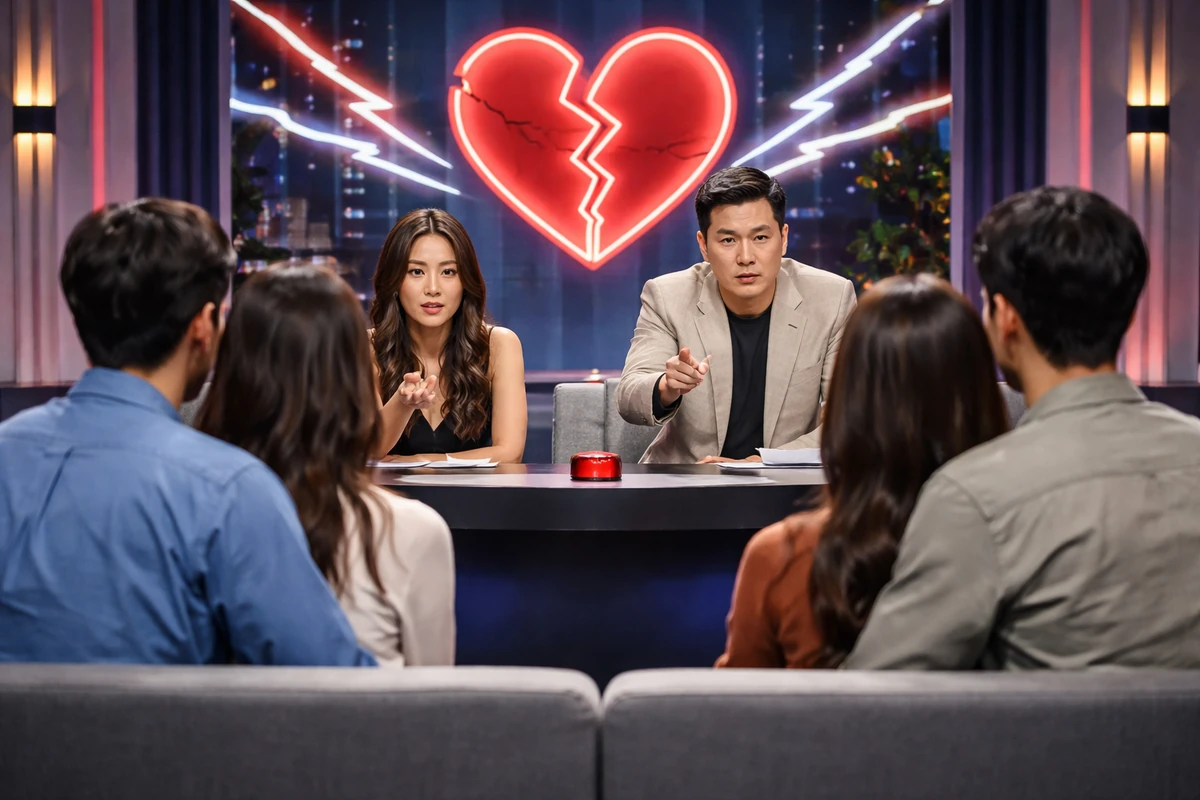
The show, unveiled April 15 and expected to debut in the first half of the year, is built around couples on the brink of breaking up. On paper, that might sound like a relationship counseling program, the kind of format American viewers might compare to daytime talk shows or reality series where experts help troubled pairs communicate better. But the hook here is something sharper. Rather than emphasizing therapy or reconciliation, “Love War” frames itself around judgment. The premise, according to Korean entertainment reports, is that two celebrity “love mentors” step into the final clash between couples considering a breakup and help bring the conflict to a conclusion.
That distinction matters. In the language of the show itself, romance is not treated as a mystery to gently unpack, but as a conflict to be ruled on. The title translates love into the vocabulary of battle. That is not merely clever branding. It reflects a broader shift in the way South Korean reality television is packaging intimacy: less as a dreamy process of connection, more as a public argument about fairness, responsibility and emotional labor.
For American viewers accustomed to the rose ceremonies of “The Bachelor,” the island flirtations of “Love Island,” or the emotional autopsies of reunion specials across the reality TV ecosystem, the concept may sound familiar in spirit if not in style. Reality television on both sides of the Pacific has long understood that conflict drives engagement. But “Love War” seems poised to formalize that instinct. It does not stop at exposing friction. It turns friction into the main event, and it invites audiences to weigh not just what happened, but whose version of a relationship is more persuasive.
That is what makes the show notable in the crowded Korean entertainment landscape. This is not simply another dating program arriving in an already saturated field. It is a sign that Korean relationship TV may be moving from observation to adjudication, from butterflies to blame.
Why Lee Hyori and Seo Jang-hoon matter
If the format gives “Love War” its edge, the casting gives it credibility. The program is anchored by two widely recognizable Korean celebrities: singer Lee Hyori and television personality Seo Jang-hoon. For audiences outside South Korea, they may not carry the same immediate name recognition as, say, Ryan Seacrest or Judge Judy. But within Korean popular culture, both come with established public personas that make them especially potent choices for a show built around competing interpretations of love.
Lee, one of the most enduring stars in Korean entertainment, first rose to fame in the late 1990s as a member of the girl group Fin.K.L. and later became one of the country’s defining solo celebrities. Over the years, she has cultivated an image that blends glamour with unusual frankness. In variety shows and interviews, she has often come across as direct, emotionally self-aware and resistant to empty niceties. In Korean celebrity culture, where image management can be meticulous and restraint is often prized, that kind of candor has helped define her brand. She is not just famous; she is seen as someone who speaks honestly about feelings, choices and the cost of staying in situations that no longer fit.
That makes her a natural fit for a program asking whether a relationship is worth saving. Lee’s appeal in this setting is not that she can deliver textbook counseling. It is that she can ask the uncomfortable emotional question many people already suspect is the real one: Are you staying because you still love this person, or because you are afraid to leave? A star with that public image can push a conversation past etiquette and toward emotional truth, or at least what feels like emotional truth on television.
Seo brings a different energy. A former professional basketball player who reinvented himself as one of Korean television’s most dependable talk and variety personalities, he has built a reputation in advice-driven entertainment as blunt, practical and unsentimental. Where Lee is associated with instinct and emotional honesty, Seo is often cast as the realist, the figure willing to strip a romantic problem down to habits, money, trust, lifestyle and repetition. In other words, he speaks the language of sustainability. Does this relationship work in daily life? Is this a one-time mistake or a pattern? Can affection survive without reliability?
That contrast is central to the show’s design. The pairing is not simply male versus female, or heart versus head in some simplistic sense. It is two different social grammars for understanding modern relationships. One asks what your feelings are telling you. The other asks what the evidence shows. For viewers, the entertainment is likely to come not just from the arguing couples, but from watching these two public figures interpret the same conflict through different moral and emotional frameworks.
That is why the casting is more than stunt programming. Korean variety shows often depend on a deep relationship between audience and persona. Viewers are not just watching celebrities react in the moment; they are watching familiar personalities perform recognizable forms of judgment. “Love War” appears to understand that the mentors are not background hosts. They are part of the story’s engine.
From butterflies to breakups
The bigger story here is what “Love War” says about where Korean dating entertainment is headed. Broadly speaking, relationship-based programming in South Korea has tended to fall into two categories. One is observational: strangers meet, spend time together and gradually build emotional connections while cameras capture the tiny signs of attraction, jealousy and hesitation. These are the shows that trade in suspense and anticipation, asking viewers to root for possible couples as if watching an extended first date. The other category is consultative: people with existing romantic problems seek help, tell their side of the story and receive some form of commentary or advice.
“Love War” belongs more to the second camp, but it also pushes beyond it. Instead of merely diagnosing a problem, it introduces the narrative machinery of a final showdown. The issue is no longer just why a couple is struggling. The issue is whether the relationship should continue. That is a different kind of dramatic question, and a much more binary one. It creates a built-in tension that advice shows do not always have, because the audience is not simply waiting for insight. It is waiting for a ruling.
This shift makes sense in a saturated market. Romantic excitement remains a useful television commodity, but like any formula, it can lose some of its charge through repetition. There are only so many versions of strangers nervously circling each other at dinner, only so many confessionals about who texted whom or who chose to sit next to whom. Conflict, by contrast, has endless variety because it is rooted in memory, resentment and expectation. A fight contains history. It invites interpretation. It gives viewers immediate stakes.
That is true in the United States as well. American reality TV long ago learned that viewers are often more invested in the breakdown of intimacy than in its beginning. Reunion episodes, divorce-centered franchises and post-relationship tell-alls work because they give audiences not just emotion, but the chance to assign meaning to emotion. What was disrespectful? What was a red flag? Who did the invisible work in the relationship? Who benefited from ambiguity? “Love War” appears built around that same appetite, but packaged in the highly structured style of Korean studio entertainment.
The premise also reflects a larger cultural reality: in many places, especially among younger viewers, romance is increasingly discussed less as destiny and more as negotiation. Compatibility is no longer just chemistry. It is about division of labor, communication styles, financial habits, boundaries and respect. Television, which often absorbs and repackages social conversations at high speed, is following that shift. “Love War” seems to recognize that today’s viewers may be less interested in idealized love than in asking whether a relationship is equitable and emotionally viable.
Why audiences may want a verdict, not comfort
The most revealing part of the show’s concept may be its assumption about what viewers want. A traditional relationship advice program offers healing, empathy or the possibility of growth. “Love War,” by contrast, appears to operate on the idea that audiences are seeking discernment. They want someone to cut through the fog. They want language for the moment when a partner’s behavior stops being a misunderstanding and starts becoming a pattern. They want help identifying the line between compromise and self-erasure.
That may sound harsh, but it is not hard to see why it resonates. In the social-media age, millions of people already consume relationship dilemmas as a kind of participatory moral exercise. Reddit threads, TikTok confessionals and Instagram therapy-speak have trained audiences to evaluate private relationships in public terms. People argue over gaslighting, weaponized incompetence, love-bombing and emotional availability with the vocabulary of mini-tribunals. They do not merely sympathize. They render judgment.
South Korea has undergone its own version of that shift. Conversations about dating increasingly involve concepts that move beyond romance in the abstract and into the everyday politics of relationships: trust, fairness, emotional responsibility, who apologizes, who remembers, who pays, who compromises, who carries the hidden strain of making the relationship function. “Love War” seems designed for viewers who do not necessarily want to be soothed. They want standards.
That is where Lee and Seo become more than hosts. They become what might be called architects of criteria. Their value lies in how convincingly they can explain why one behavior is careless, why another crosses into disrespect, or why “love” sometimes becomes an excuse to avoid accountability. The show’s real test will not be whether the couples cry or yell. It will be whether the mentors can provide a persuasive framework for understanding what viewers are watching.
And that framework matters because the audience is part of the format. These shows are no longer passive experiences. Viewers watch with their own histories in mind. They compare what they see to past relationships, friends’ breakups or unresolved arguments in their own lives. The real engine of engagement is not just spectacle. It is recognition. The show offers viewers an opportunity to ask a personal question through someone else’s public conflict: Was I right to leave? Would I have stayed too long? Did I misread what happened to me?
The ethical risk of turning relationships into public rulings
For all its potential appeal, “Love War” also walks into a difficult ethical terrain. Intimate relationships are dense with context, contradiction and private history. The more a show leans into clear verdicts, the more it risks flattening that complexity. A person who argues more eloquently on camera may not be the more truthful partner. A single incident shown in a tightly edited segment may not represent the texture of months or years. Reality television, by design, compresses and shapes reality into something legible. But legibility is not the same as fairness.
That is especially true when entertainment borrows the language of judgment. The word “war” is deliberately provocative. It promises winners and losers. It suggests decisive outcomes and emotional finality. If the show leans too hard into that framing, it could easily slip into something exploitative: a spectacle built on the pain of couples whose worst moments are repackaged for audience debate. That is the danger facing any program that converts emotional injury into consumable drama.
To avoid that trap, the series will need to do more than amplify shouting matches. It will need to translate conflict into meaning. Why did this relationship get here? What assumptions broke down? What patterns hardened? What social pressures, habits or misunderstandings made the rupture feel inevitable? If the program can show that complexity, then its “judgment” element may feel less like public shaming and more like structured interpretation.
That would distinguish it from the emptier corners of reality TV. The strongest relationship shows, whether in Korea or the United States, do more than let viewers gawk. They organize messy feelings into a conversation people recognize from real life. They identify the invisible labor, the repeated injury, the ordinary resentments that rarely look dramatic until they accumulate. If “Love War” can deliver that kind of clarity, its harsher title may prove less sensational than diagnostic.
But the burden will be heavy. Shows that promise decisive answers often create the illusion that intimacy can be solved cleanly. In life, of course, many relationships end without consensus, and many continue despite unresolved contradictions. A television format that privileges conclusion may satisfy viewers in the short term while simplifying the truth in the long term. That tension will likely define the show’s reception.
What this says about Korean pop culture now
Whether “Love War” becomes a hit or just another experiment in a crowded genre, it captures something real about this moment in Korean pop culture. For years, the global spread of Korean entertainment has often emphasized polished fantasy: glamorous idols, high-concept dramas, aspirational romance. Yet some of the most revealing recent reality formats have moved in the opposite direction, toward emotional realism, relational fatigue and the practical question of whether affection can survive everyday life.
That does not mean romance has disappeared from Korean television. It means romance is increasingly being framed as a site of negotiation rather than destiny. The audience being courted here is not only the viewer who wants to swoon. It is the viewer who wants to assess, compare and decide. In that sense, “Love War” may be less about love itself than about how contemporary audiences consume love: analytically, publicly and with a growing interest in responsibility.
For American audiences watching the continued evolution of Korean unscripted television, that is worth paying attention to. South Korea has become one of the most inventive producers of formatted entertainment in the world, and its reality genres often function like cultural barometers. They reveal not just what people enjoy watching, but what kinds of social conversations can be staged on television. When a network builds a dating show around verdicts instead of butterflies, it is telling us something about what now feels relatable, marketable and emotionally legible.
The gamble behind “Love War” is straightforward. It assumes that, in a time of dating exhaustion and public discourse saturated with amateur diagnosis, viewers no longer believe that advice alone is satisfying. They want interpretation with edges. They want someone to say what the fight means. They want a conclusion, or at least the performance of one.
That may be a shrewd read of the current moment. But it is also a revealing one. If earlier dating shows thrived on the excitement of beginning, “Love War” is betting on the fascination of endings, or near-endings. It sees the modern relationship not as a fantasy unfolding, but as a test under pressure. And in that framing, the central question is not who falls in love. It is who can make the better case for staying, and who finally gets told it is time to walk away.
Comments
Post a Comment