
A labor market shaped by more than skills
A new South Korean research report is putting a name to something many immigrants know intuitively: Sometimes a job choice is not really a choice at all. It is a survival strategy.
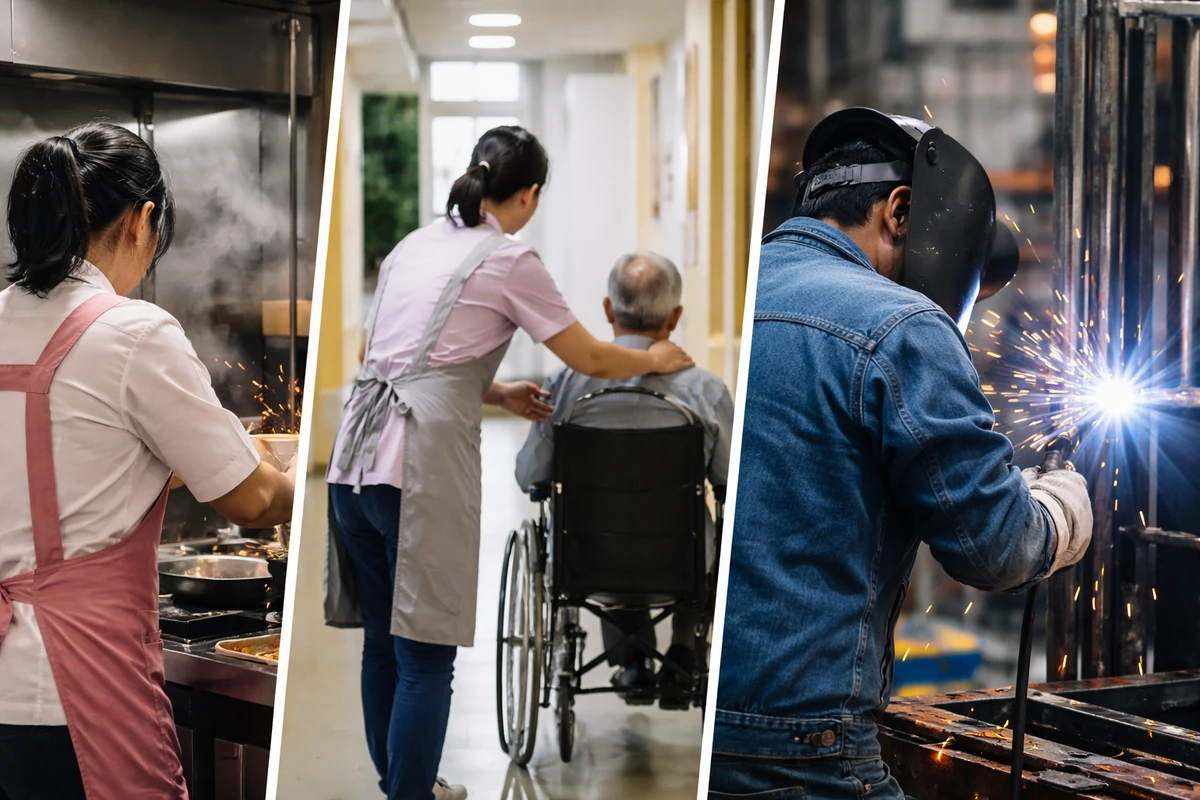
The report, released April 18, 2026, by the Migration Policy Institute of Korea, examined how two groups with deep historical ties to the Korean Peninsula — Chinese Korean migrants and Koryoin, or ethnic Koreans from the former Soviet Union — navigate work in South Korea. Based on in-depth interviews with 25 people who moved to South Korea after age 18 and are economically active there, the study found that many Chinese Korean migrants, in particular, tend to pursue small business ownership in sectors such as restaurants or obtain licenses in fields such as caregiving and welding as a way to reduce their exposure to discrimination.
On the surface, that may look like an ordinary story about immigrants adapting to a new economy: People go where the jobs are, rely on family and community advice, and seek out practical credentials. Americans have seen versions of that story in cities where immigrant communities gravitate toward nail salons, trucking, construction, home health care or food businesses. But the Korean report argues that something more structural is happening. The issue is not simply what work people prefer. It is what kind of work leaves them less vulnerable to exclusion, suspicion or being judged as less competent because of where they come from.
That distinction matters. When career paths are shaped less by aptitude or ambition than by the need to avoid bias, it signals a deeper problem in the labor market. It suggests that formal access to work may exist while equal acceptance does not. And in a country like South Korea, which is grappling with an aging population, labor shortages in care and manufacturing, and a growing debate over immigration, that finding carries implications well beyond one community.
Who are Chinese Koreans and Koryoin?
For readers outside Korea, the groups at the center of the report need some explanation. Chinese Koreans, often referred to in Korea as Joseonjok, are ethnic Koreans whose families largely settled in northeastern China generations ago. Many speak Korean, sometimes fluently, and often arrive in South Korea with the expectation that shared ancestry and language will make integration easier. Koryoin are ethnic Koreans from the former Soviet Union, with family histories that often trace back to forced migration under Stalin in the 1930s. Many Koryoin now come to South Korea from countries such as Uzbekistan, Kazakhstan and Russia.
In theory, both groups might appear well positioned to adapt. They may share ancestry, some language, and elements of cultural familiarity with South Koreans. But that assumption can be misleading. In practice, many still encounter social hierarchies that separate them from native-born South Koreans. Accent, nationality, educational background, neighborhood, work history and simple social prejudice can all mark them as outsiders.
This is a dynamic American audiences may recognize, even if the historical details are different. In the United States, racial or ethnic proximity has never guaranteed equal treatment. Being perceived as culturally adjacent to the mainstream can sometimes create its own pressure: You are expected to assimilate quickly, and if you do not, any difficulty is framed as a personal failure rather than evidence of structural barriers. The Korean report suggests something similar may be happening in South Korea.
For Chinese Koreans especially, the shared language that many South Koreans might assume would ease entry into the labor market does not erase bias. In fact, the report argues, it can obscure it. If someone can communicate capably in Korean and still struggles to gain stable footing in employment, then the explanation cannot simply be language. What remains are less visible barriers — trust, stigma, stereotypes and assumptions about where someone belongs.
Why restaurants, caregiving and welding become “safer” choices
One of the report’s clearest findings is that entrepreneurship, especially in food service, functions as a practical response to discrimination. Restaurants can offer a relatively visible pathway into self-employment. Within migrant networks, information travels quickly: which neighborhoods are affordable, what kinds of customers a district attracts, how much startup capital is needed, where to source ingredients and what pitfalls to avoid. In that environment, opening a restaurant may feel more predictable than searching for wage work in a labor market where bias is harder to control.
That does not mean running a small business is easy. Far from it. Restaurant ownership is notoriously risky in South Korea, just as it is in the United States. Profit margins are thin. Rent can be punishing. Competition is fierce. A single bad season can wipe out savings. But if traditional employment means repeatedly facing employers’ assumptions about nationality, speech patterns or gaps in one’s resume, then self-employment may still appear rational. The point is not that entrepreneurship is more secure. It is that it offers more control over the terms of evaluation.
The same logic helps explain why formal certifications in occupations such as care work and welding carry special appeal. These are jobs where skills can be measured in more concrete ways. A license or certification can serve as a credential that says, in effect, do not judge me by my background; judge me by what I can demonstrably do. In societies where immigrants often feel compelled to “prove” themselves over and over, that kind of credential can act as a shield.
Caregiving is particularly notable in the South Korean context. Like Japan and many Western nations, South Korea is aging rapidly. Demand for elder care is rising, and the country increasingly depends on a labor force willing to do physically demanding, emotionally taxing work that is often undervalued. Welding, meanwhile, sits in a different part of the economy — manufacturing and industrial labor — but it offers similar clarity. The role is specific, the skill is recognizable, and the qualification carries weight. In both cases, certification offers a route into work that may feel less subjective than open-ended hiring processes.
Americans have seen parallels in their own labor market. Immigrants frequently concentrate in sectors where credentials are standardized or where self-employment offers independence from gatekeepers. Taxi medallions once played that role in some U.S. cities. Commercial driving licenses, nursing assistant credentials, cosmetology permits and skilled-trade certifications have done the same. The Korean report places that familiar pattern in a different light: not merely as economic adaptation, but as a defensive response to social sorting.
Language is not the whole story
One of the study’s most striking conclusions is that language proficiency does not solve the problem many policymakers think it does. In South Korea, discussions of immigrant integration often begin and end with Korean-language education. And to be clear, language matters. It affects everything from daily life to access to institutions. But the report suggests it is a necessary condition, not a sufficient one.
Many of the Chinese Korean migrants interviewed were already able to communicate in Korean well enough for ordinary life when they arrived. Yet they still found themselves steering toward jobs or business models that minimized the risk of rejection. That finding challenges a common assumption in many countries: If immigrants learn the language and work hard, integration will naturally follow.
Reality is messier. In labor markets, decisions are often filtered through impressions that are difficult to quantify. Does an employer see a candidate as trustworthy? Does a customer attach social stigma to a worker’s background? Does a neighborhood carry a reputation that narrows opportunity for the people who live there? These questions have nothing to do with grammar or vocabulary, but they can shape a career just as powerfully.
There is also a subtler problem. Because Chinese Koreans may appear linguistically and culturally close to South Korean society, employers and institutions may expect a smoother path than they would from someone viewed as more visibly foreign. When reality falls short of that expectation, the gap may be interpreted as an individual deficiency rather than evidence of bias. In other words, proximity can produce not just opportunity but also harsher judgment.
That is an important lesson for any country thinking about immigrant integration. Public debate often treats adaptation as a one-way process, as if newcomers simply need the right tools to fit in. But integration also depends on whether institutions are willing to recognize people fairly once they arrive. A worker can speak the language, understand local customs and still find doors half-closed.
The power and limits of community networks
The report also highlights the role of concentrated ethnic networks, especially in areas where Chinese Korean residents live in significant numbers. In these communities, advice about jobs, licensing, housing and business opportunities circulates quickly. For new arrivals, that kind of informal information system can function as a first safety net — often more accessible than government agencies or official employment centers.
This is hardly unique to Korea. In the United States, generations of immigrants have relied on churches, hometown associations, neighborhood businesses, ethnic media and relatives to navigate an unfamiliar system. Informal networks can help newcomers avoid scams, find first jobs, locate affordable housing and learn rules that are not obvious from official forms. They can be lifesaving.
That appears to be true in South Korea as well. According to the report, community networks helped migrants identify which licenses were worth pursuing, which sectors were more open, and how to combine work with family responsibilities. In that sense, the network is not just social support. It is an economic infrastructure.
But the report is careful to note that these networks can also become boundaries. The stronger the internal community ties, the easier it may be to survive without connecting to broader public systems. That can be stabilizing in the short term, but limiting over time. If most information, employment and trust remain inside the ethnic community, mobility into the wider labor market may stay constrained. Opportunity becomes concentrated in the same sectors, neighborhoods and social circles.
There is a familiar American analogy here, too. Ethnic enclaves can be engines of entrepreneurship and belonging, but they can also reflect the failure of mainstream institutions to provide equal access. When a community has to build its own job pipeline because the broader market is unwelcoming, resilience and exclusion are operating side by side.
What Korean policy has missed
The report argues that South Korea’s immigration and job-training policies have focused too heavily on initial settlement: visa status, basic language acquisition, administrative procedures and introductory life guidance. Those things matter, especially for recent arrivals. But the study suggests the more serious challenge may come later, after the first stage of adjustment is over.
That later stage involves career accumulation and job mobility. A migrant may be legally settled, capable in Korean and already working, but still unable to convert past experience into stable advancement. Skills gained abroad may go unrecognized. Prior careers may be treated as irrelevant. Employers may push workers into a narrow range of occupations regardless of their experience. The result is not just hardship for individuals. It is a waste of talent for the society receiving them.
The researchers recommend a more targeted approach: industry-specific Korean language training, better systems to recognize prior experience and credentials, and career transition programs that help migrants translate what they already know into forms that South Korean institutions value. That is a practical idea with broad appeal. Rather than forcing people to start over from scratch, policymakers would design pathways that allow existing skills to count.
For a country facing labor shortages, the economic argument is straightforward. Better recognition of migrant skills can reduce mismatch in the labor market and connect employers with workers more efficiently. But the social argument may be even more important. When people are not forced into defensive career rebuilding simply to avoid discrimination, they have a better chance to participate more fully in society.
The report also calls for opening public vocational training systems more meaningfully to these communities and linking trusted community networks to official human resource development programs. That recommendation may sound technical, but it gets at a basic question: Who are public institutions actually designed to serve? A program may be formally available to everyone, yet still be hard to access if information is buried in administrative language, the process is cumbersome, or counseling does not reflect migrants’ actual life circumstances.
Connecting public systems to community-based trust networks could make those institutions more usable. The goal would not be to isolate ethnic communities further, but to build bridges outward from them.
A warning for Korea — and a familiar question elsewhere
At its core, the report is about more than one group’s employment patterns. It is about the hidden cost of a labor market that appears open while quietly signaling who will be accepted without question and who must continually justify their place.
That matters in South Korea now because the country is at an inflection point. It has long imagined itself as ethnically and culturally homogeneous, even as demographic and economic pressures make immigration increasingly important. As birthrates remain low and the need for workers grows in care, manufacturing and service industries, Korea is being pushed to reconsider what social membership looks like in practice, not just in rhetoric.
The study suggests that formal belonging — shared ancestry, legal status, language ability — does not automatically translate into equal treatment. For Chinese Koreans especially, that gap may be particularly painful because the promise of belonging is so close. When people who seem culturally near still feel compelled to redesign their careers to avoid bias, the issue is not simply adaptation. It is whether the society receiving them is prepared to expand its understanding of who counts as fully accepted.
That is not just a Korean question. It is one democracies around the world continue to wrestle with, including the United States. Policymakers often praise immigrants’ grit, flexibility and entrepreneurial spirit. Those qualities are real. But praise can become a way of avoiding harder questions. Why did people have to be so resilient in the first place? What barriers made resilience necessary?
In that sense, the story emerging from South Korea is both specific and widely recognizable. A caregiver’s license, a welding certificate, a modest restaurant in a neighborhood shaped by migrant networks — these are not just economic choices. They can also be evidence of a society where equality of opportunity is still conditional.
The report’s underlying message is not that migrants fail to adapt. It is that adaptation alone cannot fix exclusion. If public policy remains focused only on helping immigrants fit in, while ignoring how institutions sort, judge and limit them after they arrive, then career rebuilding will remain a private solution to a public problem.
And that may be the clearest warning in the findings. When people must reconstruct their working lives not to pursue ambition, but to avoid prejudice, the burden of integration has already shifted too far onto the individual. South Korea’s challenge now is whether it will continue to treat that burden as a personal matter — or recognize it as a test of the fairness of its labor market itself.




0 Comments