Why a Political Phrase in Ulsan Matters
In American politics, the idea is familiar even if the setting is not: If several parties or factions opposed to the incumbent camp split the vote, they can hand victory to their rivals without ever truly testing the broader public mood. That basic logic is now moving to the center of South Korea’s local political debate, and one city in particular has become a revealing case study.
In Ulsan, a major industrial city on South Korea’s southeast coast, three opposition candidates running for mayor signaled publicly that they believe they must eventually unify behind a single contender if they hope to compete effectively in the June 3 local elections. The statement itself was short, but in South Korean politics, that kind of declaration can carry outsized meaning. It suggests that the battle ahead may not be decided by policy proposals alone, or even by the popularity of individual candidates, but by whether parties that broadly oppose the conservative camp can overcome their own competing ambitions.
The candidates — Kim Sang-wook of the Democratic Party, Hwang Myeong-pil of the Rebuilding Korea Party and Kim Jong-hoon of the Progressive Party — reportedly agreed during a public discussion on April 18 that “candidate unification must be achieved.” In plain terms, they were saying that if the opposition wants a real chance in Ulsan, it cannot afford to run in three different directions.
That matters because local elections in South Korea, much like mayoral or gubernatorial races in the United States, are about more than one office. Voters are choosing a broad layer of local leadership, including mayors, district heads and council members. And while local concerns such as jobs, transit, development and quality of life always matter, these elections are also becoming a test of wider national party strategy. In places where conservatives have a sturdy organizational base, opposition fragmentation can be fatal.
Ulsan is one of those places. It has long been known as an industrial powerhouse — a city associated with shipbuilding, auto manufacturing and labor activism, but also with a political landscape where conservative and progressive forces have battled intensely for influence. That combination makes it a symbolically powerful place to watch. If opposition parties can make unity work there, they may argue that a broader anti-conservative coalition is viable elsewhere. If they fail, Ulsan could become a warning about the limits of alliance politics.
Understanding Ulsan: Korea’s Industrial Capital and a Political Bellwether
For readers in the United States who may not follow South Korean local politics closely, Ulsan helps explain itself through comparison. Think of a city that combines the industrial identity of Detroit, the port importance of Houston and the union politics of an older Midwestern manufacturing center. Ulsan is often described inside South Korea as an “industrial capital,” and that economic identity has shaped its politics for decades.
It is home to major heavy industries and has long stood at the intersection of labor power, corporate influence and regional conservatism. That makes it more politically complex than a simple left-right map might suggest. Organized labor and progressive politics have a real history there, but so do conservative party machines and business-aligned networks. In a city like that, elections are often not just about ideology; they are about which side can assemble the broadest workable coalition.
That is why the opposition’s talk of unification has landed with such force. In theory, South Korea’s opposition parties can all claim to represent some version of change or reform. In practice, they are not interchangeable. The Democratic Party is the main liberal opposition force, roughly akin to a large tent party that includes moderates, reformists and more progressive voices. The Rebuilding Korea Party, associated with former Justice Minister Cho Kuk’s political orbit, has tried to position itself as a sharper-edged anti-establishment reform force. The Progressive Party occupies a more explicitly left-wing space, with deeper ties to labor and grassroots activism.
When those forces cooperate, they can amplify each other. When they compete, they can cancel each other out. In a winner-take-all race for mayor, three opposition candidates can divide a constituency that might otherwise be competitive against a single conservative candidate. That is the strategic math behind what Korean media call “candidate unification,” or danilhwa in Korean political shorthand.
This is a common feature of South Korean elections, but it can be confusing to outside observers because it does not always mean a formal party merger. More often, it refers to a last-minute or negotiated process in which multiple candidates from ideologically adjacent camps decide that only one of them will remain in the race. The decision might be based on polls, private negotiations, regional bargaining or broader deals involving multiple offices. Imagine several factions on one side of the aisle deciding not just who should top the ticket, but who should stand down in city council races, county races and regional contests all at once. That is the kind of bargaining table now looming in Ulsan.
More Than a Mayor’s Race: Why Coalition Politics Gets Complicated Fast
One reason the Ulsan discussion matters is that the candidates were not speaking only about the mayor’s office. They also raised the possibility of broader coordination for district heads, metropolitan council seats and local council races. That may sound like routine party strategy, but it points to the real difficulty of coalition politics: It is one thing to agree in principle that unity is necessary. It is another to decide who gives up which race, in which district and for what long-term reward.
In American terms, imagine not merely deciding who should be the consensus candidate for governor, but simultaneously negotiating state legislative districts, county executive races and city council slates. Every local party operative would immediately start asking hard questions: Who keeps a foothold? Who loses visibility? Which party gets squeezed out over time? Which concession today weakens organizational strength tomorrow?
That is the central tension in Ulsan. A unified opposition slate might increase the chance of defeating the conservative bloc in the short term. But for each participating party, compromise can also mean shrinking its own regional base. A smaller party that withdraws candidates too often can disappear from voters’ minds. A larger party that gives too much ground can look weak to its own supporters. What sounds noble in public — “let’s work together” — can become bruising once the discussion turns to actual districts, survey methods and campaign resources.
Kim Jong-hoon of the Progressive Party reportedly emphasized that differences among the opposition should be gathered into a single framework and then presented to voters for consent. That language is important. It suggests a model of coalition not based simply on horse-trading, but on persuading voters that a common front serves the city’s interests. Hwang Myeong-pil of the Rebuilding Korea Party reportedly said he would accept any rational unification method, while stressing the need to coordinate lower-level races first so conservative candidates do not win by default in multiple districts.
That sequencing is revealing. In many election systems, the top race dominates attention. But in South Korea’s local elections, the lower-level contests can be where alliances either solidify or fall apart. If a party feels humiliated in council negotiations, it may resist compromise in the mayoral race. If it gains enough concessions below, it may be more willing to back a single mayoral nominee. In that sense, the mayor’s race may be the headline, but the real architecture of unity is often built further down the ballot.
And then there is the question every alliance eventually faces: Who gets to lead? The Democratic Party, as the largest opposition force, is likely to argue that it should remain the central axis of any anti-conservative coalition. The Rebuilding Korea Party can counter that it represents a fresher or more symbolically potent force in opposition politics. The Progressive Party can say it has local roots and activist credibility, particularly in labor-heavy terrain like Ulsan. All three can call for unity while quietly believing that unity should take shape around them.
The Broader Opposition Problem: Cooperation in One City, Competition in Another
If Ulsan illustrates one model of opposition politics, another city shows how fragile that model can be. On the same day that Ulsan candidates were talking publicly about the need for unification, a very different scene was playing out in Pyeongtaek, south of Seoul.
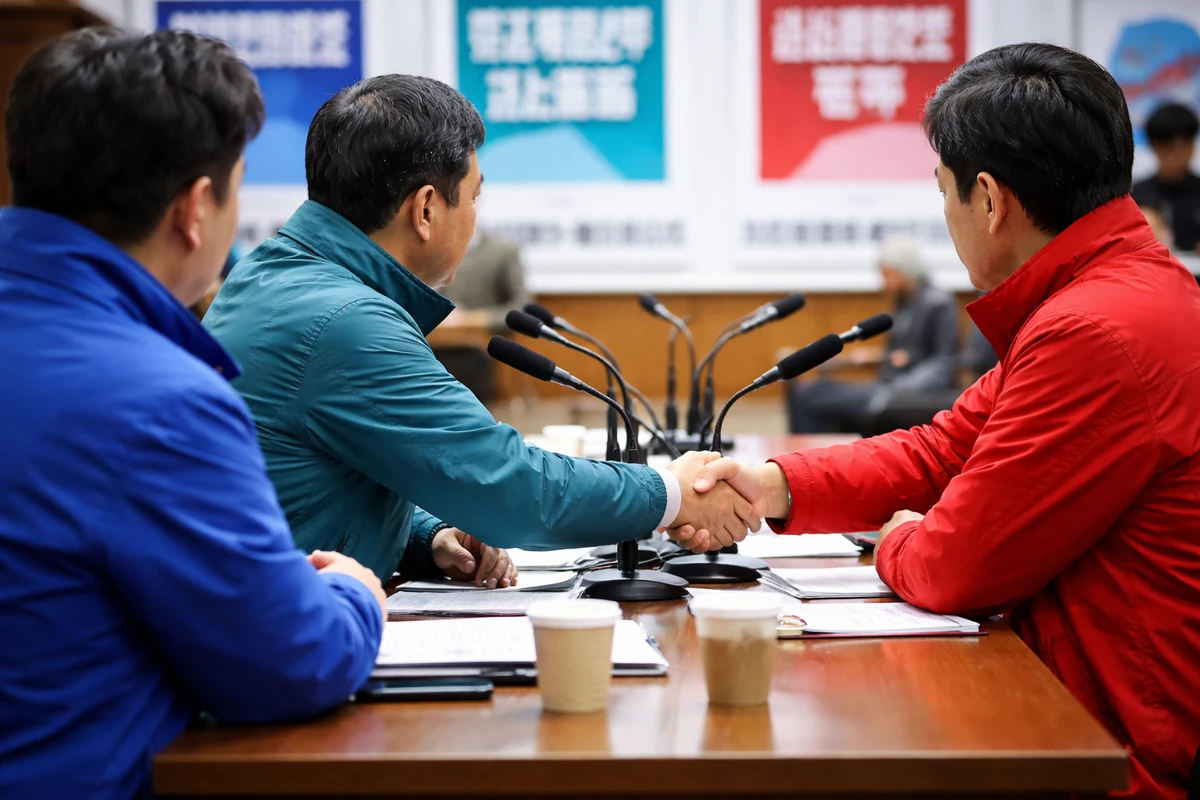
There, Cho Kuk, the leader associated with the Rebuilding Korea Party, met Kim Jae-yeon, a leading figure in the Progressive Party, while both were linked to the same electoral battleground. The public exchange was polite. Cho reportedly said, “Let’s compete in good faith,” and Kim answered warmly enough. But the handshake did not erase the conflict beneath it.
Earlier, Kim had called on Cho to withdraw, arguing that his candidacy lacked both principle and justification at a moment when opposition coordination with the Democratic Party was being explored. In other words, while Ulsan was showcasing rhetoric of alliance, Pyeongtaek was exposing the opposite reality: opposition forces can just as easily use the same election cycle to test their strength against one another.
That contrast is one of the most important takeaways from the current South Korean landscape. There is no single opposition playbook. In some regions, the urgent goal is to prevent conservatives from running the table, which creates pressure for cooperation. In others, the more immediate prize is leadership within the opposition itself. Parties are not just fighting conservatives; they are also competing to define what the opposition should look like in the years ahead.
For American readers, this may resemble moments when ideologically adjacent groups debate whether to form a united front against a dominant rival or to spend a cycle proving who truly speaks for the broader coalition. The difference is that South Korea’s multi-party structure makes those choices more visible and more procedural. Instead of intraparty primaries alone, there are often negotiations among separate parties, each with its own brand, organization and survival instincts.
That is why the image of a handshake can be misleading. In South Korean politics, cordial language does not necessarily mean strategic convergence. “Compete in good faith” can sometimes mean precisely what it says: We are not unifying, and we are going to test our own strength. Ulsan and Pyeongtaek, taken together, show a political camp struggling to decide whether its future lies in disciplined coalition-building or in open competition for primacy.
Why Local Elections in South Korea Are Also National Tests
To understand why these local maneuvers carry national weight, it helps to know how South Korea’s local elections function politically. Officially, these are contests over city halls, district offices and local assemblies. In practice, they often double as a report card on national parties, a measure of regional momentum and a preview of future presidential alignments.
That dynamic has become even more pronounced as South Korean politics grows more polarized and more personality-driven. A race for mayor can also be read as a judgment on party leadership. A district-level alliance can become a prototype for national realignment. What happens in Ulsan may therefore influence not only the city’s administration, but also larger arguments over who can credibly lead the opposition in the post-election period.
Other regions underscore this point. In Busan, another conservative-leaning city in the southeast, the Democratic Party has reportedly moved quickly to finalize candidates across all 16 districts and counties. That signals organizational readiness, but not necessarily electoral viability. In a region where conservatives remain strong, simply filling out a slate is not enough. Messaging discipline, regional alliances and outreach to moderate voters all matter. The lesson from Ulsan — that opposition coordination may need to stretch beyond a single top race — could resonate far beyond one city.
In Seoul, the stakes look different but no less national. Criticism aimed at conservative mayoral figures has framed the capital’s top office as something more than a local administrative post. Opponents have argued that the mayoralty should not become a steppingstone to party power or a future presidential run. That is a familiar complaint in democracies everywhere: local offices are often treated as laboratories of governance, but also as launchpads for national ambition.
So when opposition politicians debate whether to unify in Ulsan, they are not merely gaming out one mayor’s race. They are testing competing theories of how to confront the ruling conservative establishment across the country. Is the answer a broad but loose anti-conservative alliance led by the Democratic Party? Is it a more multi-centered opposition in which newer or smaller parties demand equal weight? Or is the future more fragmented, with different formulas emerging region by region?
The answers matter because local election outcomes can shape the internal hierarchy of South Korea’s opposition long after campaign banners come down. A successful coalition can create momentum and legitimacy. A failed one can generate recriminations, especially if supporters believe victory was lost not because the electorate rejected the opposition, but because the opposition could not get out of its own way.
The Hard Part Isn’t Agreeing on Unity. It’s Designing It.
South Korean politics has seen many calls for opposition unity over the years, and the recurring pattern is this: agreement on the goal is easier than agreement on the mechanism. Everyone can say they support cooperation. The trouble begins when they must decide who is “more competitive,” what counts as a fair method and how losers are expected to accept the outcome.
Will the parties choose a unified candidate through opinion polling? If so, which polling firm, what sample and what question wording? Will they factor in party identification, favorability or head-to-head matchups against a conservative rival? Will they negotiate district packages, in which one party stands down in one place in exchange for concessions elsewhere? And perhaps most importantly, will the losing side genuinely mobilize for the winner afterward, or offer only symbolic support?
These are not abstract procedural issues. In South Korea, process often determines legitimacy. If a unification method is viewed as biased or manipulated, the resulting alliance can collapse before it begins. Supporters may refuse to transfer their votes. Local operatives may drag their feet. Candidates who withdraw can still wound the coalition by signaling resentment. The last mile of unity is often the hardest because it demands not just tactical compromise, but emotional and organizational buy-in.
That is especially true in a place like Ulsan, where political identity has been built over years through labor struggles, industrial development and regional partisanship. Voters are not merely choosing among labels; they are choosing among networks of trust, ideology and local reputation. Any unification deal that feels too top-down risks alienating the very constituencies it is meant to consolidate.
At the same time, the pressure to unify is real. In strongly contested or conservative-leaning environments, opposition parties know that the cost of failing to coordinate can be obvious by election night. A conservative candidate may win not because the center-left and left together lacked support, but because they divided it. That possibility gives urgency to every meeting, every statement and every trial balloon about coalition terms.
For now, Ulsan has become the place where those calculations are most plainly visible. The three opposition candidates have acknowledged the strategic reality. But acknowledging it is only the opening move. The difficult part lies ahead: whether they can transform a shared sentence into a functioning political arrangement.
What Ulsan Could Tell Us About Korea’s Opposition Future
In the end, Ulsan’s significance goes beyond one city, one election date or one set of candidates. It offers a window into a larger transformation inside South Korea’s opposition politics. The old model — in which the biggest opposition party set the terms and smaller forces largely followed — appears less automatic than it once did. Newer and smaller parties now want recognition not merely as junior partners, but as actors with their own mandates, constituencies and leverage.
That means future opposition politics may not follow a single template. In some regions, the Democratic Party may remain the undisputed hub of anti-conservative cooperation. In others, coalition-making may require more equal bargaining among multiple parties. Elsewhere, direct competition may take precedence, as parties decide that proving their independent relevance matters more than immediate unity.
Ulsan is therefore not just a local battleground. It is a testing ground for what kind of opposition bloc South Korea may have in the years ahead. If the parties there manage to coordinate across mayoral, district and council races, they could offer a model of disciplined alliance politics that others try to copy. If talks unravel over procedure, status or district-level concessions, that too will send a message — that anti-conservative rhetoric alone is not enough to overcome institutional rivalry.
For American audiences, one of the clearest parallels is this: coalitions are often most persuasive when they are built around both arithmetic and meaning. The numbers must work, but so must the story. Voters need to believe that a coalition represents more than elite deal-making. They need to hear why these parties, with their real differences, deserve to govern together. In Ulsan, that narrative challenge may be just as important as the negotiation itself.
What happens next will reveal whether South Korea’s opposition can move from shared necessity to shared structure. The public statements in Ulsan suggest that major players understand the stakes. They know that in a city defined by industry, labor history and hard-edged partisanship, fragmentation may be a luxury they cannot afford. But politics has a way of turning common interest into contested process.
So the central question now is not whether opposition unity sounds sensible. In Ulsan, nearly everyone involved already appears to agree that it does. The question is whether parties with overlapping goals but competing identities can design a system of compromise that their own supporters will accept. If they can, Ulsan may become the blueprint for a broader electoral strategy. If they cannot, it may become the latest reminder that in politics, as in industry, coordination is hardest where the stakes are highest.
Comments
Post a Comment