
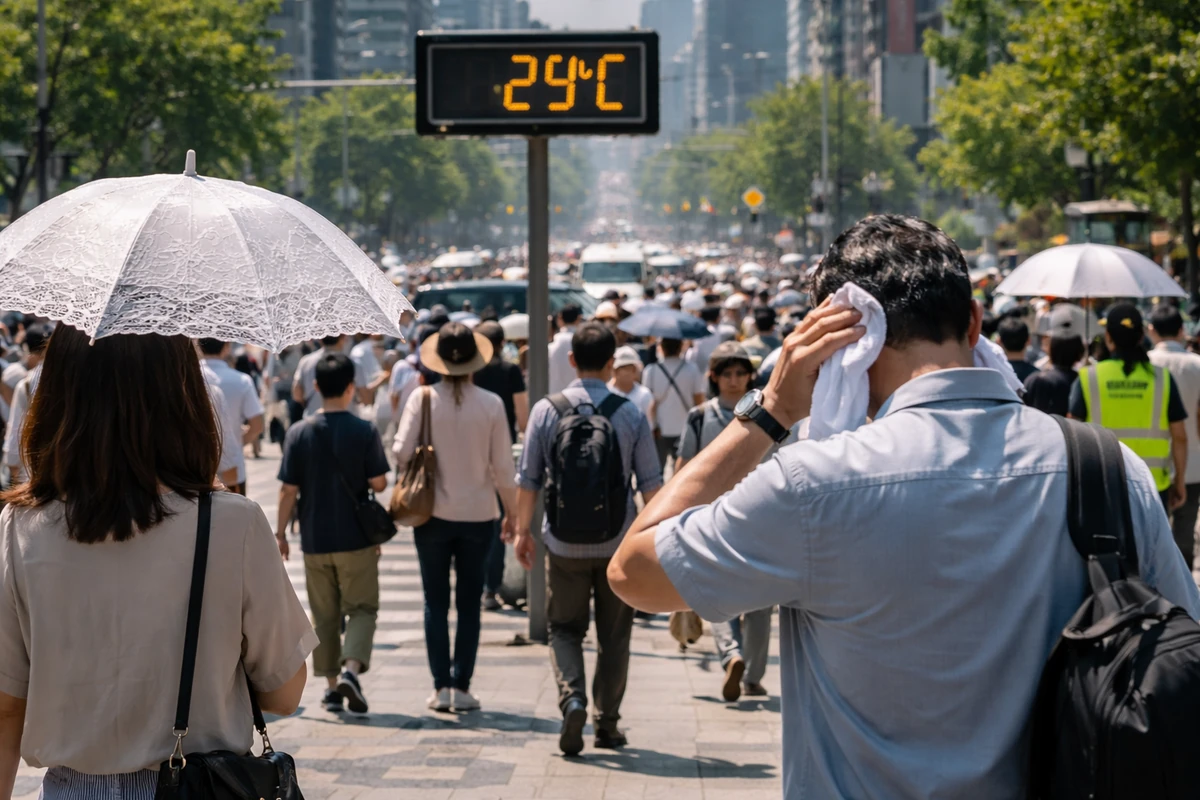
An April forecast that feels more like June
South Korea is heading into a mid-April day that would look ordinary on a postcard and unsettling on a thermometer. Forecasts for April 16 call for mostly clear skies nationwide, but also for daytime highs reaching 28 degrees Celsius, or about 82 degrees Fahrenheit, in some areas. At the same time, inland regions are expected to see temperature gaps of around 15 degrees Celsius, roughly 27 degrees Fahrenheit, between morning and afternoon. On the southern island of Jeju, forecasters have also warned of the possibility of powerful gusts topping 70 kilometers per hour, or about 43 mph.
On paper, that sounds like the kind of day many Americans might welcome after winter: sunny, warm and good for getting outside. But in South Korea, where April is typically associated with cherry blossoms, light jackets and the first real stretch of comfortable spring weather, the numbers tell a more complicated story. A day that begins with a chill, turns almost summerlike by afternoon and carries the risk of high winds in some places is not simply pleasant. It is disruptive.
That disruption is the heart of the story. No single weather condition here is necessarily catastrophic on its own. There is no typhoon, no monsoon rain event, no official midsummer heat emergency. What makes this kind of spring weather socially significant is that it pushes daily life in multiple directions at once. People may need a coat for the morning commute, short sleeves by lunch and caution about wind-related hazards by evening. Schools, workplaces and families are asked to manage more variables than the phrase “nice weather” suggests.
Why the temperature gap matters as much as the heat
In weather coverage, the high temperature usually gets the headline. A forecast high of 28 C in April is attention-grabbing, especially in a country with four distinct seasons and well-established expectations about what spring should feel like. But the more important figure may be the daily swing. A 15-degree difference between the morning low and afternoon high means people are moving through what feels like two different seasons in a single day.
That kind of rapid shift affects bodies, routines and public spaces. Americans know a version of this phenomenon from spring in places like Chicago, Denver or Washington, where mornings can start cold and afternoons turn surprisingly warm. But South Korea’s dense urban patterns magnify the experience. A commuter may walk to a bus stop in a cool breeze, then stand in a crowded subway car, then step into a sun-soaked street canyon between office towers where the heat feels much more intense. The forecast number is one thing; the lived experience is another.
There is also the issue of adaptation. By April, South Koreans are generally not operating on summer rules yet. Buildings may not be fully ready for cooling season. Schools may not be planning outdoor activities around heat stress. Workers who spend long hours outside may not yet have shifted hydration habits, clothing or break schedules the way they would in July or August. Early-season warmth can be deceptively difficult because it arrives before people have adjusted behavior, infrastructure and expectations.
Schools, commutes and the everyday choreography of discomfort
One of the first places unusual spring weather shows up is in the timing of ordinary life. Students and office workers leave home in the cooler hours of the day, then return in the warmer part of the afternoon. That makes getting dressed unexpectedly complicated. If you dress for the morning, you may be uncomfortable later. If you dress for the afternoon, the early hours may feel too cold. It sounds trivial until it is repeated across millions of people, day after day, in classrooms, offices, trains and buses.
Schools are especially exposed to this kind of mismatch. In South Korea, April is a busy month for outdoor activities. Physical education classes pick up. Field trips, sports days and spring events become more common as the academic year settles in. On a day with a near-summer afternoon but a cool start, teachers and administrators must make judgment calls that are more often associated with warmer months: whether to shorten outdoor activities, how to make sure children are drinking enough water, whether enough shade is available and how to handle students who may be more vulnerable to heat or sudden temperature changes.
The commute is its own test. South Korea’s major cities, especially Seoul, depend heavily on public transportation. That means people are moving repeatedly between indoors and outdoors, between crowded vehicles and open streets, between shaded stations and direct sunlight. Even when the temperature is not extreme by midsummer standards, that back-and-forth can create cumulative fatigue. It can also trigger familiar seasonal conflicts over air conditioning: when one person feels overheated, another still feels the lingering coolness of spring. Weather in a shared city is never only individual; it becomes a question of how public space is managed.
The people who feel early heat first
As with many weather stories, the burden is not distributed evenly. A warm April day may be an inconvenience for office workers with climate-controlled indoor jobs, but it can be a more serious occupational issue for people whose work happens outdoors or in transit. That includes construction crews, delivery workers, couriers, sanitation workers, maintenance staff and others whose exposure to sun and wind is part of the job. In those settings, the season on the calendar matters less than the conditions in the body.
That is one reason early heat deserves attention before it crosses the threshold into what governments formally classify as a heat wave. In both South Korea and the United States, extreme-weather policy often becomes most visible once a danger has reached an official benchmark. But social stress starts earlier. A worker climbing stairs with packages in an apartment complex, a street cleaner on pavement that holds afternoon warmth, or a traffic officer standing for long periods in direct sun can feel the effects long before emergency alerts go out.
Large day-night swings add another layer of difficulty. Clothing and protective gear that help in the cool morning can become uncomfortable or even counterproductive by afternoon. Workers may end up navigating a delicate balance between safety, comfort and productivity. If employers have not yet transitioned to warm-season protocols, those decisions can fall too heavily on individuals. That is often how weather becomes a social issue: not through a single disaster, but through many small choices made under pressure by people with unequal room to adapt.
Older adults, health risks and the hidden cost of an unsettled season
Older adults are another group likely to be affected by this kind of “strange spring.” South Korea is one of the world’s fastest-aging societies, and that demographic reality shapes how weather is experienced nationally. Seniors, particularly those living alone or managing chronic health conditions, can be more sensitive to sudden shifts in temperature. What appears to be a modest spring warm-up may strain routines around medication, hydration, sleep and appropriate clothing.
There is also a widespread misconception, in Korea as elsewhere, that heat-related risk belongs only to the peak of summer. In reality, early warm spells can catch people off guard precisely because they do not feel like emergencies. A person may not think to drink more water in April. A family may not yet have checked fans, cooling systems or window ventilation. Care networks that become more alert in July may still be operating on a springtime assumption that the season is fundamentally mild. The danger is not always dramatic; it can be cumulative and easy to miss.
Wide temperature swings can also complicate general health management. South Koreans often use the term “transitional season” to describe the periods between winter and summer, when dressing properly and avoiding illness becomes part of everyday conversation. Americans know the idea too, even if the phrasing differs: the time of year when allergies flare, colds linger and everyone seems to be asking whether to bring a sweater. In Korea, where daily routines are often tightly scheduled and urban movement is constant, those fluctuations can produce real wear and tear, especially for people already dealing with fragile health.
Jeju’s strong winds are a reminder that weather stress is not one-dimensional
The forecast for Jeju adds another important point: unusual spring weather is not just about heat. Jeju, South Korea’s largest island and a major domestic tourist destination often compared loosely to Hawaii for American readers, is also expected to face the possibility of strong gusts exceeding 70 kilometers per hour. That raises a separate set of concerns involving transportation, outdoor safety and the vulnerability of temporary structures or signage.
When weather presents in several forms at once, public response becomes more complicated. One region may be focused on staying cool, another on securing outdoor fixtures and monitoring travel conditions. That fragmentation matters because it can make the overall situation seem less urgent than a single dramatic event. Yet from a social standpoint, multi-directional weather pressure can be harder to manage. It spreads attention thinly across schools, local governments, businesses and households, all of which must interpret the forecast in practical ways.
For Jeju in particular, strong winds can affect more than comfort. The island’s economy depends heavily on travel, agriculture and service work, all of which can be sensitive to abrupt changes in conditions. Visitors who packed for spring sunshine may not be prepared for wind hazards. Workers may face a more physically demanding day even without rain. This is another example of why the shorthand of “clear and warm” can obscure more than it reveals.
What this says about climate, expectations and public policy
It would be too simple to point to a single hot April day and declare it proof of climate change. Weather is not climate, and responsible reporting requires that distinction. But it would also be misleading to treat unusual spring heat as merely quirky seasonal variation with no broader meaning. Around the world, including in South Korea and the United States, warmer temperatures are arriving earlier in the year more often, and seasonal patterns people once relied on are becoming less predictable. What changes first is not always the annual average. Sometimes it is the rhythm of life.
That rhythm matters in a country like South Korea, where school calendars, workplace expectations, public transit use and urban density make daily routines highly synchronized. When spring stops behaving like spring, the effects ripple quickly. Energy use changes. Clothing norms change. Outdoor labor becomes more difficult. Families caring for older relatives have more to think about. Schools and offices face new tensions over indoor temperature management. None of this may register as a headline disaster. But together, they add up to a measurable social burden.
American readers may recognize a similar pattern at home. In recent years, cities across the United States have been forced to rethink whether “summer preparedness” starts too late. School districts have adjusted sports practice rules. Employers have faced scrutiny over worker protections during heat. Public health experts have pushed for broader recognition that heat is not just a weather issue but a question of inequality. South Korea’s odd April forecast fits into that same conversation. The timing may differ, and the cultural details are local, but the underlying challenge is familiar: societies built around stable seasonal expectations are being asked to adapt to instability.
A clear day that still demands caution
The temptation with weather like this is to treat it as contradictory but harmless. The sky is clear. The sun is out. The flowers are blooming. In many cases, there may be no major immediate damage to point to when the day is over. But the absence of spectacular disaster is not the same as the absence of cost. The cost may show up as fatigue, missed concentration in classrooms, stress on older adults, preventable strain on workers and a hundred small adjustments that households and institutions are forced to make without much notice.
That is why unusual spring heat deserves to be covered not only as a meteorological curiosity but as a public-life issue. Forecasts from the Korea Meteorological Administration are not simply a guide to what to wear; they are a preview of how schools may run, how workers may cope, how public spaces may feel and how vulnerable people may fare. A 28 C afternoon in April is notable. A 15-degree temperature swing is consequential. Strong winds in Jeju are operationally important. Taken together, they describe a day that is manageable, but only if people and institutions recognize that “nice weather” is no longer a simple category.
South Korea’s “strange spring” is, in that sense, a story about adaptation. It asks how quickly ordinary systems can respond when the season no longer follows the script. It asks who gets protected first when the weather is not extreme enough to trigger alarms but unusual enough to strain daily life. And it suggests that one of the clearest signs of a changing climate may be this: not always catastrophe, but the quiet reshaping of routines people once took for granted.




0 Comments