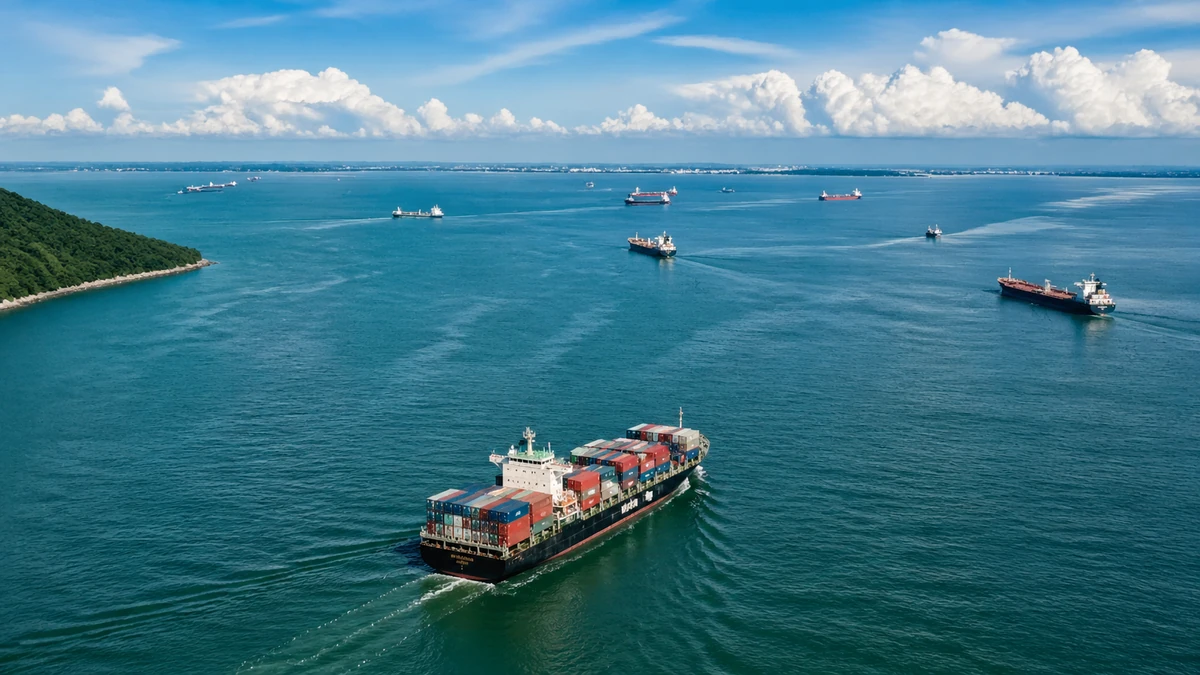
A flashpoint in one of the world’s most sensitive waterways
Sometimes the story is not a new policy, but the speed with which officials feel compelled to deny one. That was the case after remarks by Indonesia’s finance minister touched off concern over the possibility of charging vessels to pass through the Strait of Malacca, one of the most strategically important sea lanes on the planet. Within a day, according to Reuters and Bloomberg, Jakarta moved to make clear there was no such plan.
For American readers, it may help to think of the Strait of Malacca not as an obscure stretch of water on the other side of the globe, but as one of the indispensable corridors of modern commerce. It is a narrow maritime passage linking the Indian Ocean with waters leading to East Asia. Energy shipments, raw materials and manufactured goods all move through that broader network. When political uncertainty touches a chokepoint like this, the concern does not stay local for long.
That is why the episode drew so much attention. The initial comment reportedly came during an event in Jakarta, where the minister raised the question of whether it was right or wrong that Indonesia, despite sitting along such a strategically significant route, does not charge tolls to ships passing through the strait. The framing may have been rhetorical, but in global shipping, rhetorical questions from senior officials can land like trial balloons. Markets, neighboring governments and industry players often do not wait around for a white paper or a cabinet memo. They react to signals.
The quick retreat mattered as much as the original statement. Indonesia later emphasized that there was no plan to impose such fees and stressed its commitment to the U.N. Convention on the Law of the Sea, commonly known as UNCLOS. That response did more than tamp down a political dispute. It reassured other governments and shipping interests that Jakarta was not preparing to rewrite the rules around a waterway whose stability depends on predictability.
In a period when global shipping has already been strained by geopolitical risk in multiple regions, that predictability has become a kind of economic currency. Even the suggestion of changing access to a maritime chokepoint can prompt questions about insurance, routing and broader diplomatic fallout. The controversy faded quickly, but it offered a revealing look at how fragile confidence can be when it comes to the infrastructure of globalization.
Why the Strait of Malacca matters far beyond Southeast Asia
The Strait of Malacca is the kind of place Americans may not think about until something goes wrong. But it sits at the center of a system that helps keep store shelves stocked, factories supplied and fuel moving across continents. A useful comparison is the Suez Canal or the Panama Canal: even people who could not point to them on a map understand that a disruption there can ripple through the world economy. The Strait of Malacca belongs in that same conversation, even though it is governed by a different legal and geographic reality.
Its importance comes from more than geography alone. It is a chokepoint, a term often used in national security and shipping circles to describe a narrow passage through which a large volume of maritime traffic must pass. Chokepoints matter because there are only so many practical alternatives. If uncertainty grows around one of them, shipping companies and cargo owners begin thinking about delays, higher costs and the possibility of rerouting. Even if no official change ever takes effect, the mere prospect of new friction can alter behavior.
That is especially true now, when the global shipping industry has been reminded repeatedly that trade routes are not just lines on a map. They are political spaces. Conflict, piracy concerns, sanctions, military deployments and diplomatic tensions can all affect how safely and cheaply goods move. Against that backdrop, a suggestion that one of the world’s key waterways might become subject to new charges was bound to attract notice.
There is also a psychological dimension. Businesses can price in many things, including fuel costs and regular fees, if they know the rules will be stable. What they struggle with is uncertainty. A vague comment from a senior official in a strategically located country can inject exactly that kind of uncertainty, because companies know governments sometimes test ideas in public before deciding whether to formalize them. The walkback from Jakarta was therefore significant not only as a correction, but as an effort to restore confidence before speculation hardened into assumption.
For the United States and other economies far from Southeast Asia, the lesson is straightforward: the stability of global trade depends on distant corridors that most consumers rarely see. In an interconnected economy, a remark in Jakarta can matter to manufacturers in South Korea, refiners in Northeast Asia, exporters in Europe and retailers in North America. That is the reality of maritime globalization.
What Indonesia’s reversal was really signaling
Indonesia’s decision to distance itself from the comments was not just a matter of cleaning up a news cycle. It was a signal to multiple audiences at once. To neighboring countries, it said Jakarta was not looking to make a unilateral move on an internationally sensitive waterway. To markets, it said there was no imminent change in the operating environment. And to the broader diplomatic community, it said Indonesia understood the distinction between airing a grievance and advancing a policy.
That distinction is critical. In domestic politics, leaders often speak loosely about what a country should be entitled to gain from its geography, natural resources or strategic location. Those arguments can play well at home because they tap into familiar questions of national fairness and sovereign rights. But the Strait of Malacca is not a domestic bridge or turnpike. It is part of an international maritime system shaped by law, precedent and the shared interests of multiple states.
By invoking UNCLOS, Indonesia reached for the language of rules rather than grievance. For an American audience, UNCLOS can sound technical, but the basic point is simple: the world’s oceans are governed not only by power, but also by agreed principles about navigation, jurisdiction and access. Those principles do not eliminate disputes, but they create a framework that helps keep them manageable. When Jakarta underscored its commitment to that framework, it was saying, in effect, that the country was not about to turn a major international passage into an ad hoc revenue project.
The wording of the reversal also matters. Officials reportedly suggested the earlier comment was not meant as a serious policy proposal. Whether one takes that fully at face value or not, the message was clear enough. Indonesia wanted to narrow the range of interpretations before the issue became a larger diplomatic problem. In the world of international shipping, that kind of rapid clarification can itself be a form of crisis management.
The broader significance is that governments recognize how little room there is for improvisation around major sea lanes. Countries may well feel that they bear costs for securing or bordering vital waterways without receiving proportional benefits. But turning that frustration into policy is another matter entirely. The backlash to the remark was a reminder that the international system places political and legal constraints on what states can do with their geographic leverage.
Why Singapore and Malaysia reacted so quickly
The sharp response from Singapore and Malaysia, as described in the Korean summary, should not surprise anyone familiar with Southeast Asia’s maritime politics. The Strait of Malacca is not a space where one country can casually suggest a new arrangement without raising alarms in the others. It is shared, scrutinized and economically consequential. Any hint that one party might alter the terms of passage naturally invites immediate pushback.
Singapore, in particular, has long built much of its modern identity around reliability, trade connectivity and its role as a maritime and financial hub. Americans might think of it as a highly efficient city-state whose strategic importance far exceeds its size. Predictability is one of its greatest assets. Any suggestion that the rules around nearby shipping lanes might become less predictable would cut directly against that interest.
Malaysia, too, has a direct stake in how the strait is governed and perceived. For littoral states, or countries that border a body of water, maritime order is not an abstract legal question. It touches commerce, security, diplomacy and national prestige. That helps explain why even an exploratory or offhand comment can trigger a serious response. The concern is not only what was said, but what the comment might reveal about thinking inside a neighboring government.
There is a broader Southeast Asian context here as well. The region often projects an image of consensus and careful diplomacy through multilateral forums and guarded public language. That style can make the region appear calm from afar. But beneath it lies intense sensitivity over sovereignty, maritime rights and strategic access. In other words, the diplomatic tone may be measured, yet the stakes can be extremely high. Maritime issues have a way of exposing those sensitivities faster than many other policy areas.
That is what this episode demonstrated. The concern was not merely over fees. It was over trust. If countries and companies begin to suspect that a key route could become a bargaining chip, that suspicion can have consequences even if no formal step is taken. The neighboring reaction, then, was not overblown. It was a defense of the principle that the rules governing a major international passage cannot be casually thrown into doubt.
The larger issue: Who gets to benefit from strategic geography?
At the heart of the controversy is a question many countries wrestle with: if a nation sits astride a globally important route, should it be able to convert that advantage into direct economic gain? It is an intuitively appealing argument. Americans hear versions of it in debates over ports, pipelines, toll roads and natural resources. Why, the argument goes, should a country shoulder the burdens of geography without capturing more of the upside?
That logic becomes more complicated at sea. International waterways are not the same as domestic infrastructure. A state may control territory, but waterways that serve global navigation are often governed by rules that limit purely unilateral action. That is because the international system has long recognized that open access to major sea lanes is not just a private benefit to shipping companies; it is a public good for the global economy.
Indonesia’s original remark, as summarized in the Korean article, appears to have reflected precisely this tension. On one hand is a national perspective that sees strategic geography as an asset that ought to yield more obvious returns. On the other is an international framework that treats some maritime spaces as too consequential to be governed like a local toll road. The friction between those two ideas is not unique to Indonesia. It is a recurring feature of world politics.
But it is one thing to raise the issue in principle and another to pursue it in practice. The practical constraints are substantial. Any move seen as interfering with navigational norms could bring diplomatic costs, legal scrutiny and economic blowback. It could also undermine a country’s reputation as a responsible steward of international commerce. In that sense, the episode showed the limits of geographic leverage. A strategically located country may possess influence, but that does not mean it can exercise that influence however it chooses.
There is a cautionary lesson here for policymakers everywhere. In an era when governments are under pressure to maximize national advantage, the temptation to monetize strategic position is real. But not every source of leverage can be converted into revenue without collateral damage. In some cases, the value lies precisely in maintaining a reputation for stability. That is often less dramatic politically, but more durable economically.
What this means for Asian industry, including South Korea
For South Korea, the issue is not theoretical. The country is one of Asia’s major manufacturing and trading powers, deeply reliant on stable maritime routes for energy imports, industrial inputs and exports. The Strait of Malacca forms part of the wider network through which those flows move. That means even a short-lived controversy over access or governance can resonate well beyond Southeast Asia.
South Korean companies, like firms elsewhere, are used to monitoring obvious shocks: wars, sanctions, labor strikes or major accidents. Those events are visible and dramatic. What can be harder to manage are moments like this one, when no policy is adopted but uncertainty briefly increases around a crucial artery of trade. The operational challenge is different. Businesses must decide whether a headline is noise or an early warning sign. Either way, they have to pay attention.
The same holds for Japan, China and other economies across Northeast Asia that depend on dependable shipping lanes. Their interest is not in whether one Southeast Asian minister was speaking casually or seriously, but in whether the region’s maritime order remains predictable. From a boardroom perspective, predictability is the point. Manufacturers can adapt to many conditions, but they prefer not to discover that a key trade route has become a venue for political improvisation.
American readers may see a familiar parallel in the way U.S. businesses track developments in the Panama Canal, labor talks at West Coast ports or disruptions in the Red Sea. The principle is the same. Modern supply chains may be global and technologically sophisticated, but they still depend on physical bottlenecks. When one of those bottlenecks becomes politically charged, the consequences can travel quickly across sectors and borders.
That is why the Indonesian walkback matters even if nothing changed on the water. It reaffirmed a baseline assumption that Asian industry depends on: that major maritime corridors will continue to be managed within accepted legal and diplomatic frameworks, not subjected to abrupt unilateral experimentation. For businesses making long-term decisions, that reassurance has real value.
A reminder that words can be policy events in their own right
In diplomacy and markets, not every event requires action to have consequences. Sometimes a comment is enough. That is one of the clearest lessons from this episode. A senior official raised a provocative question about a critical maritime passage; neighboring states objected; the government clarified; and a potential source of instability was contained before it became something larger. In one sense, that is an encouraging story. The system worked quickly.
But it is also a revealing one. It shows how tightly wound the global shipping order has become. The world is already navigating enough uncertainty that even speculative remarks about a major chokepoint can trigger immediate concern. That does not mean policymakers must avoid difficult conversations about fairness, burden-sharing or strategic geography. It does mean they cannot assume those conversations will remain hypothetical once stated publicly.
For American audiences, the takeaway is less about Indonesia alone than about the architecture of globalization. The supply chains that support everyday life rest on a small number of highly sensitive corridors. Those corridors are governed not just by maps, but by trust, law and diplomacy. When one of those elements wobbles, even briefly, the effect is felt far beyond the region where the comment originated.
The controversy over the Strait of Malacca did not escalate into a full-blown policy dispute. That is important. Yet the speed of the backlash and the speed of the retreat both underscore the same point: the governance of global chokepoints is too consequential for casual experimentation. Countries may debate how benefits and responsibilities should be shared, but they do so within a system that punishes uncertainty very quickly.
In that sense, Indonesia’s reversal was more than a cleanup operation. It was a recognition of how much depends on keeping one of the world’s most important waterways boring in the best possible way: open, predictable and governed by rules that all sides understand. In a volatile era, that kind of boring may be one of the most valuable commodities in global trade.
Comments
Post a Comment