Japan’s Navy Is Making the Taiwan Strait Crossing Look Routine — and That Could Reshape Asia’s Security Map
A transit that says more than a course change
When a Japanese warship passed through the Taiwan Strait on its way to military exercises in the Philippines this month, the movement was notable for a simple reason: It no longer looks unusual.
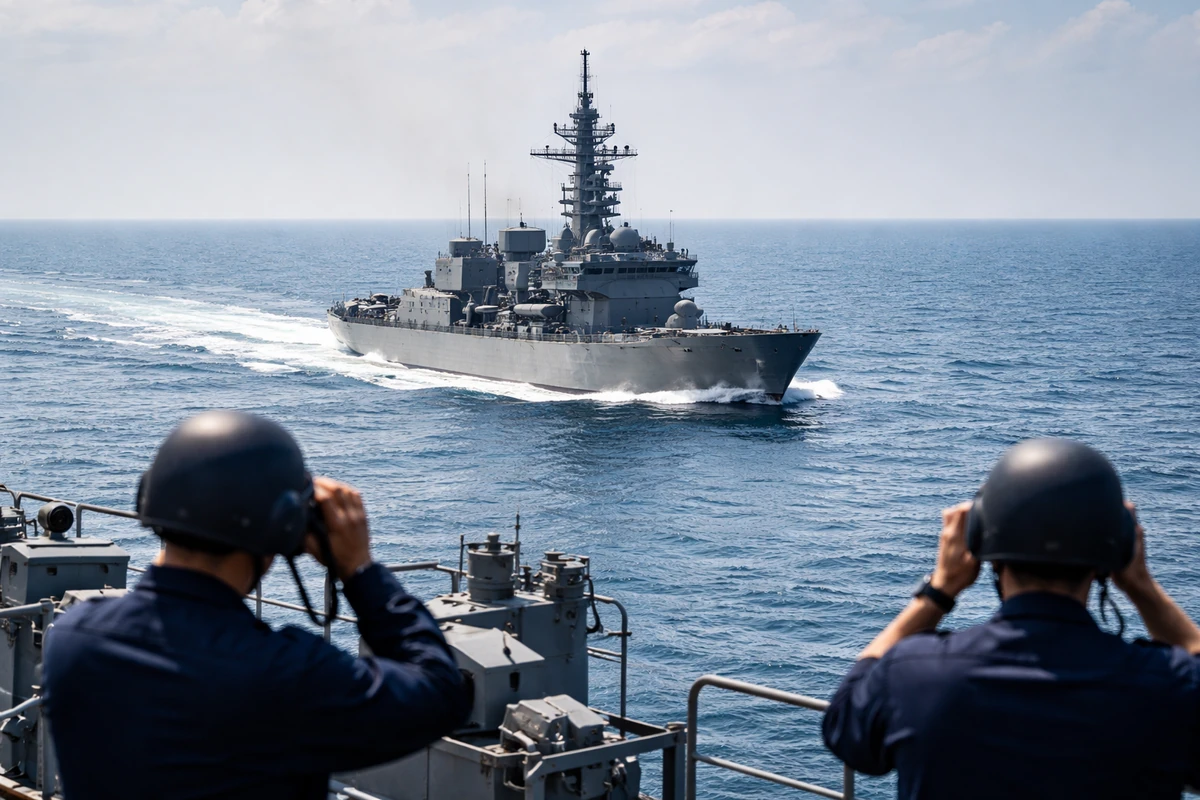
According to Japanese media reports citing government officials, the destroyer Ikazuchi, operated by Japan’s Maritime Self-Defense Force, transited the strait on April 17 en route to take part in Balikatan, the large annual military exercise led by the United States and the Philippines. The drill began April 20. On paper, that sequence makes the transit sound straightforward, even procedural: a ship headed to a scheduled exercise, using a plausible route to get there.
But warships do not move through politically sensitive waters in a vacuum. In the Taiwan Strait — one of the world’s most watched maritime corridors, where legal arguments, military signaling and great-power rivalry all collide — the route itself becomes part of the message. Timing matters. Destination matters. Repetition matters even more.
That is why this latest passage deserves attention beyond the narrow question of navigation. It was not the first time a Japanese vessel had crossed the Taiwan Strait in recent months. By the count cited in the Korean report, it was the fourth such transit since September 2024, following additional passages in February and June 2025. At that point, what once could have been described as a one-off decision begins to look like something else: an emerging pattern in Japan’s security behavior.
For American readers, the closest analogy may be how Washington gradually normalizes military activities that initially draw headlines and diplomatic protests but, over time, become part of the background architecture of deterrence. The first move is symbolic. The fourth begins to set a precedent. Japan, long known for its post-World War II restraint, appears to be approaching that threshold in waters that Beijing considers highly sensitive.
The broader implication is that Tokyo may be signaling it no longer sees the Taiwan Strait as an exceptional route to be avoided whenever possible. Instead, it may increasingly regard the strait as part of a connected maritime theater stretching from the East China Sea through Taiwan and down to the South China Sea — a single strategic space in which crises could quickly spill across geographic boundaries.
Why the Taiwan Strait matters far beyond Taiwan
To understand why a single naval transit commands such attention, it helps to understand what the Taiwan Strait represents. The waterway, roughly 100 miles wide at its narrowest point, separates self-governing Taiwan from mainland China. It is also a major artery for global commerce. Ships carrying energy, electronics and consumer goods move through nearby waters that are essential to supply chains Americans encounter every day, from smartphones and semiconductors to cars and household appliances.
But the strait is not just an economic corridor. It is also one of the most dangerous flash points in Asia. China claims Taiwan as its territory and has not ruled out using force to bring the island under its control. The United States does not formally recognize Taiwan as an independent country, but it opposes unilateral changes to the status quo and is legally committed to helping Taiwan maintain a credible capacity for self-defense. That ambiguity — meant to deter both a Chinese attack and a formal Taiwanese declaration of independence — has kept the peace for decades, but it has become harder to manage as China’s military has grown stronger and more assertive.
Into that already tense environment steps Japan, a U.S. treaty ally whose security is deeply tied to stability around Taiwan even if Tokyo does not state its interests in exactly those terms. Japan’s southwestern islands sit near Taiwan. Sea lanes that matter to Japan’s economy and energy imports run through nearby waters. And any military conflict involving Taiwan would almost certainly affect the wider region, including U.S. bases in Japan and shipping routes across the western Pacific.
That is why Japanese naval movements through the strait are read so closely by governments around Asia. Under international law, many countries argue that the Taiwan Strait includes waters open to freedom of navigation and transit passage. China, however, views foreign military activity there through a much more political lens, especially when it comes from U.S. allies. A warship’s transit is therefore never just a technical exercise in seamanship. It is also a statement, whether explicit or not, about who believes these waters should remain open and under what terms.
For Washington, this is familiar ground. American officials have long framed similar operations as lawful activity in international waters. Beijing often responds as though they are challenges to Chinese sovereignty claims and strategic red lines. Now Japan appears increasingly willing to operate in that same gray zone of lawful passage and deliberate signaling.
From isolated event to emerging pattern
The most important fact in this episode may not be the transit itself but the number attached to it: four.
In international security, the first time something happens can be explained away as an exception, a reaction to unusual circumstances or a symbolic one-off. The second and third times make that explanation harder. By the fourth, analysts start asking whether a new baseline is taking shape.
That seems to be the central development here. If Japanese destroyers were still only crossing the Taiwan Strait under extremely rare and extraordinary conditions, each transit would stand on its own as a dramatic event. But repeated passages over a relatively compressed period suggest Tokyo is becoming more comfortable lowering the political threshold for such moves.
That matters because repetition changes the strategic environment in at least three ways. First, it lowers the domestic policy cost for the country carrying out the action. A decision that may have once required a major internal debate can start to feel more routine after it has been executed several times. Second, it spreads out the diplomatic shock. Other countries may still object, but the reaction tends to lose intensity when the action becomes more expected. Third, it forces neighboring governments to update their assumptions. They no longer assess the behavior as a temporary departure from the norm; they begin to build it into future planning.
That process — the slow normalization of once-sensitive actions — can be hard to see in real time. But it is often how security policy changes happen in practice. Japan is not announcing a dramatic doctrinal revolution every time one of its ships changes course. Instead, it may be doing something more durable: building a record of conduct that quietly expands what is considered normal for the Maritime Self-Defense Force.
For a country whose military posture has long been shaped by constitutional constraints and a political culture of caution, that shift is significant. Japan has spent the past several years broadening its defense role, increasing military spending, debating counterstrike capabilities and deepening security ties not just with the United States but also with countries like Australia and the Philippines. The repeated Taiwan Strait transits fit neatly into that larger story. They suggest Tokyo’s transformation is not just rhetorical or budgetary. It is operational.
The Philippines link and the rise of a connected maritime front
The immediate reason for the Ikazuchi’s voyage matters because it sharpens the strategic message. The ship was reportedly headed to Balikatan, the annual U.S.-Philippines exercise whose name means shoulder-to-shoulder in Tagalog. For Americans, Balikatan is best understood as one of the signature demonstrations of the U.S. alliance network in Asia — the kind of joint drill that tests readiness, interoperability and political resolve all at once.
In recent years, Balikatan has taken on added significance as tensions rise in the South China Sea, where the Philippines and China have repeatedly clashed over disputed reefs, shoals and maritime rights. Washington has reinforced that an armed attack on Philippine forces in the South China Sea could trigger U.S. mutual defense obligations. Japan, meanwhile, has expanded its own security cooperation with Manila, including equipment support, high-level exchanges and increasingly visible defense ties.
That is what makes the route to the exercise as important as the exercise itself. A Japanese ship transiting the Taiwan Strait and then heading south to the Philippines effectively links two of Asia’s hottest maritime flash points: the waters around Taiwan and the South China Sea. It sends the message that these are not separate problems to be compartmentalized neatly by diplomats and planners. They are overlapping zones within a broader contest over deterrence, sea control, alliance coordination and the future regional balance of power.
In practical terms, the transit suggests Japan is thinking more holistically about maritime security. Instead of viewing the East China Sea, Taiwan Strait and South China Sea as distinct theaters with sharply different rules, Tokyo may increasingly be treating them as interconnected parts of one operational environment. That is also how many U.S. strategists think about the region: not as a set of isolated disputes, but as an Indo-Pacific map in which pressure in one area can affect decision-making in another.
The Philippines is central to that picture. Under President Ferdinand Marcos Jr., Manila has leaned harder into its alliance with Washington and opened more sites for U.S. military access under the Enhanced Defense Cooperation Agreement. Japan has been part of that trend as well, positioning itself as a key regional partner rather than a bystander. If Tokyo keeps sending ships through the Taiwan Strait en route to exercises or missions involving the Philippines, it will reinforce the idea that Japan sees itself as an active participant in regional deterrence — not merely a rear-area supporter.
How China, Taiwan and Southeast Asia are likely reading it
The same naval transit can produce very different reactions depending on who is watching.
From Beijing’s perspective, repeated Japanese passages through the Taiwan Strait are unlikely to be seen as neutral acts of navigation. Chinese officials tend to interpret foreign military movements near Taiwan through the lens of sovereignty, encirclement and U.S.-led coalition building. The symbolism is even sharper when the actor is Japan, given the countries’ long, painful wartime history and their present-day rivalry in the East China Sea.
China is therefore likely to see a pattern of Japanese warship transits as evidence that the U.S. alliance system is tightening around sensitive Chinese interests. Even if Tokyo publicly describes each voyage as a routine movement connected to training or operational necessity, Beijing may read the cumulative effect differently: as a gradual effort to erode China’s ability to define the political meaning of activity in the strait.
Taiwan, by contrast, may interpret the move as a reassuring sign that regional democracies are becoming more willing to demonstrate presence, not just issue statements. Taiwan rarely has the luxury of treating international support as symbolic. For Taipei, visible military activity by partners and like-minded countries can matter because it suggests a crisis would not necessarily unfold in diplomatic isolation.
The Philippines may read the transit in a similarly practical way. A Japanese destroyer arriving for joint exercises after passing through one of the region’s most politically sensitive waterways underscores that Japan’s support is tied to actual operations, not merely verbal backing. In a region where credibility is constantly tested, that matters.
Across Southeast Asia more broadly, however, the response is likely to be mixed. Many governments in the Association of Southeast Asian Nations, or ASEAN, support principles like freedom of navigation and a stable maritime order. At the same time, they are wary of being forced into a binary choice between Washington and Beijing. For those countries, growing Japanese military activism may be welcomed as a stabilizing counterweight in some contexts and viewed with caution in others. Much depends on whether Japan is seen as reinforcing rules and predictability, or simply adding another layer to an already crowded rivalry.
That ambiguity is one reason these transits matter so much. They do not just affect relations among Japan, China and the United States. They also shape how middle powers and smaller states calculate risk, opportunity and alignment in an increasingly polarized region.
The shrinking space between lawful passage and strategic provocation
There is a reason the Taiwan Strait remains so difficult for policymakers: almost every action there can be defended as lawful and condemned as destabilizing at the same time.
A naval transit can be described, accurately, as an exercise of navigational rights. It can also be interpreted, not without reason, as a political message meant to challenge another country’s preferred narrative of control. Those two realities coexist. That is why officials speak carefully, lawyers parse maritime rules closely and military planners obsess over timing and route selection.
Japan’s latest transit appears to fit that delicate formula. By tying the movement to participation in Balikatan, Tokyo has a clear operational rationale. It is not sending a ship into the strait without explanation. Yet by choosing that route — if indeed it was a choice rather than a simple logistical default — Japan also amplifies the political meaning of the voyage. The message is stronger precisely because the mission itself is ordinary enough to be defensible.
That kind of calibrated signaling is increasingly common in the Indo-Pacific. Countries want to demonstrate resolve without triggering a crisis. They want to normalize lawful military presence without creating the impression they are seeking confrontation. But the line between reassurance and provocation is thin, especially in a region where mistrust runs deep and military assets often operate in close proximity.
The danger is not only deliberate escalation. It is also miscalculation. If each side assumes it is acting predictably and lawfully while the other side sees those same actions as creeping coercion, the space for misunderstanding widens. Over time, repeated encounters can harden expectations, narrow diplomatic flexibility and increase the odds that a routine operation is suddenly treated as a test of credibility.
In that sense, the real issue raised by the Ikazuchi’s passage is not whether Japan had the right to transit the strait. The more consequential question is how often such passages will occur, how they will be paired with broader alliance activity and whether regional governments can preserve enough communication to prevent a signaling contest from becoming a crisis.
What this means for Japan’s future role — and for Washington
The likely takeaway from this latest transit is straightforward: Japan is becoming a more active maritime security player, and it seems increasingly prepared to show that role in contested spaces rather than just discuss it in policy documents.
If the pattern continues, future Japanese ship movements through the Taiwan Strait may draw less surprise but more strategic weight. That is how normalization works. The act itself may become less shocking, even as its cumulative implications become harder to ignore. Regional militaries will plan around it. Diplomats will message around it. China will almost certainly react to it. And U.S. policymakers will see in it both reassurance and responsibility.
For Washington, a more operationally assertive Japan offers obvious advantages. It strengthens allied burden-sharing, reinforces deterrence and complicates Beijing’s calculus by demonstrating that concern over stability in the Taiwan Strait is not an American obsession alone. It also meshes with the broader U.S. strategy of building a networked regional architecture in which allies and partners are more interoperable and more willing to act.
But it also raises familiar questions. How far is Japan willing to go in a contingency involving Taiwan? How will Tokyo balance deterrence with crisis management? And can allied coordination expand without feeding a cycle of escalation that leaves everyone less secure?
Those questions do not have easy answers, and no single ship transit can settle them. Still, the latest passage through the Taiwan Strait offers a clear clue about where the region may be heading. What used to look exceptional is beginning to look deliberate. What once seemed symbolic is taking on the shape of practice.
In Asia’s maritime security landscape, that is often how major change first appears — not through a dramatic announcement, but through a route repeated often enough that nobody can call it accidental anymore.
Comments
Post a Comment