
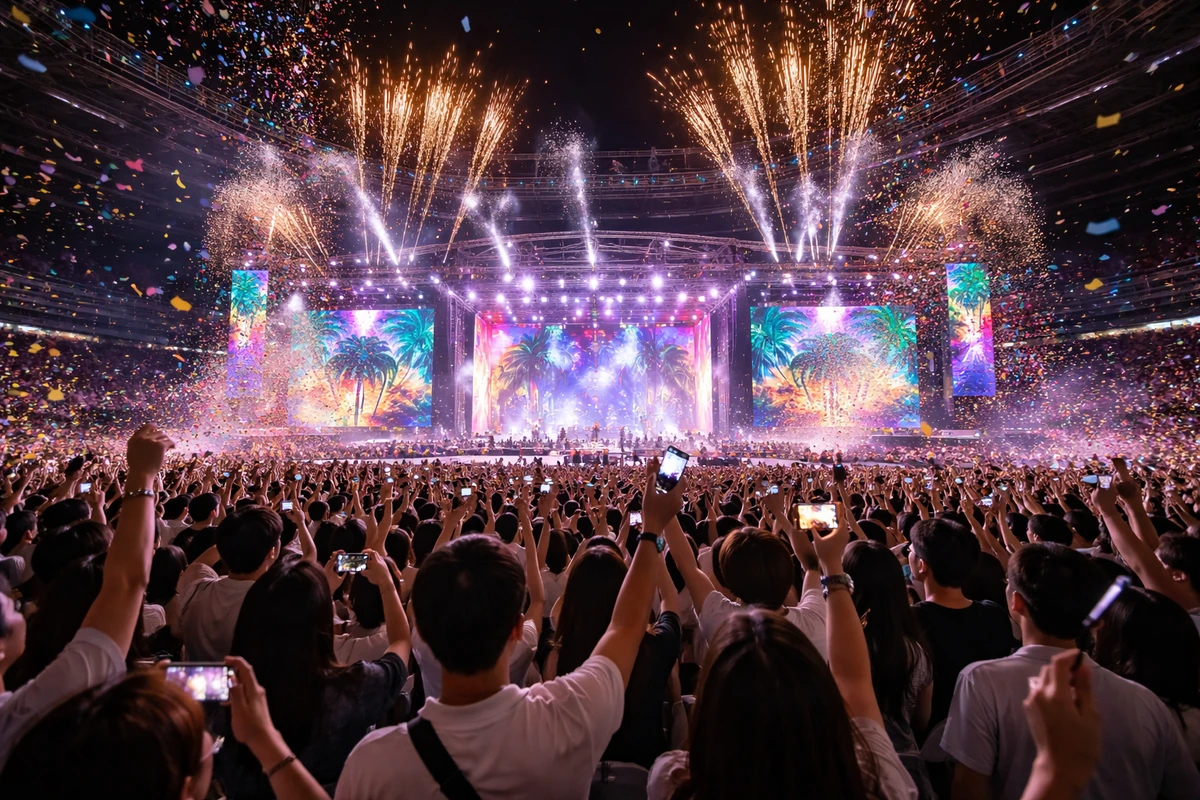
A broadcast giant shifts its center of gravity
For years, South Korea’s biggest televised music events followed a familiar calendar. Broadcasters saved their most ambitious stages, highest-profile idol appearances and splashiest collaborations for December, when year-end specials functioned as both awards-season theater and a glossy recap of the K-pop industry. That old model is now changing, and one of the clearest signs is SBS’ decision to keep investing in a summer version of its marquee music event.
SBS said its 2026 SBS Gayo Daejeon Summer will be held Aug. 9 at KINTEX in Goyang, northwest of Seoul. On paper, that may sound like a simple scheduling announcement. In practice, it signals something bigger about where Korean television, and K-pop more broadly, believe the action is moving. The event, now entering its third year in summer form, is no longer being treated like a one-off seasonal experiment. It is becoming its own annual brand.
For American readers, the easiest comparison may be the way TV networks and live-entertainment companies in the U.S. increasingly build year-round tentpole events rather than relying on a single high-stakes season. Think of how music culture now lives not just at the Grammys, but across Coachella, Lollapalooza, award shows, fan conventions, livestreams and social media rollouts that stretch anticipation over months. In that sense, SBS appears to be doing something similar: spreading cultural attention away from one crowded winter climax and into a summer event designed to work simultaneously as television program, concert experience and online content engine.
The significance of the move is tied to how K-pop functions in 2026. This is not simply a genre driven by radio singles and album cycles in the old American sense. It is an ecosystem built around carefully timed comebacks, highly organized fandoms, global travel, merchandise sales, livestreaming, video metrics and in-person events that can amplify all of the above. A summer mega-show gives a broadcaster a chance to plug into that entire machine at one of the busiest moments on the K-pop calendar.
SBS has not yet announced the performing lineup, and that too is part of the strategy. In K-pop, withholding details can create as much momentum as revealing them. Before a single artist is confirmed, the event already has a narrative: a major Korean network is once again staking out summer as prime territory for one of its biggest music brands.
Why summer matters so much in K-pop
In the United States, summer has long been synonymous with blockbuster season. Studios release franchise films when school is out, families travel and audience habits shift toward big communal experiences. South Korea’s music industry has developed a comparable rhythm. Summer is one of the fiercest periods in K-pop because it combines school vacation, holiday travel, outdoor event demand and the arrival of overseas fans planning trips to Korea.
That timing matters because K-pop is not only consumed through headphones and screens. It is also experienced as an itinerary. Fans may line up for album pop-ups, fan sign events, special broadcasts, branded exhibitions and festival appearances, often within the same trip. For agencies and broadcasters, summer offers a chance to capture that concentrated traffic. A network that can present itself as the season’s must-see live music destination gains more than ratings. It gains relevance.
That is one reason a summer edition of Gayo Daejeon carries weight beyond the title. Historically, Korean broadcast music shows were central to promotional cycles. Artists performed new songs weekly on network programs, and those stages could help build buzz. But the internet changed that balance. Today, artists can promote new releases through TikTok-style short-form video, YouTube originals, behind-the-scenes series, fan platforms, self-produced content and direct community engagement without relying on television in the same way.
In response, broadcasters are being pushed to offer something harder to replicate. A large-scale summer event does that. It gathers multiple top-tier acts in one place, packages them for television, clips them for digital distribution and gives fans an in-person experience that cannot be reduced to a single vertical video. Instead of just airing performances, the network creates a moment.
There is also a practical business logic here. A regular weekly music show may struggle to command the kind of attention it once did, especially when younger viewers are used to watching only the clips they care about. But a big branded event can attract advertisers, sponsorships and secondary revenue opportunities in ways a routine broadcast may not. In that sense, summer is not just a season. It is a commercial opportunity window.
Why KINTEX is more than just a venue
The choice of KINTEX, a sprawling exhibition and convention complex in Goyang, is another clue to what SBS is trying to build. Americans might think of the difference between shooting a TV special in a traditional studio and staging it at a major convention center that can handle concert-scale crowds, sponsor activations, fan zones and multimedia production all at once. KINTEX offers the latter.
That makes it especially useful for the way K-pop events are now designed. Modern idol performances are not simply about what appears on a stage for a few minutes. They are wrapped in giant LED screens, camera choreography tailored for social clips, fan interactions, merchandise, branded experiences and production designs that have to work for both people in the room and people watching later on phones. The architecture of the space affects the product.
By returning to a large, accessible venue in the greater Seoul area, SBS is effectively acknowledging that a music broadcast is no longer just a broadcast. It is an event platform. It has to accommodate audience movement, sponsor visibility, logistical flexibility and content capture at scale. KINTEX also benefits from being relatively easy to reach from the capital region, where much of the industry and much of the local audience are concentrated.
That accessibility matters in Korea, where transportation networks and dense metro populations can make a large event feel unusually central even if it is not in downtown Seoul. For overseas visitors, too, the location can function as a practical anchor point in a trip built around concerts, pop-up stores and neighborhood pilgrimages to famous entertainment districts. Venue choice, in other words, is not a minor production note. It is part of the event’s identity.
There is also symbolism in choosing a convention-style site rather than a smaller, more traditional hall. It suggests that the broadcaster expects the event to operate on multiple levels at once: as televised spectacle, as fan gathering and as a physically expandable entertainment business. That is very different from the older model of music TV as a program viewers simply tuned into at home.
From weekly music show to franchise event
The broader story here is one of survival and adaptation inside Korea’s legacy broadcast industry. Terrestrial networks, the over-the-air stations that once held enormous power in shaping what the public watched and heard, are navigating the same fragmentation that has rattled media companies everywhere. Younger audiences are scattered across platforms. Fans consume artists through algorithm-driven feeds, private communities and international streaming services. The center no longer holds in the same way.
So networks are trying to create a new center, if only temporarily. One way to do that is through eventization: turning content into a high-value happening. In sports, media companies fight for exclusive games because live events still command attention in a way ordinary programming often does not. In entertainment, K-pop mega-events can serve a similar purpose.
That appears to be the logic behind the continued expansion of SBS Gayo Daejeon Summer. Rather than treating music as one slot in a weekly schedule, the network is using it as the basis for a franchise. A franchise can be promoted months in advance, tied to sponsorship packages, monetized across platforms and used to project prestige. It can also reinforce the broadcaster’s role in an industry where labels, tech platforms and fandoms increasingly wield power that once belonged more squarely to television.
This strategy is unfolding against a larger policy and business backdrop. Korean media executives and regulators have been discussing issues including outdated advertising rules, financial pressure on broadcasters and the need for support in content production. That context matters because splashy music events are not created in a vacuum. They are partly artistic decisions and partly economic ones.
For broadcasters, a K-pop tentpole can be attractive because it carries a relatively direct line to advertisers and sponsors. The audience is young, globally connected and demonstrably engaged. The content also travels well. A drama or documentary may face language and distribution barriers, but a performance clip by a major idol group can circulate instantly across international fan networks. That makes K-pop events unusually valuable as media products with export potential.
None of this guarantees success, of course. Big events come with big costs: artist booking, production design, safety, staffing, technology, crowd control and the constant pressure to deliver a lineup worthy of the hype. But the fact that SBS is returning to the format again suggests the network believes the upside outweighs the risk.
The lineup isn’t public yet. That may be the point.
Perhaps the most revealing detail about the 2026 event is what remains unknown. SBS said the artist roster will be announced gradually. In many entertainment industries, a staggered release would be seen as standard promotion. In K-pop, it is practically a science.
Fans do not just care whether a favorite act is appearing. They closely analyze how artists are grouped, which generation of idols dominates the bill, whether rookies and veterans share the same night, what collaborations might happen and whether a stage could feature a first live performance of a new song. Each announcement becomes a mini news cycle of its own.
That is why holding back the full lineup can be so effective. Instead of getting one burst of attention, the broadcaster can create repeated spikes of conversation over weeks or months. Every new name generates speculation, fan-made graphics, social chatter and media pickup. The event remains alive in the public imagination long before the doors open.
American readers may recognize a version of this from major festival culture, where partial lineups, surprise guests and strategic reveal schedules fuel online discourse as much as the final show itself. But K-pop fandom often pushes that dynamic even further because of the intensity of fan organization and the global speed of digital reaction. A single lineup clue can travel through social media communities in Los Angeles, Manila, Jakarta and São Paulo within minutes.
There is also a curatorial challenge here. Success will not depend solely on how many famous names SBS can book. It will depend on balance: established chart leaders, promising new acts, fandom diversity, performance chemistry and overseas recognition. In today’s K-pop market, lineup order and artist placement can shape the mood of an entire event. A bill can tell a story about where the industry thinks it is headed.
That makes lineup construction not just a booking exercise but an editorial one. If SBS wants the event to feel like the defining summer snapshot of K-pop, it has to reflect the genre’s current realities: global ambitions, rapid generational turnover, fierce competition and an audience that expects novelty, not just star power.
What BabyMonster’s YouTube milestone says about live events
A separate K-pop headline from the same day helps explain why summer events like this still matter even in an era dominated by digital metrics. YG Entertainment said BabyMonster’s debut music video for “Sheesh” surpassed 400 million views on YouTube, making it one of the fastest debut music videos by a K-pop girl group to reach that mark.
At first glance, that kind of online success might suggest television needs live events less than ever. If a group can rack up enormous global numbers from a music video alone, what role does a broadcaster play? The answer is that digital success and live spectacle are not competing systems. In K-pop, they feed each other.
Views establish reach, but they do not fully satisfy fandom demand. Fans still want the shared thrill of seeing an artist perform in real time, hearing crowd reactions, watching a special stage arrangement and participating in a collective moment that feels bigger than individual streaming. A televised summer event offers a way to convert digital popularity into a physical and social experience.
This is one of the defining features of modern K-pop promotion: the pieces are interconnected. A comeback is not just a song release. It is a coordinated chain that may include teaser images, online trailers, a music video, challenge content, fan-platform engagement, television stages, festival appearances, merchandise and media interviews. Each element reinforces the others.
So when a group like BabyMonster posts eye-popping video numbers and then heads into a season filled with new music and major events, it strengthens the case for why networks want a stake in summer. The broadcaster can take the momentum already built online and attach it to a large-format stage, creating clips and headlines that begin another cycle of attention. The event becomes less a standalone show than a key node in the industry’s promotional infrastructure.
For American audiences used to thinking of awards shows as waning institutions, this is a useful distinction. SBS is not simply trying to recreate an old-fashioned televised ceremony. It is trying to build a multipurpose K-pop platform that can capture audiences who move fluidly between in-person events, social media and streaming services.
The end of year-end monopoly
For decades, the year-end special held a near-monopoly on prestige in Korean television music. That made sense in a media environment where broadcasters exercised stronger control and viewers accepted a more fixed national schedule. But audiences now live in a continuous feed. They do not wait until December to decide what mattered. They respond to what is hot right now.
That is the deeper implication of SBS’ summer push. The broadcaster is adapting to a world where cultural relevance is seasonal, mobile and constantly refreshed. Rather than asking fans to gather only at the end of the year for a grand retrospective, it is trying to meet them in the middle of the action, when comeback cycles, travel patterns and online attention are all peaking.
This does not mean year-end shows will disappear. They remain prestigious and still carry emotional weight in Korean pop culture. But they no longer have the stage to themselves. Summer now offers a compelling alternative: less retrospective, more immediate; less about wrapping up a year, more about seizing a moment.
That shift mirrors changes far beyond K-pop. Across media industries, companies increasingly chase recurring live moments that can cut through digital clutter. Whether it is sports, gaming expos, fan conventions or music festivals, the goal is the same: create an event people feel they need to experience, not just hear about afterward. SBS appears to believe K-pop can provide exactly that kind of urgency for Korean broadcast television.
The 2026 SBS Gayo Daejeon Summer is still missing many details. No lineup has been revealed. Stage concepts remain under wraps. The network has yet to show exactly how it will package the event for domestic and global audiences. But even at this early stage, the strategy is clear enough to read.
SBS is betting that the future of music broadcasting lies not in simply airing performances, but in designing large-scale cultural events that connect fandom, tourism, advertising, digital circulation and live experience. In that sense, the most important question is not just which stars will perform in Goyang on Aug. 9. It is whether traditional broadcasters can reinvent themselves as event companies in a K-pop economy increasingly defined by speed, scale and global fan participation.
For now, summer looks like the proving ground. And SBS, by returning again to the format, is making a very public bet that the season once treated as a break in the television year may instead become one of its most important battlegrounds.




0 Comments