
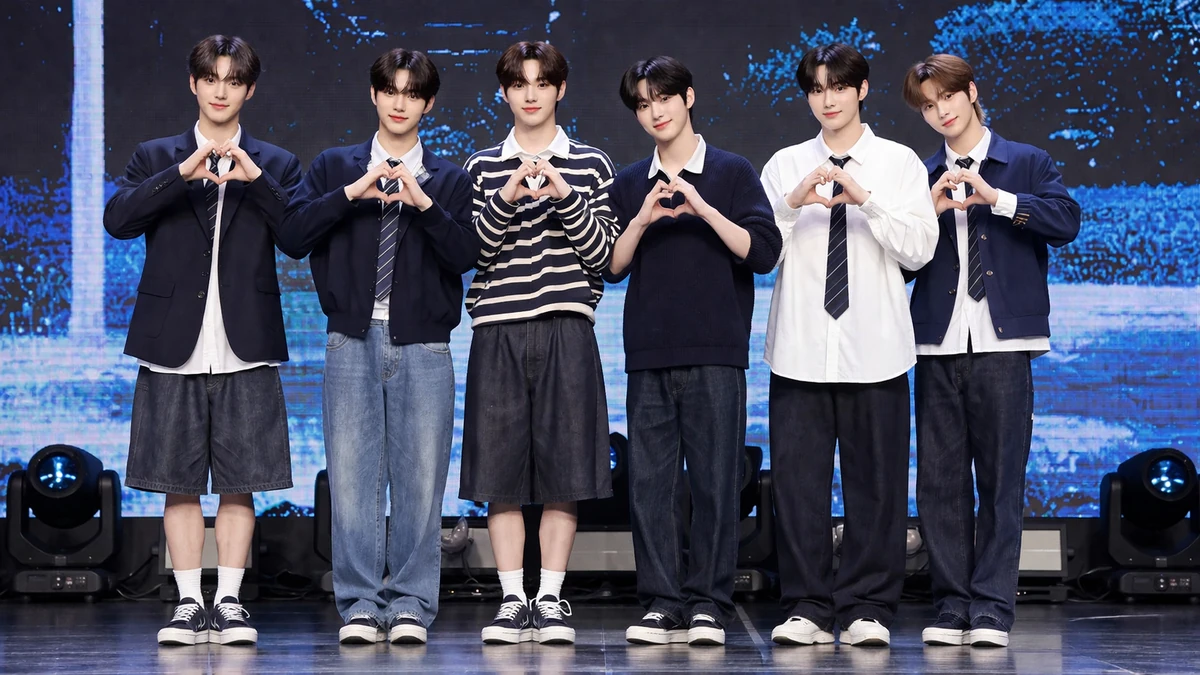
A comeback framed as a milestone
For many American pop listeners, a new album usually arrives with a familiar set of talking points: a new sound, a new image, maybe a new era after a breakup, reinvention or chart breakthrough. In K-pop, those things matter too, but comebacks often carry an additional layer that can be easy to miss from afar. They are not just releases. They are narrative checkpoints, carefully watched by fans for signs of growth, confidence and identity. That is the context surrounding the latest release from TWS, the South Korean boy group whose new mini-album, NO TRAGEDY, arrives with a message the members themselves appear eager to underline: They are stepping into adulthood, and they want their first statement in that phase to be about love.
At a Seoul showcase marking the release of the group’s fifth mini-album, the members described the project as the first one they are presenting after becoming adults. In South Korea’s idol industry, that kind of distinction carries real symbolic weight. Fans track not only the music but the life stage of the performers making it. A group’s movement from adolescence into legal adulthood is often treated as more than a birthday marker. It can signal a shift in what themes the artists can explore publicly, how they present themselves and how they want to be understood by an audience that has often watched them grow in real time.
TWS, according to remarks shared at the event, is using that transition not for a jarring reinvention but for something more measured: a clearer, more direct emotional language. The group said this is its first release to fully center love as a serious theme. That may sound ordinary in Western pop, where romantic confession is practically the default mode. But for a K-pop act still shaping its identity, especially one associated with youth and freshness, explicitly repositioning itself around love can read as a meaningful evolution. It suggests the group is not abandoning the youthful energy that helped define it. Instead, it is widening that emotional palette, keeping the bright textures of youth while adding a more mature willingness to say exactly what it feels.
The title of the mini-album also helps frame that shift. NO TRAGEDY suggests a refusal to dwell in heartbreak or helplessness. Rather than presenting love as something that simply happens to them, the members described the album as embodying a determination to move straight toward it. In other words, this is not a passive story of fate unfolding on its own. It is a story of choosing motion, of recognizing a feeling and acting on it. In a genre where storytelling is as crucial as melody and choreography, that distinction matters.
For global fans, this is part of what keeps K-pop so compelling. A song is rarely just a song. It is also evidence in a larger story about who a group is becoming. TWS seems to understand that. This comeback is not being sold merely as a collection of tracks, but as a statement about timing: who the members are now, what they are ready to sing about and how they want that next chapter to sound.
Why “adulthood” matters so much in K-pop
American audiences sometimes underestimate how central age and coming-of-age narratives are in the Korean idol system. In the United States, artists often try to project timelessness or resist being too tightly defined by age. In K-pop, age is visible, discussed and woven into group identity from the start. Debut ages are scrutinized. School uniforms, first-love concepts and graduation imagery are common. Fans often feel they are witnessing a long-form youth story unfold album by album.
That is why TWS emphasizing this release as their first after becoming adults is more than a line for a press event. It tells fans how to read the music. The implication is not that the group has suddenly become edgy or dramatically transformed. Instead, it is offering a subtle cue: the emotional stakes have changed. The same youthful spirit remains, but the members now want to speak from a place of greater self-awareness.
That kind of incremental maturation is often more effective than a hard pivot. K-pop history is full of groups that have tried abrupt image changes, sometimes successfully and sometimes at the cost of alienating fans who connected with the original identity. What makes TWS’s current move notable is that it appears calibrated rather than theatrical. The group is not rejecting its established “youth” brand. It is deepening it. Love, in this framing, becomes not a glossy accessory but a marker of transition, a sign that youth is no longer just innocence or possibility, but also desire, decision and emotional clarity.
There is also a practical industry reason this matters. Idol groups are built in part on continuity. Fans invest because they want to follow a journey. The strongest growth arcs in K-pop often preserve the core appeal while gradually broadening the emotional and artistic range. TWS’s messaging around this album suggests the group is aiming for exactly that balance. It is telling fans, in effect, that the next stage of TWS will still feel like TWS, only a little more direct, a little more certain and a little less hesitant about naming what it wants.
That approach may prove especially effective for international listeners, many of whom encounter K-pop first through social media clips, stage performances or repeated hooks before they ever read translated lyrics. A clean, legible narrative helps. “We are now adults, and this is our first real statement about love” is the kind of concept that travels well across languages and markets. It is emotionally universal, but still specific enough to feel like a meaningful chapter in the group’s development.
A title track built around pursuit, not hesitation
The title track, “You, You,” appears to crystallize the album’s central theme. The song has been introduced as a straightforward confession to someone who feels like a dream or destiny. But the key point, based on the group’s own framing, is not destiny itself. It is the response to destiny. Rather than waiting passively for a romantic moment to resolve on its own, the song places emphasis on movement toward the person who stirs those feelings.
That “moving straight ahead” concept is especially resonant in K-pop, where emotional nuance is often encoded not just in lyrics but in the architecture of a comeback. A title track is supposed to embody the clearest message of the era. If TWS wants this release to be understood as a more confident articulation of love, then building the lead single around pursuit and confession is a logical choice. It turns a conceptual claim into an audible one.
There is also a highly practical pop element at work here. The group highlighted a repeated refrain rendered as “Dda-rum Dda-rum,” the kind of catchy syllabic hook that can travel quickly even among listeners who do not speak Korean. That technique is hardly unique to K-pop, or even to Korean music. Pop history is filled with songs whose staying power comes from sound before literal meaning, from “na-na-na” choruses to instantly memorable rhythmic phrases. But in the global K-pop ecosystem, such refrains play an especially important role. They help songs jump language barriers on first listen, allowing international audiences to latch onto mood, melody and identity before fully understanding the lyrics.
For American readers, the nearest comparison might be the way a chant-like hook can propel a song on TikTok or in arena pop: you do not need to know every word to know the song is trying to pull you in. TWS appears to be leaning into that universal accessibility while anchoring the track in a more explicit emotional narrative. The result, at least conceptually, is a song designed to work on two levels: as an immediately catchy pop record and as a thesis statement for the group’s next phase.
The emphasis on confession also marks a tonal step forward. Plenty of K-pop songs circle around crushes, longing or idealized romance, but artists and agencies often keep the emotional temperature carefully regulated, especially for younger groups. TWS’s claim that this is the first time they are earnestly singing about love suggests a willingness to let the emotional stakes rise. That does not necessarily mean dramatic angst or adult-world cynicism. If anything, the impression is closer to bright certainty: the thrill of recognizing a feeling and saying it out loud.
The group’s own words reveal a deeper layer
One of the more revealing details from the album rollout is that the members said they discussed a deceptively simple question in the practice room: What is love? That detail matters because it suggests the concept was not presented to them merely as a costume to wear or a marketing slogan to repeat. In a system often criticized abroad for its high degree of top-down planning, moments like this offer a different picture, one in which the performers are trying to interpret the theme for themselves.
Of course, K-pop is still an intensely managed industry, and no one should romanticize the process too easily. Concepts are curated, schedules are tight and every public statement is likely filtered through layers of preparation. But that does not mean the artists are empty vessels. Fans pay close attention to signs of authorship, sincerity and self-reflection. TWS’s remarks indicate the members are aware that singing about love at this stage of their career carries meaning, and they want to engage that meaning rather than simply perform around it.
That sense of engagement becomes even clearer in comments from member Youngjae, who said he drew inspiration from Romeo after watching Romeo and Juliet. For American audiences, Shakespeare is about as familiar a reference point as it gets, which makes this an unusually easy cultural bridge. Yet it is worth noting why the reference is useful here. Romeo is not just a symbol of romance; he is a symbol of active, urgent, almost reckless devotion. In borrowing from that tradition, TWS signals that it is less interested in vague sentimentalism than in a recognizable archetype of headlong feeling.
That does not mean the group is staging a tragic romance. In fact, the album title explicitly pushes against tragedy. But Romeo remains a potent shorthand for emotional sincerity and forward momentum. The reference gives international readers a way into the album’s sensibility: this is not love as distant fantasy, and not love as passive destiny, but love as a force that compels action.
Another member, Hanjin, reportedly said the song would allow TWS to talk about the group’s youth while also showing a more grown side of themselves. That may be the clearest encapsulation of the project’s ambition. The point is not to replace youth with maturity as though one must erase the other. It is to present maturity as something growing inside youth, altering its contours without eliminating its energy. That is a subtle but important distinction, and one that likely explains why this comeback has generated interest among fans watching how the group defines itself in a crowded market.
What a six-song mini-album can say about a group’s ambitions
The album contains six tracks, including songs whose translated titles suggest support, immediacy and emotional openness. In the American music business, a six-track release might be treated as a relatively modest project, something between an EP and a compact album statement. In K-pop, however, mini-albums are a standard and strategically important format. They require focus. Because there is less room than on a full-length record, every track title, visual cue and lyrical theme must do more work.
That makes TWS’s thematic concentration all the more telling. By grouping together ideas like love, confession, momentum and growth in a compact release, the group is effectively arguing that these are the defining coordinates of its current identity. It is staking a claim about how it wants to be remembered at this particular moment. The mini-album format allows for breadth within limits: enough songs to sketch different shades of emotion, but not so many that the central message gets diluted.
This matters because K-pop fandoms often evaluate not only whether a title track is catchy, but whether an entire comeback feels coherent. Does the visual styling align with the songs? Do the members’ remarks line up with the lyrics? Do the B-sides deepen the story or just fill space? A six-track release can leave a strong impression precisely because it has to be selective. If TWS succeeds, fans are likely to come away feeling that the group did not simply announce adulthood as a concept, but demonstrated it through a controlled, intentional package.
There is another dimension to the mini-album structure: replay value. In a streaming-driven environment, shorter releases can be more effective for building repeated engagement, especially if the title track has a sticky hook and the supporting songs each carry distinct emotional colors. TWS’s choice to foreground a concise but thematically connected project suggests an awareness of how modern pop consumption works. Fans are not only listening; they are clipping, captioning, theorizing and integrating songs into a larger online conversation about the group’s evolution.
That is why the release is best understood not as a simple “romantic comeback,” but as a test of narrative persuasion. Can TWS make listeners believe this is the natural next step? Can six songs convincingly show that the members have entered a new phase without losing the appeal that first drew fans in? Those are the real stakes of a comeback like this, especially for a younger group building long-term credibility.
Why this evolution may resonate beyond Korea
One reason K-pop continues to grow in the United States is that its best stories are both highly specific and deeply universal. The industry’s structures, terminology and fandom rituals may be distinctively Korean, but the emotional core often travels with ease. TWS’s new release fits that pattern. You do not need to know the mechanics of a Seoul showcase or the nuances of idol branding to understand the appeal of a group deciding that its next chapter should be about growing up and saying what it feels.
That said, the Korean context sharpens the significance. In many K-pop acts, “youth” is not just a mood board but a long-term identity framework. So when a group like TWS says it is still talking about youth while also emphasizing adulthood and love, it is negotiating something delicate. It wants to keep the openness and brightness associated with being young, while allowing room for feelings that are less sheltered and more self-directed. That balancing act is familiar in American pop too, though it often plays out less explicitly. Think of the way Disney stars or teen heartthrobs have historically tried to mature their image without severing ties to the fans who grew up with them. The difference is that K-pop often foregrounds the transition as part of the art itself.
Global fandom also rewards clarity. The more legible a group’s emotional and artistic arc, the easier it is for fans across countries to connect, discuss and amplify it online. TWS’s messaging around this album is notably straightforward: this is their first serious turn toward singing about love, and they want to do so without hesitation. That kind of directness can be especially powerful in a digital environment flooded with content. It gives casual listeners a quick entry point and gives dedicated fans a narrative to champion.
There is also an understated confidence in choosing evolution over shock value. K-pop is sometimes caricatured abroad as all maximalism, all the time: radical concept swaps, elaborate lore and visual overload. Those elements certainly exist, but many of the genre’s most durable success stories are built on gradual refinement. TWS appears to be making that kind of bet here. Rather than stage a sensational break from its past, the group is making a more disciplined move, broadening its emotional language while preserving its core identity. For American observers used to dramatic reinventions in pop, that may seem modest. In the K-pop ecosystem, it can be a sign of strategic maturity.
A small release with a bigger symbolic meaning
Viewed narrowly, NO TRAGEDY is a six-song mini-album from a boy group presenting a more romantic concept. Viewed more broadly, it is a case study in how K-pop turns transition into narrative and narrative into momentum. TWS is not just releasing music. It is identifying a threshold, naming it and inviting fans to experience the crossing together.
That helps explain why the group’s own language at the showcase matters so much. They are not merely saying they have new songs. They are saying this is the first album after becoming adults, the first album to truly sing about love and the first album to present that love as something to pursue actively rather than wait for passively. Each of those claims reinforces the others. Together, they form a coherent picture of a group trying to define its next stage with precision.
Whether the album ultimately becomes a breakthrough outside Korea will depend on the usual variables: the strength of the songs, the staying power of the hook, the choreography, the live performances and the speed with which global fans embrace the era. But as a narrative proposition, the comeback is already compelling. It offers a version of maturity that does not feel cynical or defensive. It offers romance without melodrama. And it presents growth not as rupture, but as continuation with sharper edges and clearer intent.
For American audiences still learning how to read K-pop beyond the subtitles and streaming numbers, that may be the most useful takeaway. The real story here is not simply that TWS released another album. It is that the group is using one of K-pop’s most powerful tools, the coming-of-age storyline, to recalibrate how it wants to be seen. In that sense, NO TRAGEDY is less about abandoning the past than about naming the next emotion honestly. TWS is still speaking in the language of youth. It is just saying the words with more conviction now.




0 Comments