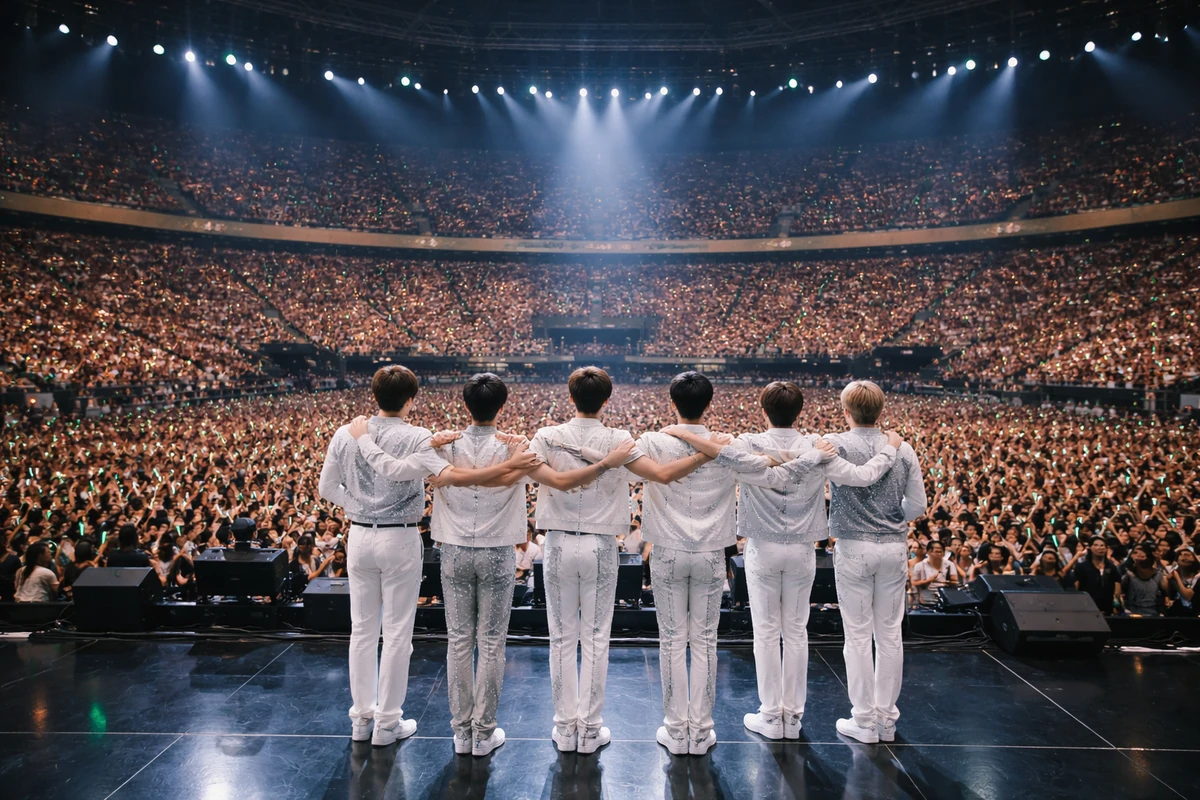
A rookie group reaches one of K-pop’s symbolic stages
In the hypercompetitive world of K-pop, where new groups debut almost every month and social media can create overnight sensations, there is still a meaningful difference between going viral and proving you can last. That is why NCT Wish’s three-night encore concert at Seoul’s KSPO Dome matters beyond the usual fanfare that surrounds a successful idol act. The boy group, only about two years into its career, drew roughly 33,000 fans over three days at one of South Korea’s most closely watched indoor concert venues, according to Korean media reports and remarks from the group at the event.
For American readers, it may help to think of KSPO Dome as more than just a large arena. In South Korea’s music industry, the venue functions almost like a rite of passage. It is not identical to Madison Square Garden in scale or history, but in K-pop it carries a similar symbolic weight: a place that signals a performer is moving from promising act to major live draw. Plenty of artists can generate streaming numbers or trend online for a week. Filling a venue like KSPO Dome, and doing it over multiple nights, suggests something more durable — fan commitment, repeat demand and the ability to command a room in real time.
That distinction is especially important for NCT Wish, the newest unit in SM Entertainment’s sprawling NCT franchise. NCT, short for Neo Culture Technology, is known for its modular structure, with different subgroups built for different markets and concepts. To audiences outside Asia, the setup can feel a little like a shared cinematic universe or a franchise sports system, where individual teams operate under one larger brand. NCT Wish entered that system with the advantages of a famous label and established brand recognition, but also with the pressure that comes from trying to justify a place inside one of K-pop’s most ambitious projects.
At the Seoul concert, member Jaehee reportedly said he could hardly believe the group had entered KSPO Dome after only two years, adding that he was so happy it was difficult to put into words. The comment may sound modest, but it gets at a larger truth about the way K-pop measures growth. For a young group, the move into a bigger venue is not just about prestige. It is a test of whether the fandom is cohesive enough, and whether the performers themselves are developed enough, to sustain the leap. In other words, this was not just a celebration. It was an audit.
The numbers matter, but so does the timing. NCT Wish tied the encore shows to the release of its first full-length album, making the concerts serve as both a victory lap and a launchpad. In an industry where image, narrative and scheduling are often engineered with remarkable precision, that kind of coordination sends a message: This group is not being presented as a novelty or a short-burst success. It is being positioned as a serious long-term act.
Why an encore can mean more than a first big show
To people outside the concert business, an encore run might sound like a bonus — more dates added because the first set sold well. In K-pop, though, an encore concert often carries a slightly different meaning. It is one thing to fill seats the first time around, when novelty and curiosity are high. It is another to bring fans back again and persuade the market that the initial success was not a fluke. An encore performance is less about repeating a win than re-proving it.
That helps explain why industry observers tend to look beyond the venue itself and ask what, exactly, the group did with the space. In K-pop, a large stage is not automatically evidence of artistic maturity. The bigger question is whether a team can actually control that stage — whether the members can keep energy levels up, manage pacing, communicate with fans across a much larger room and make the production feel intimate despite the physical distance.
NCT Wish appears keenly aware of that distinction. According to the Korean coverage, the members said they wanted to show how much they had grown through touring since their first major performances. That is not flashy rhetoric. It is the practical language of a group learning that a second appearance at a major venue is judged by different standards than the first. Early on, the storyline can be the simple emotional thrill of arrival: They made it here. By the next time, audiences and critics alike want to know how well the group commands the room, how smoothly the set list is built, how confident the new material sounds and whether the members can create real connection rather than just spectacle.
Member Riku reportedly put that shift into especially clear terms, saying that when the group performed last year, he was so nervous there was little room to communicate with fans, but this time he felt able to make eye contact. That detail may sound small, but it gets at one of the hardest parts of arena-level performance. The challenge is not simply standing before more people. It is preventing the room from feeling emotionally farther away as it gets physically bigger. In a dome or arena, the best performers make thousands of people feel personally seen. That is as much a psychological skill as a technical one.
American pop audiences have seen similar transitions before. A young act can look compelling in clips, on television or in smaller halls and still struggle to translate that charisma into a major arena. The artists who endure are usually the ones who learn how to scale up without becoming emotionally remote. If NCT Wish is indeed becoming more comfortable in that environment, the significance goes beyond one successful weekend in Seoul. It suggests the group is beginning to build the performance instincts needed for the much tougher test of regional and international touring.
The touring grind is where many K-pop groups actually grow up
K-pop is often discussed in the United States through the lens of its training system, polished music videos and highly choreographed performances. Those are real parts of the story, but they can obscure another truth: A lot of an idol group’s real development happens on the road. NCT Wish’s members said they have now performed more than 30 tour dates since last year, and leader Sion described that stretch as a period in which the group’s teamwork deepened and the schedule itself became more enjoyable.
That kind of statement can sound like standard promotional language. But for performance groups, repetition is not a side note; it is the laboratory. In concert after concert, members do more than memorize blocking or execute dance moves. They learn how to breathe together, when to leave space for crowd reaction, how to save energy for later sections of a show and how to adapt when the mood in a venue changes. What begins as rehearsed material gradually becomes lived instinct.
That process is especially significant in K-pop because concerts are no longer secondary to album promotions. If anything, live performance has become one of the clearest ways a group defines itself. Songs matter, of course, and so do visuals, but it is onstage that a team’s chemistry either becomes real or remains theoretical. Fans can tell the difference. So can the industry.
For younger groups, touring can also accelerate development in a way that traditional promotional cycles cannot. A rookie act might spend months moving between television performances, short-form video content and fan events, all of which are carefully controlled. Touring is less forgiving. Night after night, the group must recreate precision while remaining flexible enough to respond to a live audience. That is where members often start to look less like trainees who debut and more like performers who own their material.
NCT Wish’s reported comments suggest that something along those lines is happening now. Moving from nerves that limited fan interaction to greater ease onstage signals more than improved confidence. It suggests the group is starting to read a room, manage audience energy and adjust in the moment. In live entertainment, those are major steps. They mark the difference between delivering a prepared show and creating a dynamic experience.
That may be the most interesting part of this moment for NCT Wish. The headline is easy to write: a two-year-old group reaches a prestigious venue. But the more important takeaway is not that the group got big fast. It is that the members themselves are describing growth in terms that sound less like hype and more like acquired craft. In a business that often rewards speed, that is a notable distinction.
A full album and a concert become one coordinated statement
The timing of the encore concerts also mattered because they were tied to the release of NCT Wish’s first full-length album, “Ode to Love.” Korean reports said the group used the concerts to unveil performances of the title track, also called “Ode to Love,” as well as the B-side “Sticky” before the album’s official release. In practical terms, that made the concert more than a live event. It turned the stage into the first real interpretive frame for the new record.
That is a savvy move in a pop market increasingly crowded with digital releases. In many cases, fans first encounter a new album through streaming platforms, teaser clips or a music video designed to dominate attention for a few days. A concert-first reveal changes the sequence. Instead of asking listeners to imagine how the material will live onstage, it presents the songs through performance from the beginning. For a group built on choreography, visuals and audience interaction, that can be a powerful way to define the album’s identity.
It also signals confidence. Debuting brand-new material in a major venue is risky, especially in an encore setting where fans are also expecting the familiarity and payoff of known songs. If the new tracks do not land, the momentum of the event can dip. If they do land, the group sends a clear message that it is not content to coast on earlier buzz. By foregrounding new songs at such a visible moment, NCT Wish appeared to be arguing that its next chapter deserves attention on its own merits.
In K-pop, the first full-length album often carries special symbolic weight. Mini albums and singles can test concepts, refine sounds or keep a group in the public eye. A full album tends to be read as a broader statement of identity — an attempt to show what this team is, what it can do and where it may be headed. Pairing that milestone with an encore at a venue like KSPO Dome creates a unified narrative: The group is not merely celebrating what it has achieved so far; it is presenting a more complete version of itself.
For fans, that kind of packaging can strengthen loyalty. K-pop fandom is not just about music consumption. It is also about narrative participation — following growth, decoding artistic direction and taking part in key milestones. By merging a big live moment with a major recorded release, NCT Wish gives supporters a story with emotional coherence: the group’s biggest stage yet and its most substantial album yet arriving together.
That matters commercially, too. Today’s K-pop marketplace is increasingly driven not only by broad awareness but by depth of engagement. Labels want fans who buy albums, attend multiple shows, stream consistently and remain invested over time. Strategic event planning, when done well, can reinforce all of those behaviors at once. This weekend in Seoul looked like exactly that kind of effort.
The next goal, Japan dome shows, reveals the larger strategy
During the event, NCT Wish reportedly named Japan dome concerts as the group’s next goal. On the surface, that may sound like a familiar pop-star ambition: bigger venue, bigger market, bigger headline. But in the context of East Asian music business, the reference is more specific than that.
Japan has long been one of the most important overseas markets for K-pop acts, and dome concerts there are a particularly loaded benchmark. A dome show in Japan is not just a matter of capacity. It is widely understood as evidence that an artist has established a substantial local audience, strong enough to support large-scale live production and sustained promotion in a market known for being both lucrative and demanding. In some ways, American readers could think of it as a mix of breaking into a major touring circuit and proving you are not just imported hype.
For NCT Wish, the fact that the group is already speaking in those terms suggests a clear expansion route. This is not a vague dream about someday playing bigger venues abroad. It is a concrete next checkpoint built on the logic of what the group has already done: more than 30 tour dates, a successful multi-night encore in Seoul, and the launch of a first studio album positioned as a defining statement.
That sequence matters because it reflects the increasingly important economics of K-pop in 2025. Viral reach can introduce a group to millions, but long-term viability usually depends on a more stable formula: loyal fandom, repeat attendance, strong album sales and the ability to move from domestic momentum to overseas touring power. In that environment, the smartest agencies are not just trying to create big moments. They are trying to build reliable ecosystems around their artists.
Seen that way, the talk of Japan domes is less about swagger than about infrastructure. To reach that level, a group needs more than enthusiasm. It needs a dense fan base, consistent promotional follow-through, durable performance quality and a brand identity that can travel. NCT Wish’s comments suggest the group understands that the path forward will depend not simply on being visible, but on being repeatable — capable of turning one milestone into the foundation for another.
What NCT Wish’s moment says about the current state of K-pop
There is a temptation, especially in English-language coverage of K-pop, to frame every success story as a race: the fastest debut, the quickest arena upgrade, the youngest group to reach some landmark. Those metrics are easy to package and easy to share. But they can flatten what is actually happening. NCT Wish’s encore at KSPO Dome is noteworthy not only because it came quickly, but because the group appears to be building its case in a way that industry veterans usually respect: through repeated performances, sharper teamwork and a willingness to put new material on a major stage.
That makes the group’s current image less “the team that got big fast” than “the team that is learning fast.” For a newer act, that may be more meaningful. In pop music, scale can be rented for a night through marketing, hype or novelty. Competence is harder to fake, especially live. The details described by the members — less nervousness, more eye contact, stronger teamwork, more confidence in new music — point toward development that audiences can actually feel in a venue.
It would be premature to declare any young group permanently established on the basis of one successful encore run. The real test comes next. NCT Wish’s first full album will need to hold listener attention beyond its initial release window. The communication and stage command reportedly shown in Seoul will need to carry over into future promotions. And if the group truly wants to set its sights on Japanese dome performances, it will have to keep converting brand awareness into long-term ticket-buying power.
Still, this weekend appears to have marked a real threshold. In K-pop, there are moments when a group stops being discussed primarily as a prospect and starts being assessed as an active competitor in the market’s next tier. NCT Wish may have reached that point. The most persuasive thing about the group’s recent rise is not simply that it happened quickly. It is that the members themselves are describing the climb in concrete, practical terms — not as destiny, not as hype, but as work done onstage, city by city, show by show.
For American audiences trying to understand how K-pop sustains itself beyond internet excitement, that may be the clearest lesson here. The genre’s global success is built not only on polished music videos and devoted online fandoms, but on relentless live performance, strategic market expansion and the careful crafting of milestones that feel both symbolic and earned. NCT Wish’s weekend at KSPO Dome fit squarely into that model.
And if the group can keep turning major moments into proof of actual growth, rather than just evidence of fast-moving buzz, its next goals may start to look less like ambitious talk and more like the next logical stop.
Comments
Post a Comment