Pre-dawn Fire in South Korea’s Ulsan Forces Residents to Flee, Highlighting Risks of Dense Urban Living
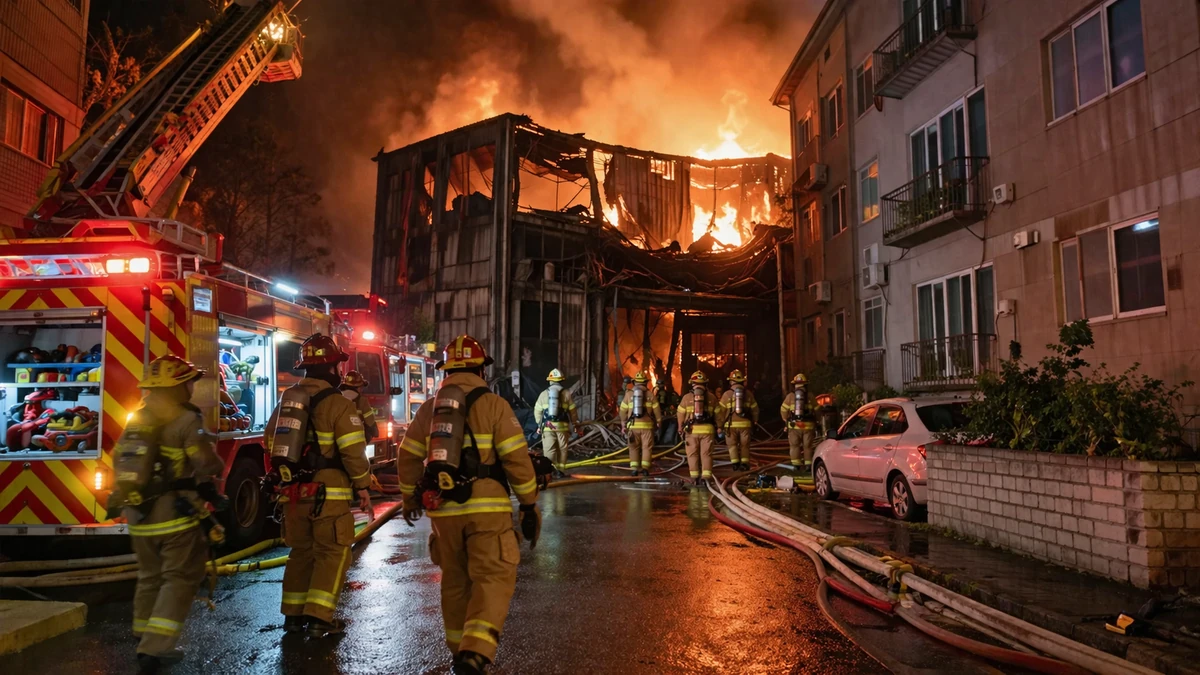
A warehouse-style store catches fire before dawn
A pre-dawn fire at a warehouse-style retail store in Ulsan, an industrial city on South Korea’s southeastern coast, forced nearby residents from their homes and prompted emergency rescues in the early hours of Monday, underscoring how quickly a commercial fire can become a neighborhood-wide emergency in one of the country’s tightly packed urban districts.
The fire broke out at about 4:11 a.m. in Dal-dong, a neighborhood in Nam District, according to South Korean authorities as cited by Yonhap News Agency, the country’s national wire service. Firefighters moved in immediately, and residents living in adjacent housing — including one-room units and low-rise villa-style buildings — evacuated as crews worked to prevent the flames from spreading.
About five people were helped out by emergency responders, known in South Korea as the 119 rescue service, a number that functions much like 911 does in the United States. Other residents got out on their own. Fire officials said they spent roughly an hour battling the blaze before bringing the main body of the fire under control.
Authorities have not yet released a cause, a full damage estimate or a detailed account of whether anyone was injured. Police and fire officials are expected to investigate once the scene is fully stabilized. At this stage, the most important facts are also the most basic: where the fire started, how close it was to homes, how many people had to flee and how quickly emergency crews moved to stop it from becoming worse.
That may sound straightforward. But in South Korea, where neighborhoods often place residential buildings, small businesses, restaurants, storage facilities and shops side by side on narrow streets, those details tell a bigger story about urban safety. A fire in a single building is rarely just about one building.
Why this kind of fire matters beyond one storefront
For readers in the United States, a “warehouse-style store” may bring to mind a big-box retailer set back behind a large parking lot, something closer to Costco, Sam’s Club or a wholesale supply outlet in a suburban commercial strip. In many Korean cities, however, a storage-heavy retail business can exist much closer to homes than Americans may expect. The mix of commercial and residential uses is tighter, the streets are denser and buildings often share walls or sit only feet apart.
That reality is central to understanding why this fire drew immediate attention. The blaze did not erupt in an isolated industrial park on the outskirts of town. It started in a business located right next to housing, including one-room residences and villas. In the Korean housing context, “one-room” usually refers to a small studio apartment, often occupied by single adults, students, younger workers or people living temporarily in a city for work. “Villa,” despite the upscale connotation the word can carry in English, usually means a modest low-rise multifamily building, not a luxury estate.
Those housing types matter because they are common in neighborhoods where affordability, convenience and density intersect. They are also the kinds of places where residents may include elderly people, shift workers, young tenants and others who can be especially vulnerable during a fire in the middle of the night. The reporting available so far does not identify the ages or backgrounds of those who were evacuated or rescued, and it would be wrong to speculate. But the layout of the neighborhood alone makes clear why emergency response was about more than saving a commercial property.
It is one thing for flames to destroy inventory or damage a retail interior. It is another when smoke and heat threaten sleeping residents just steps away. In that scenario, a store fire becomes a test of the surrounding community’s ability to alert people, move them quickly and prevent a chain reaction in adjacent buildings. That appears to have been the immediate challenge in Ulsan.
The danger of fires that erupt when people are asleep
The timing of the fire is one of the most significant details in the case. A blaze at 4:11 a.m. is not merely inconvenient. It is the kind of hour when many people are at their deepest sleep, least aware of danger and most likely to lose precious minutes before understanding what is happening.
Anyone who has covered apartment fires in the United States knows that the overnight window often changes everything. It can mean slower self-evacuation, disorientation, panic, missed alarms and greater dependence on first responders. That dynamic is not unique to Korea. Whether the setting is a row house in Philadelphia, a walk-up in Queens or a mixed-use block in Seoul or Ulsan, fires that begin before dawn carry a special level of risk because they strike when ordinary routines are suspended.
In this case, some residents were able to get out on their own, while about five needed help from 119 rescuers. That number should not be read only as a statistic. It also tells us that at least some people were in circumstances where self-evacuation was difficult or delayed. The reasons could range from smoke conditions to age, mobility, confusion, blocked routes or the simple reality of being jolted awake by an unfolding emergency. Officials have not said more, and responsible reporting means not filling in those gaps with assumptions.
Still, the need for rescue at all is revealing. It suggests this was not a minor incident confined neatly to one structure with no immediate threat to others. Rather, it was the kind of event that required both firefighting and direct human extraction almost simultaneously. That is often the clearest sign of how fragile safety can be in dense urban neighborhoods: the fire does not have to travel far before the emergency expands from property damage to life safety.
Firefighters said they brought the main blaze under control in about an hour. That is a meaningful achievement, especially given the close proximity of homes. Yet “under control” should not be mistaken for “fully resolved.” Hot spots, interior damage, structural concerns, air quality hazards and scene investigation all remain part of the aftermath. In fire reporting, the moment when flames are no longer visibly raging is often only the midpoint of the story.
What South Korea’s housing patterns reveal
South Korea’s major cities are famous abroad for high-rise skylines, fast transit and dense, efficient neighborhoods. But beneath that image is a more complicated residential landscape made up not just of gleaming apartment towers, but also older low-rise areas where housing and commerce are deeply intertwined.
Dal-dong, where the fire occurred, sits in Ulsan’s Nam District, part of a city better known internationally for shipbuilding, auto manufacturing and heavy industry than for residential vulnerability. Yet like many Korean urban neighborhoods, it includes the kind of mixed-use fabric that can intensify everyday risk. Convenience is built into the landscape: residents can live near stores, transit, restaurants and work. But so is exposure. When buildings serve different functions and stand shoulder to shoulder, trouble in one can quickly threaten many.
That pattern is not entirely foreign to American readers. Older neighborhoods in cities like Boston, Chicago, San Francisco or Baltimore also have blocks where apartments sit above stores or where small residential buildings press up against commercial structures. But South Korea’s urban density, lot patterns and building configurations can make the proximity even more immediate. It is one of the trade-offs of life in compact cities: the same closeness that supports walkability and efficient land use can amplify hazards when something goes wrong.
The one-room and villa housing mentioned in local coverage are especially worth explaining for overseas readers. These are not fringe housing types. They are a major part of how many South Koreans live, especially single-person households, which have grown sharply over the past two decades. Students, office workers, older people living alone and lower-income residents often rely on these units because they are accessible and relatively common. When a fire threatens such housing, the stakes are broader than the damage to a single address. It touches the larger issue of how a modern, densely populated society protects people living in the most ordinary and affordable spaces.
That is part of why this incident resonates, even before officials release a cause. The story is not just about a burned storefront. It is about what happens when everyday urban design meets the unpredictability of fire in the hours before sunrise.
The role of 119 and the importance of early response
South Korea’s emergency response system uses 119 as its primary number for fire and rescue, roughly the equivalent of dialing 911 for fire or medical emergencies in the United States. In stories like this, the mention of 119 matters because it reflects more than branding or local terminology. It points to the system that residents depend on when a crisis moves faster than they can.
According to local reporting, emergency crews responded quickly and conducted both suppression and rescue operations. Firefighters fought the blaze for about an hour before knocking down the largest flames, while rescuers assisted several residents in getting out. That sequence is important. In urban fires, the difference between a dangerous event and a catastrophic one often lies in the first stretch of time: how quickly the fire is reported, how fast crews arrive, whether nearby residents are alerted and whether the fire can be contained before it jumps to surrounding structures.
American readers may recognize the same principle from coverage of fires in dense city blocks, apartment buildings or neighborhoods with older construction. A delayed response can mean an entire row of structures igniting. A fast one can mean the difference between evacuation and mass casualty. Officials in Ulsan appear to have stopped the fire from escalating to that worst-case scenario, at least based on the information now available.
There is a temptation in breaking-news coverage to focus primarily on final numbers: injuries, deaths, dollars in damage. Those metrics matter deeply, and they will matter here once authorities complete their assessment. But early response is itself part of the public-interest story. The fact that residents were evacuated, some were rescued directly and the main flames were controlled within about an hour suggests the system functioned at a critical moment when delay could have carried devastating consequences.
That does not make this a triumphal story. It remains a serious fire with unanswered questions, disrupted lives and potential losses still being measured. But it does show that emergency capacity is judged not only by what is lost, but by what is prevented.
What is known, what is not and why that distinction matters
One of the most important disciplines in reporting on fires is to separate what has been verified from what remains unknown. That is especially true in the early hours after an incident, when images of smoke and evacuation can create pressure for instant explanations that investigators themselves do not yet have.
Here is what has been publicly reported so far: A fire broke out at about 4:11 a.m. Monday at a warehouse-style retail store in Dal-dong, Ulsan’s Nam District. Residents in adjacent one-room units and villa-style housing evacuated. About five people were rescued with help from 119 responders. Firefighters worked for roughly an hour and brought the main blaze under control. Police and fire authorities plan to investigate the exact extent of the damage and the cause once firefighting operations are complete.
Here is what has not been established, at least in the reporting available now: the precise cause of ignition, the exact point where the fire started within the structure, whether electrical failure or stored materials played a role, whether anyone was injured, how extensive the property loss may be or whether there were code or safety issues associated with the building.
That distinction matters because early speculation often hardens into public belief long before evidence is available. In both Korea and the United States, fires can generate instant theories — faulty wiring, illegal storage, negligence, building age, weather, weak oversight. Sometimes those guesses prove accurate; often they do not. Responsible reporting resists the urge to fill the blank spaces.
For now, the facts already on the record are enough to support a broader conclusion: this was a dangerous fire in a closely built neighborhood, it forced civilians to flee before dawn and it required hands-on rescue in addition to firefighting. Even without a confirmed cause, those details alone illuminate the vulnerability built into many urban environments where commercial and residential life are interlaced.
An ordinary morning disrupted by emergency
There is one more detail in the Korean coverage that may seem minor but is worth pausing on: the weather. At 5 a.m., Ulsan’s temperature was reported at 19.1 degrees Celsius, or about 66 degrees Fahrenheit, and the broader region was expected to remain cloudy before clearing later in the day. Across much of South Korea, rain was in the forecast that morning.
Weather did not cause this fire, and there is no basis to suggest any such connection. But atmospheric details often shape how a community experiences a disaster. A cloudy, damp morning can make an evacuation feel even more disorienting for residents suddenly standing outside in sleepwear, waiting for instructions, uncertain whether they can return home. It is the kind of scene that reminds readers that emergencies do not arrive in dramatic isolation. They interrupt regular life — before work, before sunrise, before breakfast, in the middle of a routine weekday that had otherwise begun like any other.
That may be one reason stories like this resonate so strongly in South Korea, where daily life in cities is highly compressed and shared space is a defining condition of modern urban living. A fire in a storefront is not just a business story. It is a housing story, a neighborhood story and a public-safety story all at once.
For Americans reading from afar, the Ulsan fire may not seem like an international headline on the scale of geopolitics or national crisis. But these local incidents often reveal more about how a society actually lives. They show how people are housed, how neighborhoods are arranged, how emergency systems function and how ordinary residents encounter risk. In that sense, the pre-dawn evacuation in Ulsan offers a window into a very contemporary Korean reality: a densely knit urban landscape where home and commerce exist side by side, and where the line between a contained accident and a wider community emergency can be dangerously thin.
As investigators work to determine what sparked the blaze and how much damage it caused, the larger takeaway is already visible. Urban safety is not measured only after the smoke clears. It is measured in the first frightened minutes — in alarms heard or missed, exits found or blocked, responders arriving fast enough and neighbors getting out in time. In Ulsan, that test came before dawn, and for at least several residents, it became a matter of rescue, not just evacuation.
Comments
Post a Comment