S&P’s steady view of South Korea offers a broader message: In a volatile world, resilience still counts
Why this rating matters beyond finance circles
Standard & Poor’s decision to keep South Korea’s long-term sovereign credit rating at AA, while affirming its short-term rating at A-1+ and maintaining a stable outlook, may sound like the kind of technical assessment that belongs deep inside the business pages. In reality, it is a meaningful signal about how one of America’s closest allies and one of the world’s most important export economies is viewed by global markets at a moment of unusual uncertainty.
For readers in the United States, a sovereign credit rating is best understood as a country-level report card on financial credibility. It is not a grade for whether life feels expensive, whether voters are happy, or whether stock prices rise tomorrow morning. Instead, it measures whether a government is seen as capable of meeting its financial obligations over time, and whether the broader economy has enough institutional, industrial and fiscal strength to absorb shocks. When S&P says South Korea still belongs in the AA tier, it is effectively saying that, despite geopolitical tension, energy volatility and a slowing global economy, the country remains one of the more reliable and resilient advanced economies in the world.
That matters because South Korea is not some distant, niche market. It is the world’s fourth-largest economy in Asia, a major trading partner of the United States, a treaty ally facing an immediate military threat from North Korea, and a crucial node in global supply chains for semiconductors, batteries, consumer electronics, automobiles and shipbuilding. The devices Americans use every day — smartphones, memory chips, TVs, laptops and electric vehicle components — often depend on South Korean firms or factories. A favorable assessment of South Korea’s creditworthiness is therefore not just a Seoul story. It is also a story about the durability of a country deeply woven into the global economy Americans live in.
The symbolism is also important. Credit ratings tend to attract the most attention when they are cut, as the U.S. experienced when ratings agencies downgraded federal debt amid political brinkmanship over the budget and borrowing limits. But holding a rating steady in a difficult climate can be just as revealing. It means the agency has already accounted for risks and still believes the country’s core strengths outweigh them. That is the central takeaway from S&P’s latest decision on South Korea.
What AA says — and what it does not
There is a temptation to read a rating affirmation as a declaration that everything is fine. That would be the wrong conclusion here. The more accurate reading is that South Korea is not being judged as immune from shocks, but as capable of enduring them. In other words, the message is not calm seas. It is a sturdy ship.
That distinction is especially important in the current global environment. Energy markets remain vulnerable to conflict in the Middle East. Inflation has eased in some economies but remains sticky in others. Higher interest rates have changed borrowing costs around the world. Trade is increasingly shaped by strategic rivalry, particularly between the United States and China. And South Korea lives under a constant layer of geopolitical risk because of North Korea’s weapons programs and the broader security landscape in East Asia.
Against that backdrop, S&P’s stable outlook is less a vote for complacency than a judgment that South Korea’s underlying institutions and industries remain intact. Ratings agencies look for a combination of strengths: the ability to grow, a credible state apparatus, manageable public finances, deep financial markets and industries that can compete internationally. South Korea appears to have scored well enough across that broad checklist to keep its standing unchanged.
That is significant because the country has had to navigate multiple pressures at once. South Korea is highly exposed to the global business cycle because of its export-driven model. When demand in the U.S., China or Europe weakens, Korean manufacturers feel it quickly. At the same time, because the country imports most of its energy, swings in oil and gas prices can ripple through the economy fast. Those twin realities make resilience a more meaningful concept than simple optimism. S&P’s decision suggests the country still has that resilience.
For an American audience, there is a useful comparison here. Think of South Korea less as a giant domestic consumer economy like the United States and more as a highly sophisticated, globally plugged-in manufacturing and technology power — something like a hybrid of Germany’s export strength and Silicon Valley’s hardware ecosystem, operating under constant national-security pressure. That combination helps explain why a credit rating decision on South Korea carries weight far beyond bond markets.
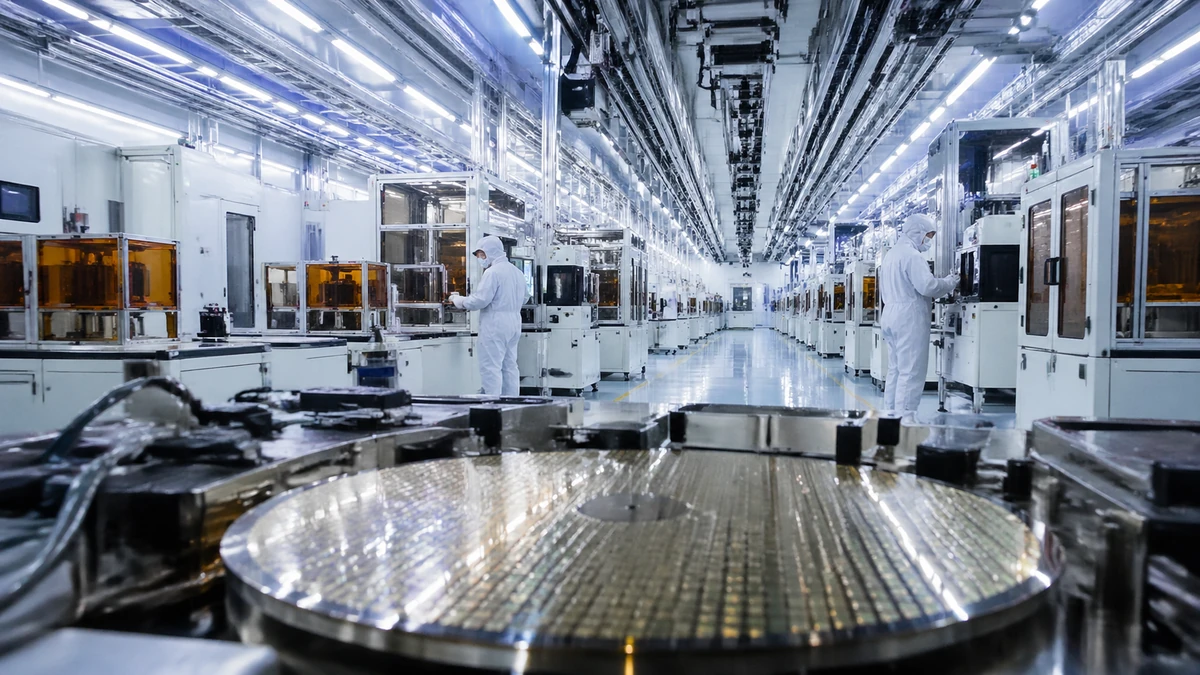
Semiconductors are not just an industry in South Korea — they are part of the national balance sheet
S&P’s emphasis on semiconductors and other key industrial sectors gets to the heart of how South Korea’s economy works. In the United States, semiconductors are often discussed through the lens of national security, industrial policy and efforts to bring manufacturing back home through the CHIPS and Science Act. In South Korea, chips are all of those things, but they are also central to the country’s export identity and financial reputation.
South Korea is home to some of the world’s most important semiconductor producers, including Samsung Electronics and SK hynix. Their memory chips sit inside data centers, personal devices, servers and artificial intelligence infrastructure worldwide. When these companies are strong, they do more than boost profits or stock indexes. They reinforce the case that South Korea retains world-class technological capacity, pricing power in strategic sectors and a durable place in the global supply chain.
That appears to be part of what S&P is recognizing. A sovereign rating does not hinge on one company or even one industry, but it is shaped by whether a country has real, competitive engines of growth. South Korea does. Its high-end manufacturing base, especially in electronics, remains one of the clearest reasons markets continue to treat it as a credible, advanced economy even when the world turns choppy.
This is an important point because there is a tendency in English-language coverage to describe the Korean Wave largely through culture: K-pop, Korean dramas, Oscar-winning films, skin care, fashion and food. All of that is real, and it has transformed South Korea’s global profile. But beneath the cultural influence sits an older foundation of industrial power. Long before many Americans knew the term “K-drama,” South Korea had already built globally competitive firms in electronics, autos, steel and shipping. Its soft power may be glamorous, but its hard economic credibility still rests heavily on factories, engineering, research and export logistics.
In South Korea, there is also a long history of state-supported industrial development, often associated with the rise of giant family-controlled conglomerates known as chaebol. For Americans unfamiliar with the term, chaebol are business groups such as Samsung, Hyundai and LG that grew into sprawling national champions with close ties to the country’s development strategy. They are sometimes admired for helping transform a war-scarred country into a high-income democracy, and sometimes criticized for concentrating economic power. Either way, they remain central to how South Korea competes globally. A credit assessment that cites industrial competitiveness is, in part, an acknowledgment that this export-led model still carries weight.
The 1.9 percent growth forecast is modest, but that may be the point
S&P projects South Korea’s economy will grow 1.9 percent this year. That is not a boom-time number, and it is not being presented as one. But growth forecasts are meaningful not only because of whether they sound high or low. They matter because of what assumptions are built into them.
In this case, the figure reads as a realistic middle-ground judgment. It suggests S&P sees South Korea as capable of expanding even while facing clear headwinds. For a mature, export-heavy economy operating in a world of high geopolitical risk, that kind of moderate growth can itself be evidence of resilience. The agency is not predicting a breakout year. It is saying the economy still has functioning growth drivers.
That nuance is worth underlining. Economic headlines often flatten everything into a binary: good news or bad news, beat or miss, expansion or contraction. But a 1.9 percent forecast in South Korea’s case is better understood as a compressed summary of competing realities. On one side are strong technology exports, industrial know-how and the possibility of support from public policy. On the other are energy costs, slowing demand in key overseas markets and strategic uncertainty across the region.
American readers may recognize a similar pattern in how analysts discuss the U.S. economy during periods of elevated inflation or high interest rates: not collapse, not exuberance, but an economy still moving forward despite friction. South Korea’s version of that story is shaped more by exports and industrial cycles than by domestic consumption alone, but the logic is comparable. Growth does not have to be spectacular to be reassuring. Sometimes it simply has to persist.
There is also a political subtext to these forecasts. In democracies, whether in Washington or Seoul, economic numbers quickly become arguments about competence. Yet ratings agencies are usually trying to do something narrower and more technical. They are less interested in campaign rhetoric than in whether the basic machinery of the economy still works. S&P’s estimate appears to reflect that approach: cautious, unsentimental and focused on structural strengths rather than short-term emotion.
Energy risk remains South Korea’s exposed flank
If there is a major caution flag in the S&P assessment, it is energy. The agency pointed to volatility in global energy markets and warned that prolonged instability in the Middle East could increase the financial burden on major South Korean energy-related public enterprises. That concern is not theoretical. It speaks to one of the more enduring vulnerabilities in the Korean economy.
South Korea is a manufacturing powerhouse, but it is not energy self-sufficient. Like Japan and many European economies, it depends heavily on imported energy. That means a supply disruption or sustained jump in oil and gas prices can feed directly into industrial costs, consumer prices and public-sector finances. For a country whose economy relies on running large-scale factories efficiently and shipping goods to the world, energy is not a side issue. It is one of the inputs that can shape the entire macroeconomic picture.
This helps explain why S&P’s statement feels balanced rather than celebratory. The agency did not say South Korea has no risks. It said those risks are being countered by enough industrial and policy strength to keep the rating intact. That is a materially different conclusion.
For Americans, there is a familiar lesson here. Even the strongest economies can remain vulnerable to energy shocks they do not fully control. The U.S. has experienced its own episodes of oil-price anxiety, though its domestic energy production gives it a different cushion. South Korea has fewer such buffers. When global energy markets lurch, the effects can be sharper, especially because the country’s economic model depends so heavily on energy-intensive manufacturing.
At the same time, S&P appears to believe those pressures can be softened. It specifically cited the competitiveness of the electronics sector and the cushioning role of fiscal policy. In plain English, that means South Korea still has both market-based strengths and government tools that can help absorb some of the damage from external shocks. It is not that the country avoids turbulence. It is that it may be better positioned than many peers to ride through it.
Why sovereign ratings affect ordinary people and global perceptions
Credit ratings can sound abstract, but they have real-world consequences. At the sovereign level, they influence how investors price a country’s debt, how companies from that country are perceived abroad and how much confidence international partners place in its economic management. A strong rating can help lower borrowing costs and reassure markets that a government is unlikely to face sudden funding stress. A weaker rating can do the opposite, feeding doubt and raising the price of capital.
For South Korea, that matters because the country’s economy is so internationally connected. Its corporations raise money globally. Its banks operate within a financial system watched closely by overseas investors. Its exporters depend on trust not just in product quality but in the broader stability of the country they operate from. A steady AA rating supports the idea that South Korea remains a dependable place to do business, even if growth is not spectacular and risks remain visible.
The rating also carries psychological force. Markets trade on narratives as well as numbers, and sovereign ratings often serve as shorthand for those narratives. A stable outlook tells investors that the current judgment is not expected to change dramatically in the near term. That does not eliminate volatility. It does, however, provide a kind of official reassurance that the state’s underlying credit profile is not seen as deteriorating fast.
For policymakers in Seoul, the message is also clear. South Korea’s industrial competitiveness remains a core national asset. Fiscal policy is still viewed as a buffer when external conditions worsen. Energy exposure remains a problem to manage, not a footnote to ignore. In that sense, the rating is less a trophy than a roadmap. It tells officials what the rest of the world believes is working and what still poses danger.
There is a wider strategic angle, too. Washington has spent years deepening economic coordination with Seoul in advanced manufacturing, semiconductor supply chains and technology security. If South Korea’s credit standing remains strong, that strengthens the credibility of the broader U.S.-South Korea partnership at a time when both countries are trying to reduce vulnerabilities in critical supply networks. A financially trusted South Korea is easier to integrate into long-term industrial and security planning.
A clearer picture of how South Korea explains itself to the world
The most revealing part of S&P’s latest decision may be the story it tells about South Korea’s place in the world. The country’s strengths are not mysterious: semiconductors and advanced electronics, export competitiveness, institutional stability and the ability to use fiscal policy to cushion shocks. Its pressures are not mysterious either: imported energy dependence, geopolitical risk and sensitivity to downturns in global demand. Put together, those elements form a portrait of a country that is neither invulnerable nor fragile, but highly capable.
That is a useful corrective to simplistic narratives about South Korea. In recent years, global fascination with Korean popular culture has sometimes overshadowed the economic architecture that made much of the country’s international rise possible. The same nation that exports K-pop groups and streaming hits also exports memory chips, EV batteries, luxury home appliances and giant cargo ships. Its global brand is part cultural magnet, part industrial superpower.
For American readers, the S&P affirmation offers a practical takeaway. South Korea remains one of the countries to watch not because it is free from risk, but because it has repeatedly shown an ability to adapt under pressure. It sits in a dangerous neighborhood, relies on volatile global markets and still manages to maintain the confidence of one of the world’s major ratings agencies. That is not a trivial achievement.
In the end, the message from S&P is less about celebration than credibility. Keeping the AA rating does not mean South Korea has entered an economic safe zone. It means global evaluators still believe the country has enough industrial muscle, policy flexibility and institutional reliability to withstand the next wave of turbulence. In a world where supply chains are political, energy markets are unstable and confidence can erode quickly, that kind of judgment carries weight.
And for a country whose fortunes are tied so closely to the technologies powering the 21st-century economy, that steady vote of confidence may be one of the most important assets it has.
Comments
Post a Comment