South Korea and Cambodia widen crime-fighting partnership as scams, drugs and illegal gambling converge
A cross-border crime problem grows more complicated
South Korea and Cambodia are expanding a joint law enforcement partnership that began as a response to online scams but is now being widened to include drug trafficking and illegal online gambling, a sign of how quickly transnational crime is evolving across Asia.
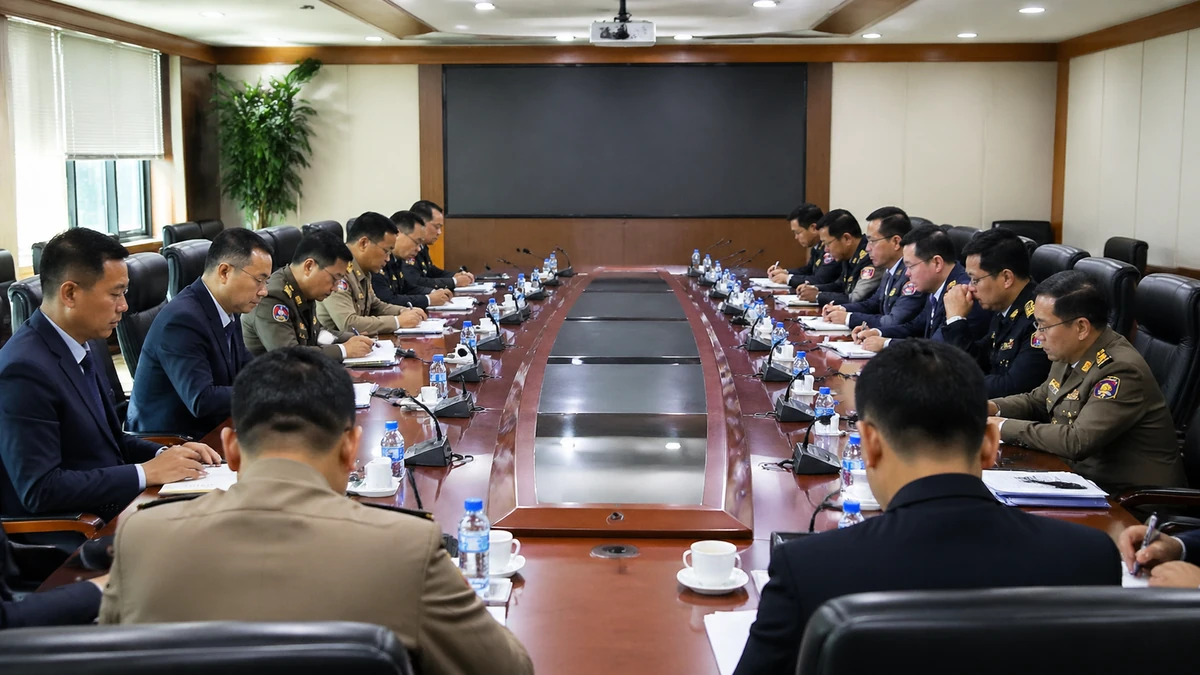
The agreement was confirmed after a meeting in Seoul between Yoo Jae-sung, the acting commissioner general of South Korea’s National Police Agency, and Sar Thet, Cambodia’s national police chief, according to the South Korean news agency Yonhap. The two sides agreed to broaden the role of a bilateral investigative unit known as the “Korea Desk,” which had focused primarily on scam-related crimes such as voice phishing and romance fraud.
For American readers, the shift may sound familiar. In the United States, federal and local authorities have spent years learning that online fraud rarely stays in one lane. The same criminal networks that run phishing schemes may also move money for narcotics, operate illegal betting platforms, or use shell companies and digital payment channels to wash profits. South Korean officials appear to be making a similar calculation: Scam crackdowns alone are no longer enough if the same cross-border infrastructure is supporting multiple forms of organized crime.
That matters because the crimes at issue do not only affect South Korea or Cambodia. They reflect a broader regional pattern in which crime syndicates exploit porous jurisdictions, encrypted messaging, remote work recruitment, online banking and social media to target victims, move workers and hide money. In Asia, as in North America and Europe, the internet has not erased geography so much as rearranged it. Criminal groups can place servers in one country, recruiters in another, financial intermediaries in a third, and victims almost anywhere.
The Seoul meeting suggests South Korea now sees those threats less as isolated incidents and more as parts of an ecosystem. By widening the joint unit’s mission, the two governments are acknowledging that voice scams, romance scams, narcotics cases and illegal gambling operations can intersect through the same routes, the same facilitators and often the same money trail.
From scam center response to broader enforcement strategy
The Korea-Cambodia joint unit first drew attention because it represented something more hands-on than routine diplomatic cooperation. Rather than simply asking a foreign government for help on a case-by-case basis, the arrangement created a more regular structure for investigators from both countries to work together on crimes affecting South Koreans.
That distinction is important. International policing often breaks down not because authorities lack laws, but because they lack speed, shared intelligence and common operating habits. By the time one country identifies suspects, sends a request and waits for a response, the suspects may have moved, wiped devices, rerouted payments or relocated workers. A dedicated bilateral team can reduce some of that delay.
South Korean officials had originally directed much of that effort toward scam crimes that have become a major public concern at home. “Voice phishing,” a term widely used in South Korea, generally refers to phone- or internet-based financial fraud in which criminals impersonate prosecutors, police, bank employees or other authorities to pressure victims into sending money or revealing sensitive account information. The crime resembles the spoofed-call and imposter scams that plague Americans, especially seniors, but in South Korea it has become so widespread and systematized that the term itself is instantly recognizable.
Romance scams are more globally familiar: Fraudsters build emotional relationships online, then manipulate victims into sending money, often by inventing emergencies or fabricated investment opportunities. In both South Korea and the United States, these schemes can leave behind more than financial losses. Victims often experience shame, isolation and psychological trauma, which can make underreporting a chronic problem.
The decision to now add drugs and illegal online gambling shows authorities believe those crimes should not be treated as separate silos. Drug trafficking relies on distribution networks, concealed communications, courier systems and laundering methods. Illegal online gambling similarly requires servers, payment channels, customer acquisition strategies and, often, sophisticated methods for evading law enforcement. Those operational similarities may make combined investigations more effective than tackling each category on its own.
In plain terms, South Korea appears to be moving toward the kind of approach U.S. investigators often call “following the network” rather than only chasing individual offenses. If the same group that recruits workers into a scam compound is also connected to illegal betting operations or narcotics movement, then a narrow fraud investigation may miss the larger organization keeping the business alive.
The tragedy that sharpened official urgency
This policy shift did not emerge in a vacuum. The joint Korea-Cambodia framework was launched after the killing of a South Korean man in his 20s who had been tortured at a criminal compound in Cambodia last year, according to the Korean summary. The case shocked South Korea and helped crystallize a growing fear that overseas crime hubs were not abstract foreign problems but direct threats to South Korean citizens.
For audiences in the United States, one useful comparison is the way stories about Americans trafficked into fraud compounds or kidnapped by organized crime abroad can suddenly change the policy debate in Washington. A single especially brutal case can expose the human cost behind what had previously sounded like an impersonal cybercrime issue. Scam centers are often described in terms of stolen data and fraudulent wire transfers, but the labor system behind them can involve coercion, confinement, violence and transnational recruitment.
That appears to be part of what has changed the South Korean government’s posture. When citizens are victimized outside national borders, traditional policing models face obvious limits. Domestic investigators can collect testimony and trace bank transfers inside South Korea, but if the perpetrators, servers, recruiters or physical compounds are overseas, the case quickly runs into jurisdictional walls. The practical answer is not only better investigation after the fact, but closer cooperation where the crimes are organized and carried out.
The language used by South Korean police also points to a broader ambition. Officials said the two sides are committed to “rooting out” transnational crimes involving South Koreans. That wording suggests the target is not just a few offenders or one headline-grabbing ring, but the underlying structures that recruit personnel, process money and protect criminal operations from disruption.
That is easier said than done. Criminal organizations thrive when governments treat incidents as isolated cases instead of connected systems. But if Seoul and Phnom Penh are serious about identifying shared logistics, shared financial channels and overlapping personnel, they may be better positioned to dismantle networks rather than merely arrest replaceable foot soldiers.
Why drugs and illegal gambling are now part of the same picture
At first glance, online scams, narcotics and illegal gambling may look like separate public safety concerns with different victims and different business models. Yet law enforcement agencies increasingly view them as overlapping parts of the same criminal marketplace.
Illegal gambling operations, especially those run online, can generate huge cash flows while relying on offshore infrastructure and legal gray zones. They often require customer solicitation, account management, back-end payment processing and methods to obscure beneficial ownership. Drug trafficking similarly depends on adaptable supply chains and concealment tactics, while online scam rings depend on mass outreach, persuasive scripts, digital identities and rapid money movement. All three can benefit from the same enablers: fake companies, corrupt facilitators, cryptocurrency channels, recruited labor, messaging platforms and fragmented international oversight.
That overlap may explain why South Korean and Cambodian police decided the Korea Desk should widen its scope instead of creating entirely separate bilateral teams for each crime category. If the investigative goal is to understand the full criminal architecture, putting connected offenses under one collaborative umbrella can make strategic sense.
There is also a victim-protection argument. Scam victims may lose retirement savings or family assets in a matter of hours. Drug trafficking can fuel addiction, overdose risk and community harm. Illegal gambling can drain household finances and foster cycles of debt and dependency. Officials in Seoul appear to be recognizing that these crimes do not merely produce different case files; they can destabilize families and communities in long-lasting ways.
For Americans, the concept is not far removed from how U.S. agencies sometimes examine the ties between online fraud, human trafficking, narcotics distribution and unlicensed gaming. The specifics differ by region, but the logic is shared: Organized crime diversifies. When one revenue stream draws too much heat, it shifts or expands. That makes compartmentalized enforcement less effective over time.
South Korea’s move also reflects how online crime has changed from a mostly domestic consumer-protection issue into a national security-adjacent concern. When criminal actors are overseas, technologically nimble and financially networked, they are harder to disrupt with conventional policing alone. Cross-border cooperation becomes not a diplomatic courtesy but a basic operational necessity.
What South Korea is offering Cambodia beyond rhetoric
The Seoul meeting was not only about broadening investigative categories. South Korea’s National Police Agency also said it would share advanced investigative techniques and public safety systems with Cambodia.
The precise technologies or systems were not publicly detailed in the summary, so it would be premature to speculate about specific software, surveillance tools or forensic platforms. But even at a general level, the offer is significant. It suggests South Korea is trying to deepen the partnership beyond liaison work and into institutional capacity-building.
That can matter enormously in modern policing. Transnational crime cases increasingly depend on digital forensics, financial intelligence analysis, data integration, multilingual evidence handling and coordinated field operations. A police partnership is only as strong as the weaker side’s ability to act quickly on information. Sharing techniques and systems can help reduce that imbalance.
For readers less familiar with South Korean institutions, the National Police Agency is the country’s central police body, roughly comparable in national importance to a combination of federal coordinating functions and a nationwide law enforcement command structure. It is not a direct equivalent to the FBI, which is an investigative bureau within the U.S. Justice Department, but it plays a similarly central role in shaping how major criminal investigations are prioritized and coordinated across the country.
That makes this more than a symbolic meeting. South Korea is signaling that protecting its citizens now requires external partnerships robust enough to function in real time, not simply after a formal request moves through diplomatic channels. In a globalized economy where people travel, study, work and communicate across borders every day, the state’s protective role increasingly depends on how well it can connect its own institutions to those abroad.
There is also a practical political message here. By offering expertise, Seoul positions itself not only as a country seeking help but as one investing in a shared enforcement framework. That can strengthen trust and make future cooperation more durable, especially in cases where quick action is needed on foreign soil.
A wider shift in how South Korea sees overseas threats
The bigger story may be how this reflects South Korea’s changing view of public safety in an era of global movement and digital dependence. For years, international crime was often framed as something that happened elsewhere and affected South Korea indirectly. That view is becoming harder to sustain.
Today, a South Korean citizen can be targeted through a messaging app by a scam operator abroad, lured to another country by a fake job posting, drawn into an illegal betting site hosted offshore or recruited into moving funds for a criminal network they do not fully understand. The physical location of the crime matters less than the network that makes it possible.
In that sense, the Korea-Cambodia arrangement reflects a broader shift from territorial thinking to network thinking. Authorities are not just asking where a crime happened. They are asking where it was organized, where the money moved, where victims were contacted, where workers were housed and where the digital infrastructure sat at each stage.
That kind of shift has been visible in other countries too. U.S. officials, for example, increasingly talk about disrupting ecosystems rather than solely prosecuting incidents. The same mindset underlies sanctions, anti-money-laundering efforts and multinational task forces aimed at cybercrime. South Korea appears to be adapting a comparable framework to threats involving its own citizens in Southeast Asia.
The policy also carries a domestic warning. As overseas travel, temporary work, study-abroad programs and online gig recruitment become normal parts of life, risk education cannot stop at the border. Authorities may need to do more to warn citizens about fake job ads, suspicious online relationships, unregulated betting platforms and trafficking-linked recruitment schemes that promise high pay abroad.
If the partnership succeeds, its effects may be measured not only in arrests but in disruption: fewer fraudulent calls reaching South Korean victims, fewer illicit gambling platforms targeting Korean users, more early identification of recruitment patterns, and faster information-sharing when a Korean national goes missing or is believed to be trapped in a criminal site overseas.
What to watch next
The practical impact of the expanded partnership will depend on what happens after the headlines fade. Bilateral announcements are common in international policing; sustained coordination is harder. The key test will be whether the two sides can translate broad commitments into casework, intelligence exchange, financial tracing and visible disruption of criminal networks.
Another question is whether the broadened mission of the Korea Desk produces a more preventive model of enforcement. If investigators can connect scam activity to gambling platforms or drug-related money movement early enough, they may be able to intervene before harm spreads. That would represent a meaningful shift from reactive policing to earlier, intelligence-led action.
There may also be implications beyond Cambodia. If South Korea views this partnership as a successful template, it could shape future cooperation with other countries where Korean nationals have faced fraud, coercion or organized criminal exploitation. In that way, the agreement could become part of a larger architecture for policing Korean-linked transnational crime across the region.
For American readers, the story is a reminder that the geography of modern crime is both distant and immediate. A fraud ring in Southeast Asia can still resemble the scam text on a U.S. smartphone, the illegal betting site one click away from a teenager, or the laundering pipeline behind fentanyl proceeds and online extortion. The labels differ from country to country, but the operating logic is recognizable.
South Korea’s decision to widen its crime-fighting cooperation with Cambodia underscores a simple reality: In the digital age, public safety no longer ends at the border. Countries that want to protect their citizens must pursue criminal networks where they recruit, where they profit and where they hide. Seoul’s latest move suggests it believes the next phase of that fight will require broader alliances, broader intelligence and a sharper understanding that scams, drugs and illegal gambling are often chapters in the same story.
Comments
Post a Comment