South Korea Pushes to Bring AI to the Battlefield, Betting Speed and Automation Will Shape the Next Era of War
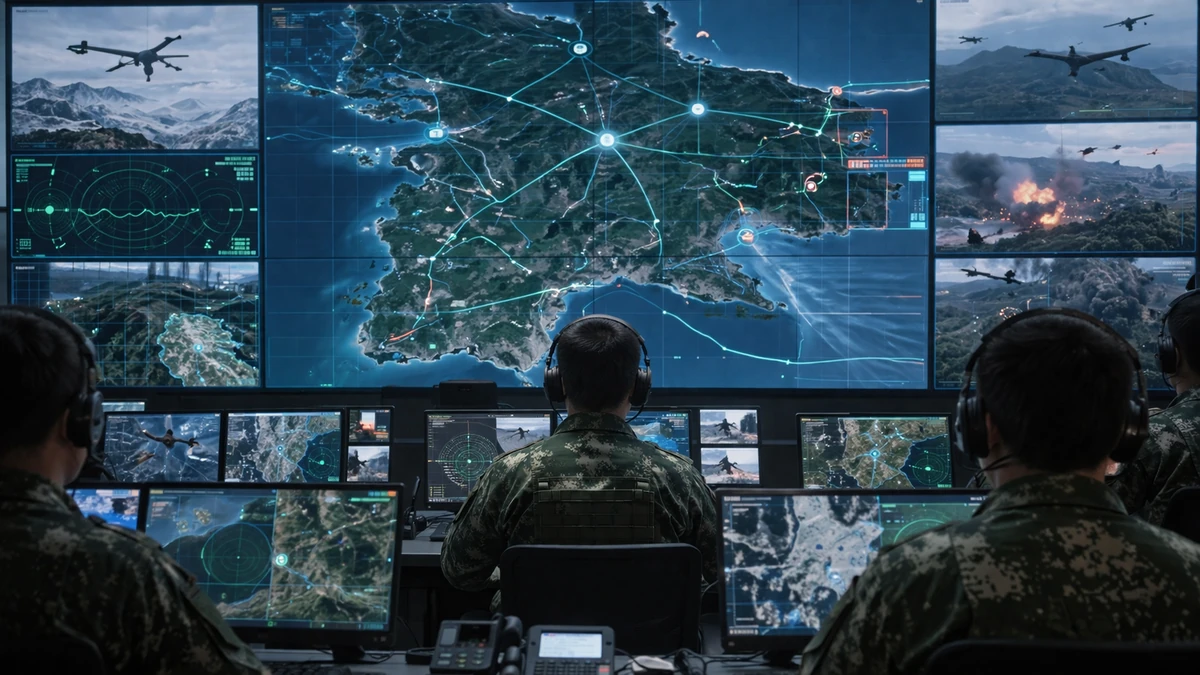
South Korea’s military is moving faster toward an AI-driven future
South Korea is accelerating plans to weave artificial intelligence into the core of its defense strategy, a shift officials frame not as a distant experiment but as the beginning of a new military era. At the center of that effort is what defense planners describe as a move toward an "AI battlefield" and the creation of an "AX" framework, shorthand for autonomous execution, designed to help military systems analyze information and carry out certain operational tasks at far greater speed than traditional command structures allow.
For American readers, the easiest comparison may be to the Pentagon’s own push for algorithmic warfare, autonomous systems and decision-support tools that can process far more data than any human staff could absorb in real time. But South Korea’s case comes with a sharper sense of urgency. The country lives under the shadow of North Korea, remains technically at war because the Korean War ended in an armistice rather than a peace treaty, and has built one of the world’s most technologically advanced militaries in response to a constant and nearby threat.
That geopolitical reality helps explain why South Korean defense officials are talking about AI not simply as a support technology, but as a possible turning point in how military operations are conducted. The concept goes beyond using software to assist with logistics or maintenance. Instead, it envisions systems that can rapidly interpret battlefield data, recommend or initiate responses, help allocate troops and equipment, and support command decisions during fast-moving situations where seconds matter.
In South Korea, where digital infrastructure is highly developed and the broader economy is deeply invested in semiconductors, robotics and telecommunications, the idea of bringing cutting-edge civilian technology into national defense fits a broader pattern. The same country that helped build the global consumer electronics industry and now competes at the forefront of chips and mobile networks wants to apply that technical edge to military readiness.
Still, the concept carries profound questions familiar to policymakers in Washington, Brussels and other capitals: How much authority should be delegated to machines in wartime? Can an AI system be trusted when the stakes involve civilian lives, escalation risks and national survival? And what happens if an algorithm moves faster than human judgment can keep up?
What South Korea means by an “AI battlefield”
The phrase "AI battlefield" can sound like science fiction, conjuring images from Hollywood movies in which robots take over combat. In practice, South Korea’s reported approach appears more grounded, though still potentially transformative. The idea is to create infrastructure and command systems in which AI can process streams of intelligence, surveillance, logistics and operational information in real time, helping commanders make decisions faster and, in some cases, automating portions of execution.
The AX concept is key here. In plain English, autonomous execution refers to systems that do more than merely flag data for human review. They can help translate commands into action across interconnected networks. That might include adjusting force deployments, refining operational plans as conditions change, prioritizing threats, assigning scarce resources or supporting weapons-related decisions under tightly controlled parameters.
For readers in the United States, one way to understand this is to think of the difference between a navigation app that simply shows traffic and one that automatically reroutes an entire fleet of emergency vehicles during a crisis. Now scale that up to a military environment involving live intelligence feeds, missile threats, cyberattacks and shifting battlefield conditions. The promise of AI, from the military’s perspective, is speed, precision and the ability to manage complexity beyond normal human limits.
South Korea’s military, like others around the world, faces a modern combat environment saturated with data. Satellites, drones, radar, signal intercepts, battlefield sensors and communications systems all produce more information than human analysts can easily process in the narrow windows demanded by modern warfare. AI systems are attractive because they can sort patterns quickly, flag anomalies, predict likely developments and assist with high-tempo decision-making.
That does not necessarily mean humans disappear from the chain of command. In many democratic countries, including South Korea and the United States, the more publicly acceptable model is often described as "human in the loop" or at least "human on the loop," meaning people retain meaningful oversight even if machines handle some analysis and execution. But as systems become faster and more capable, the boundary between human control and machine initiative can blur, especially under combat pressure.
That ambiguity is one reason the South Korean push is significant beyond the Korean Peninsula. It reflects a larger global shift in which the race for military advantage increasingly depends not only on tanks, ships and missiles, but also on software architectures, secure data pipelines and the ability to fuse AI into command-and-control systems.
Why South Korea sees urgency where others see experimentation
South Korea’s security environment is unusually intense for a U.S. ally that is also a major democracy and economic powerhouse. Seoul, a metropolitan area of roughly 26 million people, sits within range of North Korean artillery and missile systems. North Korea’s advancing missile and nuclear capabilities, combined with repeated cycles of military provocation, have kept South Korea in a posture of constant vigilance for decades.
That helps explain why defense technology debates in Seoul often feel less theoretical than they may in countries separated from adversaries by oceans. A system that can shave minutes or even seconds off response times is not just a matter of efficiency. In South Korea’s strategic thinking, it could affect survival, deterrence and the credibility of the alliance with the United States.
South Korea also has demographic reasons to favor automation. Like several advanced economies in East Asia, it faces a low birthrate and an aging population. That long-term trend has implications for military manpower. A country with fewer young people available for service has a strong incentive to invest in technologies that allow it to preserve or even increase capability without relying exclusively on troop numbers.
There is also an industrial logic. South Korea has spent years trying to position itself as a major defense exporter, selling tanks, artillery, aircraft and other systems to countries in Europe, the Middle East and Asia. If it can become a leader in military AI integration as well, that could strengthen both its strategic influence and its defense industry. In much the same way that the United States has long linked innovation with national power, South Korea increasingly sees advanced defense technology as part of its competitive identity.
Korean political and policy language can sometimes be dense for foreign audiences, and terms like AX may not yet be widely familiar outside specialist circles. But the underlying message is clear: South Korea wants to be seen not as a follower adapting old military doctrine with some new software, but as a country helping define what the next generation of warfare looks like.
That ambition fits a broader national pattern. Over the past two decades, South Korea has repeatedly turned speed and technological adaptation into strategic advantages, whether in broadband adoption, semiconductor manufacturing, electric batteries or digital platforms. The same mindset now appears to be shaping how the country thinks about deterrence and defense.
The promise: faster decisions, sharper targeting and more efficient use of force
Supporters of AI integration in defense argue that the biggest benefits are straightforward. Military operations are often slowed by the gap between sensing a threat, understanding it, deciding what to do and carrying out the response. In military jargon, that is sometimes discussed through the decision cycle or OODA loop — observe, orient, decide and act. AI promises to compress that cycle dramatically.
On a future battlefield, a networked AI system could ingest surveillance from drones, radar inputs, intelligence reports and troop location data all at once, then generate an assessment in seconds. It could identify a probable missile launch pattern, flag an unusual troop movement, predict where supplies will be needed next or propose the fastest response route to a sudden incursion. In a best-case scenario, commanders gain better options faster, while scarce personnel and equipment are directed where they are most effective.
For South Korea, which must prepare for scenarios ranging from missile attacks to localized clashes to broader escalation, that kind of responsiveness has obvious appeal. If AI can support faster threat detection and more precise force deployment, military planners may believe they can improve deterrence by demonstrating that the country is ready to respond immediately and intelligently.
There are also less dramatic but highly consequential applications. Military readiness is not only about front-line combat. It depends on maintenance schedules, fuel availability, communications resilience, spare parts management and training logistics. AI systems can help predict equipment failures, optimize inventories and identify inefficiencies that reduce readiness long before a shot is fired. In the American context, this would be comparable to how the U.S. military has explored predictive maintenance for aircraft and ships to reduce downtime and costs.
Another likely appeal is resource efficiency. Wars are expensive, and modern militaries are under pressure to do more with finite budgets. An AI-assisted command system could help allocate drones, missile defense assets, reconnaissance platforms and personnel in ways that human staffs might miss under time pressure. If done well, that could reduce waste and increase flexibility.
But the promise of efficiency has always been one of technology’s strongest sales pitches, whether in Silicon Valley or the defense industry. The central question is whether those efficiencies hold up in real-world conditions, especially when systems face deception, cyberattacks, jamming or incomplete data — all of which are common in war.
The risks: hacking, malfunction and the danger of moving too fast
If the appeal of military AI is obvious, so are the risks. South Korean officials and defense experts appear acutely aware that an AI system operating in a national security environment would need exceptionally strong cybersecurity and reliability. In a civilian setting, a software error can be costly or embarrassing. In a military setting, it could trigger a misfire, misidentify a threat or contribute to an escalation spiral with potentially catastrophic consequences.
That challenge is particularly serious for South Korea because it already faces one of the world’s most persistent cyber threats in North Korea. Pyongyang has been accused by governments and researchers of carrying out cyber operations ranging from espionage to cryptocurrency theft. Any South Korean military network designed around high-speed AI analysis and execution would be an obvious target for penetration, disruption or manipulation.
A hacked or spoofed system could be worse than a failed one. If an adversary can feed false data into an AI-enabled battlefield network, the system may produce confident but dangerously wrong recommendations. That is a concern not only in South Korea but globally, as researchers warn that machine-learning systems can be vulnerable to adversarial inputs — data intentionally crafted to deceive algorithms.
Reliability is another issue. AI models are powerful pattern-recognition tools, but they are not infallible, and many remain notoriously opaque. Even their developers may struggle to explain exactly why a system reached a particular conclusion. That lack of transparency is troubling in any high-stakes environment, but especially in military operations, where accountability matters and commanders need to justify decisions that may cost lives.
Then there is the ethical issue that has defined international debates over autonomous weapons: How much decision-making should machines handle when lethal force is involved? Supporters of military AI often stress that machines can reduce human error, cut response times and spare soldiers from dangerous exposure. Critics counter that delegating too much authority to algorithms risks lowering the threshold for violence and weakening moral accountability.
For Americans, the debate may sound familiar from discussions in Washington over drone warfare, autonomous systems and AI-enabled targeting. South Korea is now confronting similar dilemmas, but under conditions of more immediate threat. That tension — between urgency and caution — may define the success or failure of its AI defense strategy.
How this could reshape military strategy on the Korean Peninsula
If South Korea succeeds in building a credible AI-enabled operational framework, the impact could extend beyond software upgrades. It could change the way deterrence works on the peninsula. Military strategy is not only about what weapons a country possesses, but about how quickly and credibly it can detect threats, decide on a response and persuade an adversary that aggression will fail.
AI could strengthen that credibility by making South Korean responses appear faster, more coordinated and harder to overwhelm. For example, an AI-assisted system could potentially help synchronize missile defense, air surveillance, troop movement and command communications during a crisis. That kind of integration could complicate North Korean planning by making it harder to exploit confusion or delays in the South’s response.
At the same time, there is a paradox. Technologies designed to stabilize deterrence can also increase pressure to act quickly. If both sides believe speed is decisive, crises can become more brittle. Leaders may fear that waiting for full confirmation will put them at a disadvantage against an opponent whose systems can react in moments. In that sense, AI can compress not only military timelines but also political decision space.
This is not a uniquely Korean problem. U.S. strategists have worried for years that automation and hypersonic weapons could create "use it or lose it" pressures in a crisis. But on the Korean Peninsula, where distances are short and warning times can be brief, those concerns are magnified. Any move toward AI-supported command structures will likely require new doctrines, safeguards and alliance coordination to ensure speed does not come at the expense of judgment.
The U.S.-South Korea alliance will almost certainly be part of that picture. American forces are deeply integrated into South Korea’s defense posture, and wartime operational planning has long involved close coordination between the two militaries. If Seoul adopts more advanced AI-based command systems, interoperability with U.S. systems will become essential. That includes technical compatibility, shared security standards and common understandings of when machines can recommend, initiate or execute actions.
In other words, South Korea’s AI battlefield project is not just a domestic modernization effort. It is also an alliance issue, a regional security issue and a signal to rival powers that technological sophistication is becoming as central to deterrence as traditional hardware.
South Korea’s broader message: innovation is now a measure of military power
For years, countries measured military strength in visible terms: troop numbers, fighter jets, warships and missile ranges. Those metrics still matter. But South Korea’s reported defense push underscores a newer reality: Increasingly, military power also depends on who can integrate software, sensors, networks and automation faster and more securely than everyone else.
That shift mirrors the way civilian competition has changed in the digital age. The companies that dominate are often not those with the most physical assets, but those best able to collect data, process it and turn it into rapid decisions. Militaries are now trying to do something similar, only with vastly higher stakes. South Korea appears determined not to be left behind.
The country’s ambitions also reflect a rising confidence in its global role. Once seen primarily through the lens of division with North Korea and dependence on U.S. protection, South Korea has increasingly emerged as a middle power with worldwide influence — economically, culturally and technologically. To many Americans, the country is perhaps best known through K-pop, Korean dramas, Oscar-winning films like "Parasite" and a global beauty and consumer tech footprint. But those softer forms of influence have been accompanied by a harder-edge strategic evolution, including expanded arms exports and more active regional diplomacy.
The AI battlefield initiative fits into that broader story. It says South Korea does not just want to be a consumer of advanced military technology from the United States or Europe. It wants to be a producer of military innovation and, potentially, a model for other nations trying to modernize their defense systems.
Whether that vision succeeds will depend on execution, oversight and public trust. Democratic societies often move more slowly than authoritarian ones when adopting sensitive technologies, because they debate ethics, law and accountability in the open. That can be frustrating for military planners, but it can also be a strength. If South Korea can build AI systems that are both effective and subject to meaningful human control, it may offer a template others find persuasive.
If it cannot, the technology may deepen fears that the world is stumbling into a future where algorithms accelerate conflict faster than institutions can manage it.
The world will be watching what comes next
South Korea’s push toward an AI-centered defense posture comes at a moment when military establishments across the globe are wrestling with the same big question: Will artificial intelligence merely support warfare, or will it redefine it? Seoul’s answer appears increasingly clear. Its defense establishment is acting as though AI is not a side tool but a foundational layer of future combat operations.
That does not mean robot wars are around the corner, nor does it mean human commanders are about to vanish from the battlefield. But it does mean one of America’s closest allies in Asia is moving quickly to build a military architecture in which data analysis, command support and portions of operational execution can happen with machine speed.
For American readers, South Korea’s decision matters for several reasons. It offers a preview of how front-line U.S. allies may adapt to a world of constant surveillance, cyber conflict and compressed decision times. It raises questions about how Washington will coordinate with partners whose military systems become increasingly AI-enabled. And it highlights an often overlooked truth about the AI race: Some of the most important experimentation may happen not only in Silicon Valley or at the Pentagon, but in allied states facing immediate threats and little margin for delay.
In the coming years, analysts will likely look to South Korea as a test case. If its military can integrate AI in ways that genuinely improve readiness, deterrence and responsiveness without sacrificing control or security, the country may emerge as a leading voice in the next phase of defense modernization. If vulnerabilities, ethical controversies or operational failures mount, it could become a cautionary tale.
Either way, the direction is unmistakable. On the Korean Peninsula, where the cost of hesitation has always been high, South Korea is betting that the future of defense belongs to the countries that can think, decide and adapt at the speed of AI — while still remembering that war, for all its technology, remains a profoundly human responsibility.
Comments
Post a Comment