
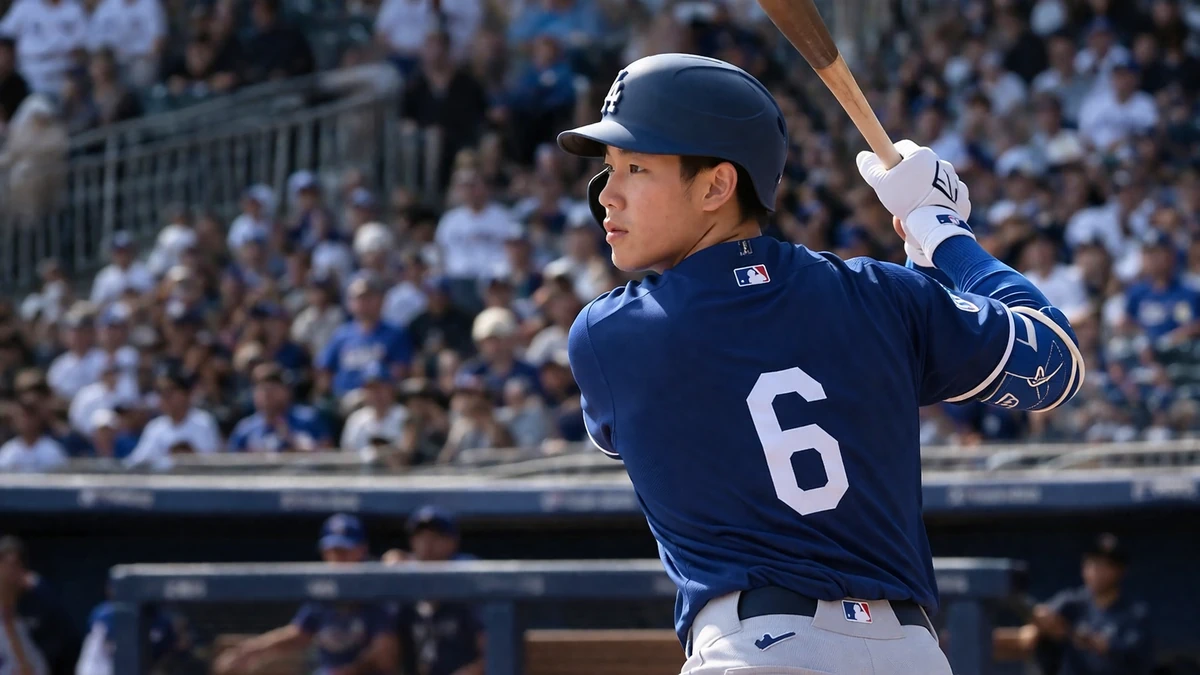
A call-up with bigger meaning
For most Major League Baseball teams in April, roster shuffles are part of the background noise of a long season. A player goes on the injured list, another comes up from the minors, and the move is logged, analyzed briefly and then folded into the next game preview. But the Los Angeles Dodgers’ decision on April 6 to bring infielder Hyeseong Kim back to the major league roster, while placing star Mookie Betts on the injured list, carries a significance that extends well beyond a simple transaction wire update.
For the Dodgers, the move is about surviving the early season with enough flexibility to keep one of baseball’s deepest rosters functional during a road trip. For Kim, it is a fresh opportunity to prove that his skill set translates in the major leagues, not in theory but in the small, high-pressure moments that often define bench players’ careers. And for South Korean baseball fans, the move lands as another closely watched chapter in the long and complicated story of how Korean position players carve out space in MLB.
That broader interest makes sense. Korean stars have made major impacts in the United States, but the paths have often differed by position. Pitchers such as Chan Ho Park, Ryu Hyun-jin and Kim Ha-seong’s fellow countrymen on the mound have tended to be evaluated through familiar statistical frameworks. Position players, especially those not arriving as obvious middle-of-the-order sluggers, often face a different challenge. They must prove they can adapt to faster pitching, more demanding defensive expectations and the everyday strategic demands of the major leagues.
That is why Kim’s return is worth watching carefully. The verified facts are straightforward: the Dodgers recalled him, Betts went on the injured list, and Kim is now available during the club’s road series in Toronto from April 6 to April 8. What remains uncertain is the more revealing part: how often he will play, where he will be used and what kind of trust the coaching staff is prepared to place in him. Those answers, more than the headline itself, will tell the real story.
Mookie Betts’ absence changes more than one lineup spot
Any discussion of this move has to begin with Betts, because few players in baseball affect a roster the way he does. For American fans, the easiest comparison is to what happens when a football team loses a franchise quarterback or when an NBA contender is suddenly without its primary playmaker. Betts is not just a productive bat. He is one of the Dodgers’ foundational players, a former MVP-caliber presence whose influence stretches across offense, defense, leadership and game management.
So when Betts goes on the injured list, the question is not merely who takes his official roster spot. The larger issue is how the Dodgers redistribute the functions he performs. That can mean changing the batting order, moving defenders around the infield or outfield, and using the bench more aggressively in late-game situations. Teams rarely replace a player like Betts one-for-one. They patch together solutions.
That reality is part of what makes Kim a logical, even if not flashy, choice. He is not being asked to become Betts overnight. No one is seriously arguing that a single call-up can substitute for Betts’ bat, star power or all-around reliability. Instead, Kim appears to fit the kind of role contenders often prioritize in the first month of the season: a player who can improve a team’s flexibility, cover multiple possibilities and help the manager navigate matchups without burning through options too early.
In modern baseball, that matters more than casual fans sometimes realize. The end of a roster is no longer reserved only for a backup catcher, a pinch-hitter and a specialist. Managers increasingly value players who can handle several defensive spots, run the bases well and avoid mistakes in games decided by one run. A bench player who can enter in the seventh inning, take an extra base in the eighth and make a clean defensive play in the ninth can swing a game even without collecting a highlight-reel home run.
The Dodgers, perhaps more than most organizations, are built around this kind of layered roster thinking. They are a star-driven team, but they are also one of the smartest clubs in the sport when it comes to depth, versatility and preserving options over a 162-game season. Calling up Kim at this moment signals that the team believes his profile matches an immediate need.
Why Kim’s skill set fits an early-season bench role
Kim’s value is not easiest to explain through one eye-popping statistic, and that is part of why his story may be unfamiliar to some American readers. In South Korea’s KBO League, where he built his reputation before moving into the Dodgers’ system, Kim was known less as a pure power threat than as a player whose game is built on speed, defensive range, quick reads and situational awareness. Those qualities can sound modest on paper. In practice, they are often exactly what a major league team wants from a utility player trying to earn trust.
Think of the archetype American fans have seen for years on winning teams: the versatile infielder who is not necessarily the star of the lineup but who can fill in at second, short or third, take a key at-bat near the bottom of the order and become an immediate late-inning weapon on the bases. Those players often gain importance in April and May, when regulars are still building rhythm, minor injuries begin to pile up and teams are not yet inclined to overwork their stars.
That is the lane Kim appears to be entering. The summary of the Korean reporting suggests caution against viewing him immediately as a locked-in starter. That is the right frame. The more realistic expectation is that he will be used as a practical, game-ready option: a bench piece who could start depending on matchups, a defensive replacement, a pinch-runner, or a player who helps the Dodgers reshuffle the infield if another move becomes necessary during the series.
There is a reason that sort of player can hold real value. The major leagues ask bench players to stay ready with little warning. A player might sit for six innings and then be asked to pinch-run in a tie game, field a difficult hop under pressure, or face a reliever throwing 98 mph with runners on base. The players who last in those roles are not always the most naturally gifted. They are often the ones who make the fewest mental mistakes and adapt the fastest to changing game situations.
Kim’s resume suggests he can help in exactly those areas. Quick first steps in the field, clean decision-making on the bases and comfort moving between assignments are traits managers appreciate immediately. If he can provide those things in Toronto, he gives himself a real chance not only to stay useful during this call-up but to make a stronger argument for future opportunities as the season develops.
The Toronto trip is a test of usage, not just playing time
The Dodgers’ road series in Toronto adds another layer to the story. Road trips can be revealing for players on the edge of the roster, because they force a team to use all 26 spots with a little more intention. Travel, time-zone changes, unfamiliar stadium rhythms and the strategic complications of a three-game set can elevate the need for bench versatility. In other words, this is the kind of stretch where a multi-use player can become more visible.
That does not necessarily mean Kim will start multiple games. In fact, one of the most important points in the Korean coverage is that how he is used may matter more than how much he is used. If he enters games late as a defensive replacement or pinch-runner, that is still meaningful. It would suggest the Dodgers see him as a trusted operational piece, someone who can execute a narrow but important job without adding risk. Managers do not hand those moments to players they do not believe are prepared.
If he starts, the context will matter just as much. A start near the bottom of the lineup against a particular type of pitcher could indicate the Dodgers want to evaluate his at-bats in a manageable setting. A late-inning defensive assignment in a close game could signal stronger confidence in his glove. Repeated use off the bench would point to a role as a practical chess piece rather than a temporary placeholder. Each of those patterns says something different about how the organization views him.
This is one of those baseball stories where counting plate appearances alone may miss the point. A single game can reveal quite a bit depending on the leverage of the moment. Did the Dodgers ask Kim to protect a lead? To run for a slower baserunner? To handle an infield switch in the middle of a tight contest? Those are the kinds of clues that show whether the coaching staff sees him as merely available or actively useful.
That distinction matters because MLB careers are often built in increments. A player gets a chance to handle one role, succeeds, and then is trusted with a little more. The jump from “usable” to “worth keeping” is not always dramatic. Sometimes it is simply a matter of proving that the manager can put you into a game without worrying that the moment will become too big.
The challenge Korean position players face in the majors
To understand why Kim’s return resonates in South Korea, it helps to understand the broader context of Korean baseball in the United States. American fans are often more familiar with Japanese stars arriving with major hype or with Korean pitchers who carry defined scouting narratives. Korean position players, by contrast, have sometimes entered MLB under a more skeptical lens, especially if they are not marketed as obvious power bats.
The adjustment is substantial. MLB pitching is generally harder, deeper and less forgiving than what many hitters face in the KBO. Fastballs arrive with more velocity, breaking balls are sharper, and relief pitching can feel relentless from the sixth inning on. The strike zone management required in the major leagues is also exacting. Hitters must adapt not just to better stuff, but to a different rhythm of attack, more specialized matchups and fewer forgiving sequences within an at-bat.
There is also the cultural adjustment. For American readers unfamiliar with Korean baseball, the KBO is not a minor or fringe baseball scene. It is South Korea’s top professional baseball league, with deeply loyal fan bases, packed stadium atmospheres and a central place in the country’s sports culture. Success there is meaningful. But translating that success into MLB still requires adaptation, just as even elite college players in the United States must adjust to professional baseball’s pace and quality.
That is part of what makes every Korean position player’s call-up a point of national attention back home. Fans are not just watching one athlete’s career. They are also tracking what his opportunity says about how Korean-developed position players are evaluated and used in the world’s most powerful baseball league. Kim’s presence on the Dodgers’ roster, even in a flexible bench role, contributes to that larger conversation.
For the Dodgers, of course, the lens is more practical than symbolic. They are not making decisions to satisfy a storyline. They are trying to win games while managing injuries and preserving roster integrity. But the symbolic layer exists anyway, because baseball in South Korea is tightly connected to national pride and to the growing visibility of Korean athletes across global sports. Kim’s next few games will be dissected not just as Dodgers games, but as evidence in an ongoing debate about fit, readiness and long-term major league viability.
What Kim still has to prove
For all the intrigue around this move, there is good reason to avoid overstating it. A call-up is an opportunity, not a guarantee. A roster spot opened by injury can be temporary by nature, and teams often make these decisions based on short-term need rather than long-term promotion plans. That appears to be part of the caution embedded in the Korean reporting: this is significant, but it is not proof that Kim has locked down a permanent major league role.
To extend his stay, he likely will need to show more than defensive competence and baserunning value. Those traits can help a player make an impression quickly, but hitters eventually must demonstrate at least baseline competitiveness at the plate. In Kim’s case, that means showing he can handle major league velocity, manage counts intelligently and avoid looking overmatched in limited opportunities.
That can be difficult for any player, especially one not getting everyday reps. Pinch-hit appearances are notoriously tough. Spot starts can come against difficult pitching matchups. A player trying to establish himself may be judged on a small sample of at-bats that do not fully capture his ability. Still, that is the reality of the role. Bench players often have to earn more time with fewer chances.
There is also the matter of roster math. The Dodgers are a contender built around high-end talent and constant competition for playing time. Even if Kim performs capably in Toronto, his status could still depend on Betts’ recovery timeline, the health of other infielders and the club’s broader roster needs. One productive road series may strengthen Kim’s case, but it may not eliminate the uncertainty that comes with being a multi-use depth piece on a championship-caliber team.
That is why the best way to read this moment is as a test, not a coronation. The Dodgers have signaled that Kim fits what they need right now. The next step is whether he can turn that fit into trust, and then turn trust into staying power.
Why this matters to Dodgers fans and Korean baseball alike
From the Dodgers’ perspective, the immediate concern is simple: weather Betts’ absence without losing flexibility or sharpness during a road series. Kim helps because he offers options. He may not replicate a star’s production, but he can make the rest of the roster easier to arrange, and that alone can be valuable in April.
For Dodgers fans, this is a reminder of how strong teams navigate the edges of the roster. Championships are not won only by MVP candidates and front-line starters. They also depend on whether a club can survive short injuries, withstand travel-heavy stretches and find useful innings and at-bats from players who are not everyday household names. A player like Kim fits into that underappreciated part of roster building.
For Korean baseball fans, the significance is more personal and more symbolic. Kim’s return represents another chance for a Korean-developed infielder to show that there is room in the majors for a style of player built on versatility, speed and baseball IQ, not just power. In a sport increasingly obsessed with exit velocity and home-run potential, that is not a small point. It speaks to whether a different kind of contributor can still force his way into meaningful games.
There is also a global dimension here. Baseball’s talent pipeline is more international than ever, and teams increasingly search for value in players who can do several things well rather than one thing spectacularly. Kim’s opportunity sits right at that intersection. If he handles the moment, he strengthens his own case and adds to a growing body of evidence that Korean position players can provide immediate tactical value in the major leagues, even when they arrive without superstar billing.
The coming days in Toronto may not deliver a dramatic breakout. Kim might start once, enter late twice, or spend one game waiting for a moment that never comes. That is the nature of this kind of opportunity. But the meaning of the move is already clear. The Dodgers did not simply fill an empty seat. They chose a player whose particular skills fit the practical demands of a contender dealing with an early-season disruption. For Kim, that is the opening. What he does with it will determine whether this becomes a brief footnote or the beginning of a larger major league foothold.


0 Comments