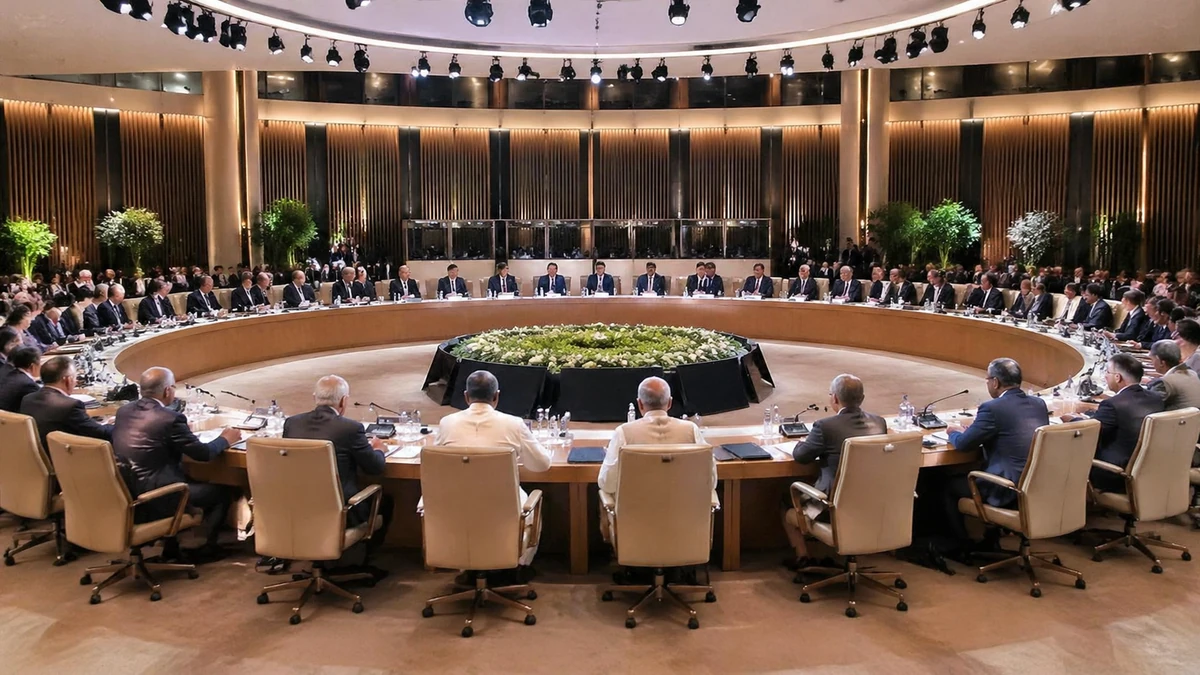
South Korea’s diplomatic map is getting bigger
For many Americans, news out of South Korea is often framed through a familiar set of lenses: North Korea’s nuclear threat, the U.S.-South Korea alliance, tensions with Japan, or the economic rivalry and strategic balancing act involving China. Those issues remain central. But a major development in Seoul’s foreign policy this week points to something larger and longer-term. South Korea has been confirmed as the host of the 2028 Group of 20 summit, and President Lee Jae Myung used the current G20 cycle to embark on a trip through the Middle East and Africa, underscoring that Seoul wants to be seen not merely as a country reacting to great-power competition, but as one helping shape the agenda.
That shift matters. The G20 is not just another diplomatic photo opportunity. It is one of the world’s most consequential forums for coordinating policy on the global economy, supply chains, energy, climate change, food security and financial stability. Unlike the United Nations, where the agenda can be sprawling and outcomes diffuse, the G20 has become a practical arena where the world’s largest economies and influential emerging powers try to find common ground on issues that affect prices, production, investment and political stability around the globe.
South Korea’s selection as the 2028 host says something important about how the country is now viewed internationally. It suggests that other major governments see South Korea not simply as a manufacturing powerhouse or a frontline democracy in Northeast Asia, but as a capable middle power with the administrative strength, political credibility and economic relevance to convene difficult conversations. In Washington terms, it is a bit like the difference between being invited to the table and being asked to set it.
For an American audience, it helps to think of South Korea as a country that has spent decades proving its success story at home and is now trying to convert that success into institutional leadership abroad. This is a nation that transformed itself from war devastation into one of the world’s most advanced industrial economies, built globally competitive companies, developed a robust democracy after years of authoritarian rule, and exported popular culture on a scale few would have predicted a generation ago. Hosting the 2028 G20 gives Seoul a chance to weave all of those strengths into a more ambitious diplomatic identity.
The timing is also telling. Lee’s travel through Egypt and on to South Africa during the current G20 process is not just about attending meetings. It is a signal that Seoul’s diplomatic horizon is widening beyond the usual power centers. In other words, the story here is not only that South Korea will host an important summit in three years. It is that South Korea increasingly wants to act like a country whose interests and responsibilities stretch across regions that many Koreans, and many Americans, once treated as distant.
Why the G20 matters more than many readers may realize
The G20 was created in the aftermath of financial crises and grew dramatically in importance during the 2008 global economic meltdown, when leaders of the world’s major economies needed a faster, more flexible venue than older institutions could provide. Today it includes the United States, China, the European Union, India, Japan, South Korea, South Africa, Brazil, Saudi Arabia and other major economies. That combination gives it unusual weight. It brings together wealthy democracies, authoritarian states, energy exporters, manufacturing hubs and fast-growing developing countries that do not always share the same priorities.
That tension is precisely why the G20 matters. When global trade is under strain, when semiconductor supply chains are vulnerable, when wars affect fuel prices and food availability, and when climate goals collide with the development needs of poorer countries, the G20 becomes one of the few places where those competing pressures are hashed out in the same room. Sometimes the results are modest. Sometimes the final communiques are carefully massaged documents that conceal more disagreement than unity. But even then, the work matters, because the wording of those agreements influences how countries cooperate on lending, investment, development, energy transition and crisis response.
For South Korea, hosting the G20 in 2028 is about much more than logistics, security and ceremonial prestige. The summit itself lasts only a short time, but the host country spends years preparing ministerial meetings, working-level negotiations, business forums, civil society events and side agreements. The presidency of the G20 allows the host to shape themes, frame discussions and act as a broker among countries whose interests often clash. It is a role that requires careful agenda-setting and diplomatic stamina.
Americans have their own reference points for this kind of influence. When the U.S. hosts a major international gathering, the event becomes a platform for Washington to emphasize its preferred language on trade, security, technology or democratic values. The same principle applies here, albeit on a different scale. South Korea’s opportunity is to highlight issues that sit at the center of its national strengths and vulnerabilities: resilient supply chains, open trade, digital governance, advanced manufacturing, green technology and practical development cooperation.
It is also a test of whether South Korea can move beyond what might be called reactive diplomacy. For years, Seoul’s international role was often defined by external pressures: deterring North Korea, navigating disputes between Washington and Beijing, managing historical tensions with Tokyo, or responding to fluctuations in the global economy. The 2028 summit gives South Korea a chance to be more proactive. Instead of simply responding to the agenda set by others, it can help write the agenda.
Africa and the Middle East are no longer peripheral to Seoul
One of the clearest signals in this moment is geographic. Lee’s travel through the Middle East and Africa, especially his arrival in South Africa in connection with the G20, carries significance beyond the immediate trip. For decades, South Korean diplomacy naturally concentrated on Northeast Asia, the United States and, increasingly, Europe. That was understandable. South Korea’s security challenges are immediate, and its export-driven economy depends heavily on relations with major markets and technology partners.
But the global economy has changed. The scramble for critical minerals used in batteries and electronics, the growing importance of food and energy security, the effects of climate disruption, and the rise of emerging consumer markets have made Africa and parts of the Middle East far more central to long-term economic strategy. For Seoul, these regions are no longer remote places visited mainly for symbolic outreach. They are increasingly part of the practical architecture of growth, supply-chain diversification and diplomatic influence.
South Africa, in particular, is a meaningful stop. It is the only African country in the G20 and has long played a bridge role, linking continental priorities with broader global governance debates. It is also widely seen as a voice for what is often called the Global South, a broad and sometimes imperfect term used to describe developing and emerging countries that want greater influence in institutions historically dominated by the West. To appear on that stage, and to emphasize themes such as solidarity, equality and sustainability, is to send a message that South Korea does not want to be seen solely as a rich industrial economy speaking to other rich industrial economies.
There is an interesting Korean phrase embedded in the government’s description of this diplomatic approach: a vision of a “responsible global power” pursuing “pragmatic diplomacy.” Those phrases are worth unpacking for readers outside Korea. “Pragmatic diplomacy” generally means a preference for results over ideology. It suggests Seoul is less interested in grand rhetoric than in practical partnerships that produce investment, market access, energy cooperation, technology exchange or strategic support. “Responsible global power” implies a country that believes its success gives it obligations beyond its immediate neighborhood.
That language may sound abstract, but the underlying calculation is straightforward. South Korea wants broader markets, more diversified economic links, stronger access to resources, a larger diplomatic footprint and more room to maneuver in a world increasingly divided into blocs. Building deeper ties with African and Middle Eastern partners serves all of those goals. It also helps Seoul reinforce an image that is increasingly valuable in the 21st century: not a superpower, but a trusted connector.
What South Korea brings to the table as a middle power
In international affairs, “middle power” can sound like faint praise, but in practice it can describe some of the most nimble and effective players in global diplomacy. Countries like South Korea, Australia, Canada and, in different ways, some European states often rely on coalition-building, institutional know-how and issue-based partnerships to exert influence they could not command through raw military or economic size alone. South Korea fits that mold, but with a distinctive story.
It is one of the few countries that can credibly speak from multiple historical experiences at once. It was once an aid recipient and is now a donor. It industrialized rapidly but remains deeply dependent on open global markets. It has a vibrant democratic culture but also a hard-earned understanding of how fragile security can be. It has become a digital leader, with advanced public services and globally competitive tech firms, while also cultivating cultural soft power through music, film, television and beauty brands that have become shorthand for the Korean Wave.
For Americans who know South Korea primarily through Samsung phones, Hyundai vehicles, Oscar-winning cinema or K-pop stadium tours, this is the broader policy version of the same phenomenon. South Korea’s global profile is no longer confined to one lane. It is not just a security ally, not just an export machine, and not just a cultural success story. It is increasingly a country that can package industrial policy, technological competence, development experience and soft power into a coherent diplomatic offering.
That is one reason the 2028 G20 matters. A host country is not only responsible for protocol; it is expected to help mediate among sharply different interests. In the coming years, those interests will include U.S.-China competition, Europe’s economic anxieties, the demands of energy producers, the financing needs of developing countries and the persistent disagreements over who should bear the biggest burden for climate action. South Korea is unlikely to dominate those debates. But it may be well positioned to frame them in ways that make compromise easier.
Seoul’s value proposition is not that it can overpower rivals. It is that it can often understand both sides. It knows what export dependence means, because its economy lives and dies by global demand. It knows what development looks like from the inside, because its own modern rise happened within living memory. It understands digital transformation not as a theory but as an administrative reality. And it has enough distance from the largest power centers to present itself as a relatively credible convener, especially on issues where ideological posturing gets in the way of practical outcomes.
Trade, climate and supply chains are not abstract issues for Korea
The themes highlighted in the current G20 context, solidarity, equality and sustainability, can sound like standard summit language. But for South Korea, they connect directly to economic survival. This is one of the world’s most trade-dependent advanced economies. Its semiconductor producers, automakers, battery manufacturers, shipbuilders and content companies are tightly bound to global demand, cross-border investment and stable transportation routes. When the international system becomes more fragmented, South Korea feels the disruption quickly.
That is why support for multilateral trade is not simply an idealistic talking point in Seoul. It is a material interest. As protectionism rises and major powers weaponize tariffs, subsidies and export controls, countries like South Korea face increasing costs and uncertainty. A more predictable trading system benefits them disproportionately. So does any effort to stabilize supply chains for crucial goods, from energy to industrial components to critical minerals.
The same logic applies to climate policy. Developed countries often frame decarbonization as a moral and technological imperative. Many developing nations see it through the lens of fairness: Who caused the problem, who pays to fix it and how can poorer countries grow without being locked out of progress? South Korea occupies an interesting space in that argument. It is an advanced industrial economy, but one that can still credibly speak about the pressures of development, industrial upgrading and infrastructure transition. That gives it a potentially useful role in bridging the politics of climate responsibility and economic growth.
There is another layer here that American readers may recognize from their own debates over industrial policy. South Korea has invested heavily in advanced manufacturing, digital infrastructure and strategic industries. It is also trying to compete in green sectors while maintaining export strength in legacy industries. That balancing act mirrors broader global tensions: how to remain competitive, protect jobs, secure energy and meet environmental targets without triggering backlash at home or conflict abroad.
In that sense, the G20 offers South Korea a stage on which its domestic economic model and its foreign policy priorities intersect. Seoul can advocate for open trade because it needs it. It can push for supply-chain resilience because it has firsthand exposure to disruption. It can promote digital governance because it has implemented it at scale. And it can engage on development and sustainability because its own national story gives it unusual credibility across different audiences.
The political test at home: Can Seoul think beyond partisan fights?
There is also a domestic political dimension to all this. South Korean politics, like politics in many democracies, can be intensely polarized. News cycles often revolve around electoral maneuvering, prosecutorial battles, scandals and partisan brinkmanship. None of that disappears because a summit is on the horizon. But major international responsibilities tend to expose whether a country can sustain strategic consistency beyond the daily churn of political conflict.
That will be especially true as South Korea prepares for 2028. Hosting the G20 is not a one-ministry project. It requires coordination across foreign affairs, trade, industry, climate, security, transportation, digital administration, policing, tourism, media operations and corporate engagement. In American terms, think of the kind of whole-of-government planning that goes into a major international event such as a summit meeting, an Olympics-level logistical challenge or a high-stakes global conference where diplomacy and domestic competence are on display simultaneously.
Lee’s acknowledgment that the responsibility is heavy is, in that sense, less political theater than plain realism. The host is judged both inside and outside the conference hall. It must keep the machinery running, prevent diplomatic breakdowns, manage public expectations and create enough substantive momentum that the event is remembered for more than staging. If the summit goes well, South Korea can strengthen its international brand as a serious, dependable state. If it goes poorly, the shortcomings will be visible to the world.
There is also a deeper question about political maturity. Can South Korea treat the expansion of its diplomatic reach as a long-term national strategy rather than as a partisan trophy? That matters because ties with the Middle East, Africa and the broader developing world are not side projects. They are increasingly tied to market expansion, energy resilience, supply-chain diversification, development partnerships and influence in global rule-setting. Those are strategic interests that outlast any single presidency.
For a country of South Korea’s size, foreign policy bandwidth is always finite. The challenge is not whether Seoul can remain focused on North Korea, the United States, Japan and China. It must. The challenge is whether it can add layers to that strategy without losing coherence. The current moment suggests that Seoul is trying to do exactly that: keep its traditional priorities intact while widening the circle of countries and issues through which it defines its national interest.
The Global South may be the next big stage for Korean diplomacy
If there is one phrase likely to define the next phase of South Korea’s foreign policy, it may be “Global South.” The term is sometimes vague and sometimes controversial, since it groups together countries with very different histories, political systems and levels of development. But as a shorthand, it points to a real trend: many of the world’s fastest-growing populations, most urgent infrastructure needs, critical resource bases and major climate vulnerabilities lie in parts of Africa, the Middle East, South Asia and Latin America.
Those regions are not simply diplomatic add-ons. They are increasingly central to the future of global growth and governance. For South Korea, stronger engagement there could produce opportunities in technology transfer, smart infrastructure, health cooperation, education, development finance, digital public services and clean energy partnerships. It could also expand Seoul’s influence in the very institutions where global standards and priorities are negotiated.
Here again, South Korea has some unique tools. Its model of development, though not universally replicable, remains attractive to many policymakers abroad because it combines state capacity, export competitiveness, educational investment and technological adaptation. Its electronic government systems are often cited internationally. Its pop culture appeal can open doors that traditional diplomacy cannot. And its identity as a country that rose from poverty to prosperity gives it a narrative that resonates in places where Western lectures on development can provoke skepticism.
That does not mean South Korea’s path will be easy or universally welcomed. Competition for influence in the Global South is intensifying. China has invested enormous resources across Africa and beyond. The United States and Europe are trying to deepen their own engagement. Regional powers such as India, Turkey, Saudi Arabia and the United Arab Emirates are also expanding their footprints. South Korea enters a crowded field.
But there is room for a country that offers competence, technology and partnership without the baggage or dominance associated with larger powers. That is the niche Seoul appears to be pursuing. The Middle East and Africa trip, together with the 2028 G20 host role, is best understood not as a standalone diplomatic flourish but as part of a broader repositioning. South Korea wants to be seen as a country that can connect advanced economies with emerging ones, industrial priorities with development goals, and strategic interests with practical cooperation.
A summit in 2028, but a message for right now
The immediate headlines may focus on the ceremony of confirmation or the symbolism of presidential travel, but the larger message is already clear. South Korea is trying to lengthen the timeline and widen the geography of its foreign policy. One part of that timeline is present tense: active summit diplomacy and outreach to regions that matter more than ever to the global economy. Another part is future tense: preparing to assume the responsibilities of a G20 host in 2028.
That combination gives Seoul something it has long sought and increasingly earned: a chance to define itself internationally on its own terms. Not merely as a frontline state facing a dangerous North Korean regime. Not merely as a treaty ally of the United States. Not merely as a cultural exporter with remarkable soft power. But as a country that can convene, mediate and help shape conversations about the rules of the global economy.
For American readers, this is a reminder that one of Washington’s closest allies in Asia is evolving in plain sight. South Korea remains deeply tied to the U.S. security umbrella and to regional power politics. Yet it is also building a diplomatic identity that is broader than alliance management and more ambitious than economic branding. That is good news for a world in need of more capable bridge-builders and for the United States, which benefits when allies bring initiative rather than simply looking to Washington for direction.
Between now and 2028, much can change. Elections, economic shocks, wars, technological disruptions and climate disasters could reshape the global agenda several times over. The G20 itself will remain a frustrating forum, sometimes productive, often messy. But that is exactly why South Korea’s new role matters. In an era defined by fragmentation, countries able to span divides, between rich and developing, East and West, established powers and emerging ones, may prove especially valuable.
South Korea is betting that it can be one of them. Its upcoming turn as G20 host, and the diplomatic outreach surrounding it, suggests that the country no longer sees itself as operating on the margins of global decision-making. It sees itself as helping organize the center.
Comments
Post a Comment